
Fight for Education with Education: The Street Library Fueling Delhi’s NEET Protests
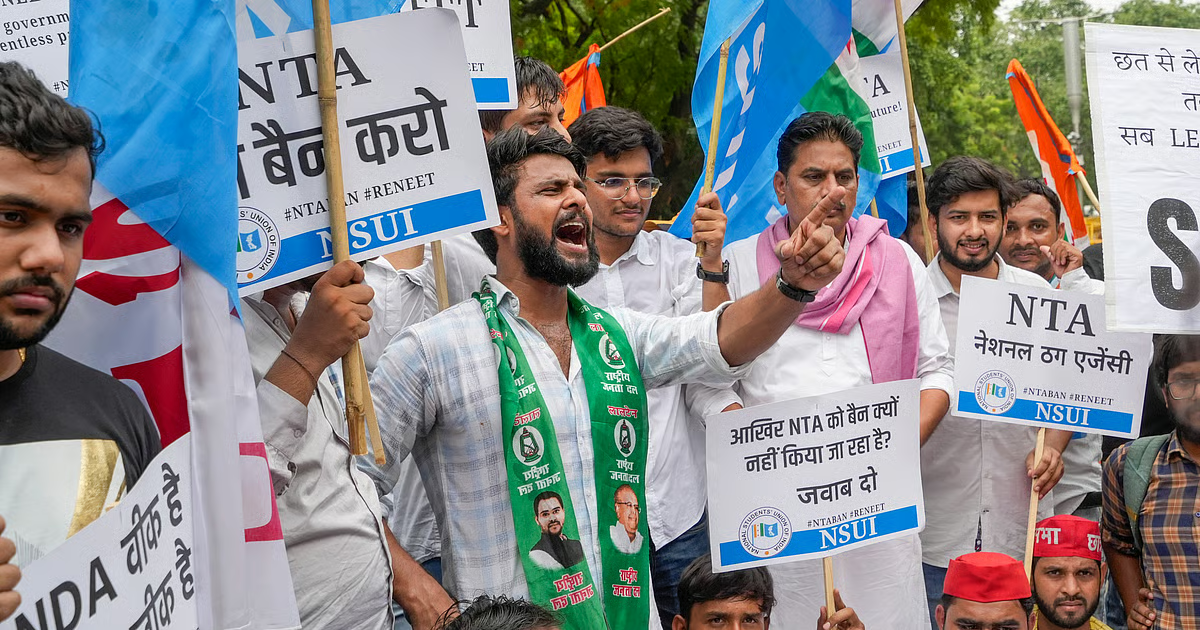
The sweltering heat of Delhi’s Jantar Mantar is no stranger to the sounds of slogans, megaphones, and political outrage. Yet, in June 2026, a different kind of sound began to emerge from the heart of the capital’s latest student-led mobilization: the quiet turning of pages. Amid the sea of placards demanding structural reform and accountability, a makeshift, open-air reading sanctuary has materialized.
Known as the “Free Library,” this space has become the intellectual epicenter of the ongoing Delhi NEET protests. Built under the powerful rallying cry of “Fight for Education with Education,” this unique street library is redefining how democratic resistance is staged in India.
Set up in response to the deep systemic failures of national entrance examinations—most notably the controversial NEET UG paper leak—this library serves a dual purpose. It is both a quiet haven of learning for exhausted aspirants and a silent, symbolic weapon against what students call a corrupt and broken educational bureaucracy.
If you are a student, a parent, a policy analyst, or a citizen concerned with the integrity of public education in India, understanding this peaceful revolution is essential.
In this comprehensive blog post, we will unpack the origins of the street library Delhi initiative, analyze the underlying structural factors of the NEET UG 2026 crisis, and explore how books have become the ultimate tools of democratic resistance.
1. What is the "Fight for Education with Education" Initiative?
At the core of the Jantar Mantar sit-in is a fundamental philosophical shift in student activism. For decades, protests in India have been characterized by loud rallies, blockades, and physical confrontations. The “Fight for Education with Education” initiative, pioneered by the All India Students’ Federation (AISF) of Delhi University, seeks to change that narrative.
                  "Fight for Education with Education" Framework
                                       │
         ┌─────────────────────────────┼─────────────────────────────┐
         ▼                             ▼                             ▼
  Community Reading            Awareness of Rights            Alternative Classrooms
(Setting up free books        (Educating aspirants on       (Running peer-to-peer tutoring
 at the protest site)          the history of civil laws)    sessions amid demonstrations)
The core thesis is simple: the most effective way to protest a corrupt academic assessment system is to demonstrate an unyielding, superior commitment to actual learning. By building a functional library at the very site where they are protesting the National Testing Agency (NTA), students are sending a powerful message: You may have compromised our exams, but you cannot compromise our love for knowledge.
2. The Genesis of the Jantar Mantar Street Library
The street library Delhi did not begin with institutional funding or corporate sponsorships. It was built entirely from the ground up through grassroots solidarity. On the second day of the sit-in organized by the Cockroach Janta Party (CJP) and allied student bodies, volunteers decided that shouting slogans all day was causing physical and mental exhaustion.
In a matter of hours, students, DU faculty, parents, and passing supporters began donating books from their personal collections. Within 48 hours, a simple wooden table under a tarpaulin sheet was transformed into a library of over 100 high-quality books. This small, shaded corner rapidly grew into a bustling hub of learning and peaceful resistance, attracting national media attention and drawing hundreds of young minds.
3. Inside the Street Library: What Protesting Students are Reading
What makes the Jantar Mantar student protest library so fascinating is its eclectic and deeply intellectual curation. The books available are not standard physics or biology test prep guides; they are texts designed to expand political awareness, historical knowledge, and social consciousness.
Demonstrators can be seen sitting on public mats, quietly reading:
Biographies: Ranging from the revolutionary writings of Bhagat Singh and B.R. Ambedkar to the life of APJ Abdul Kalam.
Anthropology and History: Deep dives into India’s socio-economic evolution, freedom struggles, and the history of public policy.
Law and Civil Rights: Texts explaining the Indian Constitution, citizens’ fundamental rights, and the legal mechanisms governing public exams.
“Literacy and awareness are the only ways to fight a corrupt educational system,” noted a student volunteer at the site. These books are helping students contextualize their individual academic struggles within the larger, historical fight for social justice in India.
4. The NEET UG Paper Leak and the Crisis of Student Trust in India
To understand the intense anger driving the Delhi NEET protests, one must examine the baseline educational crisis. The National Eligibility cum Entrance Test (NEET UG) is the sole gateway for admission to prestigious medical colleges across India. For millions of students, preparing for this exam is a grueling multi-year process that demands immense financial, physical, and emotional sacrifices.
However, the NEET UG paper leak scandal has completely shattered the trust of the student community. Reports of paper leaks, grace marks irregularities, and compromised test centers have left over two million aspirants in a state of agonizing uncertainty. When the very agency mandated to conduct fair examinations—the NTA—fails to secure the process, the entire merit-based educational system is thrown into question.
For detailed news reporting on the background of these examination irregularities, you can review the extensive updates on the Deccan Chronicle portal.
5. The Cockroach Janta Party (CJP) and the Rise of Student Agitation in 2026
The political landscape of student activism has evolved dramatically in 2026, as evidenced by the prominence of the Cockroach Janta Party (CJP). Under the leadership of founders like Abhijeet Dipke, the CJP has launched a sustained campaign against corruption and corporate-style inefficiencies in public education.
The CJP’s indefinite sit-in at Jantar Mantar has focused on a series of core demands:
The immediate resignation of Union Education Minister Dharmendra Pradhan.
A complete structural overhaul and decentralization of the National Testing Agency (NTA).
A transparent, independent, and judicial-led inquiry into all national level competitive exam leaks.
The immediate implementation of strict anti-paper leak laws with severe penalties for corrupt facilitators.
6. Personal Stories of Resilience: Why Students Are Flocking to Jantar Mantar
Behind the macro-political headlines of the Delhi NEET protests are the deeply moving, human stories of individual sacrifice. The protest site has become a micro-community where students look out for one another.
Take the story of 24-year-old Manpreet Singh and his two friends, who traveled all the way from rural Uttarakhand in a general railway coach without telling their parents, just to stand in solidarity. Or the case of Saurabh from Vrindavan, who arrived for a single-day rally and has stayed for days, relying on fellow protesters to share extra clothing and food.
Perhaps the most emotional symbol of the protest is 35-year-old Babita Anjali from Odisha. Despite actively battling liver cancer, she traveled to Delhi with her 13-year-old son and medical equipment, staying at the protest site day and night. “I came here for my own child, but every student in this country is like my own,” she shared, highlighting the deep parental anxiety fueled by these recurring systemic failures.
7. Beyond Slogans: How Books Become Weapons of Peaceful Resistance
The presence of the street library Delhi has fundamentally altered the physical atmosphere of Jantar Mantar. It acts as an implicit de-escalation tool. Amid heavy police barricading and massive security deployments, the sight of hundreds of students sitting quietly with books is a powerful testament to the peaceful, democratic, and constructive nature of the protest.
By using literature as their primary form of expression, the students are successfully shifting the public debate away from “law and order” concerns and back to where it belongs: the quality, transparency, and ethics of India’s education system.
8. Demands for Reform: Addressing the NTA and Call for Leadership Accountability
The core target of the student agitation is the highly centralized framework of national-level examinations. The protesters argue that the NTA has become an unaccountable mega-corporation that is completely detached from the local realities of student aspirants.
                      The Proposed Decentralization Model
                                       │
         ┌─────────────────────────────┼─────────────────────────────┐
         ▼                             ▼                             ▼
  Regional Auditing            State-Level Testing           Academic Oversight
(Continuous independent       (Empowering states to run     (Empowering educators and
 checks of exam centers)      localized exam boards)         parents, not bureaucrats)
The demand is not just to replace individual leaders, but to completely dismantle this single-point-of-failure model. The “Fight for Education with Education” movement argues that only a decentralized, transparent, and multi-layered testing system can restore integrity to Indian competitive exams.
For additional perspectives on the structural challenges of national examinations in India, check out the editorial archives on the MillenniumPost platform.
9. The Psychological Toll of Examination Irregularities on Indian Youth
We cannot talk about the NEET UG 2026 crisis without addressing the devastating psychological impact on young minds. When students spend up to 16 hours a day studying for years, only to find that the exam papers were sold to wealthy buyers in advance, the resulting feelings of hopelessness and betrayal are immense.
This stress has contributed to a tragic spike in student suicides across major coaching hubs like Kota and New Delhi. The Jantar Mantar protesters recently organized a solemn candlelight march to honor the lives of those lost to examination-related distress, emphasizing that the fight for educational reform is, quite literally, a fight to save young lives.
10. How You Can Support the Street Library and the NEET Protesters
The Jantar Mantar free library relies entirely on the continuous support of civil society to sustain its operations. If you are in Delhi and wish to contribute to the “Fight for Education with Education” movement, there are several ways to get involved:
Donate Books: Drop off high-quality books on history, civic studies, motivational biographies, or social science at the Jantar Mantar site.
Provide Basic Supplies: Volunteers at the protest site are always in need of water, simple food packets, oral rehydration salts (ORS), and basic medical supplies like mosquito repellents for those staying overnight.
Spread the Word: Share the stories of these peaceful, book-driven protests on social platforms using hashtags like #FightForEducation, #NEETAudits, and #JantarMantarLibrary to keep the national focus on educational justice.
For official updates, schedules of open-air teach-ins, and coordination guides, consult the All India Students’ Federation (AISF) media portals.
11. Conclusion: Shaping the Future of Educational Justice in India
The street library Delhi is much more than a simple book stall at a protest site. It is a living, breathing symbol of hope, intellectual resilience, and democratic maturity. By choosing to “Fight for Education with Education,” the young medical aspirants at Jantar Mantar are demonstrating that the true power of a nation does not lie in its bureaucratic institutions, but in the educated conscience of its youth.
As the indefinite sit-in continues, one thing has become abundantly clear: you cannot defeat a generation that responds to systemic corruption by reading, learning, and expanding its mind. The struggle for a fair NEET UG 2026 is the defining battle for the soul of Indian meritocracy. By protecting our classrooms, supporting our student creators, and insisting on absolute transparency, we can ensure that the noble pursuit of knowledge remains a sacred, untarnished path to a brighter tomorrow.

How useful was this post?
Click on a star to rate it!
Average rating 0 / 5. Vote count: 0
No votes so far! Be the first to rate this post.