
Online vs. Offline Coaching: Which is Better for Competitive Exam Preparation?
The journey of preparing for competitive exams in India is a major turning point in a student’s life. Whether you are aiming for engineering through JEE, medical sciences through NEET, civil services through UPSC, or various banking and government jobs, the path you choose to prepare will dictate your daily routine, mental health, and ultimate success. For decades, the default choice for serious aspirants was to pack their bags and move to physical coaching hubs like Kota, Delhi, or Hyderabad.
However, the rapid advancement of digital classrooms, interactive video lectures, and live doubt-solving portals has changed the landscape forever.
Today, students and parents face a massive, high-stakes question: Online vs. offline coaching—which is better for competitive exam preparation? Both systems possess distinct advantages and structural limitations. This comprehensive guide will analyze the differences between these models, help you calculate the actual costs, explore study dynamics, and provide a clear framework to help you make a logical, regret-free decision.
1. The Ultimate Dilemma: Choosing Your Exam Preparation Pathway
Selecting a preparation model is not just about choosing where to sit; it is about choosing how you learn best. Every student has a unique cognitive makeup. Some thrive under strict physical supervision, while others experience high levels of anxiety in crowded physical classrooms.
Historically, coaching institutes in India relied entirely on physical presence, lecture halls, and printed study packages. The internet revolution has completely decentralized this knowledge. Today, the very best educators are available on personal screens, allowing students in remote villages to access the same quality of instruction as those in major metropolitan cities. To choose between these formats, you must evaluate them across multiple dimensions, including discipline, doubt resolution, cost, peer pressure, and psychological safety.
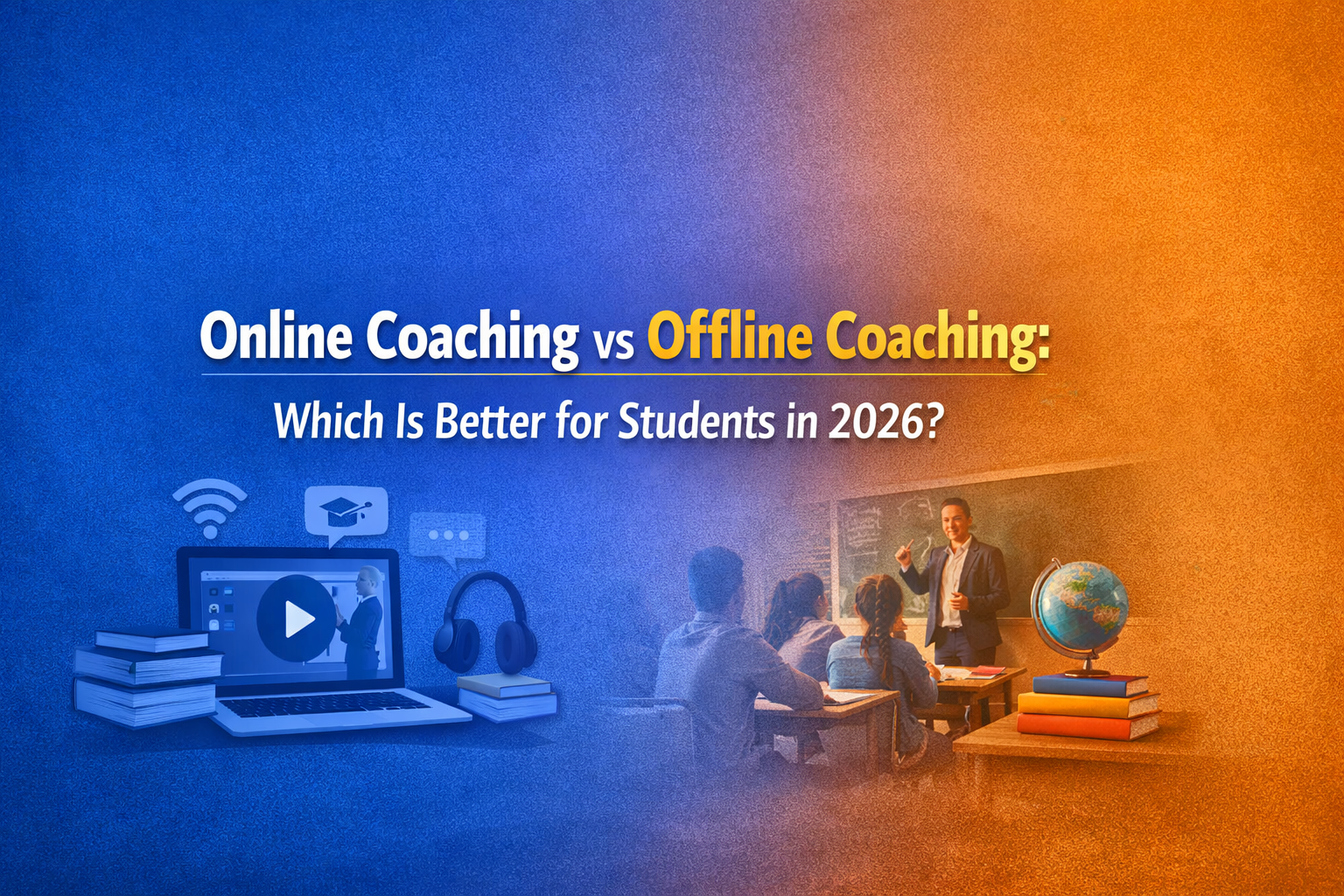
2. Decentering the Classroom: The Rise of Modern Online Coaching Portals
The explosive growth of online education platforms has transformed how students approach high-stakes syllabus coverage. An online coaching competitive exams model offers unprecedented flexibility and convenience.
Learn at Your Own Pace: In a traditional classroom, if you miss a concept, the teacher cannot pause the class of eighty students for you. Online portals allow you to pause, rewind, and re-watch complex lectures on thermodynamics or organic chemistry until you achieve absolute clarity.
Access to National Elite Faculty: You are no longer restricted to the teaching quality of your local city tutors. Online coaching allows you to learn directly from the country’s top-rated educators from the comfort of your home.
Highly Customized Study Materials: Most online platforms provide diagnostic toolkits, interactive e-books, and modular question banks that adapt to your personal pace, allowing you to focus heavily on your weak links.
3. The Classical Power of Offline Coaching: Structured Discipline and Peer Pressure
Despite the convenience of digital screens, the traditional physical classroom remains a formidable force in competitive exam preparation. The benefits of offline coaching classes lie in the psychological structure they impose on adolescent minds.
Enforced Daily Routine: Preparing for exams like JEE, NEET, or UPSC requires consistent, long hours of daily study. Offline institutes force you to wake up, travel to a physical center, and sit in a classroom, building a strong, distraction-free routine.
Healthy Peer Competition: Sitting in a room filled with hundreds of highly motivated students who are solving the same physics numericals or history prompts builds an immediate, healthy competitive drive. Seeing your peers work hard inspires you to push your own limits.
Direct Teacher-Student Interaction: In a physical classroom, a teacher can read your body language, notice if you look confused, and explain the concept differently in real time. This immediate human connection is difficult to replicate through a computer screen.
4. Comparing the Financial Implications: Tuition Fees, Relocation, and Hidden Expenses
For most middle-class households, the cost of competitive coaching is a major financial decision. When analyzing the financial aspect, online coaching is the undisputed winner in terms of pure affordability.
Traditional, premium offline coaching centers in major cities charge substantial tuition fees, often ranging from one to three lakhs per year. When you factor in the hostel rent, security deposits, mess food, daily commuting, and healthcare expenses associated with relocating to high-stress coaching hubs, the total bill can place immense financial pressure on families. To review national efforts in making education affordable and transparent, you can read updates on the Ministry of Education India Portal which details initiatives to regulate private coaching fees.
Online coaching platforms entirely eliminate these relocation and boarding costs. The tuition fees for digital courses are often a small fraction of offline programs, making high-quality resources highly accessible to underprivileged students.
5. The Battle of Doubt Resolution: Instant Online Platforms vs. Physical Doubt Counters
Unresolved doubts are the absolute killers of high competitive ranks. If you accumulate conceptual backlogs in core topics, your confidence will decline rapidly.
Doubt Clearing in Offline Centers: In physical coaching institutes, clearing a personal doubt requires waiting in long queues after class or visiting dedicated physical “doubt counters” during specific hours. Due to high student-to-teacher ratios, you may only get a few minutes of a teacher’s personal attention.
Doubt Clearing in Online Platforms: Modern online coaching relies on twenty-four-seven doubt-solving portals. By simply taking a photograph of a difficult math problem or chemistry reaction and uploading it to the platform, you receive step-by-step video solutions and text breakdowns within minutes.
This rapid feedback loop ensures your study momentum is never broken by a single roadblock. To explore how centralized testing agencies are adapting to digitized student queries and mock schedules, you can refer to the National Testing Agency (NTA) Official Site which serves as the core coordinator for national entrance testing systems.
6. Study Environment and Daily Discipline: Staying Motivated Without Supervision
The greatest vulnerability of online learning is the risk of personal distraction. The internet is a double-edged sword; the same device used to access lectures can easily lead to social media notifications, online gaming, and digital procrastination.
Without a physical teacher standing over you, maintaining high-level focus during three-hour study blocks requires exceptional self-regulation and intrinsic motivation. Many teenage students struggle with this level of autonomy, leading to incomplete schedules and high levels of stress. Offline coaching, on the other hand, operates in a completely controlled environment. Cell phones are often prohibited in classrooms, and physical attendance tracking ensures you stay accountable to your daily study targets.
7. Mock Tests and Exam Day Realism: Transitioning to Computer-Based Testing
Since almost all major national exams (like JEE Main, JEE Advanced, CAT, and various banking exams) have transitioned to entirely computer-based formats, mock testing has become a crucial part of preparation.
Online coaching platforms are naturally aligned with this digital reality. They provide simulated exam interfaces that mirror the exact look and feel of the actual exam screen, helping students overcome technical anxiety and master time-management strategies.
However, for paper-and-pencil exams like NEET, physical exam simulation remains essential. Students must practice the physical act of bubbling Optical Mark Recognition (OMR) sheets within strict time limits. Offline coaching centers excel here, organizing regular, supervised mock exam events inside physical halls to build real-world test-day stamina. To access standardized, high-quality sample papers and reference resources for preparation, students can review materials compiled on the NCERT National Educational Portal.
8. Mental Wellness and Preventing Burnout in Intense Preparation
The emotional toll of preparing for competitive exams is immense. Chronic academic stress, isolation from family, and the constant pressure to score high marks often lead to psychological burnout.
Offline coaching centers in congested coaching hubs can sometimes feel like high-pressure environments, where students are continuously compared to their peers. This constant exposure to competition can induce high levels of academic anxiety.
Preparing via online coaching allows students to study from the safety and emotional comfort of their homes, surrounded by supportive family members. Having access to home-cooked meals, physical comfort, and immediate family support acts as a powerful buffer against cognitive fatigue and emotional distress.
9. The Emerging Champion: Why the Hybrid Coaching Model is Taking Over
As educators and technology platforms realize that neither a purely virtual system nor a legacy physical system is perfect, the industry is shifting toward a unified solution: the hybrid coaching model.
The hybrid model combines the face-to-face accountability, peer interaction, and physical mock testing of offline classrooms with the twenty-four-seven doubt-solving, recorded backup libraries, and personalized diagnostics of online portals. Under this structure, students attend physical centers two to three days a week for core conceptual lectures and interactive workshops, while managing their self-study and practice sessions via digital portals. This balanced approach is emerging as the most successful preparation model, yielding exceptional success rates in competitive exams.
10. Direct Comparison Table: Online vs. Offline Coaching
The table below provides a detailed, side-by-side comparison of the core features of online and offline learning formats:
+------------------------------------+------------------------------------+------------------------------------+
| Dimension of Evaluation            | Online Coaching Portals            | Traditional Offline Coaching       |
+------------------------------------+------------------------------------+------------------------------------+
| Financial Investment Requirement   | Low to Moderate (Highly affordable)| Very High (Tuition + Boarding)     |
| Learning Location Flexibility      | Infinite (Study from home or travel) | Rigid (Must relocate or commute)   |
| Daily Accountability & Discipline  | Dependent on student self-regulation| High (Enforced by physical tutors) |
| Peer Environment and Interaction   | Virtual communities & chat groups  | Direct, physical peer competition  |
| Doubt Resolution Speed             | Fast (24/7 digital assistants)     | Slow (Queue-dependent counters)   |
| Mock Testing Interface             | Native digital computer-based tests| Physical OMR sheets / Computer labs|
| Risk of Cognitive Burnout          | Moderate (Buffered by home comfort)| High (Hyper-competitive centers)   |
+------------------------------------+------------------------------------+------------------------------------+
11. Diagnostic Guide: How to Determine Your Ideal Learning Alignment
If you are still struggling to choose between these two formats, use this diagnostic checklist to determine the path that aligns with your personal needs:
Choose Online Coaching if:
You possess high levels of self-discipline, can organize your own timetable, and can study without continuous parental supervision.
Your target teachers are not physically available in your hometown, and you want to avoid the high cost and stress of relocating to a coaching hub.
You prefer a quiet, comfortable study environment at home and want to maintain your physical and emotional well-being alongside your preparation.
Choose Offline Coaching if:
You easily get distracted by smartphones or computer screens and need physical surveillance to stay focused on your studies.
You thrive on direct, in-person competition and need the immediate energy of a physical classroom to stay motivated.
Your target exam is a paper-and-pen test (like NEET), and you need regular, physical mock testing sessions to master OMR sheet management.
12. Conclusion: Making a Future-Proof Decision for Your Competitive Success
The definitive verdict is clear: there is no single format that is universally better for every student. The ideal model depends entirely on your self-discipline, financial budget, and personal learning style.
If your priority is financial affordability, study flexibility, and the comfort of preparing from home under parent supervision, online coaching is an outstanding and highly effective choice. It democratizes elite education, putting the country’s best resources directly onto your screen.
However, if you struggle to maintain focus independently, need the physical presence of mentors to clear doubts face-to-face, and find motivation in intense peer competition, offline coaching remains a highly reliable pathway to competitive success.
Evaluate your academic strengths and weaknesses honestly, weigh the actual costs, consult with your family, and choose the preparation format that will empower you to study consistently, perform confidently, and secure your professional dreams.

How useful was this post?
Click on a star to rate it!
Average rating 0 / 5. Vote count: 0
No votes so far! Be the first to rate this post.