
How Gamification in EdTech is Solving India's Student Engagement Problem
The traditional educational system in India is undergoing a massive digital evolution. For generations, classrooms relied on passive, rote-learning methodologies characterized by long lectures and dense, standardized textbooks. While this compliance-based structure historically processed millions of students, it has struggled to maintain active interest, giving rise to a massive, nationwide student engagement problem. As digital classrooms become mainstream, educators are realizing that simply moving offline textbooks onto mobile screens does not encourage active learning.
Instead, the solution lies in a profound technological shift. By leveraging gamification in EdTech, modern learning platforms are transforming passive content consumption into active, self-directed exploration. Through the integration of reward loops, storytelling, progression trees, and social play, EdTech gamification India is permanently solving student engagement challenges.
This comprehensive, logic-driven analysis evaluates how gamified learning platforms are restructuring cognitive focus, details the scientific motivators behind game mechanics, profiles the localization strategies of Indian EdTech startups, and outlines the blueprint to build a highly successful, interactive learning ecosystem.
1. Decoding India's Chronic Student Engagement Problem
To understand why traditional learning fails to hold a student’s attention, we must first analyze the structural bottlenecks of Indian classrooms. The average class size in India frequently exceeds forty or fifty students in both public and private institutions. In such hyper-congested environments, providing personalized attention is practically impossible. Teachers are forced to design lessons for the median student, leaving advanced learners disengaged and struggling students left behind.
This rigid “one-size-fits-all” model has triggered a massive student engagement problem. When students cannot connect with the pace of a classroom, they experience cognitive fatigue, classroom anxiety, and a complete loss of academic confidence. Furthermore, the high-pressure environment of board exams and entrance tests turns daily study into a stressful chore rather than an intellectual adventure.
By implementing strategic gamification educational tools, platforms are bypassing these physical limitations. Gamification meets the student at their individual skill level, using interactive interfaces to turn difficult, abstract concepts into engaging, bite-sized tasks, laying the foundation for a highly successful educational journey.
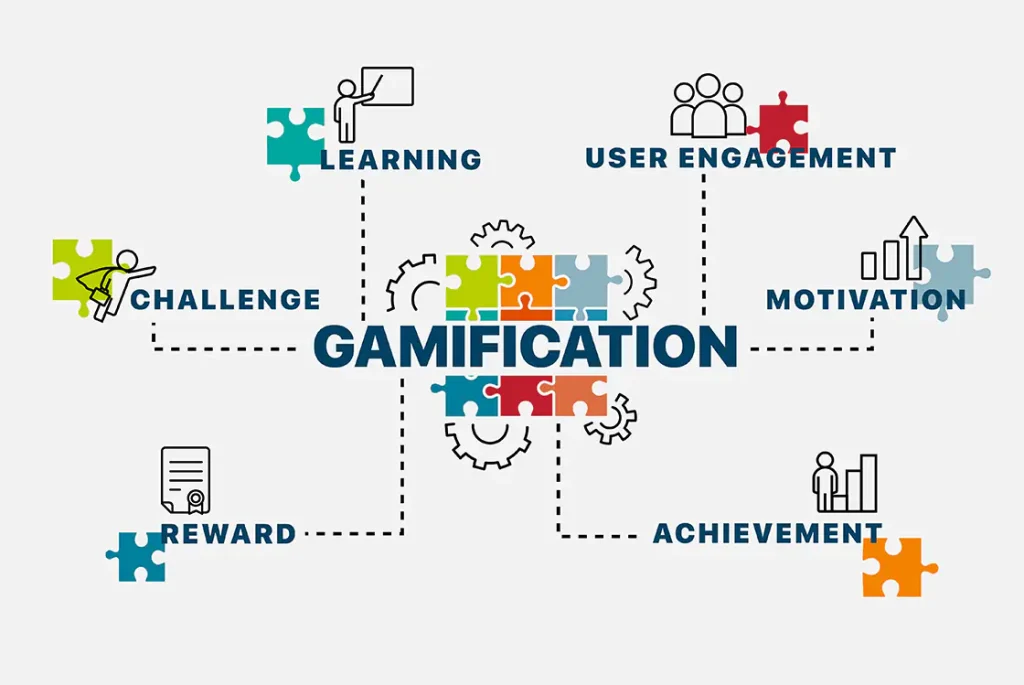
2. What is Gamification in EdTech? Beyond Points and Leaderboards
Before exploring the behavioral impacts, it is vital to demystify what authentic gamification in EdTech represents. Many developers fall into the trap of assuming that gamifying a platform simply means slapping a generic point system, badges, and a leaderboard onto an existing library of recorded video lectures.
True gamification is a highly structured, behavior-driven pedagogical cycle. As defined in comprehensive industry overviews on Upshot’s Gamification in EdTech Guide, gamification involves incorporating game design elements and behavioral principles into non-game educational products to motivate participation and enhance knowledge retention.
Instead of treating the game mechanics as a distraction, the best platforms integrate the lesson directly into the gameplay. For example, a student doesn’t just read about chemical bonds; they play a mini-game where they must pair positive and negative ion characters to escape a digital maze. This seamless integration ensures that the gameplay actively serves the learning objectives, making the educational experience both entertaining and intellectually rewarding.
3. The Attention Deficit: Why Traditional Learning Models Fall Short in India
In the digital era, students are exposed to high-stimulus environments. Mobile applications, short-form video feeds, and immersive multiplayer video games are continuously competing for a student’s cognitive attention. Trying to counter this high-stimulus ecosystem with dry, text-heavy slides is a losing battle.
The legacy classroom model relies on passive listening, which places students in low-engagement cognitive networks. Research highlights on the Research and Markets Gamification in Education Report reveal that the global gamification market is experiencing exponential growth primarily because institutional student disengagement has intensified.
When a student is forced to sit through a two-hour passive lecture, their focus decays precipitously within the first twenty minutes. This attention deficit is not a sign of student laziness; it is a natural physiological reaction to cognitive overload. To capture and hold attention, learning platforms must transition from passive delivery to active, real-time curriculum adaptation, which is the core driver of modern game-based learning.
4. The Science of Motivation: Dopamine Loops in Gamified Learning Platforms
The effectiveness of gamified learning platforms is rooted deeply in human neurobiology. When a person encounters a challenge, struggles to overcome it, and receives immediate, positive validation, their brain releases dopamine—the neurotransmitter associated with pleasure, motivation, and learning reinforcement.
This neuro-cognitive feedback loop can be structured into three distinct phases:
The Challenge (The Cue): The platform presents a structured, achievable goal, such as completing a level or unlocking a new concept pathway.
The Effort (The Routine): The student engages in active recall, problem-solving, and critical thinking to overcome the hurdle.
The Validation (The Reward): The system instantly celebrates the victory with virtual currency, progress bar updates, or level-up badges.
This cycle creates a positive learning-reward loop. Rather than experiencing study as a stressful obligation, the student’s brain begins to associate academic effort with dopamine-driven gratification, drastically reducing user drop-off rates and establishing consistent, long-term study habits.
5. Leaderboards and Progression Trees: Personalized Pathways to Mastery
One of the most powerful features of EdTech gamification India is the visual representation of academic progress. In traditional schools, progress is only communicated during quarterly report cards, leaving students in the dark regarding their day-to-day growth.
Gamified systems utilize two key visual anchors to provide continuous feedback:
Progression Trees (Skill Maps): Inspired by role-playing video games, subjects are organized into visual constellations of knowledge. A student can see their entire learning path, understanding exactly which basic skills they must master to unlock advanced, high-level topics.
Personalized Leaderboards: Rather than comparing every student in a national ranking, which can trigger social anxiety, smart systems place students on localized, dynamic leaderboards with peers of similar capability. This friendly rivalry encourages students to challenge themselves without experiencing public academic shaming.
By providing clear, visual, and real-time representations of achievement, these tools help students visualize their growth, turning a massive, intimidating syllabus into a sequence of manageable, rewarding sprints.
6. Solving Student Engagement Through Social Quests and Peer-to-Peer Play
Humans are inherently social creatures, possessing a universal desire to connect, collaborate, and compete with others. This psychological trait is known as relatedness. Many online platforms fail because they isolate the learner, forcing them to study in a lonely, virtual silo.
Modern platforms are solving student engagement by integrating collaborative, social mechanics directly into their interfaces:
Multiplayer Quizzes (Clash Arenas): Students can challenge classmates or random peers across India to real-time, synchronous quiz battles, testing their speed and conceptual accuracy.
Cooperative Quests: Grouping students into virtual study teams where they must collectively achieve a weekly target—such as solving fifty physics problems—to unlock group rewards, fostering peer-to-peer mentoring.
Peer-to-Peer Discussion Forums: Integrating interactive, gamified discussion boards where students earn reputation points for answering classmates’ academic doubts, creating a self-sustaining community of learning.
This transition from isolated virtual study to active, collaborative play ensures that students remain highly motivated, leveraging friendly rivalry to build deep, permanent conceptual connections.
7. How Indian EdTech Startups are Localizing Gamified Educational Tools
The Indian education market possesses unique cultural and regional dynamics. A generic, Western-centric gamification model cannot easily be copied and pasted into the Indian context. Recognizing this, pioneering Indian EdTech startups are designing localized, culturally resonant game mechanics.
As detailed in specialized reviews on the Cubegon Gamification in K-12 India Blog, the integration of game-based elements is democratizing quality education across both urban and rural India. Startups are localizing these systems through:
Multilingual Gamification: Translating quest instructions, story narratives, and interactive quizzes into regional Indian languages (like Hindi, Tamil, Telugu, and Marathi) to ensure accessibility for tier-2 and tier-3 students.
Low-Bandwidth Optimization: Designing lightweight, software-driven gamified apps that run smoothly on low-cost smartphones with unstable internet connections, bypassing rural infrastructure limits.
Cultural Storytelling: Framing math and history lessons around localized Indian mythology, historical events, and regional heroes, making the narrative highly engaging for local students.
This deep localization ensures that interactive learning in India is not a luxury restricted to elite urban schools, but a highly scalable, democratic tool that can elevate student outcomes nationwide.
8. The Role of Gamification in Reducing Anxiety Surrounding Competitive Exams
The competitive exam pressure in India is immense. Millions of students sit annually for high-stakes tests like JEE, NEET, and UPSC, where a single mark can alter their professional destiny. This hyper-competitive pressure often leads to academic anxiety, cognitive burnout, and mental health crises.
Gamification acts as an emotional safety net, reducing the psychological friction of exam preparation:
Gamified Diagnostic Mock Tests: Instead of writing intimidating, full-length papers immediately, students practice with micro-challenges, earning virtual badges for speed and accuracy.
Streak-Preservation Mechanics: Encouraging daily consistency by rewarding students for maintaining “study streaks.” If a student practices just ten questions a day, they preserve their streak, building a healthy, stress-free daily routine.
Objective, Judgment-Free Practice: Unlike a physical classroom where making a mistake can trigger peer disapproval, a gamified app provides a safe, objective, and private space to fail. A student can re-attempt a difficult level twenty times, and the system will never lose patience or make them feel academically inferior.
By lowering the stakes of daily practice and focusing on incremental, positive growth, gamification helps students build exam-day stamina and emotional resilience under pressure.
9. Avoiding the "Edutainment" Trap: Maintaining Pedagogical Depth
While the benefits of gamification are undeniable, researchers warn of a major psychological hazard known as the “edutainment” trap. This occurs when a platform prioritizes flashing animations, virtual currency, and addictive game loops over genuine academic progress.
If a student spends eighty percent of their study session dressing up a virtual avatar, playing non-educational side quests, or watching cartoons, and only twenty percent on actual cognitive tasks, the platform has failed. Excessive gamification creates a false sense of achievement while bypassing deep conceptual comprehension.
To prevent this hollowing-out of student capability, developers must adhere to strict quality standards. Game mechanics should always serve the educational goals, not distract from them. The reward points, level ups, and badges must be tied directly to mastering complex, syllabus-aligned competencies, ensuring that the visual fun of play is backed by rigorous pedagogical depth.
10. Best Practices: Integrating EdTech Gamification in Classroom Settings
To maximize the impact of gamified educational tools, they should not be used as isolated apps at home. The highest success rates are achieved when schools integrate these digital tools directly into their physical classroom routines:
Implement Flipped Classroom Models: Have students play introductory, gamified concept levels at home, and use physical classroom hours for collaborative group debates and hands-on experiments.
Utilize Live Polls and Quizzes: Teachers can kick off lessons with interactive, live-polling apps, turning the first ten minutes of class into a friendly, gamified competitive event.
Establish Balanced Screen-Time Rules: Ensure that digital gameplay is balanced with physical sports, peer-to-peer discussions, and offline reading, preventing cognitive fatigue and screen addiction.
Leverage Teacher Dashboards: Choose platforms that provide clear, analytical dashboards for educators, showing exactly which students are struggling with specific concepts during gameplay, enabling timely, real-world teacher interventions.
By designing a balanced, integrated ecosystem, schools can combine the infinite, precise analytical power of EdTech with the compassionate, empathetic leadership of human teachers.
11. Conclusion: The Horizon of Interactive Learning in India
The definitive verdict for the Indian education sector is highly encouraging: excellence is no longer locked behind the gates of traditional, rigid classrooms. The future of learning belongs to the self-directed, continuous learner, powered by the analytical precision of gamified EdTech.
By transitioning from a passive, industrial-era classroom model to a dynamic, hyper-personalized learning trajectory, we are unlocking the unique potential of every student. To understand how larger global demographics and social patterns influence these technological transformations across different regions, you can refer to behavioral research briefs compiled by the Pew Research Center.
As classrooms across India continue to adapt, the ultimate goal remains clear: to build a balanced, empathetic, and scientifically designed preparation ecosystem. By protecting the productive friction of learning, supporting student mental health, and integrating robust, gamified educational tools, we can ensure that our children grow into highly confident, creative, and self-motivated leaders ready to conquer the challenges of tomorrow.

How useful was this post?
Click on a star to rate it!
Average rating 0 / 5. Vote count: 0
No votes so far! Be the first to rate this post.