From Fierce Controversy to Enforceable Justice: What the UGC Equity Regulations 2026 Mean for You
The landscape of higher education in India is currently experiencing a historic, highly charged transformation. For years, the battle against discrimination, social bias, and systemic harassment on university campuses operated under a framework of symbolic gestures, paper-based compliance, and lengthy, bureaucratic grievance cells. However, with the arrival of the year 2026, the governance of campus justice has reached a critical watershed moment.
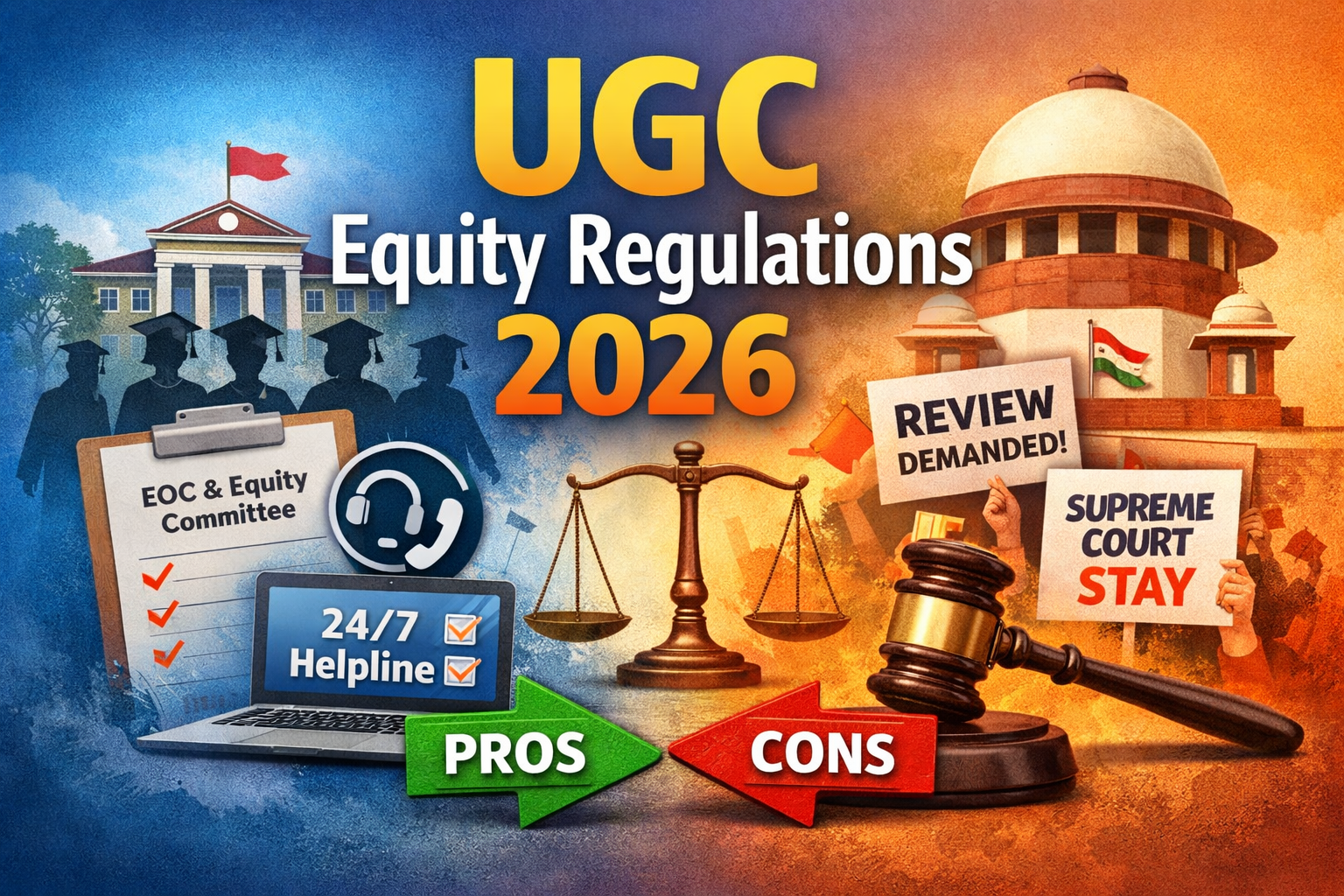
On January 13, 2026, the University Grants Commission notified a revolutionary and highly debated set of guidelines: the UGC (Promotion of Equity in Higher Education Institutions) Regulations, 2026. Often referred to as the UGC Equity Regulations 2026 or the UGC anti-discrimination rules 2026, this newly introduced framework is designed to dismantle paper-based, symbolic compliance and replace it with a highly structured, legally binding system of accountability.
Yet, this attempt to institutionalize campus safety has ignited a fierce nationwide debate, culminating in student demonstrations, intense academic pushback, and a landmark intervention by the Supreme Court of India. Whether you are an undergraduate student, a research scholar, an academic professor, or a university administrator, understanding the direct, operational implications of the Promotion of Equity in Higher Education Institutions Regulations 2026 is essential to navigate the future of campus life.
1. The Great Transition: Why the UGC Equity Regulations 2026 Represent a Seismic Shift
To understand the sheer magnitude of the modern legal changes, we must first look back at the historical framework. In 2012, the University Grants Commission made its first structured attempt to check social bias by enacting the initial equity regulations. However, the 2012 framework suffered from several structural limitations. It relied on a single, isolated Anti-Discrimination Officer, lacked clear, fast-track investigatory timelines, and featured very loose enforcement mechanisms that allowed higher education institutions to treat compliance as a mere administrative checkbox.
The UGC Equity Regulations, 2026 Wikipedia Profile highlights how the new 2026 guidelines represent a complete paradigm shift. Under the updated regulations, the old paper-only advisory model has been permanently replaced by a strictly enforceable, multi-layered legal matrix.
Officials at the University Grants Commission pointed to a steady rise in campus complaints and structural gaps in university responses as the primary justifications for this total regulatory overhaul. By moving away from symbolic individual grievance officers and creating robust, highly visible campus safety nets, the UGC anti-discrimination rules 2026 aim to establish institutional accountability as a non-negotiable standard.
2. Deconstructing the Core Mandate: Who Do the New Regulations Protect?
At its absolute core, the Promotion of Equity in Higher Education Institutions Regulations 2026 recognizes that securing physical access to a university seat is completely meaningless unless it is accompanied by personal dignity, equal opportunity, and an environment that is entirely free of implicit and explicit bias.
The scope of the UGC Equity Regulations 2026 is broad, applying to all public, private, deemed, and state-backed universities across India. The protective framework specifically targets the eradication of discrimination based on:
Caste, with enhanced focus on Scheduled Castes (SC), Scheduled Tribes (ST), and Other Backward Classes (OBC).
Religion, race, gender, place of birth, and language.
Physical and cognitive disabilities (protecting Persons with Disabilities – PwD).
Socio-economic standing, explicitly covering students from the Economically Weaker Sections (EWS).
Importantly, the updated guidelines expand protections past the student body. The regulations explicitly shield teaching faculty, non-teaching staff, administrators, and even online and distance learners, ensuring that every stakeholder on campus is legally protected from harassment.
3. The Power of Equal Opportunity Centres (EOCs) on Modern Campuses
One of the most highly discussed structural updates mandated by the UGC Equity Regulations 2026 is the mandatory establishment and strengthening of an Equal Opportunity Centre (EOC) in every single higher education institution in India.
Rather than operating as a passive administrative back-office, the EOC is designed to act as the primary, active engine of campus diversity and integration. As outlined in the comprehensive legal reviews on the Legal Bites Structured Overview of the 2026 Equity Regulations, the EOC is tasked with:
Implementing equity-related policies and supportive academic programs.
Providing targeted academic, financial, social, and legal guidance to marginalized cohorts.
Hosting mandatory sensitivity orientation programs for faculty and students alike.
Operating a highly secure, online grievance portal dedicated exclusively to reporting discrimination.
By institutionalizing the EOC, the University Grants Commission is ensuring that diversity and inclusion are treated as active daily practices rather than abstract policy slogans.
4. Behind the 24-Hour Rule: The Swift Grievance Redressal Timeline Explained
In competitive educational environments, delayed justice can severely disrupt a student’s academic standing, cognitive wellness, and career potential. To eliminate the long, exhausting wait times that characterized the old grievance cells, the UGC anti-discrimination rules 2026 have established an incredibly strict, fast-track timeline for complaint resolution:
+-----------------------------------+-----------------------------------+
| Stage of Grievance Redressal      | Mandatory Enforceable Timeline    |
+-----------------------------------+-----------------------------------+
| Initial Filing of Complaint       | Round-the-clock online or helpline|
+-----------------------------------+-----------------------------------+
| First Meeting of Equity Committee | Within 24 hours of receiving info |
+-----------------------------------+-----------------------------------+
| Completion of Formal Inquiry      | Within 15 working days            |
+-----------------------------------+-----------------------------------+
| Action Taken by Head of Institute | Within 7 days of receiving report |
+-----------------------------------+-----------------------------------+
The establishment of this rapid, step-by-step timeline is a massive departure from the 2012 rules, which allowed complaints to drag on for up to 60 days. By forcing the newly mandated Equity Committee—chaired directly by the Vice-Chancellor or Principal—to meet within 24 hours of a filed complaint, the regulations ensure that severe cases of harassment or bias are addressed before they can lead to major student distress.
5. Vigilance Redefined: The Ground-Level Role of Equity Squads and Ambassadors
To guarantee that equity is actively maintained outside of administrative offices, the 2026 framework introduces highly innovative, ground-level monitoring bodies designed to maintain vigilance across all campus spaces:
Equity Squads: These are highly mobile, active monitoring teams tasked with patrolling vulnerable and informal campus spaces—such as hostels, laboratories, dining halls, and libraries. The primary goal of the Equity Squad is to actively prevent ragging, caste-linked targeting, and exclusionary social behaviors.
Equity Ambassadors: These are student peer-mentors and designated campus stakeholders appointed within individual departments. They act as local, accessible nodal points of contact, helping students report distress anonymously and cultivating a supportive, inclusive peer culture.
This ground-level enforcement model is designed to ensure that safety and dignity are maintained in the daily, informal social lives of students on campus.
6. From Paper Rules to Enforceable Justice: Harsh Penalties and the Ombudsperson’s Power
A key factor that separates the Promotion of Equity in Higher Education Institutions Regulations 2026 from previous policy attempts is its massive, punitive enforcement mechanism.
The regulations mandate the appointment of an independent Equity Ombudsperson to handle escalated grievances. If an institution is found to have ignored complaints, condoned discriminatory behavior, or filed fraudulent compliance reports, the Ombudsperson possesses the direct authority to recommend severe financial and administrative sanctions to the UGC.
These regulatory consequences are highly strict, including the immediate suspension of development grants, the withdrawal of the university’s fit-for-grant status, public academic shaming on national portals, and even the withdrawal of the institution’s official recognition. This financial accountability ensures that university administrations cannot afford to treat student safety as an afterthought.
7. The Spark of Backlash: Why the 2026 Overhaul Triggered Nationwide Protests
Despite the highly noble intentions of the updated guidelines, the gazette notification of the 2026 rules was instantly met with fierce controversy, sparking student demonstrations and protests outside the UGC headquarters in New Delhi and across multiple states.
Many critics, including student associations and teachers’ groups, argued that the rules are “arbitrary” and carry high potential for misuse. Protesting groups expressed deep concerns that the broad and highly subjective definitions of discrimination could be utilized to target faculty members, settle personal vendettas, or compromise institutional autonomy. Academic associations raised warning signs that the continuous monitoring by mobile Equity Squads inside hostels and informal student spaces represented a major threat to the Right to Privacy and academic freedom, creating an atmosphere of surveillance and identity-based polarization on campus.
8. Under Judicial Scrutiny: Why the Supreme Court of India Placed the Rules in Abeyance
The escalating tension on campuses quickly moved from the streets to the courtroom. In a major legal turn of events, the Supreme Court of India stepped in to review the constitutional validity of the updated framework.
Analyzing the legal arguments, the apex court ordered a stay on the implementation of the Promotion of Equity in Higher Education Institutions Regulations 2026, placing the entire framework in temporary abeyance. The Supreme Court highlighted that certain clauses in the regulations appeared “prima facie vague” and required a highly rigorous constitutional review.
Because of this judicial stay, the highly active 2026 rules are temporarily on hold. As a result, universities are advised to continue following the old 2012 guidelines until the University Grants Commission redrafts the 2026 rules to satisfy the court’s concerns regarding due process, clarity, and inclusivity.
To read a detailed breakdown of the legal arguments, civil protections, and the ongoing judicial proceedings, you can review the India Today Analysis of the 2026 vs 2012 Equity Regulations.
9. The False Complaint Paradox: Navigating Campus Safety and Due Process
One of the most complex ethical and legal debates surrounding the UGC Equity Regulations 2026 centers on the “False Complaint Paradox.”
In the initial draft of the 2026 rules, the UGC included a dedicated clause prescribing strict penalties for knowingly false or malicious complaints. However, in the final gazetted version of the rules, this penalty clause was completely removed.
The removal of this safeguard was intended to protect vulnerable, marginalized victims from being intimidated into silence by powerful university administrators. Ethically, this ensures that a struggling student does not fear legal retaliation if they fail to prove an implicit bias. However, legally, it creates a major due process concern, leaving the accused with very few protections against strategic or motivated allegations. Resolving this paradox is a primary focus of the Supreme Court’s current constitutional review.
10. The Road Ahead: How Universities Must Balance Autonomy, Privacy, and Equity
As the University Grants Commission prepares to redraft the rules under the guidance of the Supreme Court, the central challenge remains finding a balanced, sustainable path forward. Higher education equity in India cannot be built on a foundation of mutual distrust, surveillance, or procedural unfairness.
The ideal redraft must balance:
Uncompromising Campus Safety: Enforcing swift, 24-hour response mechanisms to protect marginalized students from severe harassment, caste-slurs, and isolation.
Tight Procedural Guardrails: Introducing independent, external legal members to the Equity Committees to ensure unbiased investigations.
Respecting Student Privacy: Redefining the boundaries of Equity Squads to ensure that safety monitoring does not violate the personal autonomy of students in their social lives.
By establishing a transparent, balanced, and highly objective framework, India’s universities can transition from environments of structural anxiety to true centers of learning, equity, and human dignity.
11. Conclusion: What the Shifting Legal Landscape Means for Students and Faculty
The definitive verdict of the ongoing UGC Equity Regulations 2026 controversy is clear: excellence in higher education cannot exist without a foundation of absolute equality, safety, and respect.
While the Supreme Court’s temporary stay has put the highly active 2026 rules in abeyance, the national conversation has fundamentally changed. The era of paper-only compliance is officially over. Whether under the restored 2012 rules or the upcoming redrafted 2026 guidelines, higher educational institutions are being held to unprecedented standards of accountability.
As a student or faculty member navigating this dynamic landscape, stay informed of your constitutional rights, understand the grievance mechanisms active on your campus, and actively participate in building an academic culture that is both technologically progressive and deeply inclusive for all.

How useful was this post?
Click on a star to rate it!
Average rating 0 / 5. Vote count: 0
No votes so far! Be the first to rate this post.