
1. OBJECT OF CRIMINAL PROCEDURE
Under the section Object of Criminal Procedure, the text outlines how procedural law operates as a vital enforcement mechanism for substantive criminal law.
While substantive law defines offenses and prescribes penalties, it remains ineffective without a procedural framework establishing the police, courts, prosecutors, and correctional systems required for crime detection, arrest, evidence gathering, trial, and sentencing.
Criminal procedure also creates essential safeguards to protect human rights, shield innocent individuals from state overreach, and balance investigative powers against arbitrary abuse.
Reaffirming the Supreme Court’s observation that procedure marks the vital line between the rule of law and arbitrary caprice, the passage emphasizes that procedural rules exist to subserve substantive justice.
Consequently, while courts may excuse minor technical breaches in the interest of justice, procedural laws remain valid statutory enactments that must be routinely respected rather than casually dismissed.
2. IMPORTANCE OF CRIMINAL PROCEDURE
Under the heading Importance of Criminal Procedure, the text outlines three primary reasons why procedural criminal law is vital to society.
First, procedural rules operate continuously in daily administration and affect a far broader portion of the population than other legal domains.
Second, as they govern state authority, arrests, and liberty, fundamental human values and constitutional rights are implicated more deeply than in ordinary civil matters.
Third, as a complementary framework to substantive criminal law, any failure or inefficiency in procedure weakens the protective shield that criminal statutes provide to society.
Ultimately, excessive costs, procedural delays, and legal uncertainty may render even well-designed penal laws useless, ineffective, and oppressive.
3. THE EXTENT AND APPLICABILITY OF THE NAGARIK SURAKSHA SANHITA, 2023
Under Section 3, titled The Extent and Applicability of the Nagarik Suraksha Sanhita, 2023, the text outlines the territorial and jurisdictional application of India’s principal code of criminal procedure.
While the BNSS extends across the entire territory of India, most of its provisions—except those relating to public order, security for peace, and preventive police action—do not automatically apply to Nagaland or specified tribal areas in Assam due to unique local conditions.
However, State Governments may extend them by notification, subject to the fair-trial mandates of Article 21 of the Constitution.
The BNSS universally governs investigations, inquiries, and trials under the Bharatiya Nyaya Sanhita (BNS) and other laws, but gives priority to specialized statutes where a special procedure or designated tribunal is established.
Where a special law is silent on the trial forum, jurisdiction reverts to the High Court or the appropriate court under the First Schedule of the BNSS.
Finally, as criminal procedure falls under the Concurrent List of the Seventh Schedule, State Legislatures may modify BNSS provisions within their jurisdictions, balancing a uniform nationwide procedural framework with localized statutory flexibility.
4. TERRITORIAL DIVISIONS
Under Section 4, titled Territorial Divisions, the text explains the administrative framework for organizing criminal justice operations across India under the BNSS.
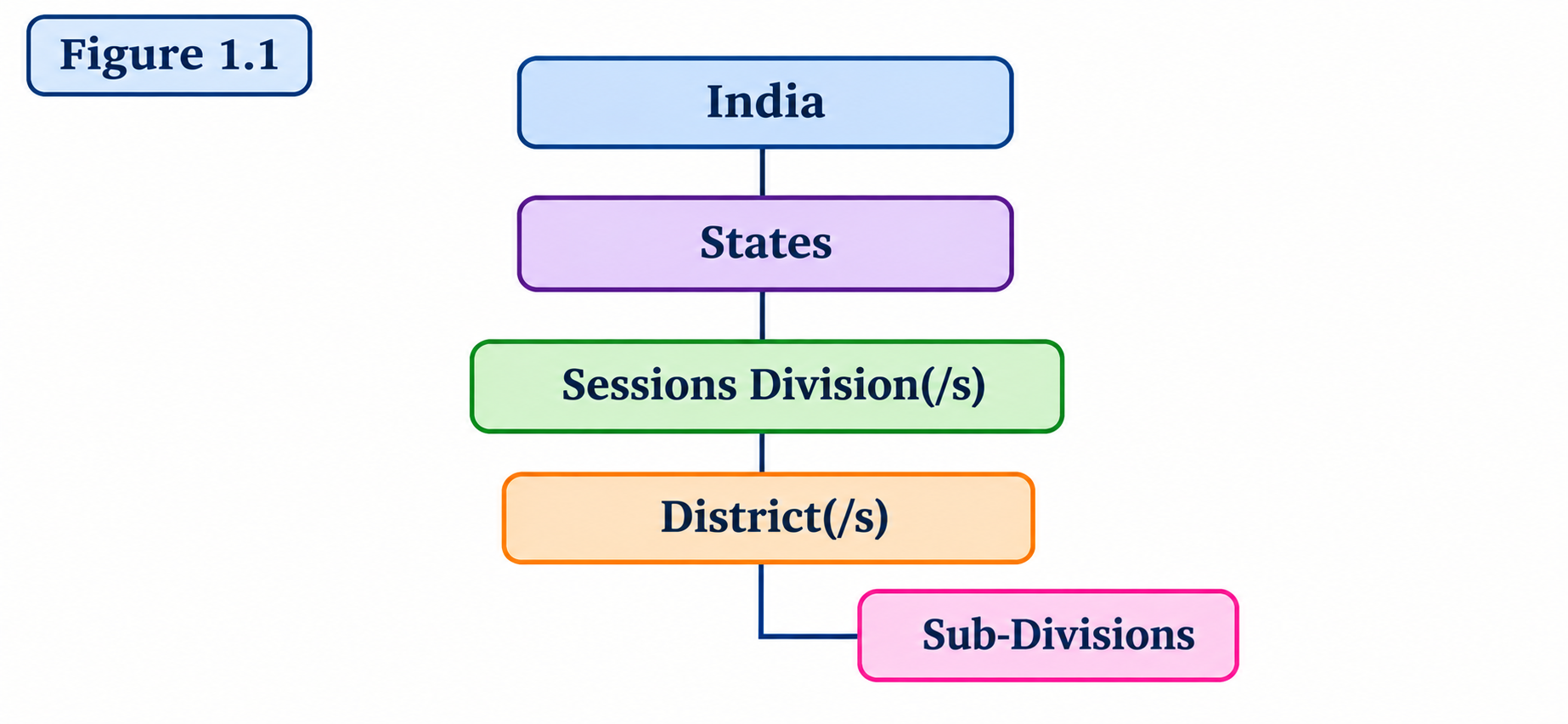
For judicial and administrative efficiency, India is divided into States, each consisting of one or more sessions divisions.
These sessions divisions comprise individual or multiple districts, which may be further subdivided into sub-divisions to meet local administrative demands.
To accommodate changing administrative needs, State Governments retain the statutory authority to alter the limits or number of these territorial units, provided they do so in consultation with the High Court of that State.
5. CLASSIFICATION OF OFFENCES
Under Section 5, titled Classification of Offences, the text presents the tripartite division of offences and cases under the Bharatiya Nagarik Suraksha Sanhita (BNSS) based on seriousness, trial procedures, and fundamental rights.
Offences are primarily divided into cognizable and non-cognizable categories.
Cognizable offences—generally serious crimes carrying three or more years of imprisonment—allow the police to investigate and arrest without a warrant, while non-cognizable offences require a Magistrate’s direction for police intervention.
A secondary classification distinguishes bailable offences, where the accused has an absolute right to bail, from non-bailable offences, where bail remains subject to judicial discretion.
Finally, criminal cases are classified as summons cases (punishable by up to two years) and warrant cases (punishable by death, life imprisonment, or more than two years), determining whether the initial court process begins with a summons or warrant and whether a simplified or elaborate trial procedure is followed.
6. FUNCTIONARIES UNDER THE BNSS
Under Section 6, titled Functionaries Under the BNSS, the text outlines the key institutional pillars responsible for implementing the criminal justice system under the Bharatiya Nagarik Suraksha Sanhita.
It identifies five essential functionaries: police (investigation and arrest), prosecutors (state representation), defence counsel (legal defence for the accused), magistrates and judges (judicial oversight and trial management), and prison and correctional personnel (custody and rehabilitation).
Together, these functionaries form the operational machinery necessary to exercise statutory powers, perform procedural duties, and uphold the administration of criminal justice.
7. MAIN SEGMENTS OF CRIMINAL PROCEDURE
Section 7, titled Main Segments of Criminal Procedure, establishes that the primary objective of criminal proceedings under the BNSS is to guarantee a full and fair trial anchored in the principles of natural justice.
The process unfolds sequentially, beginning with pre-trial procedures where police receive information, visit the scene, gather evidence, make arrests, conduct searches, and conclude by filing a police report under Section 193(3) BNSS.
Overlapping these stages are rules governing jurisdiction and bail, which apply continuously through pre-trial, trial, and review phases.
Once the trial concludes with a judgment, the procedure transitions to review mechanisms—such as appeals, references, and revisions—and ultimately to execution of final court decisions.
Additionally, BNSS covers non-trial administrative and social-welfare matters, including crime prevention, public nuisance abatement, and maintenance orders for wives, children, and parents.