
1. THE POLICE
Section 1, titled The Police, explains that state police forces are established under the Police Act of 1861 or corresponding state legislation as the primary agency for preventing and detecting crime.
Structurally, state administration is headed by the Inspector General of Police, while district-level operations are led by the District Superintendent of Police under the oversight of the District Magistrate.
Under the BNSS, enrolled police officers receive statutory powers such as arrest and search, with Officers in Charge of Police Stations holding expanded investigation powers for cognizable offences, while superior officers may exercise the same powers across their whole local jurisdiction.
2. THE PROSECUTORS
Section 2, titled The Prosecutors, highlights that criminal offences are treated as wrongs against the State, placing the responsibility of prosecution on Central and State Governments through designated statutory officers.
Public Prosecutors, Additional PPs, Special PPs, and Assistant Public Prosecutors (APPs) are appointed across various levels of courts based on strict experience criteria, with APPs generally handling Magistrate Courts and Public Prosecutors handling Sessions and High Court trials.
Rather than acting as mere agents of the government or police, prosecutors function as independent statutory officers and “ministers of justice” whose primary mandate is to ensure fair trials by presenting all relevant material—including exculpatory evidence—to the court under the constitutional mandate of fair disclosure.
Furthermore, Section 20 of the BNSS establishes a structured Directorate of Prosecution (led by a Director, Deputy Directors, and Assistant Directors under the Home Department) to systematically monitor and expedite cases categorized by potential sentence length, while preserving the prosecutor’s exclusive, independent discretion regarding withdrawal from prosecution in the interest of public justice.
3. THE DEFENCE COUNSEL
In an adversarial criminal trial system, the State deploys its resources and prosecution to present charges, while the accused relies on a competent defence counsel to challenge evidence and cross-examine witnesses to secure a fair trial under Article 21 of the Constitution of India.
Because the constitutional right to counsel becomes meaningless if poverty prevents an accused from hiring a lawyer, both Article 21 and statutory provisions mandate that the court proactively inform indigent accused persons of their right to free legal aid and assign them State-funded representation without requiring a formal application.
This obligation applies from the moment of initial appearance or remand through trial, and the State cannot claim financial constraints to deny it.
Although past judicial rulings attempted to restrict free legal aid in certain offences based on concepts of social justice, modern statutory frameworks—notably Section 341 BNSS and the Legal Services Authorities Act, 1987—ensure that legal representation is made available irrespective of the offence, protecting the presumption of innocence and ensuring trials are not invalidated due to inadequate defense representation.
4. THE COURTS
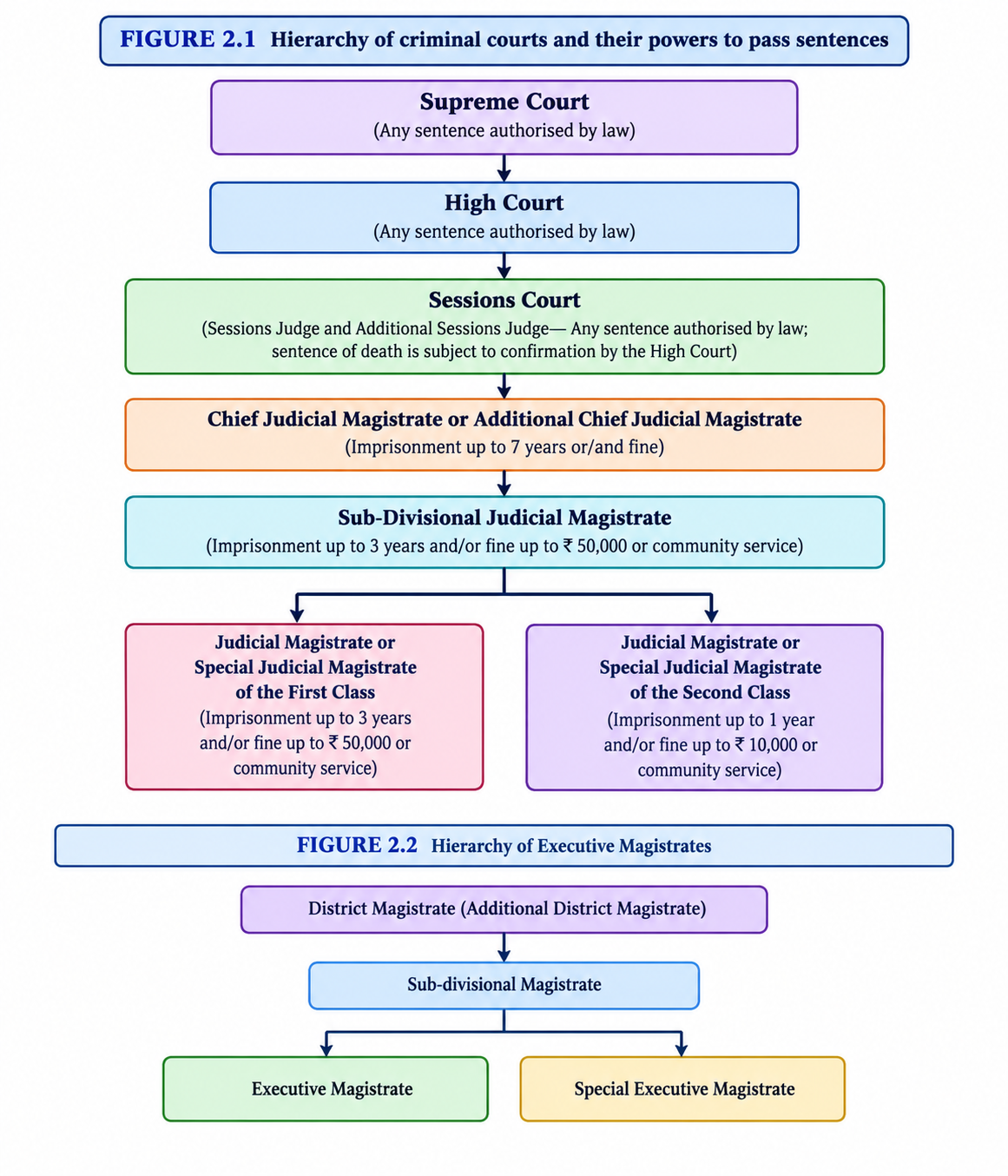
Section 4, titled The Courts, details the structural organization of India’s criminal court framework under the Constitution and the Bharatiya Nagarik Suraksha Sanhita (BNSS), dividing authority into the higher judiciary, subordinate judicial courts, and executive magistrates.
The Supreme Court and State High Courts maintain constitutional jurisdiction, with High Courts holding direct administrative superintendence and inherent powers over Sessions Courts and Judicial Magistrates (First Class, Second Class, and Chief Judicial Magistrates) to guarantee the fair and speedy administration of justice.
In keeping with the constitutional imperative to separate the judiciary from the executive, Judicial Magistrates fall under High Court control to handle judicial determinations, whereas Executive Magistrates—comprising District Magistrates, Sub-divisional Magistrates, and designated police officials—operate under the State Government to execute administrative and public-order functions.
Furthermore, while Special Judicial Magistrates may be appointed temporarily for specific matters, the statutory framework carefully balances administrative flexibility with judicial oversight, ensuring that both judicial independence and administrative governance remain clearly demarcated across district hierarchies.
5. PRISON AUTHORITIES AND CORRECTIONAL SERVICES PERSONNEL
Upon conviction, a criminal court must either pass a sentence or process the offender under probation and reformative laws, executing sentences under BNSS guidelines that historically relied on colonial-era statutes such as the Prisons Act of 1894 and the Probation of Offenders Act of 1958 for administrative machinery.
To modernize this structure, the Union Government introduced the advisory Model Prisons and Correctional Services Act, 2023, which integrates video conferencing and transparent technology while establishing incentives like parole, furlough, and remission alongside vocational training and dedicated accommodations for women and transgender prisoners.
As States and Union Territories adopt this modern framework to replace outdated legislation, the demand for structured correctional services will rise significantly due to the BNSS’s heightened emphasis on rehabilitating and training young offenders.