
Scholarship Opportunities for Indian Students Pursuing Higher Education Abroad
Introduction: The Global Gateway for Indian Scholars
Securing financial assistance remains a paramount milestone for Indian aspirants seeking international academic exposure. With tuition fees, health insurance, and living costs continuously rising across major study destinations, competitive grants transform ambitious educational dreams into practical reality. Obtaining funding requires a clear understanding of eligibility criteria, application timelines, and selection standards. From government-backed awards to private trust endowments, numerous global opportunities exist to support outstanding scholars. This guide provides a comprehensive overview of financial aid avenues designed for candidates venturing overseas for undergraduate, master’s, and doctoral studies.
1. Government-Funded International Scholarships for Indian Applicants
Government-sponsored funding programs stand among the most prestigious financial pathways for higher education. These competitive grants are structured to foster bilateral relationships and facilitate global knowledge exchange.
┌─────────────────────────────────────────────────────────────┐
│             GOVERNMENT SCHOLARSHIP ARCHITECTURE             │
│  State/Central Schemes ──► Full Tuition + Monthly Stipends │
│  Bilateral Partnerships ──► Travel Grants & Visa Support     │
└─────────────────────────────────────────────────────────────┘
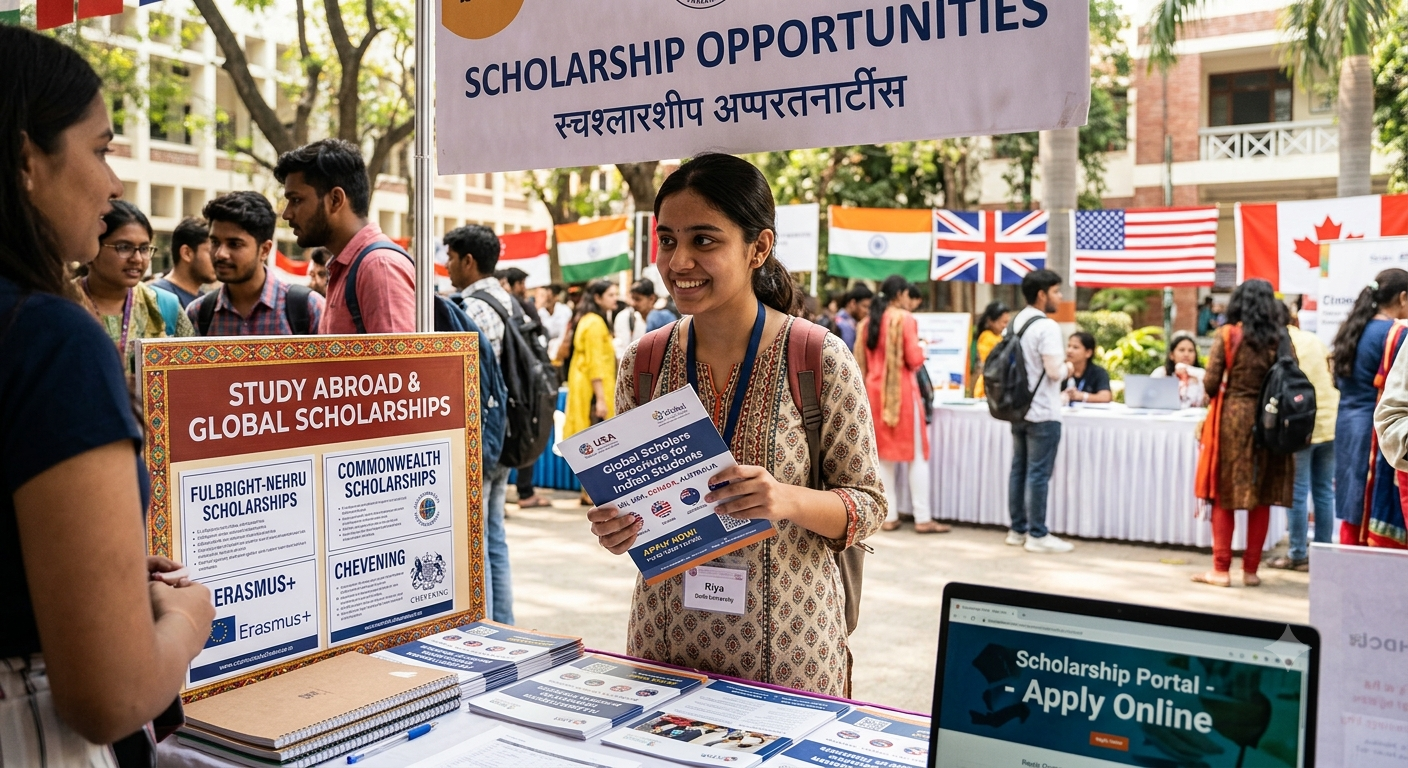
The Fulbright-Nehru Master’s Fellowships, administered by the United States-India Educational Foundation, support exceptional individuals pursuing postgraduate degrees across American universities. Similarly, the UK Government’s Chevening Scholarship offers fully funded master’s degree coverage, including flight fares, living allowances, and tuition fees for leaders demonstrating academic excellence. Additionally, the Commonwealth Scholarship scheme supports postgraduates from Commonwealth nations studying at participating institutions in Great Britain.
For official updates regarding bilateral fellowship frameworks, candidates can visit the Ministry of Education portal.
2. Indian Government Schemes: Central and State Overseas Funding
Central ministries and regional state governments in India actively provide dedicated financial aid to ensure inclusive access to global educational institutions.
The National Overseas Scholarship (NOS), managed by the Ministry of Social Justice and Empowerment, assists eligible students from low-income and marginalized background categories pursuing master’s or doctoral programs abroad. This central sector scheme offers coverage for tuition fees, maintenance allowances, passage fares, and contingency costs. Furthermore, several state governments—such as Maharashtra, Telangana, and Delhi—run regional departmental schemes granting substantial financial support for higher studies in internationally ranked universities.
3. Major European Study Grants: DAAD and Erasmus Mundus
European higher education systems offer some of the most accessible funding networks for international master’s and doctoral research candidates.
  DAAD Germany      ──► Monthly Stipends + Health Insurance
  Erasmus Mundus    ──► Multi-Country Mobility + Full Fee Waiver
The DAAD (German Academic Exchange Service) funding portfolio provides extensive monthly allowances, travel stipends, and medical insurance for students entering German public universities. Meanwhile, the Erasmus Mundus Joint Masters program enables scholars to study across multiple European campuses under a single degree program, offering generous monthly living stipends alongside complete tuition coverage.
Applicants seeking comprehensive information on European academic frameworks can explore the official European Union Education initiative pages.
4. Prestigious University-Specific Financial Aid in the UK and USA
Ivy League institutions and top UK research universities offer institutional financial awards directly to high-achieving applicants during the admission selection cycle.
The Gates Cambridge Scholarship, established by the Bill & Melinda Gates Foundation, offers full-cost awards to outstanding international postgraduate applicants admitted to the University of Cambridge. Equally prestigious is the Rhodes Scholarship at the University of Oxford, supporting postgraduate study across diverse academic disciplines. In the United States, institutions like Stanford University offer the Knight-Hennessy Scholars program, providing full funding for graduate enrollment.
5. Private Indian Trusts and Foundation Grants
Private philanthropic trusts established within India have supported ambitious scholars for over a century through merit grants and low-interest education loans.
┌─────────────────────────────────────────────────────────────┐
│                 PRIVATE TRUST FUNDING MODELS                │
│  Inlaks Foundation  ──► Pure Grant Assistance (Up to $100k) │
│  JN Tata Endowment  ──► Concessional Micro-Loan Assistance   │
└─────────────────────────────────────────────────────────────┘
The Inlaks Shivdasani Foundation offers grants up to $100,000 for postgraduate degree programs across top institutions in America, Europe, and Great Britain. For those seeking accessible loan-scholarships, the JN Tata Endowment provides low-interest financial support for higher studies across all academic fields. Additionally, the KC Mahindra Education Trust awards postgraduate scholarships annually to deserving candidates heading abroad.
6. Australian and Canadian Government Research Fellowships
Both Australia and Canada offer attractive research grants for international postgraduates entering STEM and social science tracks.
The Australia Awards Scholarships, funded by the Department of Foreign Affairs and Trade, cover full tuition, return air travel, operational living allowances, and Overseas Student Health Cover. For research-oriented candidates heading to North America, Canada’s Vanier Canada Graduate Scholarships deliver CAD 50,000 annually for three years during doctoral research pursuits. Furthermore, Australian institutions offer the Research Training Program (RTP) stipend, supporting international master’s and PhD researchers.
7. Merit-Based vs. Need-Based Assistance: Key Differences
Navigating financial aid systems requires understanding how committees evaluate candidate profiles during selection cycles.
Merit-Based Awards: Evaluated primarily on academic history, standardized test results, published research papers, and leadership portfolios.
Need-Based Grants: Calculated based on verified family income records, financial assets, and demonstrated financial shortfalls relative to total program costs.
Hybrid Scholarships: Combine academic excellence standards with demonstrated financial need criteria during final evaluation stages.
Prospective students can check financial assessment guidelines published by the United States-India Educational Foundation for further clarity on application standards.
8. Key Application Components for International Scholarships
Submitting a compelling application demands meticulous document preparation well ahead of institutional deadlines.
  Academic Transcripts + Standardized Tests (IELTS/GRE)
                       │
                       ▼
  Statement of Purpose (SOP) + Letters of Recommendation (LOR)
                       │
                       ▼
  Final Scholarship Committee Review & Interview Round
Every scholarship dossier must contain verified university transcripts, competitive language proficiency scores (IELTS or TOEFL), and specialized entrance exam results (GRE or GMAT) where required. A well-crafted Statement of Purpose must explain career goals, community engagement impact, and academic alignment with the chosen degree. Furthermore, strong Letters of Recommendation from academic professors or workplace supervisors provide vital third-party validation of an applicant’s potential.
9. Step-by-Step Strategic Timeline for Scholarship Applicants
Applying for international financial aid requires a structured timetable starting at least 12 to 18 months before the intended course start date.
12–18 Months Prior: Research target universities, match program prerequisites, and identify relevant scholarship schemes.
10–12 Months Prior: Take required English proficiency tests and standardized examinations.
8–10 Months Prior: Draft personal statements, request recommendation letters, and organize official financial records.
6–8 Months Prior: Submit official university applications alongside early-bird scholarship portal entries.
3–5 Months Prior: Attend scholarship interviews, accept formal award letters, and initiate student visa procedures.
10. Common Pitfalls to Avoid in Scholarship Applications
Many capable applicants miss out on funding opportunities due to avoidable administrative errors during submission.
Applying past published deadline windows remains a frequent issue, as most fellowship portals close months before university admission cycles end. Submitting generic essays that fail to reflect the scholarship provider’s core mission also reduces candidate scores. Additionally, ignoring eligibility clauses regarding age limits, minimum work experience, or return-to-home-country conditions leads to immediate disqualification. Thorough proofreading and strict adherence to document guidelines are essential for success.
11. Conclusion: Empowering Your Global Academic Journey
Securing international funding is a transformative step toward achieving world-class academic and professional success. By exploring diverse avenues—including government-backed schemes, university awards, and private trust grants—Indian scholars can ease the financial demands of studying overseas. Success requires early preparation, meticulous document compilation, and a clear presentation of your academic vision. With the right strategy and determination, your dream of pursuing higher education abroad is well within reach.

How useful was this post?
Click on a star to rate it!
Average rating 0 / 5. Vote count: 0
No votes so far! Be the first to rate this post.