
What Is Quantum Computing and Why Indian Research Institutes Are Investing Heavily In It.
We are currently witnessing the sunset of classical silicon computation. For over half a century, Moore’s Law dictated that the number of transistors on a microchip doubles roughly every two years, continuously driving down costs and scaling computational power. However, as transistors shrink to the size of a few nanometers, we run head-first into the unyielding walls of quantum physics. At this atomic scale, electrons begin to leak through physical barriers via quantum tunneling, rendering classical binary logic unstable.
This physical bottleneck has catalyzed the next great leap in computational science: quantum computing.
As we navigate through 2026, the global race to achieve quantum supremacy has escalated from theoretical physics laboratories to national strategic imperatives. India is positioning itself at the absolute forefront of this revolutionary paradigm. Led by the government’s ambitious multi-crore initiatives, premier Indian research institutes quantum computing departments are investing heavily in building indigenous quantum hardware, developing post-quantum cryptographic protocols, and training a highly specialized scientific workforce.
This comprehensive analysis explains the core physics behind quantum computing, breaks down the technical mechanisms of quantum superiority, explores why India is investing billions in this frontier, and highlights the specific academic institutes pioneering the quantum age.
1. What Is Quantum Computing? Understanding the Subatomic Paradigm Shift
To comprehend why quantum systems are so highly disruptive, we must understand the fundamental difference in how they process information.
A classical supercomputer—regardless of its scale—operates on binary bits. A bit is a tiny, physical switch that can exist in only one of two mutually exclusive states: 0 (off) or 1 (on). Every algorithm, video stream, and artificial intelligence model is ultimately broken down into trillions of these sequential 0s and 1s.
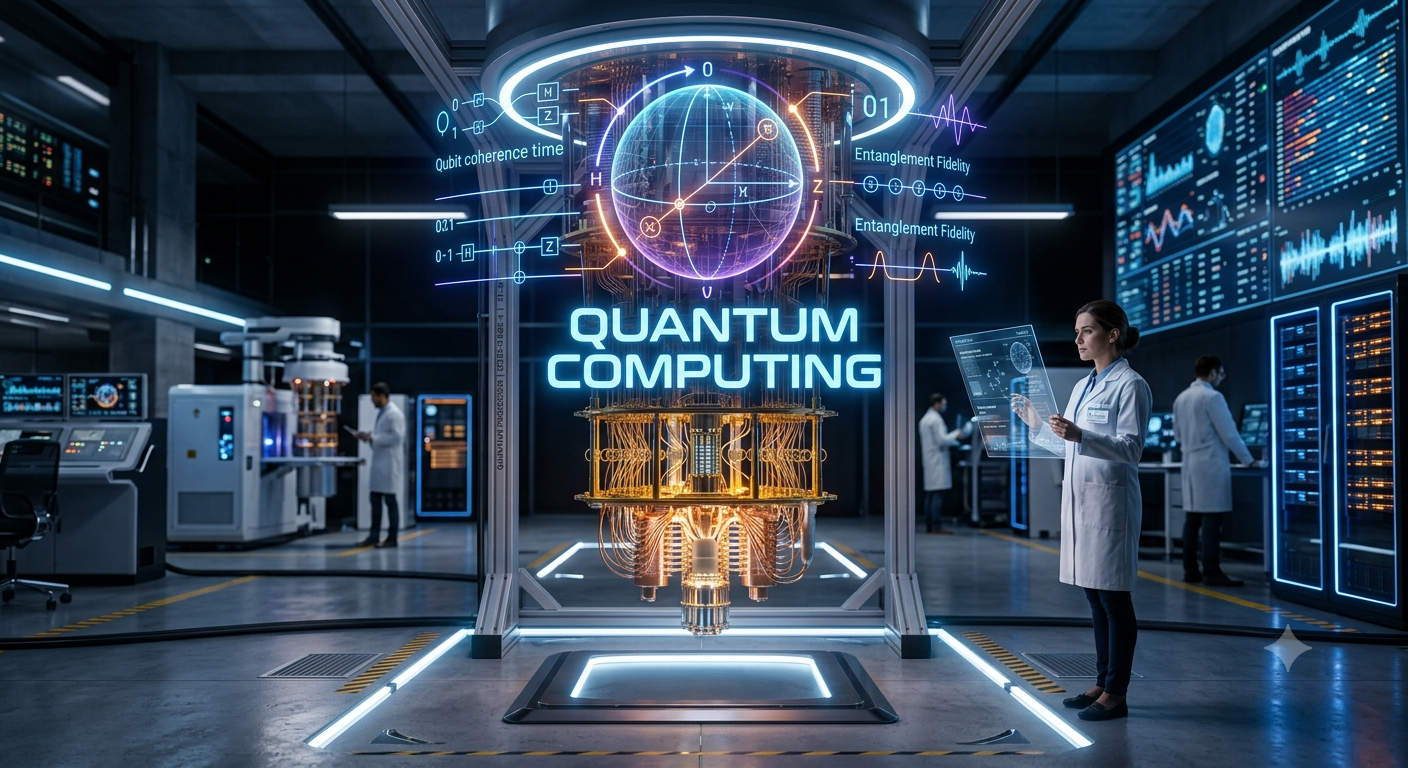
In contrast, a quantum computer utilizes the bizarre laws of quantum mechanics to process complex information in ways that classical physics cannot explain. Instead of classical bits, these machines use quantum bits, or qubits. Because qubits operate at the subatomic level, they do not behave like binary switches. They can exist in multiple states simultaneously, allowing a quantum system to calculate millions of possibilities at the exact same time.
2. The Mathematics of Quantum Superiority: Superposition, Entanglement, and Interference
The computational power of a quantum computer does not scale linearly; it scales exponentially with each additional qubit. This immense scaling capacity is driven by three core quantum principles:
Superposition
Superposition is a fundamental principle in physics and wave mechanics stating that when two or more waves of the same type cross at the same point, the resulting displacement at that point is equal to the vector sum of the displacements of the individual waves. This interaction can cause constructive interference (where the waves reinforce each other) or destructive interference (where they cancel each other out).
In quantum mechanics, this concept expands to mean that a particle or physical system can exist in multiple states or configurations simultaneously. It remains in this combination of probabilities until an external measurement forces it to collapse into a single, definite state.
Entanglement
Quantum entanglement is a phenomenon in physics where two or more particles become deeply interconnected. When this occurs, the physical state of one particle instantly dictates the state of the other, no matter how far apart they are—even if separated by light-years.
If you measure the spin of one entangled particle, you immediately know the spin of its partner. This instantaneous connection led Albert Einstein to skeptically call it “spooky action at a distance.” Today, entanglement is a foundational principle driving advanced technologies like quantum computing, unbreakable quantum cryptography, and quantum teleportation.
Quantum Interference
To find the correct answer to a highly complex calculation, a quantum computer utilizes constructive and destructive interference. The system is designed to amplify the probability amplitudes of the correct solutions (constructive interference) while systematically canceling out the amplitudes of the incorrect solutions (destructive interference), leading the final physical measurement directly to the correct output.
3. How Quantum Bits (Qubits) Differ From Classical Bits
The table below breaks down the fundamental structural differences between classical computational bits and advanced, subatomic qubits in 2026:
+------------------------------------+------------------------------------+------------------------------------+
| Dimension / Metric                 | Classical Bits                     | Quantum Bits (Qubits)              |
+------------------------------------+------------------------------------+------------------------------------+
| Fundamental Physical State         | Binary (Strictly 0 OR 1)           | Superposition (0 AND 1)            |
| Data Processing Pattern            | Sequential (One step at a time)    | Exponentially Parallel             |
| Scaling Capacity                   | Linear (1:1 Relationship)          | Exponential (2^N Power Scaling)    |
| Operational Environment            | Standard Room Temperatures         | Near Absolute Zero (Cryogenic)     |
| Sensitivity to Physical Noise      | Extremely Low                      | Exceptionally High (Decoherence)   |
| Primary Applications               | General computation, databases     | Simulations, cryptography, ML      |
+------------------------------------+------------------------------------+------------------------------------+
4. The Strategic Importance: Why India Cannot Afford to Wait
If quantum computing is still in its developmental infancy, why is India pouring billions of rupees into this technology today? The answer is simple: sovereign security and global economic survival.
Any nation that fails to develop sovereign quantum capabilities risks becoming completely obsolete. When fully realized, high-performance quantum computers running Shor’s algorithm will easily crack RSA encryption—the fundamental cryptographic architecture that currently secures global financial transactions, military communications, government databases, and internet protocols.
If India relies on foreign quantum hardware or software, its national cyber infrastructure will be completely vulnerable to decryption by adversaries. Developing domestic quantum cryptography and hardware is a matter of absolute national security.
To read more about the geopolitical and strategic implications of quantum technologies on global security, you can refer to the policy updates published on the Department of Science and Technology (DST) India Portal.
5. The National Quantum Mission (NQM): Funding India’s Quantum Future
To systematically address this technological challenge, the Union Cabinet launched the landmark National Quantum Mission (NQM). With an official budget allocation exceeding ₹6,000 Crore, the mission seeks to transition India from a consumer of technology to a leading developer of quantum innovations.
The NQM focuses on four primary thematic hubs:
Quantum Computing: Developing physical quantum computers with 50 to 1000 physical qubits using various hardware platforms (such as superconducting qubits and photonic systems).
Quantum Communication: Designing secure satellite and fiber-based quantum key distribution (QKD) networks across India.
Quantum Sensing and Metrology: Engineering highly sensitive atomic clocks, magnetometers, and gravimeters for advanced geological navigation.
Quantum Materials and Devices: Synthesizing novel materials (like topological insulators) to construct more stable, noise-resistant qubits.
Progress updates and mission directives can be tracked on the official government portals managed by the Ministry of Electronics and Information Technology (MeitY).
6. Key Indian Research Institutes Leading the Quantum Charge
India’s top academic and research centers are translating these massive funding channels into physical realities. The leading hubs driving quantum computing in India include:
Indian Institute of Science (IISc), Bengaluru
IISc is the crown jewel of India’s scientific research. The institute’s Centre for Quantum Technologies (CQT) is spearheading research into superconducting qubits and quantum materials. IISc researchers are actively developing advanced cryogenic dilution refrigerators to cool quantum processors to temperatures colder than deep space (10 millikelvin above absolute zero). Learn more about their ongoing research projects on the official Indian Institute of Science (IISc) Academic Portal.
Indian Institute of Technology (IIT) Madras
IIT Madras has emerged as a powerhouse for quantum software and algorithms. The institute’s Centre for Quantum Information, Communication and Computing (CQuICC) is building localized quantum networks and collaborating directly with global tech giants to build industrial-use algorithms. Students and researchers can explore their academic publications via the IIT Madras Research Portal.
Tata Institute of Fundamental Research (TIFR), Mumbai
TIFR is home to some of the most advanced experimental physics setups in India. The TIFR team, under the Quantum Measurement and Control Laboratory (QuMaC), has successfully built and tested India’s first indigenous 3-qubit superconducting quantum processor, establishing a solid baseline for future scalability.
Raman Research Institute (RRI), Bengaluru
RRI is the undisputed pioneer of quantum communication in India. In collaboration with ISRO, RRI researchers have successfully demonstrated secure Quantum Key Distribution (QKD) via moving satellites and long-distance fiber networks, laying the groundwork for a highly secure, unhackable quantum internet.
7. Target Applications: What Problems Will Indian Quantum Systems Solve?
Indian research institutes are not just interested in theoretical physics; they are focusing on solving massive, real-world computational bottlenecks:
Accelerated Drug Discovery and Molecular Simulation
Currently, bringing a new medicine to market takes over a decade and costs billions of dollars because classical computers cannot accurately model the chemical reactions of molecules. A quantum computer can simulate molecular behaviors at the quantum level, allowing researchers to design customized cancer-fighting drugs or synthesize life-saving vaccines in days instead of years.
Optimizing Agricultural Yields (The Haber-Bosch Puzzle)
The synthesis of chemical fertilizers via the Haber-Bosch process consumes nearly 1% to 2% of the world’s total energy output. This process relies on high temperatures and pressures to convert nitrogen to ammonia. Nature, however, does this effortlessly at room temperature using a specific enzyme (nitrogenase). Quantum computers can simulate this catalyst, helping scientists replicate natural nitrogen fixation, which could dramatically reduce fertilizer production costs and secure India’s food supplies.
Financial Portfolio and Logistics Optimization
Calculating the optimal routing for thousands of delivery vehicles or balancing massive high-yield investment portfolios requires analyzing trillions of variables. Quantum algorithms can solve these optimization problems in seconds, boosting national logistics efficiency and optimizing investment strategies for financial institutions.
8. The Private Sector Synergy: Building a Quantum Startup Ecosystem in India
For quantum technology to scale, academic research must seamlessly transition into the commercial market. India’s premier institutes are bridging this gap by incubating high-tech deep-tech startups:
QNu Labs: Incubated out of IISc Bengaluru, QNu Labs is a global leader in quantum cryptography, offering commercial quantum key distribution (QKD) and quantum random number generator (QRNG) systems to secure corporate networks.
BosonQ Psi: Based in India, this startup is developing specialized quantum-computing-as-a-service (QCaaS) software to run complex structural and aerodynamic simulations for aerospace and automotive companies.
These startups prove that India is successfully building a robust, commercial quantum startup ecosystem that matches global standard innovations.
9. The Talent Gap Bottleneck: How Universities are Restructuring Curriculums
Building a quantum processor requires a unique blend of skills—spanning advanced quantum physics, cryogenic engineering, materials science, and computer science. Currently, there is a major global shortage of qualified quantum engineers.
To address this talent gap, Indian research institutes are aggressively restructuring their academic offerings:
Interdisciplinary Master’s Programs: Launching specialized M.Tech programs in Quantum Technology that accept students from physics, electronics, and computer science backgrounds.
State-Sponsored Internships: Facilitating fully funded research fellowships under the National Quantum Mission to allow undergraduate students to work inside physical quantum labs early in their academic careers.
Collaborative Ph.D. Pipelines: Partnering with premier international universities to run joint doctoral programs, ensuring Indian researchers have access to cutting-edge cleanrooms and fabrication bays worldwide.
10. Quantum Cryptography and National Security: Protecting India's Cyber Frontiers
As quantum processors scale, traditional firewalls and encryption standards will be completely bypassed. To protect national security, defense agencies and research institutes are actively developing Post-Quantum Cryptography (PQC).
PQC relies on complex mathematical problems (such as lattice-based cryptography) that are mathematically proven to be secure against both classical and quantum attacks. By deploying quantum cryptography India is ensuring that its military communications, banking systems, and public grids remain completely safe from quantum-armed hackers.
11. Conclusion: Positioning India as a Quantum Superpower by 2030
The rapid rise of quantum computing represents a complete rewrite of computational logic. While the physical challenges of scaling hardware—such as minimizing quantum decoherence and developing robust quantum error correction—are immense, the progress made by Indian research institutes is highly impressive.
Backed by the strategic funding of the ₹6,000 Crore National Quantum Mission, hubs like IISc, TIFR, RRI, and the IITs are establishing the foundational pillars of India’s quantum future.
By developing sovereign quantum processors, deploying unhackable quantum key distribution networks, and training a highly skilled workforce, India is not merely participating in the global quantum revolution; it is positioning itself to lead it. The investments made today inside these academic cleanrooms will ensure that India steps confidently into the future as an independent, secure, and highly competitive quantum superpower.

How useful was this post?
Click on a star to rate it!
Average rating 0 / 5. Vote count: 0
No votes so far! Be the first to rate this post.