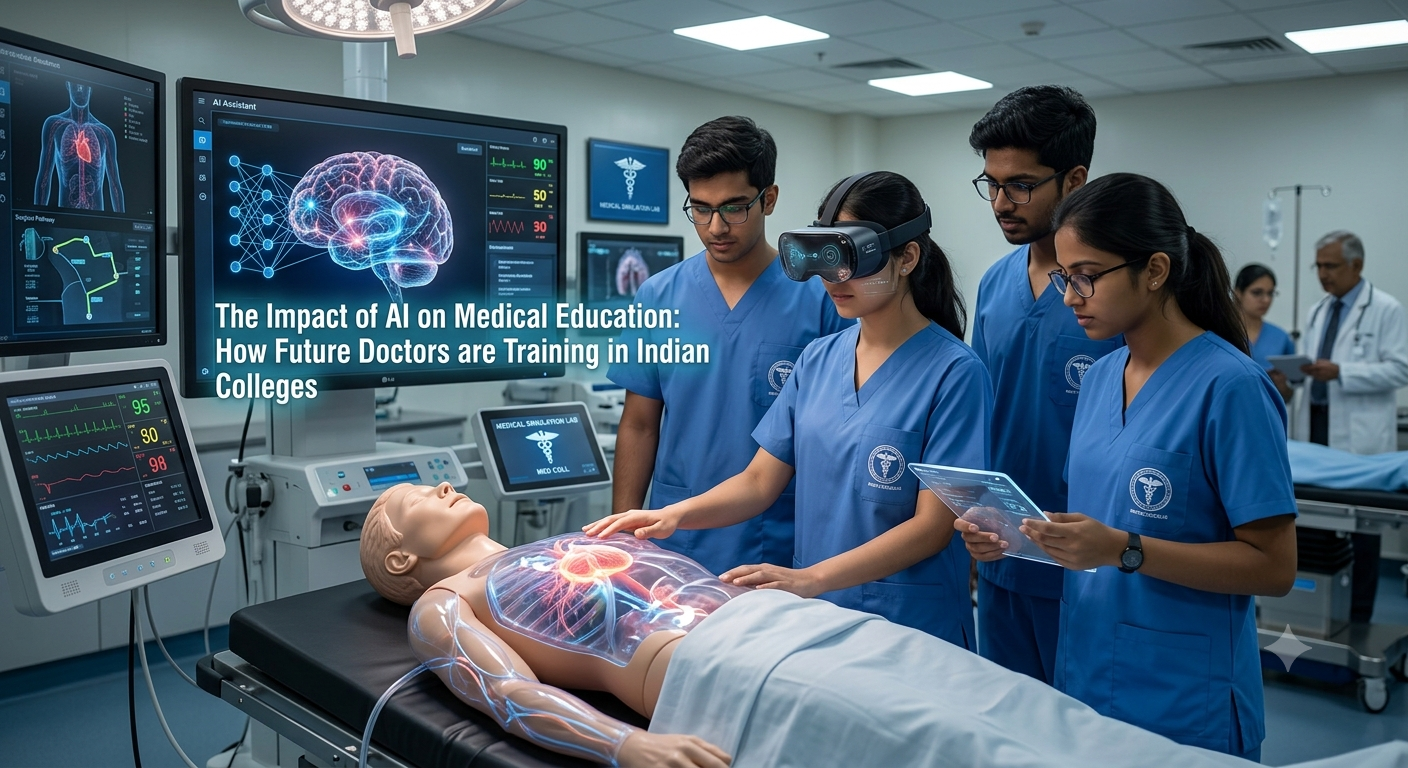
The Impact of AI on Medical Education: How Future Doctors are Training in Indian Colleges
The landscape of healthcare is shifting beneath our feet. For generations, the pathway to becoming a physician in India was defined by thick, leather-bound textbooks, long nights of rote memorization, and classical clinical rotations under the watchful eye of senior residents. While the core human values of empathy, clinical judgment, and direct physical diagnosis remain the heart of medicine, the toolsets available to clinicians have changed forever.
As we progress through 2026, artificial intelligence (AI), machine learning (ML), virtual reality (VR) simulations, and automated diagnostic systems are leaving the realm of research labs and entering active hospital workflows. Consequently, India’s premier medical institutions are undergoing a dramatic transformation to prepare students for an increasingly digitized clinical environment.
This deep-dive guide explores the comprehensive impact of AI on medical education, details how future doctors are training in Indian colleges, highlights the regulatory shifts pushed by the National Medical Commission (NMC), profiles pioneering institutions, and analyzes the structural technologies building the next generation of future-ready medical professionals.
1. The Technological Overhaul: Why Indian Medical Education Must Adapt
The integration of artificial intelligence into clinical diagnostics, robotic surgery, and treatment planning means that the traditional boundaries of medical school are no longer sufficient. If undergraduate and postgraduate medical trainees are taught exclusively using traditional, static pedagogical frameworks, a massive disconnect will emerge between classroom learning and real-world clinical practices.
In today’s advanced hospitals, AI systems are routinely used to flag critical anomalies in chest X-rays, identify metastatic breast cancer margins, and optimize surgical trajectories. To produce competent clinicians who can use these tools safely, Indian medical colleges must move beyond passive textbook ingestion. Fostering high-level AI literacy is no longer an optional extracurricular pursuit; it has become a fundamental pillar of modern medical education in India.
2. The Regulatory Mandate: Why India's NMC is Promoting AI Literacy
The momentum toward integrating technology into classrooms has received strong support from India’s medical regulator. Speaking at HealthAIcon, Chairperson of the National Medical Commission (NMC) Dr. Abhijat Sheth emphasized that “AI is already a part of the clinical environment now. Our education system must accept and reflect that reality.”
Rather than turning medical students into software engineers, the objective is to empower future doctors to understand the capabilities, limitations, and ethical boundaries of automated systems. Under the updated regulations and notifications issued on the Official National Medical Commission (NMC) Portal, the regulatory body is actively encouraging medical colleges to reform undergraduate and post-graduate curriculums. The goal is to ensure that every graduate from an Indian medical institution can interpret AI-driven diagnostic readouts critically, protect student and patient data, and maintain independent clinical judgment.
3. Inside the Classroom: Redefining Competency-Based Medical Education (CBME)
The current MBBS curriculum in India is structured around Competency-Based Medical Education (CBME). CBME emphasizes the practical acquisition of specific clinical skills rather than mere theoretical testing.
Integrating AI into this competency-focused environment has dramatically enhanced the learning cycle:
Personalized Learning Paths: AI-powered learning management systems analyze individual student test performances to pinpoint specific conceptual weaknesses. The software dynamically generates customized study modules, targeted revision questions, and remedial anatomical case studies to help students master challenging concepts.
Socratic AI Tutors: Interactive chatbots trained exclusively on verified medical databases provide students with round-the-clock, Socratic study assistance. Students can ask the system to explain complex physiological pathways—such as the Renin-Angiotensin-Aldosterone System (RAAS)—using multiple clinical analogies until they achieve absolute comprehension.
Automated Mock Evaluators: Advanced platforms generate high-yield multiple-choice questions mapped directly to the $2,683 distinct competencies outlined in the NMC syllabus, providing instant feedback and performance tracking.
4. The Anatomy of Tomorrow: Virtual Reality (VR) and 3D Simulation
For centuries, mastering human anatomy meant spending hours inside dissection halls working with physical cadavers. While cadaveric dissection remains highly valuable for tactile learning, the availability of high-quality donor bodies is structurally limited across many newer medical colleges in India.
To bridge this gap, modern Indian medical colleges are deploying advanced virtual reality simulation in medical training labs.
Using VR headsets and haptic feedback gloves, future doctors can step into virtual dissection rooms. They can rotate 3D cardiovascular models, peel away layers of muscle to visualize the exact pathway of deep femoral arteries, and simulate blood-flow dynamics in real time. This multi-sensory learning approach makes complex, abstract anatomical relationships easy to visualize. By the time students transition to clinical postings, they possess a highly sophisticated, three-dimensional spatial understanding of the human body, reducing surgical learning curves.
5. Diagnosing the Algorithm: Training on Diagnostic AI Tools
One of the most practical applications of AI medical training tools is teaching undergraduate students to work alongside automated diagnostic engines.
In clinical radiology and pathology rotations, students are taught to review patient imaging (like MRIs and CT scans) and tissue slides independently. They then run those exact images through clinical-grade AI diagnostic platforms. By comparing their own physical findings with the machine’s algorithmic annotations, students learn to spot microscopic abnormalities—such as early-stage pulmonary nodules or subtle cerebral hemorrhages—that are easily missed by the human eye alone.
This training model teaches students to treat AI as a powerful co-pilot, enhancing their diagnostic sensitivity while learning to verify machine outputs using evidence-based clinical guidelines.
6. Pioneering Institutions: Kasturba Medical College (KMC) Manipal
While many institutes are in the planning phases of technological integration, others are paving the way forward. A landmark milestone occurred when Kasturba Medical College (KMC), Manipal launched India’s first dedicated Department of Artificial Intelligence (AI) in Healthcare.
As outlined on the official KMC Manipal Academic Portal, this pioneering department operates as an interdisciplinary hub uniting medicine, data science, and engineering. The department’s objectives are highly ambitious:
Integrated Curriculum Design: Up-skilling undergraduate MBBS students and postgraduate residents in predictive analytics, machine learning, and decision-support systems.
Advanced Degrees: Offering specialized M.Sc. and integrated Ph.D. programs focusing exclusively on translating AI research into clinical software.
Collaborative Research: Running clinical-validation projects alongside hardware and software partners to build real-world diagnostics for oncology, ophthalmology, and public health.
By establishing this department, KMC Manipal has set a new benchmark for medical education in India, creating a scalable blueprint for other universities to follow.
7. EdMedAI and the Rise of AI-Powered CBME Platforms
To manage the complex compliance and tracking requirements of the NMC’s competency framework, Indian medical colleges are adopting specialized software. Leading this charge is EdMedAI, India’s first AI-powered Competency-Based Medical Education platform.
As detailed on the EdMedAI Platform Portal, the system acts as a digital co-pilot for both students and faculty. The platform optimizes the daily administrative and educational workflow of medical colleges through:
NMC-Compliant Digital Logbooks: Fully digitizing the logging of student clinical postings, complete with multi-layer authenticity verification to eliminate fraudulent entries.
DOAP Skills Tracker: Seamlessly tracking the Demonstrate, Observe, Assist, Perform (DOAP) milestones required for surgical and clinical procedures, ensuring HOD approval is secured digitally.
AI-Generated Case Studies: Automatically generating diverse, simulated patient scenarios based on real-world Indian demographic data, allowing students to practice history-taking and treatment formulation.
Geo-Fenced Attendance: Utilizing AI facial recognition and geo-fencing to enforce the NMC’s strict 75% theory and 80% practical attendance thresholds automatically.
These automated systems drastically reduce faculty burnout, allowing professors to redirect their time from manual record-keeping to high-value student mentoring.
8. Clinical Application: AI Collaborations at Premier AIIMS Campuses
India’s premier public institutions are also driving major innovations at the intersection of AI and medicine. At the All India Institute of Medical Sciences (AIIMS) Nagpur, researchers conducted a comprehensive cross-sectional study evaluating medical students’ perspectives on AI in the undergraduate curriculum.
The findings, published in the PMC National Library of Medicine Database, revealed a powerful consensus: over 87% of Indian medical students hold highly positive views on incorporating AI education into their curricula, with over 80% believing that this training must be highly experiential and hands-on.
Simultaneously, campuses like AIIMS Delhi are running active, multi-disciplinary clinical research projects. Medical students are actively participating in designing AI models to analyze mammograms for early-stage breast cancer screening, predict cardiovascular risks from simple retinal scans, and optimize drug-dosage protocols for complex oncology patients. This early exposure ensures that India’s public sector doctors are globally competitive and highly skilled in data-driven medicine.
9. The Empathy and Ethics Equilibrium: AETCOM in the AI Era
While the analytical power of AI is unmatched, a machine cannot sit with a patient, hold their hand, and deliver a challenging terminal diagnosis with compassion. Learning is a deeply emotional, social, and human experience.
Recognizing this, the NMC’s Attitude, Ethics, and Communication (AETCOM) modules are being adapted to address the ethical challenges of digital healthcare. Indian medical colleges are structuring ethics training to focus heavily on:
Informed Consent for AI Diagnostics: Teaching students how to explain to patients why an AI algorithm was used during their diagnostic workflow and securing their informed consent.
Addressing Algorithmic Bias: Educating future doctors to recognize that if the historical datasets used to train an AI model are biased or lack representations of local Indian demographics, the platform’s diagnostic outputs could be highly skewed.
Data Privacy and DPDP Compliance: Ensuring that future doctors understand their legal obligations to protect patient health records under the Digital Personal Data Protection (DPDP) Act of India, preventing unauthorized data sharing.
By balancing technical skills with rigorous ethical education, colleges ensure that the future of Indian medicine remains deeply compassionate, inclusive, and patient-centric.
10. Direct Comparison: Traditional Training vs. AI-Integrated Medical Training
How do these two educational pathways compare when preparing future doctors for the clinical realities of tomorrow?
+---------------------------+---------------------------------+---------------------------------+
| Attribute / Metric        | Traditional Medical Training    | AI-Integrated Medical Training  |
+---------------------------+---------------------------------+---------------------------------+
| Anatomical Comprehension  | Static textbook diagrams & labs | Multi-sensory 3D VR simulation  |
| Diagnostic Precision      | Purely experiential pattern-rec | AI-assisted co-pilot verification|
| Student Progress Tracking | Manual paper-based logbooks     | Digital, AI-verified dashboards |
| Case Study Diversity      | Dependent on local ward intake  | Infinite AI-generated scenarios |
| Focus on Tech Literacy    | Minimal (Often ignored)         | High (Ethical AI & metrics)     |
| Administrative Burnout    | High (Heavy manual recording)   | Low (Automated tracking & logs) |
+---------------------------+---------------------------------+---------------------------------+
11. Conclusion: Shaping the Future of Medicine in India
The definitive verdict is clear: artificial intelligence is not replacing doctors; however, doctors who use AI will replace doctors who do not.
By changing medical education from a rigid model of rote memorization to a dynamic, tech-driven framework, Indian medical colleges are ensuring their graduates are fully prepared for the future of healthcare. Through the standardization of NMC guidelines, the launch of dedicated departments at KMC Manipal, and the deployment of AI-powered CBME platforms like EdMedAI, future doctors are building the skills required to deliver faster, cheaper, and highly accurate patient care.
As medical classrooms across India continue to adapt, the ultimate goal remains unchanged: to combine the infinite analytical power of artificial intelligence with the compassionate, ethical, and empathetic leadership of human doctors to build a healthier, brighter tomorrow for all.

How useful was this post?
Click on a star to rate it!
Average rating 0 / 5. Vote count: 0
No votes so far! Be the first to rate this post.