
How to Choose Between MBBS and Alternative Medical Careers (BAMS, BHMS, and Biotech)
The dream of wearing a white coat and stethoscope is shared by millions of students across India. Every year, the National Eligibility cum Entrance Test (NEET) witnesses an exponential rise in applicants, with over 2.5 million aspirants competing for a highly restricted pool of government medical seats. For many, this hyper-competitive bottleneck leads to a critical crossroads: how to choose between MBBS and alternative medical careers?
Historically, students who did not secure an MBBS seat faced immense societal pressure, with alternative systems of medicine often viewed as second-best. However, as we progress through 2026, the global healthcare paradigm has fundamentally transformed. Holistic health, wellness, preventative medicine, and deep-tech biological engineering are experiencing an unprecedented boom.
Whether you are looking to treat patients using classical medicine, integrate ancient healing sciences, practice individualized therapeutics, or design next-generation vaccines inside a research laboratory, this guide will analyze the differences between MBBS vs BAMS vs BHMS vs Biotech, outline high-yield alternative medical courses in India, review market placements, and help you make a logical, future-proof decision to avoid career regret after NEET.
1. The High-Stakes Dilemma: Understanding the Selection Pressures of NEET
The competitive pressure in Indian medical admissions is statistically daunting. With a selection ratio of less than 5% for government MBBS seats, the emotional and mental toll on young aspirants is immense. This physical and systemic bottleneck forces students to look beyond the conventional allopathic route and explore high-value NEET alternative career options.
To make a rational decision, you must strip away social prestige and analyze these degrees based on your core academic interests, clinical temperament, financial investment capacity, and long-term professional aspirations.
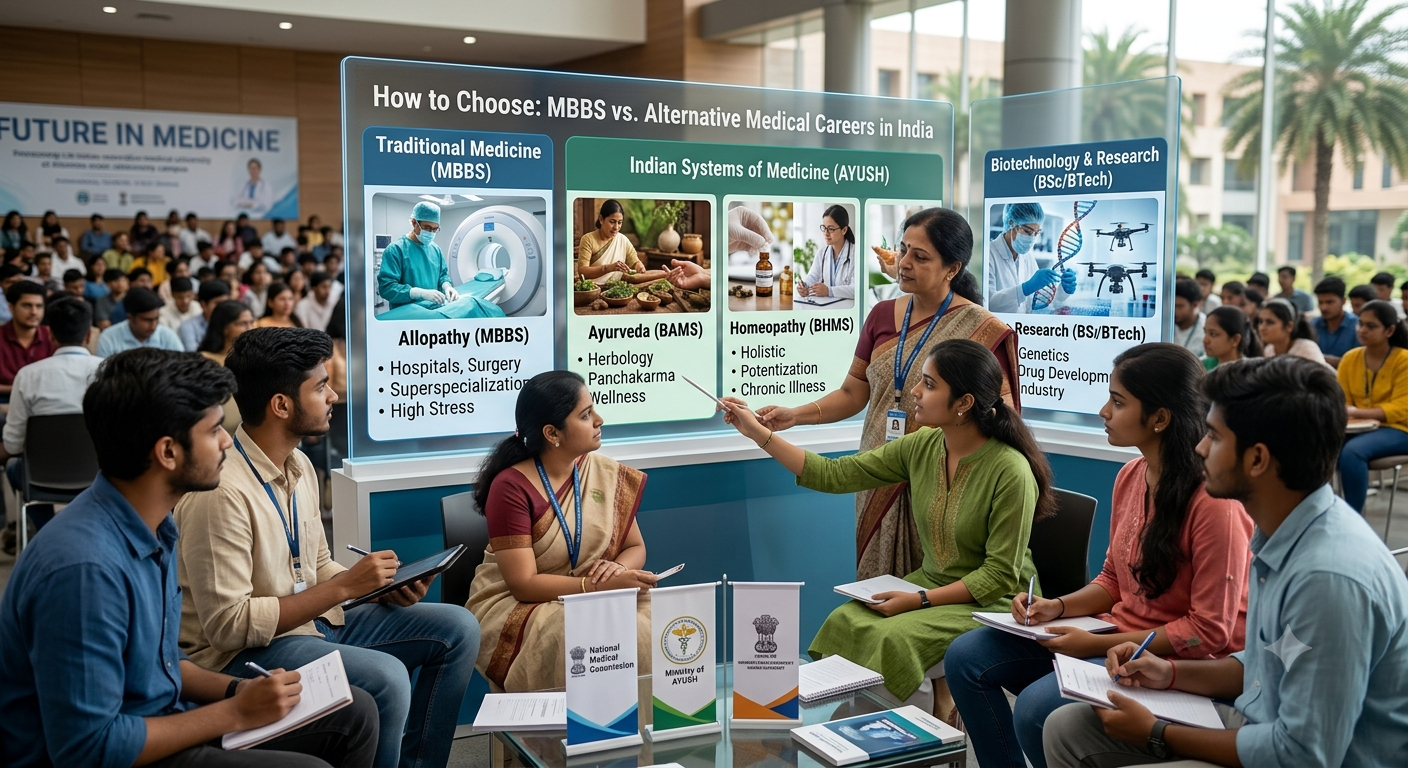
2. Deconstructing the Contenders: MBBS, BAMS, BHMS, and Biotechnology
Before choosing your academic pathway, you must understand what each of these distinct fields represents in the modern healthcare ecosystem:
MBBS (Bachelor of Medicine and Bachelor of Surgery): The traditional, allopathic system of medicine utilizing pharmaceutical drugs, clinical surgeries, and evidence-based diagnostic interventions to treat diseases.
BAMS (Bachelor of Ayurvedic Medicine and Surgery): A comprehensive system of Indian traditional medicine (Ayurveda) combined with modern anatomy, physiology, and surgical principles.
BHMS (Bachelor of Homeopathic Medicine and Surgery): A holistic medical system based on the principle of “like cures like,” utilizing highly diluted natural substances to trigger the body’s self-healing mechanisms.
Biotechnology (B.Sc / B.Tech): A research-driven, technological discipline that utilizes cellular and biomolecular processes to develop products and technologies for healthcare, agriculture, and environmental sustainability.
3. MBBS: The Traditional Gold Standard of Allopathic Medicine
The MBBS degree remains the most widely recognized and globally standardized clinical qualification. It requires 4.5 years of intensive academic study followed by a mandatory 1-year rotating internship.
Curriculum Rigor: The training is exceptionally demanding, requiring students to master 19 complex subjects ranging from biochemistry to forensic medicine and general surgery. To explore the latest standardized curriculum guidelines, you can refer to the official National Medical Commission (NMC) Portal.
The Specialization Trap: An MBBS degree alone is no longer sufficient for high-tier clinical practice in urban areas. To be highly competitive, graduates must crack the NEET-PG or NEXT (National Exit Test) examinations to secure specialized MD (Doctor of Medicine) or MS (Master of Surgery) credentials, adding another 3 to 6 years to their training timeline.
4. BAMS: Integrating Ancient Ayurvedic Wisdom with Modern Diagnostics
Ayurveda is no longer treated as a purely historical folk science. Under the progressive governance of the Indian medical system, Ayurvedic doctors are trained extensively in both classical texts and modern diagnostic systems.
Surgical Integration: One of the most significant reforms of recent years is the official authorization of trained Ayurvedic postgraduates (MS Ayurveda) to perform specified general surgical procedures, bridging the gap between traditional and modern surgical practices.
AYUSH Movement: Backed by massive government funding and global wellness demands, the scope of Ayurveda has scaled globally. For official guidelines, research updates, and institutional frameworks, you can consult the Ministry of AYUSH Portal.
BAMS Scope and Salary 2026: Graduates can work as clinical practitioners in specialized AYUSH hospitals, open independent wellness clinics, enter corporate pharmaceutical companies (like Himalaya, Dabur, or Patanjali) as research scientists, or secure administrative roles in public health sectors.
5. BHMS: The Individualized and Holistic Therapeutic Pathway
Homeopathy has emerged as the second most widely practiced system of medicine globally. The BHMS curriculum spans 5.5 years, aligning classical homeopathic philosophy with modern pharmacology, pathology, and clinical diagnostics.
Holistic Focus: Homeopathy treats the patient as a whole rather than merely suppressing local disease symptoms. If your intellectual curiosity leans toward understanding patient psychology, constitutional typing, and chronic disease management, BHMS offers a highly rewarding career path.
BHMS Career Opportunities: Graduates are recruited by government dispensaries, private homeopathic clinics, corporate wellness chains, and international manufacturing units. The registration, licensing, and standardized educational guidelines for these traditional systems are regulated directly by the National Commission for Indian System of Medicine (NCISM).
6. Biotechnology: The Scientific Frontier of Lab-Bench Innovation
For students who are fascinated by medical science but prefer the research laboratory over direct, high-stress patient care, Biotechnology is the ultimate career accelerator.
Curriculum and Focus: This branch skips clinical patient treatment to focus on genetic engineering, drug design, vaccine development, molecular biology, and bioinformatics.
Biotechnology vs Medical Degrees: While medical degrees train you to apply existing treatments to patients, Biotechnology empowers you to invent the treatments of tomorrow. From CRISPR gene-editing to mRNA vaccines, biotechnologists are the architects of modern medical revolutions.
Research Pipelines: To understand the macro-level funding, national laboratory networks, and startup incubation schemes operating in this space, you can refer to the Department of Biotechnology (DBT) India Portal.
7. Strategic Decision Matrix: Calculating Your Career Alignment Score
To choose the ideal stream without emotional bias, you can mathematically model your personal suitability using this Career Alignment Score (CAS) formula:
CAS = w1(Ap) + w2(Fs) + w3(Cl)
Where:
Ap represents your Aptitude and Interest Index (0 to 10 scale). Rate your natural alignment with direct patient contact vs. research-lab testing.
Fs represents your Financial and Time Sustainability Index (0 to 10 scale). Rate your ability to fund long-duration courses (MBBS/MD) vs. faster entries into the job market (Biotech/BAMS).
Cl represents your Career Longevity and Flexibility Index (0 to 10 scale). Rate your desire for global mobility, private practice ownership, or industrial employment.
w1, w2, w3 represent customized weights assigned to each metric based on your personal priorities, subject to the normalization constraint: w1 + w2 + w3 = 1.
A high CAS score in a specific domain points directly to the path where you are statistically most likely to experience long-term professional fulfillment and financial success.
8. Head-to-Head Comparison: Structural Metrics of Medical and Allied Careers
The table below provides a structured, side-by-side comparison of the core parameters of each professional pathway in 2026:
+---------------------------+---------------------------------+---------------------------------+---------------------------------+---------------------------------+
| Dimension / Metric        | MBBS (Allopathy)                | BAMS (Ayurveda)                 | BHMS (Homeopathy)               | Biotechnology (Research)        |
+---------------------------+---------------------------------+---------------------------------+---------------------------------+---------------------------------+
| Course Duration           | 5.5 Years (Incl. Internship)    | 5.5 Years (Incl. Internship)    | 5.5 Years (Incl. Internship)    | 3 to 4 Years (B.Sc / B.Tech)    |
| Primary Focus Area        | Allopathic Drugs & Surgery      | Ayurveda & Modern Diagnostics   | Individualized Homeopathy       | Genetic & Biomolecular Eng.     |
| Academic Workload         | Exceptionally High              | Very High (Sanskrit + Modern)   | High (Philosophy + Pathology)   | Moderate to High (Lab Practice) |
| Direct Patient Contact    | Exceptionally High              | High                            | High                            | Minimal to None (Lab-focused)   |
| Global Mobility Option    | High (Requires licensing exams) | Moderate (Expanding globally)   | Moderate (Europe & South Asia)  | Exceptionally High              |
| Average Starting Package  | ₹7 - ₹12 LPA (Fresher)          | ₹4 - ₹8 LPA (Fresher)           | ₹3.5 - ₹6 LPA (Fresher)         | ₹4 - ₹9 LPA (Depends on Degree) |
| Long-term Income Ceiling  | Exceptionally High (Super-spec) | High (Specialized Wellness)     | High (Established Practice)     | Exceptionally High (IP/Industry)|
+---------------------------+---------------------------------+---------------------------------+---------------------------------+---------------------------------+
9. Placement Options, Salary Trajectories, and Return on Investment (ROI)
When evaluating AYUSH courses scope and placements versus MBBS or Biotech, you must analyze the financial return on your educational investment:
MBBS Financials: While MBBS leads to the highest long-term salary ceiling, the upfront cost can be astronomical if you enroll in a private medical college (often ranging from ₹60 Lakhs to ₹1.2 Crore). If you secure a government seat, the ROI is exceptional.
BAMS & BHMS Financials: Tuition fees in both government and private AYUSH colleges are significantly lower than private MBBS programs (ranging from ₹1.5 Lakhs to ₹5 Lakhs per year). The rise of wellness tourism, specialized Ayurvedic resorts, and global homeopathic chains (such as Dr. Batra’s) has created a highly profitable private practice market.
Biotechnology Financials: A B.Tech or B.Sc. in Biotechnology followed by an M.Tech or MS offers a rapid, highly cost-effective entry into the booming biopharmaceutical, agricultural tech, and bioinformatics industries. For professionals who transition into intellectual property rights (IPR) law, clinical trial management, or corporate business analytics, salaries scale exponentially, easily matching the earnings of clinical super-specialists.
10. Smart Diagnostic Guide: How to Determine Your True Alignment
If you are still struggling to choose between these distinct healthcare verticals, use this simple diagnostic checklist to determine your path:
Choose MBBS if:
You possess high psychological resilience and can handle 12-hour emergency shifts and high-stress clinical environments.
You are willing to invest 8 to 12 years in continuous, high-intensity academic training (including PG and super-specialization).
Your primary interest lies in surgical interventions, critical care, and classical western pharmaceutical treatments.
Choose BAMS or BHMS if:
You believe in holistic healing, preventative wellness, and treating chronic illnesses by addressing root bodily causes.
You want the legal authority to run your own clinical practice and prescribe treatments but want to avoid the high stress of ICU emergencies.
You are fascinated by natural sciences, botany, constitutional psychology, and customized therapeutic regimens.
Choose Biotechnology if:
You prefer the quiet, high-focus environment of research cleanrooms, laboratory experiments, and computational modeling over daily patient consulting.
You want a career with immediate global mobility options, allowing you to transition into international research networks or corporate biotech empires.
You are passionate about cutting-edge scientific innovations like gene therapy, molecular cloning, bioinformatics, and vaccine design.
11. Conclusion: Crafting a Successful Healthcare Career in 2026
The ultimate verdict of this guide is highly empowering: the medical domain is no longer a single, linear highway. It has evolved into a multi-dimensional, high-growth ecosystem.
While MBBS remains an outstanding and highly prestigious professional choice, alternative medical careers like BAMS, BHMS, and Biotechnology are no longer compromise options. They represent highly specialized, rewarding, and financially sound careers that cater to the evolving health demands of the global population.
Do not let peer pressure, social stereotypes, or temporary NEET results dictate your professional destiny. Audit your strengths honestly, consult verified regulatory guidelines, calculate your personal career alignment scores, and confidently choose the path that will allow you to make a lasting, compassionate, and highly successful impact on the world of healthcare.

How useful was this post?
Click on a star to rate it!
Average rating 0 / 5. Vote count: 0
No votes so far! Be the first to rate this post.