What ISRO’s Next Big Mission Means for High School Science Students
The Indian Space Research Organisation (ISRO) is pushing the boundaries of space exploration. With ambitious endeavors on the horizon, including the human spaceflight initiative Gaganyaan, the lunar sample-return mission Chandrayaan-4, the NISAR Earth-observation satellite, and the Bharatiya Antariksha Station project, India is establishing itself as a dominant spacefaring nation.
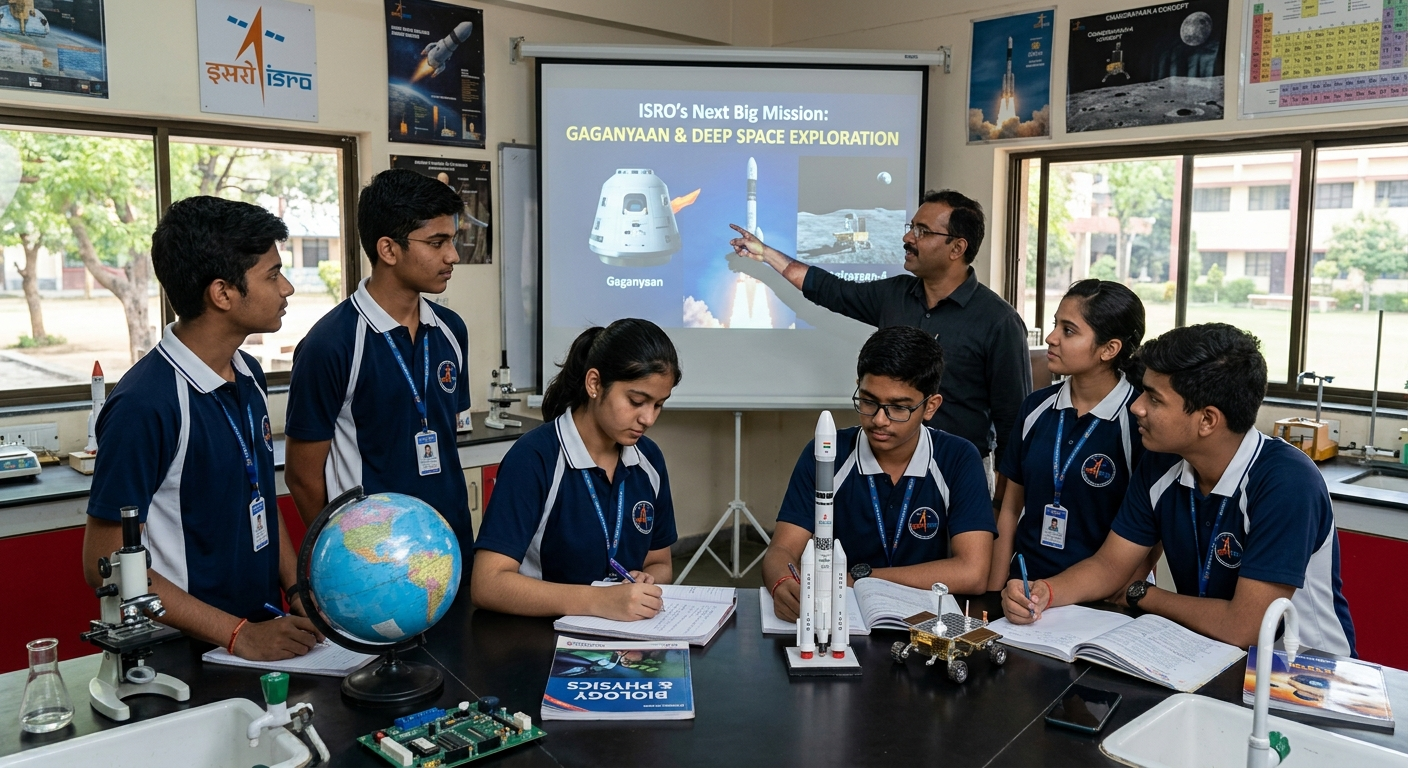
For secondary school learners, these developments are not merely headlines; they serve as a dynamic extension of the academic curriculum. The technical accomplishments of ISRO illustrate how core concepts from physics, chemistry, biology, and mathematics function in real-world applications. Understanding what ISRO’s next big mission means for high school science students bridges the gap between theoretical textbook learning and advanced scientific discovery.
1. 9th Grade Science Connection: Foundations of Motion, Gravitation, and Matter
In the 9th-grade curriculum, students encounter fundamental physical laws that describe how objects move and interact. ISRO’s upcoming launch schedules provide a practical demonstration of these foundational principles.
Kinematics and Newton’s Laws of Motion
When evaluating launch vehicles like the Launch Vehicle Mark-3 (LVM3), 9th-grade physics concepts become directly visible. The propulsion of a heavy-lift rocket relies entirely on Newton’s third law of motion: the downward expulsion of high-velocity exhaust gases generates an equal and opposite upward reaction force, propelling the rocket into the upper atmosphere.
Furthermore, concepts such as momentum, acceleration, and inertia are central to trajectory design. Students learning to calculate velocity or uniform acceleration can observe these exact parameters in real-time telemetry data broadcast during satellite launches.
Universal Gravitation and Free-Fall Dynamics
Understanding gravitational acceleration is essential when studying planetary orbits. ISRO’s space missions utilize gravitational assists and low Earth orbit (LEO) insertions.
Gravitational attraction: Determines how a satellite remains locked in orbit around the Earth without drifting into deep space.
Microgravity environments: Allow researchers to analyze how fluids and physical objects behave when the effects of Earth’s gravitational force are neutralized by free-fall conditions.
Matter, Elements, and Materials Science
Rocket fabrication demands specialized materials capable of enduring thermal stress and mechanical vibrations. The 9th-grade chemistry syllabus covers states of matter, mixtures, and elemental properties. In space technology, these principles dictate the choice of light, heat-resistant alloys, carbon composites, and specialized chemical polymers used in thermal protection shields.
2. 10th Grade Science Connection: Light Optics, Chemical Propulsion, and Environmental Sensing
The 10th-grade science framework introduces sophisticated optical phenomena, chemical reaction dynamics, and ecological balances—all of which form the operational core of modern space platforms.
Optical Physics and Remote Sensing Technologies
The joint NASA-ISRO Synthetic Aperture Radar (NISAR) mission relies heavily on electromagnetic spectrum principles studied in 10th-grade physics.
Refraction and Reflection: Satellite optical cameras use precise lens and mirror arrangements to capture high-definition imagery of Earth’s surface.
Electromagnetic Waves: Radar sensors emit radio and microwave frequencies that penetrate cloud cover and vegetation canopy to map crustal deformation and melting glaciers.
Light Dispersion: Astronomical payloads analyze light spectra emitted by stars and planets to determine their composition and atmospheric characteristics.
Chemical Reactions and Rocket Fuels
Propulsion engineering relies on high-energy chemical transformations. High school chemistry students study exothermic oxidation-reduction reactions, which directly mirror rocket engine operations:
| Propulsion Type | Chemical Components | Reaction Characteristics |
| Solid Propellant | Hydroxyl-terminated polybutadiene (HTPB) mixed with ammonium perchlorate | Provides high thrust during initial liftoff; non-throttleable. |
| Liquid Propellant | Unsymmetrical dimethylhydrazine (UDMH) paired with dinitrogen tetroxide | Highly controllable; allows engines to shut down and restart in orbit. |
| Cryogenic Stage | Liquid hydrogen (H2) burned with liquid oxygen (O2) | Highly efficient combustion yielding water vapor as a byproduct; operates at sub-zero temperatures. |
Environmental Monitoring and Ecosystem Dynamics
The 10th-grade biology curriculum highlights ecology, natural resource management, and environmental conservation. Remote sensing satellites operated by ISRO monitor forest degradation, track marine productivity, and evaluate groundwater depletion. Analyzing satellite data helps students recognize how environmental science combines with orbital technology to manage ecological challenges on Earth.
3. 11th Grade Science Connection: Advanced Mechanics, Thermodynamics, and Organic Chemistry
In 11th grade, science subjects branch into rigorous, detailed sub-disciplines. ISRO’s mission engineering reflects these advanced academic topics.
Rigid Body Dynamics and Orbital Mechanics
11th-grade physics expands into rotational dynamics, torque, angular momentum, and orbital motion:
Escape Velocity: The minimum speed needed for an interplanetary probe to break free from Earth’s gravitational field.
Kepler’s Laws of Planetary Motion: Describe elliptical orbits, sweep velocities, and the relationship between an orbital radius and its period.
Conservation of Angular Momentum: Applied to maintain satellite orientation (attitude control) using reaction wheels inside spacecraft.
Thermal Physics and Thermodynamics
Space environments exhibit extreme temperature swings, ranging from direct solar radiation to the cold vacuum of deep space. 11th-grade thermodynamics principles are crucial for building spacecraft systems:
Heat Transfer: Spacecraft thermal control systems regulate heat loss via radiation and internal thermal conduction.
Cryogenics: Liquid fuel management requires insulating propellants kept near absolute zero, preventing boiled-off fuel loss before ignition.
Isothermal and Adiabatic Processes: Re-entry modules entering Earth’s atmosphere experience high-pressure gas compression, converting kinetic energy into intense heat along the thermal shield.
Organic Synthesis and Polymer Science
Chemical research at ISRO involves advanced organic chemistry. 11th-grade organic chemistry introduces functional groups, structural isomerism, and polymerization. Space missions rely on high-performance synthetic polymers, structural adhesives, and self-lubricating compounds that retain structural integrity in harsh space environments without degrading or releasing toxic gas.
4. 12th Grade Science Connection: Modern Physics, Electrochemistry, and Microgravity Biology
The 12th-grade curriculum covers modern physics, electrochemistry, and complex biological processes—fields that directly drive long-duration crewed spaceflight and space exploration.
Electromagnetic Induction, Semiconductors, and Modern Physics
Modern satellite engineering relies on principles from 12th-grade physics:
Photovoltaic Conversion: Multi-junction solar arrays convert solar radiation into electrical power, storing excess energy in high-capacity lithium-ion batteries.
Semiconductor Physics: Integrated microcontrollers, sensor arrays, and communication transceivers rely on p-n junction electronics hardened against cosmic radiation.
Wave Optics and Polarization: Instruments like those on the X-ray Polarimeter Satellite (XPoSat) measure the polarization of high-energy cosmic radiation to study extreme astronomical objects like neutron stars and black holes.
Electrochemistry and Fuel Cell Power Systems
During crewed space operations (such as the Gaganyaan mission and future space station habitats), spacecraft require reliable power sources. 12th-grade electrochemistry covers standard electrode potentials and fuel cell reactions:
Hydrogen fuel cells produce clean electricity for onboard systems while generating pure water as a usable byproduct for life-support systems.
Human Physiology and Microgravity Biochemistry
Sending humans into orbit introduces challenges covered in 12th-grade human physiology and cell biology:
Musculoskeletal System: Microgravity reduces mechanical stress on bones and muscles, leading to bone mineral density loss and muscle atrophy.
Cardiovascular Dynamics: Fluid redistribution in microgravity alters blood pressure regulation, forcing the heart to adapt.
Cellular Division and Plant Biology: Space biology experiments test how plant seeds germinate and perform cellular respiration in weightless conditions to support long-term crewed missions.
5. STEM Skill Development and Educational Pathways
Beyond textbook theory, ISRO’s space programs encourage high school students to pursue STEM (Science, Technology, Engineering, and Mathematics) careers. Building a national space ecosystem requires a skilled workforce in software development, data analytics, mechanical engineering, and research science.
Technical Competencies Encouraged by Space Missions
Data Literacy: Analyzing satellite datasets, weather radar feeds, and telemetry telemetry streams.
Computational Logic: Understanding basic programming, control systems, and automated tracking loops.
Interdisciplinary Problem Solving: Applying physics, chemistry, and biological principles together to resolve complex engineering challenges.
6. Educational Resources for High School Science Students
Students and educators looking to connect space science with their academic studies can explore several official platforms:
ISRO Official Portal: Access launch schedules, scientific payload parameters, and press releases for upcoming space programs.
ISRO STEM Education & YUVIKA Program: Learn about the YUva VIgyani KAryakram (Young Scientist Programme), which offers hands-on space science training for secondary school students.
NCERT Science Resources: Review standard secondary science curriculum guidelines to see how physics, chemistry, and biology modules align with national technological projects.
NASA STEM Engagement: Access educational modules, orbit simulators, and interactive science activities for joint missions like NISAR.
Understanding what ISRO’s next big mission means for high school science students highlights the connection between classroom science lessons and advanced aerospace technology. By observing how physical, chemical, and biological principles operate in orbit, secondary school learners gain a practical foundation for future scientific study.

How useful was this post?
Click on a star to rate it!
Average rating 0 / 5. Vote count: 0
No votes so far! Be the first to rate this post.