
"Open Book" Exams for Class 9: A Gift or a Trap?
The conventional image of an examination hall is rooted in absolute stress: rows of silent desks, sweat-palmed students staring at the ceiling, and the frantic attempt to recall a formula memorized at 2:00 AM. However, a massive structural shift is rippling through the modern educational system. School boards worldwide are increasingly experimenting with a controversial assessment format: open book exams for Class 9.
To a fourteen-year-old student, the phrase “open book exam” sounds like a dream come true, a literal get-out-of-jail-free card. No more brutal rote memorization, no more flashcards, and no more exam anxiety, right? But seasoned educators are sounding the alarm, warning that this progressive-looking assessment method might actually be a wolf in sheep’s clothing. Is this new testing format a genuine gift designed to foster critical thinking, or is it a psychological trap that sets students up for academic failure?
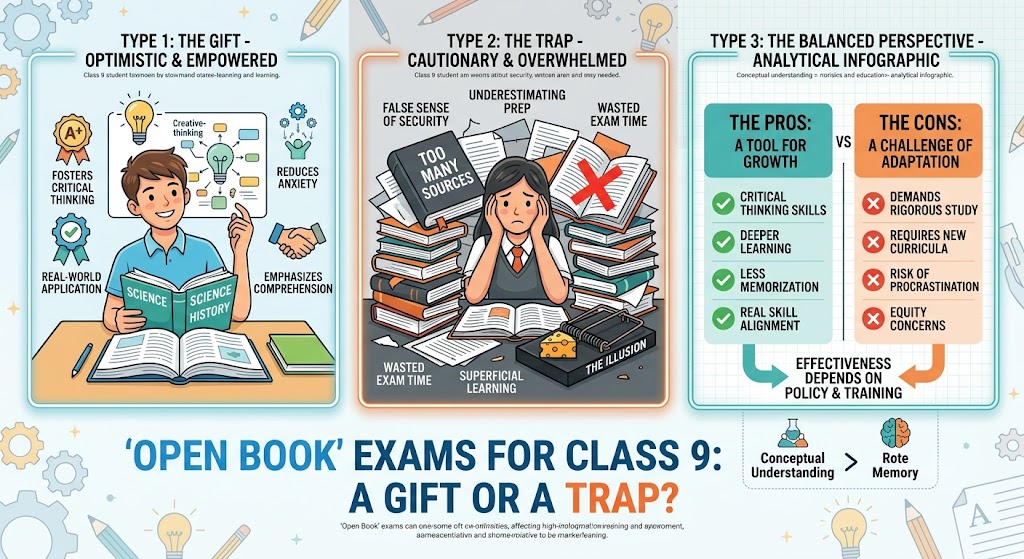
The Gift- "Optimistic & Empowered"
A perspective that views open-book exams not as a shortcut, but as a valuable tool (the gift) that reduces rote-memorization anxiety (the optimistic view) and shifts ownership of learning to the student by testing critical thinking, analysis, and information-retrieval skills (the empowered view).
The Gift: It reframes the exam from being a “gotcha” penalty to an opportunity. It is a “gift” because it removes the grueling, stressful burden of memorizing hundreds of pages of facts, dates, and formulas just to regurgitate them on a paper.
Optimistic: It holds a positive outlook on student behavior and future potential. It assumes that if you remove the pressure of memorization, students won’t just slack off—instead, they will actually engage deeper with the material.
Empowered: It changes the power dynamic in the classroom. Instead of the student feeling helpless against a test designed to trick them, the student feels like a capable researcher. They have the resources (the book) right in front of them; success depends entirely on their ability to think, apply, and solve.
The Trap- "Cautionary & Overwhelmed"
A scenario where a seemingly easier testing format turns out to be significantly more difficult (the trap), serving as a warning about the hidden complexities of application-based testing (the cautionary view) and leading to intense mental exhaustion because students lack the advanced critical-thinking skills required to handle it (the overwhelmed view).
The Trap: An open-book exam sets a psychological ambush. Because students are allowed to bring the textbook into the room, they are lulled into a false sense of security. They assume they don’t need to study, only to open the test paper and realize the answers cannot be found directly in the text.
Cautionary: It acts as a warning sign. It cautions teachers, parents, and policymakers that changing the format without changing how kids are taught is a recipe for disaster.
Overwhelmed: It describes the mental state of the student during the exam. Instead of flipping smoothly through pages, the student panics. They find themselves drowning in information, running out of time, and unable to connect the dots under intense pressure.
The Balanced Perspective- "Analytical & Infographic"
An unbiased framework that weighs both the advantages and disadvantages of a system (the balanced perspective), utilizing data visualization, charts, and structured comparisons (the analytical infographic) to help stakeholders make an informed, evidence-based decision.
The Balanced Perspective: This means avoiding extreme stances. It doesn’t label open-book exams as purely a “blessing” or entirely a “curse.” Instead, it logically accepts that both sides have valid points and looks at the exact conditions under which the system succeeds or fails.
Analytical Infographic: This is the tool used to present that balance. Instead of a long, dense essay, it uses flowcharts, pros-and-cons pillars, Venn diagrams, and statistical metrics to break down the information so the brain can process the logic instantly.
1. The Big Shift: Why Boards are Rethinking the Examination Hall
To understand the sudden push for open book exams for Class 9, we have to analyze the flaws of traditional student assessment. For decades, our education systems have heavily rewarded rote memorization. The students who score the highest are often not the most intelligent or analytical, but simply those with the best short-term memory retrieval.
As we progress through the digital age, memorizing easily searchable facts has become obsolete. Recognizing this, major educational boards—including the Central Board of Secondary Education (CBSE) and various international school systems—have begun piloting open book examinations. The goal is to align modern schooling with real-world scenarios where information is always readily available at our fingertips.
2. Deciphering the Blueprint: How an Open Book Test Actually Works
There is a massive, highly dangerous misconception among ninth-graders regarding what an open book exam actually entails. Many students mistakenly assume they can walk into the exam hall, flip through their textbook, find the exact sentence corresponding to the question, and copy it down word-for-word for a perfect score.
In reality, the blueprint of an open book assessment format is designed to completely prevent direct copying.
[Traditional Exam] ───> Ask: "When did the war happen?" ───> Memory-Based Answer
[Open Book Exam]   ───> Ask: "Why did the war happen?" ───> Critical Analysis Answer
Instead of testing what you know, an open book test evaluates how you apply what you know. Questions are explicitly crafted to be analytical, abstract, and application-oriented. You won’t find the answers directly printed on page 42; instead, page 42 will merely provide the raw raw materials you need to build a brand-new argument.
3. The Illusion of Ease: The Dangerous Psychological Trap for Students
The single greatest danger of introducing open book exams for Class 9 is the false sense of security it creates. This psychological trap completely alters student behavior leading up to exam week. When a teenager knows they can bring their textbook or reference material into the testing room, their motivation to study drastically drops.
Procrastination Acceleration: Students delay their revision schedules, assuming they can just “figure it out on the day of the test.”
Superficial Reading: Active study techniques like active recall and spaced repetition are abandoned in favor of lazy, passive reading.
Underestimating the Clock: Because students haven’t internalized the core material, they waste precious exam minutes frantically flipping through pages trying to find basic concepts.
Ultimately, the illusion of ease turns the exam into a race against time, leaving unprepared students completely overwhelmed.
4. Class 9 as the Crucible: Why the Timing of This Policy Matters
The decision to introduce open book examinations specifically at the Class 9 level is highly strategic, yet incredibly risky. Class 9 acts as the critical bridge between middle school and the high-stakes environment of senior secondary education and board exams.
At this developmental age (around 13 to 15 years old), a student’s brain is undergoing significant cognitive transitions. They are shifting away from concrete thinking toward abstract reasoning. Introducing open book formats at this specific juncture forces students to develop higher-order cognitive skills early. However, if the transition is managed poorly, it can severely damage a student’s foundational knowledge, leaving them ill-equipped for the rigorous, closed-book standardized testing structures they will inevitably face in Class 10 and Class 12.
5. The Case for the "Gift": The Academic Benefits of Open Book Testing
When implemented correctly, open book testing can be a phenomenal educational tool. Proponents of this methodology argue that it brings numerous long-term benefits to a student’s academic performance and cognitive growth.
Fostering Critical Thinking and Analysis
Because the questions demand application rather than recitation, students are forced to think like real scientists, historians, and mathematicians. They must synthesize multiple concepts, compare case studies, and evaluate evidence.
Eliminating Toxic Exam Anxiety
Rote-based testing environments are a primary driver of youth mental health crises. By removing the pressure of total recall, open book tests drastically lower student stress levels, creating a healthier, more supportive learning environment.
Real-World Skill Alignment
In a professional career, no boss will ever lock an employee in a room and demand they solve a corporate crisis without using the internet or company data. Real-world success relies on information literacy—knowing how to locate, filter, verify, and apply data. Open book testing directly builds this crucial contemporary skill.
6. The Reality of the "Trap": Why Teachers and Parents are Worried
Despite the theoretical benefits, the practical execution of open book exams for Class 9 triggers massive anxiety among teachers and parents. The primary concern is that our current school structures are simply not built to support this advanced assessment format.
| Key Challenge | Why It Threatens Student Success |
| Lack of Teacher Training | Many educators have spent decades teaching rote methods and struggle to design effective open book questions. |
| Inadequate Textbooks | Traditional curriculum materials are written for memorization, lacking the case studies required for open book evaluation. |
| The Conceptual Void | Students who do not memorize core formulas or vocabulary struggle to engage in higher-level problem-solving. |
Many parents fear that their children will mistake “open book” for “no study,” leading to a generation of students who possess superficial knowledge but completely lack foundational academic discipline.
7. The Art of the Question: Why Crafting the Exam is a Teacher's Nightmare
For an open book exam to succeed, the burden of effort shifts entirely onto the shoulders of the educator. Designing a traditional exam is relatively straightforward; designing an open-book paper is an exhausting pedagogical nightmare.
If a teacher makes the questions too simple, the exam loses all academic integrity, turning into a basic speed-reading and copying race. If the questions are made too complex, they can easily exceed the cognitive development level of a average fourteen-year-old, leading to widespread failure and frustration across the classroom. Teachers must undergo intensive professional training to master the art of writing questions that probe for deep comprehension without driving students to despair.
8. Survival Strategies: How Students Must Adapt Their Study Habits
If your school district or board is adopting open book exams for Class 9, you must completely overhaul your study habits. Walking in unprepared is an absolute recipe for academic disaster. To conquer this format, students must treat the open book test with more respect than a closed-book exam.
Master the Index and Structure: You must know your textbook inside and out. You should know exactly which chapter, subheading, and page contains specific data models so you can navigate the book instantly.
Create Custom Reference Sheets: Do not rely on the book alone. Create condensed summaries, formula sheets, and concept maps. The act of building these references trains your brain to understand the connections between topics.
Practice Time Management: The biggest enemy in an open book format is the ticking clock. Take timed practice tests to ensure you can read a complex prompt, analyze the data, synthesize an answer, and write it down before the bell rings.
9. Equity and the Digital Divide: Access to Quality Reference Material
An overlooked aspect of the open book exams for Class 9 debate is educational equity. In many progressive school models, open book tests allow students to bring in not just a single textbook, but external reference binders, research notes, or even digital devices.
This instantly creates a divide between privileged students and disadvantaged students. A student from an affluent background may have access to high-end guidebooks, printed study guides, and private tutoring that teaches them exactly how to index their materials. Meanwhile, a student from an underfunded school might rely on a single, worn-out, outdated textbook. If the exam format rewards the quality of the reference material brought into the room, it risks widening the achievement gap within the educational system.
10. The Verdict: Balancing Conceptual Memory with Real-World Application
So, are open book exams for Class 9 a gift or a trap? The truth lies strictly in the execution. If implemented carelessly as a lazy shortcut to reduce student stress, it is undoubtedly a trap—one that breeds academic laziness and leaves students unprepared for future challenges.
However, if paired with rigorous curriculum changes, proper teacher training, and explicit student guidance, it transforms into an incredible gift. It shifts the definition of intelligence from remembering to understanding. The future of global education isn’t about choosing between closed books or open books; it’s about teaching students to open their minds, using the book merely as a stepping stone to higher learning.
What is your take on this major shift in education? Do you think Class 9 students are mature enough to handle the analytical demands of an open book exam, or should we stick to traditional testing methods?

How useful was this post?
Click on a star to rate it!
Average rating 0 / 5. Vote count: 0
No votes so far! Be the first to rate this post.