
Digital Marking: Is an AI Checking Your Paper?
The terrifying yet fascinating reality of modern education is that the person grading your next essay might not be a person at all. Welcome to the era of digital marking, where automated essay scoring and AI grading tools are quietly shifting from experimental novelties into standard classroom practice.
For generations, the image of a teacher grading papers involved a late night, a massive stack of physical essays, and a leaking red pen. Today, that stack of papers has been uploaded to the cloud, and the red pen has been replaced by sophisticated algorithms. As educational technology evolves at a breakneck pace, students, parents, and teachers alike are asking a critical question: is an artificial intelligence evaluating your intellect, and can we actually trust a machine to judge human creativity?
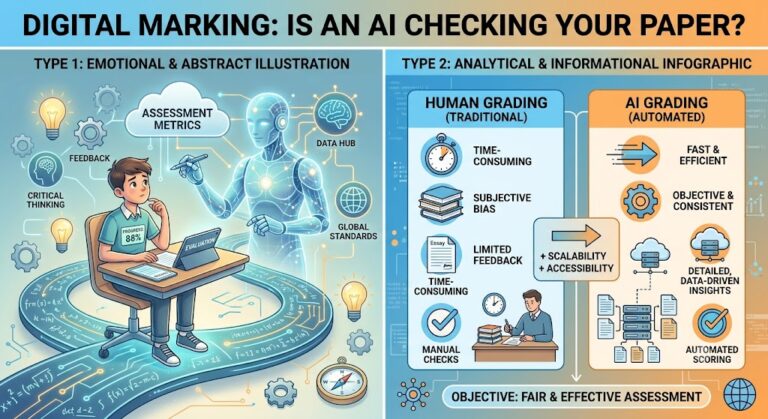
"Emotional & Abstract Illustration"
An artistic depiction that rejects realistic, literal imagery in favor of conceptual metaphors (the abstract) to vividly communicate the underlying anxiety, vulnerability, and complex feelings (the emotional) of a student whose academic fate is being decided by an invisible machine algorithm.
The Emotional: It focuses on the inner psychological state of the human being involved. It doesn’t look at the software code; it looks at the student’s fear of being misunderstood, the feeling of losing human connection, and the dread of being reduced to a mere data point by a machine.
The Abstract: This means the visual art doesn’t show a literal student sitting at a literal Dell computer. Instead, it uses surreal imagery, symbolic shapes, colors, and metaphors to represent concepts that are hard to see in real life—like “the coldness of an algorithm” or “the feeling of being judged by a ghost.”
"Analytical & Information Infographic"
A factual, step-by-step visual schematic that uses diagrams, flowcharts, and technical data (the information) to objectively explain the exact algorithms, accuracy rates, and operational mechanics (the analytical) of how artificial intelligence evaluates and scores student assessments.
The Information: This is the “what” and the “how.” It provides the concrete facts of the system. It breaks down the process into sequential stages, removing the mystery of the “black box” AI so the reader understands exactly what happens to a digital exam paper after it is submitted.
The Analytical: This is the logic and the data. It focuses on the metrics that define the technology—such as Natural Language Processing (NLP) architecture, error margins, speed statistics, and comparative accuracy graphs showing how AI scores align with human graders.
1. The Automated Classroom: The Fast Rise of AI Grading Tools
To understand how digital marking became so prevalent, we have to look at the sheer scale of modern education. Teachers are overwhelmed, burnt out, and drowning in administrative tasks. Grading a single 1,000-word essay thoroughly can take a human teacher anywhere from 10 to 20 minutes. Multiply that by 150 students, and you have a recipe for chronic exhaustion.
Enter AI grading tools. Designed to alleviate this massive workload, these software programs promise to analyze student work in mere seconds. What started as basic spell-checkers has evolved into highly complex natural language processing models capable of evaluating essay structure, vocabulary diversity, and thematic coherence. For school districts looking to optimize efficiency, the appeal of automating this bottleneck is undeniable.
2. Behind the Screen: How Artificial Intelligence Actually Scores an Essay
Many students imagine that automated essay scoring works like an advanced Ctrl+F search, hunting down specific keywords and instantly generating a grade. In reality, the underlying technology is much more intricate. Modern AI grading tools rely on machine learning and natural language processing (NLP).
Before a machine ever touches a student’s actual paper, it must undergo an intensive training process:
[Human Graders score 1,000+ Sample Essays] ───> [AI Analyzes the Graded Samples]
                                                            │
                                                            ▼
[Student Submits New Paper] ◄─── [AI Recognizes Patterns & Assigns Score]
The algorithm is fed thousands of sample essays that have already been carefully evaluated by human experts. The software looks for patterns, correlations, and linguistic structures that differentiate a top-tier paper from a failing one. It measures sentence variety, paragraph transitions, grammar accuracy, and how well the text addresses the given prompt. When a student submits a new paper, the AI isn’t reading it for enjoyment; it is comparing it to the massive dataset it has already memorized.
3. The Pros of Digital Marking: Why Schools are Embracing Automated Grading
The shift toward digital marking isn’t just about cutting corners; advocates argue it provides several major advantages to the educational ecosystem.
Instantaneous Feedback: Human teachers can take weeks to return graded assignments. By the time a student gets their paper back, they’ve often forgotten what they wrote. AI grading tools offer instant feedback, allowing students to learn from their mistakes in real-time.
Eliminating Human Bias: Humans are inherently subjective. A teacher might give a lower grade because they are having a bad day, or because an essay was read at 1:00 AM. AI doesn’t experience fatigue, personal biases, or favoritism. It treats every single paper with the exact same objective metrics.
Scalability: For massive open online courses (MOOCs) or standardized state exams where millions of students test simultaneously, human grading is logistically impossible. Automated systems make widespread testing viable.
4. The Cons of Digital Marking: The Severe Limitations of Machine Evaluation
Despite the technical marvels of automated essay scoring, critics warn that relying too heavily on algorithms poses serious risks to genuine learning. A computer can count words and check commas, but it cannot truly comprehend meaning.
| Feature Evaluated | Human Teacher Capability | AI Grading Tool Capability |
| Grammar & Syntax | Excellent, understands context and stylistic choices. | Excellent, catches technical errors instantly. |
| Emotional Resonance | Deeply moved by personal narratives and voice. | Completely blind to emotional depth or nuance. |
| Fact-Checking | Can cross-reference external facts and logic. | Prone to missing subtle factual inaccuracies if well-written. |
| Originality/Irony | Appreciates unique arguments and satire. | Often flags creative formatting or irony as “structural errors.” |
The primary flaw of digital marking is that it rewards conformity over creativity. Because the machine grades based on historical patterns, it favors predictable, formulaic writing. A student who writes a flawless, completely uninspired five-paragraph essay will often score higher than a student who takes a brilliant, creative risk that breaks standard structural conventions.
5. Can AI Feel Your Writing? The Missing Element of Human Empathy
Writing is inherently an act of human connection. When a student writes an essay about a personal loss, a political belief, or a creative concept, they are trying to communicate an internal state to another human being. AI grading tools completely strip this relationship out of the educational process.
An algorithm cannot be inspired, it cannot be challenged, and it cannot be persuaded. It does not possess empathy. When we replace the human reader with an automated processor, we risk turning writing into a sterile exercise in algorithmic optimization. Students stop trying to write something meaningful and instead focus on how to “hack” the software to get a higher score.
6. The Rise of the Anti-AI Arms Race: AI Detectors vs. GenAI
As schools adopt digital marking, an entirely separate battle is raging in the background: the war against generative AI tools like ChatGPT. Teachers aren’t just using AI to grade; students are using AI to write. This has forced digital marking platforms to incorporate controversial AI detectors.
These detectors scan student submissions to calculate the probability that the text was generated by an algorithm. However, this has created an atmosphere of deep distrust in the classroom. AI detectors are notoriously unreliable, frequently generating false positives. Innocent students—particularly those who write in a direct style or are English Language Learners (ELL)—frequently find themselves falsely accused of academic dishonesty because their natural writing pattern mimics the predictability of an AI.
7. Hacking the System: How Students Outsmart Automated Essay Scoring
It didn’t take long for tech-savvy students to realize that automated essay scoring models have major blind spots. Because the software evaluates structural proxies for quality rather than actual truth, it can be easily manipulated.
In famous testing experiments, researchers found that adding long, sophisticated-sounding vocabulary words—even if they made absolutely no sense in context—consistently inflated the scores given by grading algorithms. Similarly, lengthening sentences and repeating key transition phrases like “furthermore,” “consequently,” and “in contrast” tricked the AI into thinking the essay possessed high-level logical cohesion. When students figure out that nonsense prose packed with high-tier vocabulary can trigger an “A” grade, the integrity of the educational assessment crumbles entirely.
8. The Future Framework: The Hybrid Model of "Human-in-the-Loop"
Given the extreme limitations of standalone software, the future of digital marking is not a complete machine takeover. Instead, the educational community is pivoting toward a hybrid framework known as Human-in-the-Loop (HITL).
In an HITL system, the AI grading tools act as a highly efficient teaching assistant rather than the final judge. The software handles the tedious, objective aspects of grading: flagging typos, assessing basic structural formatting, and pointing out syntax issues. It then highlights these areas for the teacher and suggests a baseline score. The human educator then steps in to evaluate the nuance, voice, argumentation, and creativity. This synthesis saves the teacher time while ensuring that every student still receives a thoughtful, human reading.
9. Data Privacy and Equity: The Hidden Ethics of Automated Grading
Beyond the classroom dynamics, the widespread implementation of digital marking raises massive ethical concerns regarding data privacy and socioeconomic equity.
The Privacy Dilemma: Every time a student uploads an essay to a proprietary grading database, their intellectual property and personal data are being processed by private corporations. Who owns that data? Is it being used to train future commercial AI models without the student’s explicit consent?
Furthermore, there is a distinct risk of digital bias. If the training data used to build an automated essay scoring system primarily features essays written by a specific demographic, the algorithm will naturally penalize students who use regional dialects, culturally unique idioms, or non-traditional rhetorical structures. Without rigorous oversight, automated systems risk institutionalizing systemic educational biases.
10. Reclaiming Education: Ensuring Technology Serves the Student
The question is no longer if an AI will check your paper, but how much of your paper it will check. As digital marking continues to solidify its place in schools, we must remain vigilant about maintaining the human heart of education.
Technology should be utilized to liberate teachers from administrative drudgery so they can spend more time interacting directly with their students, not less. If we allow algorithms to completely dictate how student intelligence is measured, we risk raising a generation that knows exactly how to please a machine, but has forgotten how to speak to another human being. The ideal modern classroom is one where technology handles the data, but humans handle the inspiration.
What is your take on this technological shift? Would you feel comfortable knowing your final exam or thesis paper was evaluated by an algorithm, or should grading remain a strictly human responsibility?

How useful was this post?
Click on a star to rate it!
Average rating 0 / 5. Vote count: 0
No votes so far! Be the first to rate this post.