
The "Advanced Math" Split: Choose Wisely or Lose Out?
It’s a decision that hits eighth and ninth graders like a sudden academic tidal wave: the choice between standard mathematics and advanced math. Around the world, the educational system is increasingly introducing a tracking pipeline, often referred to as the “math split.” School boards are requiring students to choose early in their academic journey whether they want to pursue a rigorous, accelerated mathematics curriculum or stick to a foundational, general math pathway.
To many teenagers, choosing the standard track sounds like a relief—fewer sleepless nights, less homework anxiety, and an easier path to maintaining a high GPA. But educators, policymakers, and anxious parents are sounding the alarm. This early fork in the road is far more consequential than choosing an elective. In the modern economic landscape, making the wrong choice during the advanced math split can quietly close doors to future university programs, derail potential career opportunities, and permanently impact a student’s academic performance. Is this academic tracking system a necessary tool for tailored learning, or is it a systemic trap that forces kids to limit their futures before they even turn fifteen?
1. Navigating the Fork: What Exactly is the "Advanced Math" Split?
To understand why this choice carries so much weight, we have to look at how the modern high school mathematics curriculum is structured. The math split typically occurs right as students transition into high school. School districts divide their mathematics offerings into distinct tracks designed to cater to different learning speeds and career aspirations.
In the standard track, the focus is on practical, foundational math—essential algebraic concepts, basic geometry, and statistical literacy required for everyday life. In contrast, the advanced math track is a fast-paced, high-intensity pipeline. It compresses standard algebra and geometry into shorter timeframes, pushing students rapidly toward advanced trigonometry, pre-calculus, and eventually, college-level Advanced Placement (AP) calculus or International Baccalaureate (IB) mathematics. It is a rigorous academic sprint that demands high-level abstract reasoning from day one.
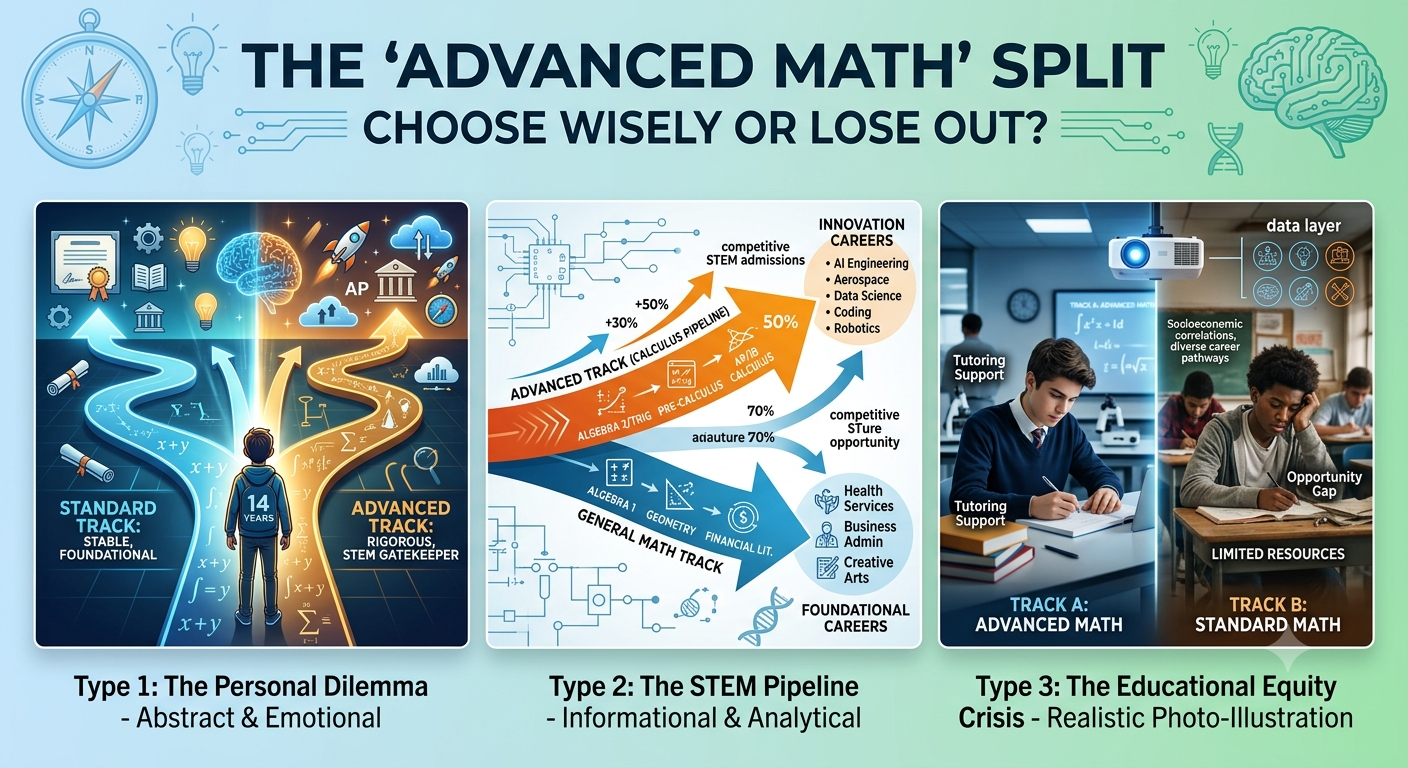
The Personal Dilemma: "Abstract & Emotional"
A situation where an individual is stuck between a conceptual, high-level ideal (the abstract) and a deeply felt, instinctive feeling (the emotional), making a clear-cut logical choice incredibly difficult.
The Personal Dilemma: A fork in the road where you have to make a choice. No one else can make it for you, and there is no objectively “correct” answer.
The Abstract: The realm of “shoulds,” theories, ethics, long-term logic, rules, or big-picture concepts. It’s what your brain processes when you try to look at things from 30,000 feet in the air.
The Emotional: The realm of “feels,” gut instincts, fears, attachments, and immediate desires. It’s the raw, heavy weight in your chest or stomach.
The Stem Pipeline : "Information & Analytical"
A systematic framework that uses data tracking, statistical modeling, and objective metrics (the analytical) to monitor and guide the journey of individuals from early education into high-tech careers (the STEM pipeline).
The STEM Pipeline: A metaphor for the educational and career pathway in Science, Technology, Engineering, and Math. It assumes talent enters at one end (kindergarten/school) and flows through to the other end (workforce).
Information & Analytical: This is the lens through which we look at the pipeline. It’s not about the emotional stories of the students; it’s about the hard numbers, data points, leakages, percentages, and predictive trends.
The Educational Equity Crisis : "Realistic Photo-Illustration"
A factual, data-supported emergency where students are denied equal access to quality schooling based on their background or income (the educational equity crisis), captured through true-to-life, unembellished imagery that reflects the raw reality of the situation (the realistic photo illustration).
The Educational Equity Crisis: “Equity” is different from “equality.” Equality means giving every student the exact same pair of shoes. Equity means giving every student a pair of shoes that actually fits them. The crisis is that the students who need the most support are often given the fewest resources, trapping them in a cycle of disadvantage.
Realistic Photo Illustration: This is the execution tool. It means we aren’t using abstract art, sugar-coated marketing images, or cartoon infographics. It means using photography—or artwork that looks exactly like a real photograph—to show the stark, unfiltered truth.
2. The STEM Gatekeeper: Why High-Level Calculus Opens Big Doors
Mathematics is rarely just about numbers; it is the fundamental language of global innovation. The advanced track acts as the ultimate gatekeeper for the high-paying world of STEM (Science, Technology, Engineering, and Mathematics).
If a student dreams of working in software engineering, aerospace design, biomedical research, or data science, the advanced track isn’t optional—it is a mandatory prerequisite. University admissions departments for highly competitive engineering and computer science programs look specifically for calculus on high school transcripts. If a student chooses the standard track in the 9th grade, they create a domino effect that makes it mathematically impossible to reach calculus by the 12th grade without expensive summer school acceleration. By opting out of advanced algebra early on, a student might inadvertently disqualify themselves from competitive tech and engineering degrees before they even learn how to drive a car.
3. The Cognitive Dividends: How Rigorous Mathematics Re-Wires the Brain
The benefits of tackling a demanding mathematics curriculum extend far beyond college applications and career paths. From a developmental perspective, wrestling with complex geometric proofs and intricate algebraic equations pays massive cognitive dividends.
The Neuroplasticity Factor: The adolescent brain is undergoing an intense period of synaptic pruning and growth. Engaging with highly abstract mathematical models forces the brain to build complex neural networks, significantly boosting working memory, spatial reasoning, and executive functioning skills.
When a student practices high-level math, they aren’t just learning how to find the value of $x$. They are training their minds to break down massive, chaotic problems into small, logical, sequential steps. This builds a profound level of cognitive resilience and structural logic that applies to every aspect of life, from law and philosophy to corporate strategy and financial investing.
4. The GPA Dilemma: The Risk of Over-Acceleration and Academic Burnout
With the stakes so high, the natural impulse for many ambitious parents is to push their children into the advanced track at all costs. However, this aggressive approach can backfire spectacularly, triggering severe academic burnout and damaging a student’s overall grade point average (GPA).
| Mathematics Track | Core Focus & Speed | Primary Risk Factors |
| Standard Track | Foundational concepts, steady pacing, practical real-world application. | Potential limits on elite university STEM admissions. |
| Advanced Track | Accelerated calculus pipeline, abstract theory, rapid execution. | High risk of academic anxiety, chronic stress, and GPA drop. |
If a student genuinely struggles with foundational math logic, throwing them into an accelerated, high-speed environment can destroy their academic confidence. Instead of fostering a love for problem-solving, it can create intense math anxiety, leading to a profound sense of frustration and declining test scores. A lower grade in an advanced class can sometimes hurt a college application more than an excellent grade in a standard class, creating a high-stakes balancing act for families.
5. The Equity Crisis: The Invisible Biases of Early Math Tracking
One of the darkest aspects of the advanced math split is its impact on educational equity. Studies across the globe show that early math tracking frequently reinforces socioeconomic divides within the educational system.
When the split happens at a young age, the decision is rarely made by the student alone. It is heavily influenced by teacher recommendations, parental advocacy, and access to external resources. Affluent families can afford private tutors, enrichment camps, and test-prep programs to ensure their children pass the gateway exams for the advanced track. Meanwhile, bright students from underfunded communities or marginalized backgrounds—who may lack systemic support or early academic intervention—are disproportionately funneled into standard or remedial tracks. This early misallocation of talent creates a compounding disadvantage, quietly shutting low-income students out of the high-tech economy of tomorrow.
6. The Real-World Utility: Does the Average Adult Actually Need Calculus?
As the debate over tracking rages on, critics of the traditional mathematics curriculum raise a very practical question: does the average citizen actually use advanced calculus in their daily life? For the vast majority of professionals outside of specialized engineering fields, the honest answer is no.
Many progressive educators argue that our schools are suffering from an unhealthy obsession with calculus. They propose that instead of forcing every student down an abstract algebraic pipeline, our schools should offer high-level tracks in financial literacy, computer coding, data analysis, and applied statistics. Understanding how to read an algorithmic data model, manage corporate risk, or code a script is arguably far more relevant to the modern workforce than calculating the volume of a solid of revolution using calculus integration.
7. The Parental Pressure Cooker: Navigating the Stress of Teen Decisions
The math split has turned eighth-grade parent-teacher conferences into high-stress combat zones. Parents feel an immense amount of pressure, believing that their child’s entire socioeconomic future hinges on this single track placement. This anxiety is frequently absorbed by the teenagers themselves.
Educators emphasize that parents need to look at the child in front of them rather than a hypothetical future resume. Pushing a student who loves creative writing and historical analysis into an exhausting, multi-year calculus grind just for the sake of “prestige” can lead to deep emotional resentment and mental exhaustion. The role of the parent should be to help their child find the sweet spot between healthy academic challenge and emotional well-being.
8. Survival Strategies: How to Succeed in the Advanced Track Without Losing Your Mind
If you and your child decide to take the leap and choose the advanced math pathway, you need to completely change how you approach learning. The study habits that worked in middle school will not suffice in an accelerated high school pipeline.
Ditch the Rote Memorization: Advanced math cannot be conquered by memorizing formulas the night before a test. You must understand the underlying conceptual “why” behind the theorems.
Normalize the Struggle: In an advanced class, you will get stuck. This isn’t a sign of failure; it is a normal part of the cognitive growth process. Learning to sit with a difficult problem for an hour without giving up is a vital skill.
Build an Immediate Support Network: The moment a concept feels fuzzy, seek help. Utilize teacher office hours, form peer study groups, or look up high-quality educational videos online. Because the curriculum moves so fast, a tiny gap in understanding in October can turn into a total academic collapse by December.
9. The Alternate Routes: Bridges, Community Colleges, and Post-High School Detours
For families who feel overwhelmed by the finality of the ninth-grade math split, it is important to remember that the educational system is not entirely set in stone. Missing the advanced track in early high school does not mean a student is permanently banned from a STEM career.
Many progressive schools now offer “bridge courses”—intensive summer programs designed to help motivated standard-track students catch up and transition into advanced classes later in their high school career. Furthermore, community colleges and state universities offer foundational math sequences that allow students to complete their pre-calculus requirements as adults. While these alternate pathways require immense self-discipline and can take longer, they provide a vital safety valve for late bloomers who find their academic focus later in life.
10. The Ultimate Verdict: Finding the Right Equation for Your Child's Future
Ultimately, the advanced math split shouldn’t be viewed as a simple win-or-lose scenario. It is about aligning a student’s current cognitive readiness, genuine academic interests, and future career goals into a balanced equation.
Choosing the standard track is not an inherent failure; for a student tracking toward the humanities, arts, or communication, it is a smart, strategic optimization of their time and mental energy. Conversely, choosing the advanced track shouldn’t be done blindly for status; it should be approached as a rigorous, exciting commitment to mastering the foundational code of the universe. By removing the panic from the decision and evaluating the choice with clarity and honesty, families can ensure that technology and numbers serve as tools for empowerment, rather than instruments of academic despair.
Where does your family stand on this digital-age academic dilemma? Do you believe schools should push more students into advanced tracking pipelines early on, or is it time to overhaul the curriculum to focus on practical, real-world financial and data literacy?

How useful was this post?
Click on a star to rate it!
Average rating 0 / 5. Vote count: 0
No votes so far! Be the first to rate this post.