
The Education Crisis: Why Do Exam Papers Leak in India?
For millions of students in India, competitive exams are not just tests; they are the ultimate gateway to a secure future. Whether it is a government job, a seat in a prestigious medical college, or an engineering degree, an entire family’s aspirations often ride on a single hall ticket.
Imagine studying for 14 hours a day, sacrificing your social life, and spending your family’s hard-earned savings on coaching, only to wake up on exam day and find out that the question paper was already selling on social media the night before.
This is no longer an isolated incident. It has escalated into a full-blown national crisis. But to understand the gravity of the situation, we have to dig deeper than the breaking news headlines. We need to ask the uncomfortable question: Why do exam papers leak in India? Let’s break down the hidden machinery, the systemic failures, and the massive socio-economic pressures that keep fueling this multi-crore paper leak industry.
1. The High-Stakes Pressure Cooker of Indian Education
To understand why a black market for exam papers exists, you first have to understand the sheer scale of demand. India has a massive youth population competing for an incredibly scarce number of opportunities.
When 2.4 million students compete for just over 100,000 medical seats, or when millions of applicants fight for a few thousand secure government jobs, the margins for error disappear. A single mark can alter a student’s rank by thousands of positions.
This hyper-competitive environment creates an atmosphere of desperation. When the stakes are this high, getting your hands on a leaked paper becomes a shortcut to guaranteed success. For some affluent families, paying lakhs of rupees for a leaked paper is seen as a calculated financial investment to secure a lifetime of societal respect and financial stability. Where there is desperate demand, an illegal supply chain will inevitably form.
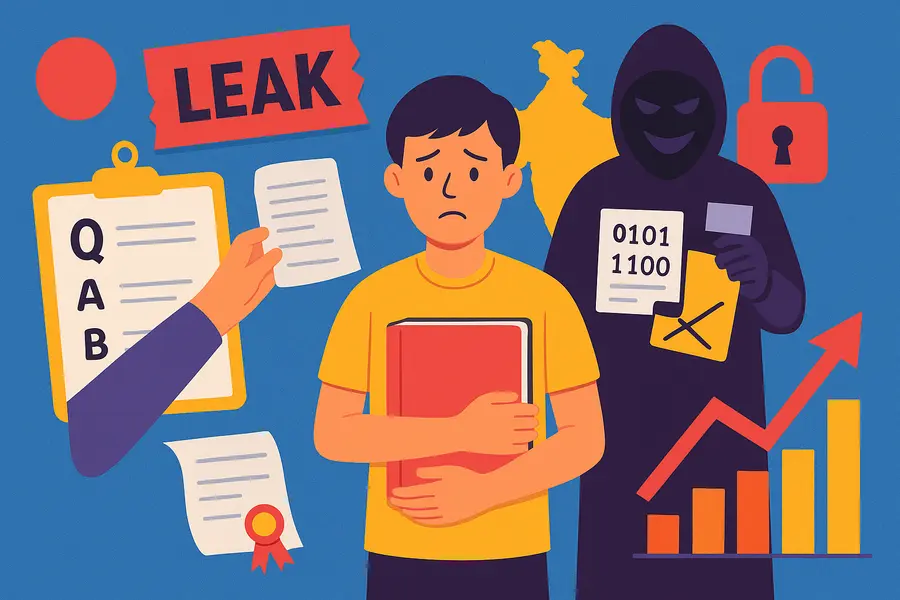
2. Inside the Organized Multi-Crore "Paper Leak Mafia"
Paper leaks in India are rarely the work of a single rogue student or a lone corrupt clerk. It has evolved into a highly sophisticated, organized criminal enterprise often referred to as the “Paper Leak Mafia.”
This underground network operates like a well-oiled corporate machine. It involves a chain of corrupt actors, including:
Insiders: Corrupt officials within examination boards or printing presses.
Middlemen: Agents who locate desperate parents and students willing to pay exorbitant fees.
Tech Operators: Individuals who quickly digitize, solve, and distribute the leaked materials.
These syndicates charge anywhere from ₹5 lakhs to ₹50 lakhs per candidate, depending on the prestige of the exam. They operate with immense financial backing, allowing them to bribe officials, secure safe houses where candidates are given leaked answers overnight, and hire top-tier legal defense teams if they ever get caught.
3. Logistical Nightmares in Physical Paper Distribution
4. The Role of Private Coaching Centers and the Nexuses
The multi-billion dollar private coaching industry in India plays a complex role in this crisis. Cities like Kota have become synonymous with rigorous exam preparation, but the intense pressure to deliver results has driven some elements of the coaching ecosystem into dark territories.
For a coaching institute, having the top rankers in a national exam is the ultimate marketing tool. It guarantees thousands of new admissions and crores in revenue for the next academic year. This massive commercial incentive has occasionally created an unhealthy nexus between corrupt coaching center owners, printing press officials, and testing agency insiders.
While the vast majority of coaching centers focus purely on education, the few that engage with paper leak networks do so because a leaked paper ensures their students top the charts, cementing the institute’s reputation.
5. How Digital Tools and Social Media Accelerate the Crisis
In the past, if an exam paper leaked, it was printed on physical paper and distributed locally. The damage was contained to a specific city or region. Today, technology has weaponized the speed and scale of these leaks.
Once a physical paper is compromised, someone takes a quick photograph with a smartphone. Within minutes, that image can be uploaded to encrypted messaging apps like Telegram, WhatsApp, or hidden groups on social media.
By the time the examination authority realizes a breach has occurred, the paper has already been shared hundreds of thousands of times across the country. Digital tools make it incredibly easy for the paper leak mafia to distribute the stolen material instantly, while remaining largely anonymous behind VPNs and untraceable accounts.
6. Weak Institutional Security and Fragmented Testing Bodies
India does not have a single, unified system for conducting exams. Instead, responsibility is fragmented across dozens of central and state-level boards, university groups, and recruitment commissions.
Many state-level boards lack the rigorous security protocols, advanced cybersecurity frameworks, and independent oversight required to protect high-stakes data.
Furthermore, many testing bodies outsource their ground-level operations to third-party private vendors. These vendors manage the digital infrastructure, hire temporary invigilators, and secure local test centers. If these private agencies fail to conduct strict background checks or maintain rigid cybersecurity standards, they create easy entry points for hackers and corrupt syndicates looking to exploit the system.
7. The Legal Response: Analyzing the Public Examinations Act
For decades, the legal penalties for leaking an exam paper were relatively minor, often treated as simple cheating or breach of trust. However, recognizing the existential threat this poses to the nation’s youth, the government introduced the Public Examinations (Prevention of Unfair Means) Act.
This landmark legislation is specifically designed to dismantle organized cheating syndicates:
Strict Penalties: The law imposes severe punishments, including imprisonment ranging from 3 to 10 years and massive fines up to ₹1 crore for those involved in organized paper leaks.
Targeting the Infrastructure: It holds complicit service providers, printing presses, and coaching centers accountable, allowing authorities to attach their properties to recover costs.
Protecting Innocent Students: Crucially, the law draws a clear line between the criminal syndicates orchestrating the leak and the regular students. It focuses on punishing the perpetrators rather than criminalizing candidates who might have inadvertently received leaked information, ensuring innocent students aren’t subjected to undue legal harassment.
8. The Psychological and Economic Toll on Students
Behind every cancelled exam and headline about a paper leak are millions of human tragedies. The psychological toll on young aspirants is devastating. Months—sometimes years—of sleep deprivation, intense isolation, and immense pressure culminate in a single moment, only for that moment to be stolen away.
When exams are postponed or cancelled due to a leak, it triggers a wave of anxiety, depression, and hopelessness among students.
From an economic perspective, the burden on poor and middle-class families is immense. Parents often take out high-interest loans to pay for coaching fees, hostel rent, and travel expenses to test centers. When an exam is cancelled, that financial investment vanishes, forcing families to sustain these expenses for several more months while waiting for a re-examination.
9. Structural Reforms: The Path to Leak-Proof Exams
Stopping exam paper leaks permanently requires moving away from patchwork fixes and implementing deep, structural reforms across India’s entire evaluation infrastructure:
Secured Digital Transmission: Moving away from physical paper printing and transit. Question papers can be encrypted and transmitted digitally directly to the test center’s computers, opening only via a secure biometric or time-locked key just minutes before the exam begins.
Comprehensive Auditing: Testing bodies must implement continuous, independent security and technical audits of all partner vendors and physical test centers.
Rethinking the “One-Day” Assessment: The ultimate solution might require changing how we evaluate students. Relying entirely on a single, high-stakes, three-hour exam creates an environment of extreme desperation. Transitioning toward holistic, continuous evaluation or multi-window, on-demand testing models can lower the stakes, making the multi-crore black market for leaked papers collapse from a lack of desperate buyers.
10. Conclusion: Restoring Trust in the Merit System
The paper leak crisis is not just an administrative glitch; it is an assault on the concept of merit and equal opportunity. When the integrity of an exam is compromised, it shakes the faith of an entire generation in the fairness of the system.
While strict laws like the Public Examinations Act provide the legal teeth needed to punish the paper leak mafia, long-term success will rely on a combination of unyielding political will, cutting-edge technology, and a cultural shift away from hyper-centralized, high-pressure testing.
India’s youth deserve an educational ecosystem where hard work, dedication, and genuine merit are the only currencies that matter. Securing the examination system is the vital first step toward restoring that trust.

How useful was this post?
Click on a star to rate it!
Average rating 0 / 5. Vote count: 0
No votes so far! Be the first to rate this post.