Why Choose School Frameworks Over Coaching for 6th to 12th Standard Education?
The moment a child enters the 6th standard, a subtle but undeniable shift happens in almost every Indian household. The carefree days of early childhood are quietly packed away, and a heavy cloud of academic anxiety sets in. Parents begin looking toward the future—the daunting board exams of Class 10 and 12, competitive entrance tests like JEE or NEET, and college admissions.
In this state of panic, the most common reflex for families is to look for a neighborhood tuition center or enroll their child in a massive, commercial coaching institute. The general consensus in society has accidentally become: “School is just for attendance; real learning only happens at coaching.”
But is this high-pressure, exam-centric setup actually helping our children grow into competent individuals? Or is it silently burning them out before they even reach adulthood?
As modern educational trends evolve, a major realization is dawning upon parents and top educators alike. To truly thrive, students do not need the assembly-line pressure of a test-prep factory. They need a structured, nurturing, and deep educational environment.
Let’s explore the deep structural reasons why choose school frameworks over coaching for 6th to 12th standard education, and how a holistic institutional model builds the ultimate foundation for your child’s life and career.
The Core Difference: Brand Slogans vs. Real Education
To understand why a structured system wins, we must look past the flashy marketing billboards of coaching centers. There is a massive difference between a platform that relies on temporary shortcuts and an institution built on a true “School, Not Coaching” educational philosophy.
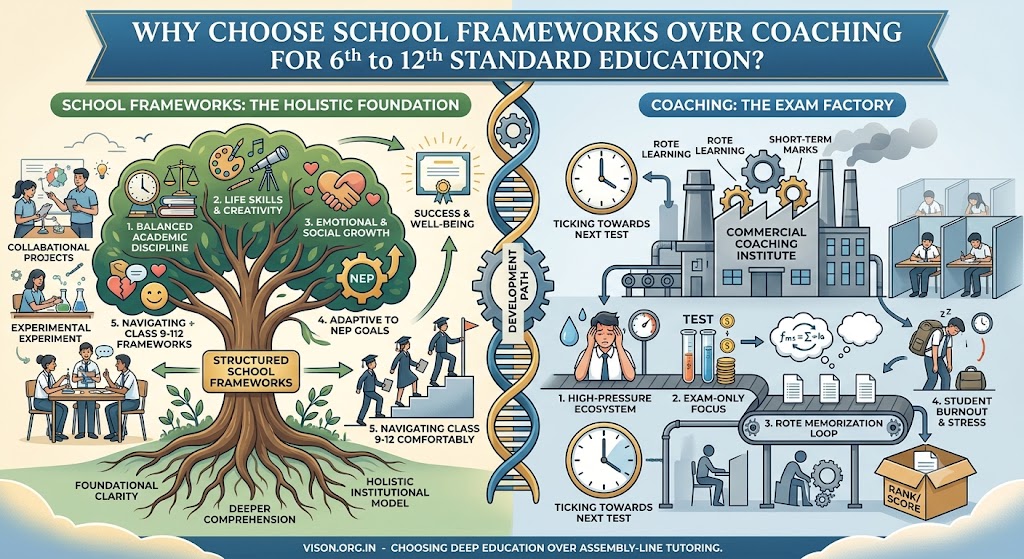
Coaching centers operate on a simple commercial transaction: they promise quick tricks and mechanical formula-memorization to clear the next immediate test. They treat students as ranks and roll numbers on a spreadsheet.
Conversely, a genuine school framework focuses on the complete cognitive development of a human being. It views the student holistically, ensuring that their emotional well-being, logical reasoning, and academic milestones grow at a balanced, sustainable pace.
1. Building a Foundation vs. Chasing Short-Term Marks
When deciding why choose school frameworks over coaching for 6th to 12th standard education, the first factor to look at is the timeline of learning. Coaching centers are naturally short-sighted. They work on a weekly or monthly cycle—preparing the student just enough to clear the upcoming unit test or mock exam.
A structured school framework, however, plays the long game. It understands that a student in Class 6 or Class 7 cannot grasp complex, abstract scientific theories if their core baseline math and language skills are weak.
Instead of forcing children to memorize chapters to pass a weekend test, a school framework meticulously builds foundational conceptual principles. It ensures that the building blocks are firmly set during the middle-school years so that when the student encounters high-stakes concepts in Class 11 and 12, they don’t crash under the weight of the curriculum.
2. Breaking the Toxic Cycle of Mechanical, Exam-Only Rote Learning
The biggest flaw of the modern coaching ecosystem is its extreme reliance on mechanical, exam-only rote learning. Walk into a typical coaching class, and you will hear teachers saying things like: “Don’t worry about why this formula works; just memorize it because it always appears for 4 marks in the exam.”
This approach strips away all joy and curiosity from learning. It turns bright, creative minds into parrots.
When you prioritize structured school frameworks, the educational model flips. The focus shifts entirely to deeper comprehension. Students are encouraged to ask “Why?” and “How?”. They learn to connect classroom theories with real-world applications. When a child understands the foundational principle behind a concept, they don’t need to spend hours blindly memorizing it. They simply know it
3. Why Deeper Comprehension Wins When Exam Patterns Change
Rote learning works perfectly fine as long as the exam paper follows a predictable, repetitive pattern. But what happens when the examiner introduces a tricky, analytical, or application-based question?
This is where the coaching-factory model fails spectacularly. Every year during board exams, we hear stories of students who scored 95% in mock tests but panicked during the actual paper because the questions were twisted or indirect.
Students who grow up within a structured school framework possess a massive advantage here. Because their education is rooted in conceptual clarity rather than just pattern-matching, they possess the mental flexibility to break down brand-new, complex problems. They don’t just survive surprise changes in exam papers; they excel because their foundations are unbreakable.
4. The Critical Importance of Structured School Frameworks in Middle School
The middle-school phase—covering the 6th, 7th, and 8th standards—is the most neglected period in a child’s academic journey. Many parents believe these years don’t matter much since there are no board exams. Coaching centers capitalize on this by either ignoring these classes entirely or introducing intense, premature competitive exam tracks that overwhelm the child.
This is exactly why choose school frameworks over coaching for 6th to 12th standard education during these formative middle-school years.
A structured school framework treats middle school as a golden window for cognitive expansion. It introduces discipline, organized study routines, and critical thinking skills without the crushing weight of competitive stress. It gives the child the space to read, write, experiment, and develop a genuine love for learning before the intense pressure of high school kicks in.
5. Navigating the High-Stakes Years of Class 9 to 12 Comfortably
As a student steps into Class 9, the academic landscape transforms completely. The sheer volume of the syllabus doubles, and the abstract nature of subjects like Physics, Chemistry, and Advanced Mathematics goes up significantly.
If a student enters this phase relying entirely on the frantic, fast-paced environment of a coaching center, they easily get left behind. Coaching institutes move at a ruthless speed; if a student misses a couple of classes or fails to grasp a concept on the first try, the batch moves forward regardless.
A holistic institutional model provides a safe, structured safety net during these high-stakes years. It aligns the learning pace with the student’s capacity, offering consistent reinforcement, regular revisions, and personalized feedback. It ensures that the transition from school-level basics to board-level expertise is a smooth, manageable staircase rather than a vertical cliff.
6. The Psychological Toll: Combating Student Burnout and High Pressure
We cannot talk about education without addressing the silent crisis of student mental health. The traditional coaching institute culture is fundamentally a high-pressure ecosystem. It thrives on fear, constant comparison, public ranking systems, and an unrelenting focus on marks. By the time many students reach Class 12, they are completely burnt out, anxious, and deeply disillusioned with education.
A structured school framework actively protects a child’s psychological well-being. It balances academic rigor with personal growth. By removing the toxic, comparative environment of a test-prep factory and replacing it with a nurturing, supportive community, it keeps the student’s morale high.
Learning shouldn’t feel like a punishment. A healthy mind absorbs concepts faster, retains them longer, and performs significantly better under exam conditions.
7. Holistic Institutional Models Build Life Skills, Not Just Test Scorers
Let’s look beyond the school gate for a moment. What happens after Class 12? When a student steps into a university, a corporate job, or attempts to build a business, nobody cares about how many short-term shortcuts they memorized in a coaching class.
The real world demands critical thinking, effective communication, collaboration, ethical decision-making, and structural discipline.
Coaching centers completely ignore these life skills because they cannot be measured in a multiple-choice mock test. A holistic institutional model builds these traits naturally. Through structured routines, interactive group discussions, presentation opportunities, and balanced evaluations, a school framework shapes a well-rounded personality. It doesn’t just prepare a child to clear an exam; it prepares them to navigate life successfully.
8. Aligning with National Education Policy (NEP) Goals
Modern education boards are shifting rapidly toward the goals laid out by the National Education Policy (NEP). The focus is moving completely away from rote memorization and heading toward competency-based learning. In fact, board exams are increasingly adding analytical and case-study questions that cannot be solved using traditional coaching institute tricks.
School frameworks are natively designed to adapt to these national policy shifts. They build environments where continuous and comprehensive evaluation takes place through practicals, project work, and conceptual assignments. Choosing a school framework ensures your child is learning in total alignment with modern, updated national standards rather than outdated exam factory patterns.
Conclusion: Making the Right Choice for Your Child's Future
When we sit back and analyze the ultimate goal of education, the answer becomes crystal clear. We do not want our children to spend the most vital, creative years of their youth trapped in a mechanical cycle of rote memorization, stressed out by commercialized coaching hubs.
We want them to grow up with deep intellectual clarity, high self-confidence, and an unshakable understanding of the world around them.
That is the definitive reason why choose school frameworks over coaching for 6th to 12th standard education. By opting for a structured, foundational, and truly holistic institutional model, you are giving your child the greatest gift possible: a balanced environment where they can master their subjects, secure exceptional board results, and build a beautiful, sustainable future.

How useful was this post?
Click on a star to rate it!
Average rating 0 / 5. Vote count: 0
No votes so far! Be the first to rate this post.