
A Complete Guide to Clinical Research Careers in India: Eligibility, Salaries, and Growth
The global pharmaceutical industry is engaged in a continuous, high-stakes race to develop life-saving medical treatments, discover targeted vaccines, and design highly precise diagnostic tools. However, before a newly synthesized drug molecule can transition from a laboratory cleanroom to a pharmacy shelf, it must undergo a rigorous, multi-layered validation process to prove its safety and efficacy in human volunteers. This vital phase is known as clinical research.
Over the last decade, India has emerged as one of the most preferred global destinations for clinical trials. Driven by a massive and diverse patient population, a highly skilled scientific workforce, state-of-the-art medical infrastructure, and a highly competitive cost-operational structure, the Indian clinical research sector is experiencing unprecedented growth.
For life science graduates, pharmacy professionals, and medical doctors looking to build a highly rewarding, high-impact career outside of traditional hospital wards or raw manufacturing units, exploring clinical research careers in India offers a direct, future-proof pathway to global success. This comprehensive guide breaks down the core eligibility requirements, outlines the major professional roles, evaluates salary trajectories, and explores the long-term career growth of this booming sector.
1. The Evolution of Clinical Trials: Why India is a Global Hub
Historically, the vast majority of global clinical trials were conducted exclusively in Western nations. However, high operational costs, slow patient recruitment rates, and strict administrative delays forced global biopharmaceutical giants to look eastward.
India’s integration into the global clinical trial ecosystem has been accelerated by progressive regulatory reforms. The introduction of standardized clinical guidelines, coupled with a vast network of multi-specialty government and private hospitals, allows international pharmaceutical companies to execute multi-centric trials rapidly and cost-effectively.
Today, major global Contract Research Organizations (CROs) like IQVIA, Labcorp, Syneos Health, and Parexel, alongside premier domestic biopharmaceutical giants, run massive, concurrent clinical programs in India. This high volume of clinical activity translates directly into a continuous, high-speed demand for qualified clinical trial professionals across the country.
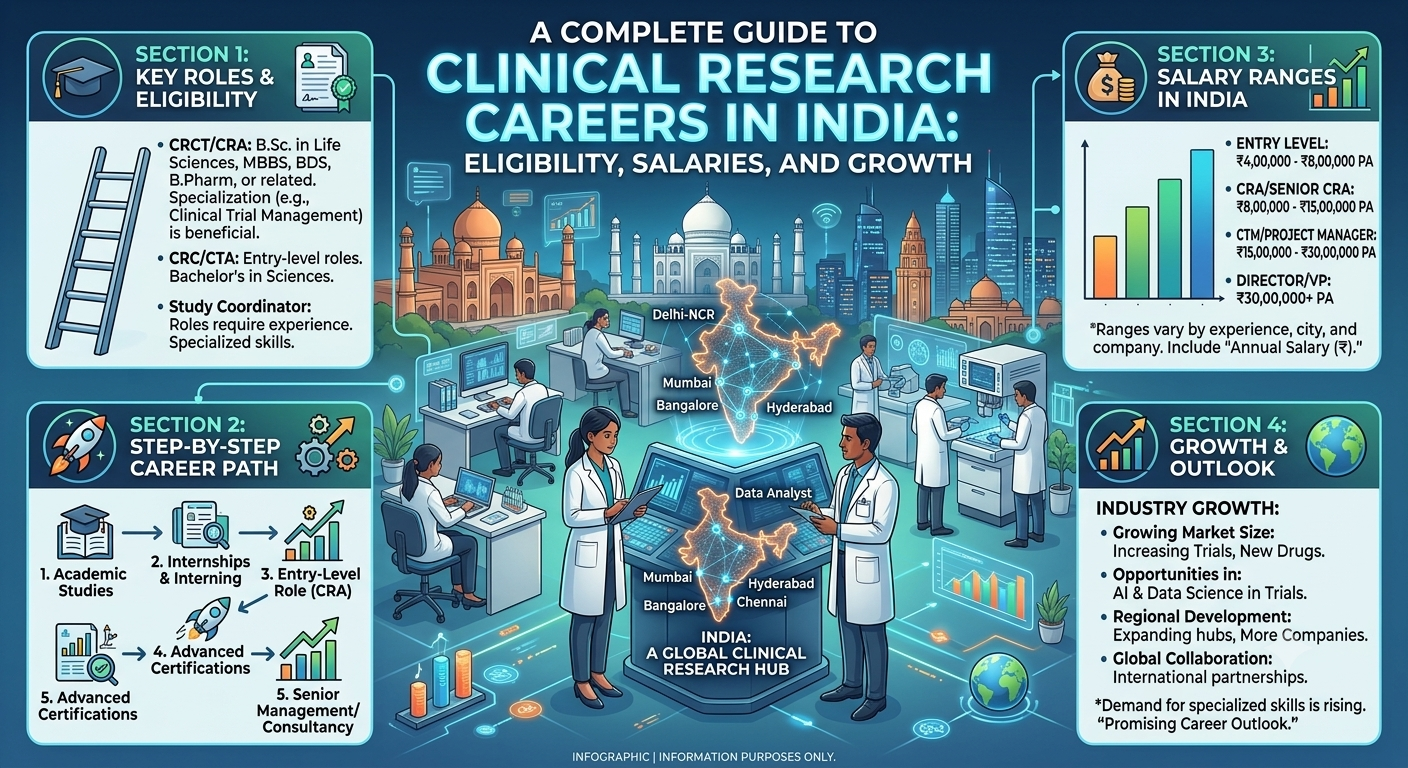
2. What is Clinical Research? Understanding the Core Lifecycle
Before entering this field, it is vital to understand that clinical research is a highly regulated, multidisciplinary science. It is not a single job; it is a complex lifecycle comprising multiple operational phases:
Phase I (Safety Evaluation): Testing a new drug on a small group of healthy human volunteers to evaluate its metabolic pathways, side effects, and safe dosage ranges.
Phase II (Efficacy Testing): Administering the treatment to a larger group of patients suffering from the target disease to measure its initial therapeutic effectiveness.
Phase III (Comparative Confirmation): Conducting large-scale, multi-centric trials on thousands of diverse patients globally to confirm overall efficacy, monitor adverse reactions, and compare it with existing standard treatments.
Phase IV (Post-Marketing Surveillance): Continuously monitoring the drug’s long-term safety, drug interactions, and real-world performance after it has been officially approved and launched in the market.
Each of these phases requires a vast army of specialized monitors, data coordinators, patient counselors, and safety officers to ensure strict adherence to international ethical and scientific guidelines.
3. Eligibility Criteria: How to Qualify for Clinical Research Careers in India
Because clinical trials directly impact human lives, the entry barrier to this profession is highly structured. You cannot enter clinical research with a general, non-scientific background. The primary educational streams that qualify candidates for clinical research eligibility in India include:
Life Sciences Graduates: Candidates possessing a B.Sc, M.Sc, or Ph.D. in biotechnology, microbiology, genetics, biochemistry, zoology, or molecular biology.
Pharmacy Professionals: Graduates and postgraduates holding a B.Pharm, M.Pharm, or Pharm.D degree. These candidates are highly prized due to their deep understanding of pharmacology, drug interactions, and formulation chemistry.
Medical and Allied Health Professionals: Doctors holding clinical degrees such as MBBS, BDS, BAMS, BHMS, BPT, or BVSc. These professionals typically fast-track into high-level medical monitoring, clinical trial design, or principal investigator roles.
Nursing Graduates: Individuals possessing a B.Sc or M.Sc in Nursing, who excel in patient-centric clinical coordination and bedside trial management.
4. Top Courses and Certifications in Clinical Research
While possessing a basic life science or pharmacy degree is mandatory, securing an elite, high-paying role straight out of university often requires specialized postgraduate training.
Completing one of the top clinical research courses in India bridges the gap between basic academic theory and the highly technical, regulatory-compliant reality of corporate trials. When selecting a certification program, look for postgraduate diplomas (PGD) or master’s programs that cover:
Good Clinical Practice (GCP) Guidelines: The international ethical and quality standard for designing, conducting, and reporting clinical trials.
Clinical Trial Methodology: Understanding how to write trial protocols, design Case Report Forms (CRFs), and manage patient informed-consent documents.
Regulatory Affairs: Navigating national and international drug approval frameworks, ensuring compliance with global regulatory standards.
To explore certified academic pathways, clinical development guidelines, and government-backed training initiatives designed to build clinical research capacity in India, candidates can consult the Sree Chitra Tirunal Institute for Medical Sciences and Technology (SCTIMST) Portal, which runs premier clinical research training and translational health programs.
5. Career Path 1: Clinical Research Coordinator (CRC) – The Frontline Operator
The Clinical Research Coordinator (CRC) is the absolute backbone of on-site trial execution. CRCs operate directly inside the hospitals or medical centers where the trial is being physically conducted.
The Core Responsibilities: CRCs act as the primary link between the patient, the clinical investigator (doctor), and the sponsoring pharmaceutical company. They manage patient recruitment, schedule clinical visits, administer informed-consent forms, collect vital physical samples, and meticulously record all patient data into the trial’s Case Report Forms.
The Skillset Required: This role demands high-level clinical empathy, strong interpersonal communication, attention to detail, and a deep understanding of hospital operational environments.
6. Career Path 2: Clinical Research Associate (CRA) – The Compliance Guardian
If the CRC manages the hospital site, the Clinical Research Associate (CRA)—also known as a Monitor—represents the eyes and ears of the sponsoring pharmaceutical company or Contract Research Organization (CRO).
The Core Responsibilities: CRAs travel extensively to different hospital sites to audit trial progress. They verify that the trial is being conducted in strict compliance with the approved scientific protocol, Good Clinical Practice (GCP) standards, and national laws. They run source-data verification, checking that the physical hospital charts match the digital entries, and audit the storage of experimental drugs.
The Skillset Required: This role is ideal for individuals who enjoy traveling, possess strong auditing capabilities, and have an uncompromising commitment to scientific quality and regulatory compliance.
7. Career Path 3: Clinical Data Manager (CDM) – The Tech-Savvy Architect
With modern clinical trials generating millions of data points across global sites, managing this information requires a highly specialized blend of biology and computational data science. This is the domain of the Clinical Data Manager (CDM).
The Core Responsibilities: CDMs do not participate in direct patient contact. Instead, they design the highly secure, digital databases used to collect trial information. They write data validation checks to flag errors, manage data entry portals, clean up database inconsistencies, and lock the final database once the trial is complete to prepare it for statistical analysis.
The Skillset Required: This career path is highly suitable for life science or pharmacy graduates who possess strong analytical reasoning, database management skills, and basic programming literacy.
8. Career Path 4: Pharmacovigilance (PV) and Drug Safety Associate
Once a drug enters clinical trials and even after it is launched in the market, its safety profile must be monitored continuously. This specialized field of drug safety is known as Pharmacovigilance (PV).
The Core Responsibilities: Pharmacovigilance Associates collect, analyze, and document reports of Adverse Events (AEs) and Serious Adverse Events (SAEs) experienced by patients taking specific medications. They write detailed clinical narratives describing the events, evaluate if the drug was the direct cause of the reaction, and submit safety reports to national and international regulatory databases.
The Skillset Required: Due to the complex medical nature of drug reactions, this path is highly popular among B.Pharm, M.Pharm, Pharm.D, BDS, and AYUSH graduates who possess strong clinical understanding and medical writing skills.
9. Clinical Research Salary in India: Role-by-Role Breakdown
The clinical research industry in India is highly lucrative, offering rapid financial scaling for professionals who demonstrate skill, technical specificity, and strong leadership.
The table below provides a detailed, role-by-role overview of the estimated annual salary ranges for freshers and experienced professionals within the Indian clinical trial ecosystem in 2026:
+------------------------------------+---------------------+---------------------+----------------------+
| Professional Job Role              | Entry-Level (0-2 Y) | Mid-Level (3-5 Yrs) | Senior (6-10 Years)  |
+------------------------------------+---------------------+---------------------+----------------------+
| Clinical Research Coordinator (CRC)| ₹2.5 - ₹4.0 LPA     | ₹4.5 - ₹7.0 LPA     | ₹8.0 - ₹12.0 LPA     |
| Clinical Research Associate (CRA)  | ₹3.5 - ₹5.5 LPA     | ₹6.0 - ₹9.5 LPA     | ₹11.0 - ₹18.0 LPA    |
| Pharmacovigilance (PV) Associate   | ₹3.2 - ₹4.8 LPA     | ₹5.5 - ₹8.5 LPA     | ₹10.0 - ₹16.0 LPA    |
| Clinical Data Manager (CDM)        | ₹3.5 - ₹5.0 LPA     | ₹6.0 - ₹10.0 LPA    | ₹12.0 - ₹20.0 LPA    |
| Medical Writer / Safety Narrator   | ₹3.0 - ₹4.5 LPA     | ₹5.0 - ₹8.0 LPA     | ₹9.0 - ₹15.0 LPA     |
| Clinical Project Manager (CPM)     | Not Applicable*     | ₹12.0 - ₹18.0 LPA   | ₹20.0 - ₹35.0 LPA+   |
+------------------------------------+---------------------+---------------------+----------------------+
*Note: Clinical Project Manager (CPM) is a senior leadership role that cannot be entered as a fresher. It requires several years of experience as a CRA, CDM, or lead coordinator.
10. Growth Trajectory and Global Mobility in Clinical Research
The career progression in the clinical trial industry is structured, merit-based, and highly transparent. A professional typically begins their journey on the frontline as a CRC or a junior safety associate. Within two to three years of active site auditing or data management, they scale into CRA-II, senior data manager, or PV team-lead roles.
At the senior midpoint of the career (6 to 10 years), professionals transition into Clinical Project Managers, Clinical Operations Directors, or Global Safety Leaders. In these executive roles, they oversee entire portfolios of international clinical trials, manage multi-million dollar budgets, and coordinate with international health regulators.
Furthermore, because Good Clinical Practice (GCP) guidelines are globally standardized, the skills you develop inside Indian CROs are completely portable. Experienced Indian clinical trial professionals enjoy exceptional global mobility, with highly lucrative career opportunities available across major biotechnology and pharmaceutical hubs in Europe, North America, and the Middle East.
11. Regulatory Frameworks: Understanding CDSCO and CTRI Guidelines
Every clinical trial executed in India must be authorized and monitored under a strict, centralized regulatory framework to guarantee patient safety and ethical research practices. Aspiring researchers must familiarize themselves with these key regulatory channels:
Central Drugs Standard Control Organisation (CDSCO): Operating as the national regulatory authority of India under the Ministry of Health and Family Welfare, the CDSCO—led by the Drugs Controller General of India (DCGI)—approves clinical trial protocols, inspects trial sites, and grants manufacturing and import licenses for new drugs. To check updated guidelines, clinical trial application processes, and regulatory circulars, professionals can refer directly to the CDSCO Official Portal.
Clinical Trials Registry – India (CTRI): Managed by the National Institute of Medical Statistics (NIMS) under the ICMR, the CTRI is a secure, public database where every clinical trial conducted in India must be registered before the first patient is recruited. This registry ensures complete transparency, preventing trial duplicity and public health bias. To review active registered trials, observational studies, and national safety registries, you can search the CTRI Portal.
International Standards: For trials targeting global approvals (such as the US FDA or European Medicines Agency), Indian researchers align their studies with the international registries hosted on the U.S. National Institutes of Health ClinicalTrials Database and the WHO Clinical Trials Registry Platform.
12. Conclusion: Shaping Your Future in Clinical Research
The definitive verdict for life science and healthcare graduates is highly encouraging: the modern healthcare sector offers incredibly rewarding, high-impact career paths far beyond traditional hospital wards or raw manufacturing labs.
By entering the fast-growing domain of clinical research—whether by managing patient-centric execution as a CRC, auditing compliance as a CRA, building secure digital databases as a CDM, or monitoring drug safety in pharmacovigilance—you can play an active role in designing the medical treatments of tomorrow.
Step away from traditional, crowded career paths. Focus on developing strong regulatory understanding, mastering GCP guidelines, staying updated via official CDSCO and CTRI databases, and step confidently onto a career path that will empower you to shape the future of global medicine and healthcare.

How useful was this post?
Click on a star to rate it!
Average rating 0 / 5. Vote count: 0
No votes so far! Be the first to rate this post.