How Is Artificial Intelligence Changing Medical Diagnosis in India in 2026?
Introduction: The New Era of Indian Healthcare Diagnostics
The Indian healthcare ecosystem has historically faced structural challenges, ranging from critical shortages of specialist doctors to severe urban-rural diagnostic disparities. For decades, patients in semi-urban and rural regions traveled hundreds of kilometers to metropolitan tertiary hospitals merely to obtain accurate radiological reviews or specialized blood diagnostic reports. However, the rapid expansion of high-speed digital networks, government-backed digital health ecosystems, and frugal MedTech innovation has set the stage for a major technological shift.
By integrating artificial intelligence into clinical workflows, Indian diagnostic laboratories, rural primary health centers, and corporate hospital chains are reshaping clinical decision-making. Today, AI-powered diagnostic tools process high-resolution medical imaging, analyze complex genomic sequences, and detect pathology indicators with speed and accuracy. This article explores how artificial intelligence is transforming medical diagnosis across India in 2026, democratizing specialist care, and improving early intervention outcomes.
1. Automated Radiology: Accelerating X-Ray, CT, and MRI Scan Processing
A major challenge in Indian healthcare infrastructure is the scarcity of trained radiologists outside major Tier-1 cities.
┌─────────────────────────────────────────────────────────────┐
│                 RADIOLOGY DIAGNOSTIC WORKFLOW               │
│                                                             │
│   Traditional Workflow:                                     │
│   Scan Acquisition  ──► Manual Review  ──► 24-48 Hour Wait  │
│                                                             │
│   AI-Augmented Workflow:                                    │
│   Scan Acquisition  ──► Instant AI Screening ──► Prioritized Review │
└─────────────────────────────────────────────────────────────┘
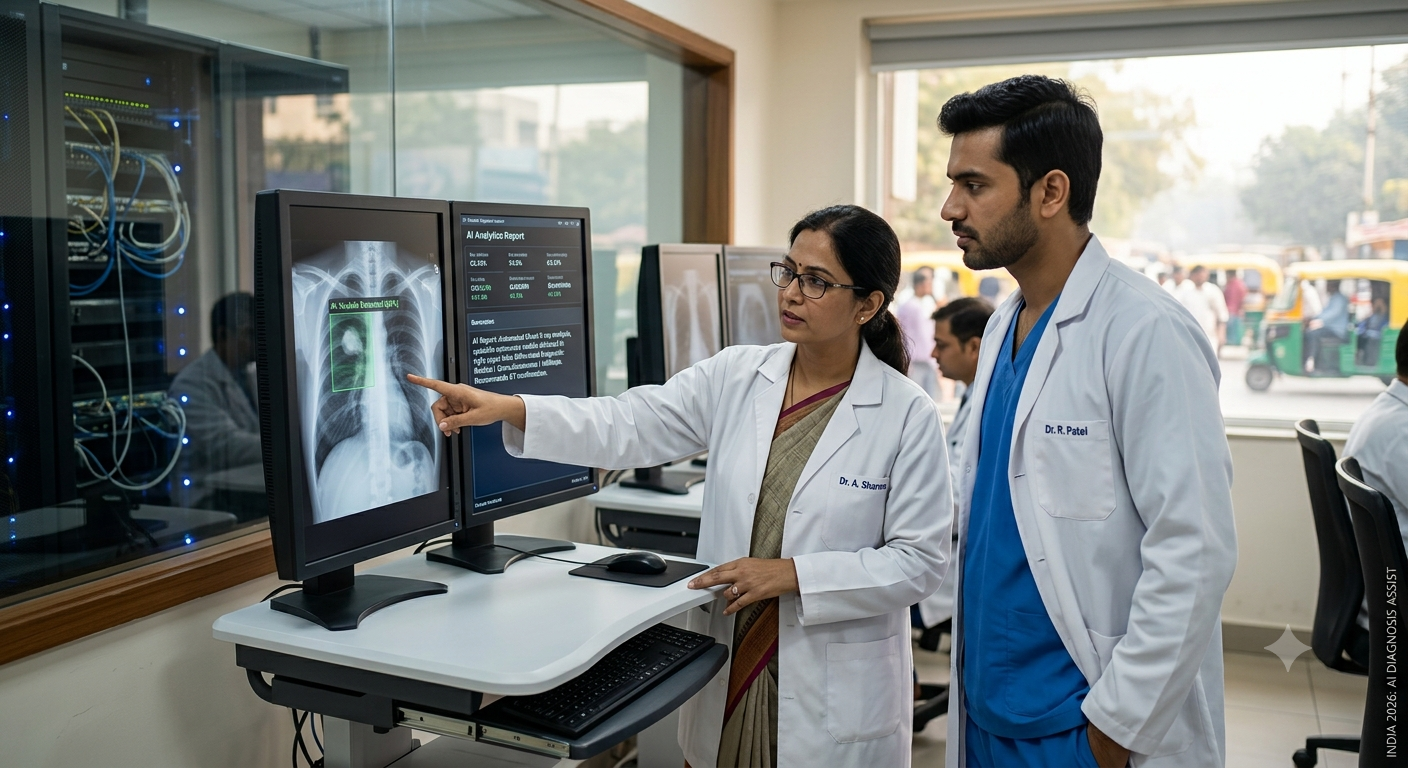
Advanced radiological AI algorithms analyze chest X-rays, CT scans, and MRI outputs in seconds, flagging subtle pulmonary nodules, intracranial hemorrhages, and bone fractures. In 2026, major hospital chains across India utilize deep-learning software to reduce MRI scanning durations by up to 40% while enhancing image resolution. These automated imaging platforms act as a first line of screening, prioritizing critical emergency cases for immediate radiologist verification.
To review official national biomedical research initiatives and guidelines on diagnostic AI tools, explore updates hosted by the Indian Council of Medical Research (ICMR).
2. Early Tuberculosis (TB) and Pulmonary Disease Detection at Scale
Eradicating tuberculosis remains a top public health priority for the Government of India, demanding rapid, low-cost screening tools for high-density populations.
Mobile Chest X-Ray Unit ──► Offline AI Triage Model ──► Instant High-Risk Flagging
AI-enabled portable digital X-ray devices now allow healthcare workers in remote districts to perform instant, high-accuracy TB screening without needing an on-site radiologist. The deep-learning models analyze lung opacity patterns, identifying early-stage tubercular lesions that might be missed during routine visual inspection. This point-of-care diagnostic capability enables immediate sputum collection and treatment initiation, reducing community transmission across rural districts.
3. Retinal AI Imaging: Preventing Diabetic Retinopathy and Vision Loss
India’s growing diabetic population makes the early detection of diabetic retinopathy a crucial public health goal.
┌─────────────────────────────────────────────────────────────┐
│              RETINAL DIAGNOSTIC AI PIPELINE                 │
│  Fundus Camera Capture ──► Cloud/Edge AI Analysis           │
│                                    │                        │
│                                    ▼                        │
│  Instant Risk Classification ◄── Microvascular Breakdown Check │
└─────────────────────────────────────────────────────────────┘
Handheld fundus cameras equipped with edge-AI software empower non-specialist nurses at rural Primary Health Centers (PHCs) to scan patients’ eyes for microvascular damage. The diagnostic software classifies retinal lesions into severity tiers in less than a minute, immediately alerting local health officers if a patient requires ophthalmologist referral. This scalable screening approach prevents irreversible vision loss for thousands of diabetic patients in underserved regions.
4. Pathology and Digital Microscopy: AI-Driven Cancer Cytology
Traditional pathology relies heavily on manual slide inspection under optical microscopes, a time-intensive process prone to observer fatigue and variability.
Modern digital pathology platforms scan slide biopsies and convert tissue samples into ultra-high-resolution digital files. Specialized pathology AI models then analyze cellular morphology, flagging cancerous cell clusters, estimating mitotic counts, and detecting biomarker expressions across cervical, oral, and breast tissue samples. This collaborative diagnostic loop accelerates biopsy turnaround times from weeks to days, enabling early oncology interventions.
For official updates on digital health framework integration and national health ID standards, visit the Ayushman Bharat Digital Mission (ABDM) portal.
5. Non-Invasive Cardiovascular Risk Stratification and ECG Analysis
Heart disease remains a leading cause of mortality in India, requiring rapid diagnostic tools for emergency cardiac care.
Single-Lead Handheld ECG ──► AI Waveform Analysis ──► Early Ischemia / Arrhythmia Alert
Portable smart ECG devices integrated with deep-learning algorithms can interpret complex cardiac waveforms in real time, detecting subtle silent ischemia, atrial fibrillation, and ventricular hypertrophy. Emergency ambulance technicians and general practitioners across Tier-2 and Tier-3 cities use these AI devices to perform pre-hospital risk stratification. This rapid diagnostic feedback ensures patients experiencing acute coronary syndromes receive immediate thrombolytic care or catheterization referrals.
6. Frugal MedTech and Offline-First AI for Rural Health Infrastructure
Deploying advanced medical technologies in semi-urban and rural India requires hardware designed specifically for challenging local conditions.
┌─────────────────────────────────────────────────────────────┐
│                 FRUGAL DIAGNOSTIC TECH STACK                │
│  Battery-Powered Hardware ──► Local Offline AI Models       │
│           ▲                              │                  │
│           └────── ABDM Health ID Sync ◄──┘                  │
└─────────────────────────────────────────────────────────────┘
Indian MedTech innovators lead the world in frugal engineering—developing low-power, lightweight diagnostic devices capable of running AI models locally without continuous internet connectivity. These offline-capable diagnostic tools run on long-lasting internal batteries, allowing healthcare workers to perform mass screenings during rural health camps. The diagnostic findings synchronize automatically with national digital health records whenever connectivity is restored.
7. Genomic Diagnostics and Personalized Precision Oncology
Deciphering complex genetic profiles is becoming essential for tailoring targeted therapies in modern oncology and rare disease management.
Next-generation genomic sequencing platforms leverage machine learning algorithms to process terabytes of DNA and RNA data from cancer patients. The predictive AI identifies specific genetic mutations, predicts drug resistance behaviors, and matches patients with personalized targeted therapies. This precision medicine approach shifts cancer care in India from trial-and-error chemotherapy toward targeted molecular treatments.
8. Public-Private Collaborations and National Data Infrastructures
Scaling responsible AI diagnostics requires robust national data frameworks, high-performance compute access, and strict ethical oversight.
Initiatives such as the collaboration between IndiaAI and the Indian Council of Medical Research (ICMR) establish dedicated biomedical dataset platforms like MIDAS and AIKosh. These centralized repositories supply anonymized, ethics-approved clinical data to researchers, startups, and medical institutions. This national compute infrastructure accelerates the development of medical AI models trained specifically on diverse Indian demographic datasets.
For policy news and national technological initiatives, review updates published by the Ministry of Electronics and Information Technology (MeitY).
9. Regulatory Frameworks, Data Privacy, and Ethics in Health AI
Ensuring patient safety, data privacy, and algorithmic fairness remains a critical priority as diagnostic AI tools enter routine clinical practice.
Core Regulatory and Ethical Pillars in India:
CDSCO Device Licensing: Medical AI software is regulated under Medical Device Rules, requiring thorough clinical validation before market deployment.
ICMR Ethical Guidelines: Mandates strict data anonymization, explicit patient consent, and continuous algorithmic auditing.
Human-in-the-Loop Governance: Ensures AI systems serve as diagnostic assistants alongside doctors, keeping final clinical liability with licensed medical professionals.
Data Protection Compliance: Protects sensitive health records in accordance with national digital privacy legislation.
10. Comparative Analysis: Traditional vs. AI-Augmented Diagnostics in India
| Diagnostic Benchmark | Traditional Clinical Setup | AI-Augmented Setup (2026) |
| Imaging Turnaround | 24–48 hours for specialist report | Real-time triage with instant flagging |
| Rural Specialist Access | Very low (Requires patient travel to cities) | High (PHC nurses screen using AI devices) |
| TB & Disease Screening | Slow (Lab-bound sputum tests) | Instant (Mobile AI chest X-ray screening) |
| Early Retinopathy Check | Low (Ophthalmologist required) | High (Automated fundus camera checks) |
| Data Record Tracking | Manual paper charts | Integrated ABDM digital health records |
11. Step-by-Step Blueprint: How Hospitals Adopt Diagnostic AI
Integrating artificial intelligence safely into clinical workflows requires a structured implementation roadmap:
Select CDSCO-Approved Tools: Partner with MedTech providers offering validated AI diagnostic algorithms compliant with Indian regulatory standards.
Integrate ABDM & PACS Systems: Connect AI diagnostic devices with hospital Picture Archiving and Communication Systems (PACS) and national health IDs.
Train Clinical & Nursing Staff: Conduct training for nurses, technicians, and doctors on interpreting AI diagnostic outputs correctly.
Establish Audit Protocols: Perform regular diagnostic accuracy audits to monitor algorithmic performance across diverse patient populations.
Conclusion: The Future of AI-Driven Healthcare in India
The expansion of artificial intelligence across medical diagnosis marks a milestone in building an equitable, accessible, and high-quality healthcare system for India. By transforming specialized clinical knowledge into scalable point-of-care devices, AI diagnostic tools eliminate geographic barriers, lower screening costs, and enable early medical interventions.
As regulatory guidelines mature and public-private compute infrastructure expands, AI-driven medical diagnosis will serve as a foundational pillar of modern Indian healthcare—empowering doctors, elevating patient care, and saving lives across every corner of the nation.

How useful was this post?
Click on a star to rate it!
Average rating 0 / 5. Vote count: 0
No votes so far! Be the first to rate this post.