
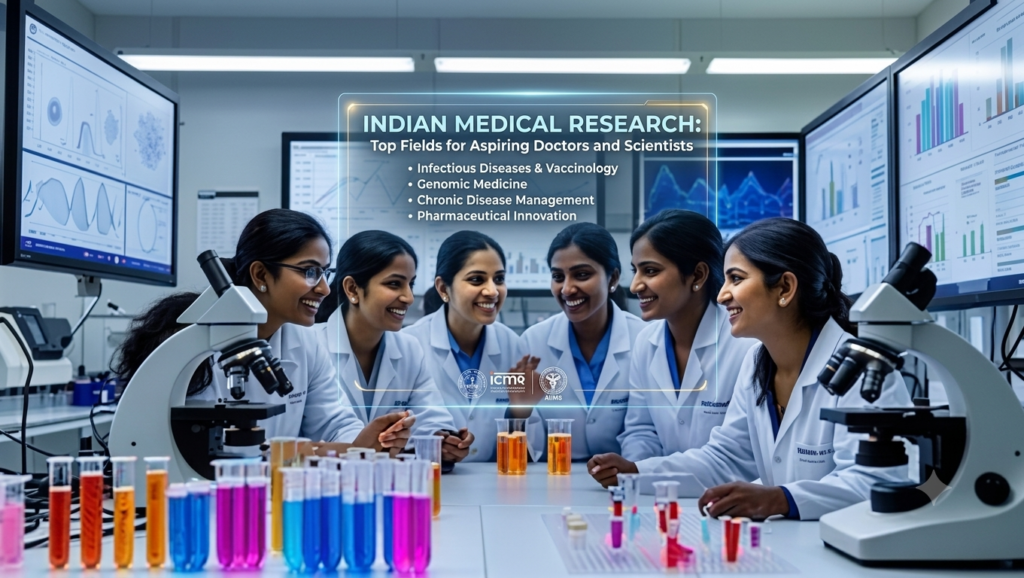
Indian Medical Research: Top Fields for Aspiring Doctors and Scientists
The landscape of healthcare is shifting beneath our feet. For generations, the career path of a medical graduate in India was linear and clinical: complete an MBBS, crack the postgraduate entrance exam, specialize in a clinical branch, and treat patients in a hospital ward. While active clinical practice remains a noble and vital calling, a parallel revolution is taking place.
As we navigate through 2026, the boundaries between clinical medicine, laboratory science, computational data, and engineering have completely fractured.
Today, India is emerging as a global powerhouse in translational medical research. Driven by landmark government initiatives, increased venture capital in biotech, and a growing domestic demand for localized healthcare solutions, Indian medical research has become an exceptionally rewarding, high-impact career path. For aspiring doctors and scientists, pursuing a medical research career India offers a unique opportunity to not only treat individual patients but to design cures that can save millions of lives globally.
This comprehensive guide explores the top fields in modern Indian medical research, details the skills required to thrive, and outlines the funding and career pathways available to the next generation of scientific leaders.
1. The Changing Horizon of Medical Research in India
The traditional model of relying on Western clinical data to treat Indian patients is no longer sufficient. Because of India’s unique ancestral lineages, diverse socio-economic structures, and distinct environmental exposures, the global medical community is realizing that clinical research must be highly localized.
In response, national bodies like the Indian Council of Medical Research (ICMR) have systematically overhauled their funding models, research labs, and academic partnerships.
The modern researcher in India is no longer isolated in a traditional laboratory. They are working at the intersection of genetics, software, clinical trials, and public health. This multidisciplinary ecosystem has opened up highly specialized clinical research fields that allow doctors and scientists to work together on solving the country’s most pressing medical challenges.
2. Precision Medicine and Pharmacogenomics: Treating the Individual
The age of the generic, mass-produced pharmaceutical drug is gradually coming to an end. Precision medicine India represents a major shift toward designing customized healthcare regimens tailored to an individual patient’s unique genetic blueprint.
Because of India’s vast genetic diversity, consisting of thousands of distinct endogamous communities, a drug that is highly effective for one population may cause severe side effects or display zero efficacy in another. Research in this field focuses on:
Genomic Sequence Analysis: Mapping the genetic variations of different Indian cohorts to identify disease-susceptibility markers.
Targeted Drug Dosing: Understanding how specific local genetic lineages metabolize drugs to prevent adverse drug reactions.
Indigenous Biobanking: Building large-scale databases of Indian genetic materials to support personalized oncology and cardiovascular therapies.
This field is heavily supported by the Department of Biotechnology (DBT), which is actively mapping the national genetic footprint to ensure that the future of Indian pharmacotherapy is safe, precise, and highly personalized.
3. Stem Cell Therapy and Regenerative Medicine: Rebuilding Living Tissue
For decades, chronic organ damage, spinal cord injuries, and degenerative joint diseases were considered irreversible. Stem cell therapy and regenerative medicine are changing this paradigm, allowing scientists to treat cellular damage by growing healthy, functional tissues in laboratories.
Indian researchers in this domain are conducting cutting-edge work on:
Induced Pluripotent Stem Cells (iPSCs): Reprogramming adult human skin or blood cells to behave like embryonic stem cells, which can then be grown into specialized heart, liver, or nerve cells.
3D Bioprinting of Organs: Utilizing biological inks to print functional tissue scaffolds that can help repair damaged blood vessels or skin.
Bone Marrow and Cord Blood Research: Developing advanced, low-cost stem cell transplants to treat severe blood disorders like leukemia, thalassemia, and sickle cell anemia.
This research-heavy discipline bridges the gap between basic biological science and clinical therapeutics, making it a premier choice for scientists who want to work on the absolute frontier of cellular healing.
4. Digital Health and Artificial Intelligence in Diagnostics
The integration of artificial intelligence (AI), machine learning, and big data into clinical medicine has created a highly dynamic research vertical. Modern hospitals are utilizing automated software to analyze medical scans, predict patient risks, and manage intensive care units.
Research areas in this fast-growing domain include:
AI-Driven Radiological Imaging: Training machine learning algorithms to identify microscopic tumors, early-stage tuberculosis nodules, or subtle brain hemorrhages on X-rays and CT scans.
Predictive Epidemic Modeling: Analyzing public health data to predict outbreaks of vector-borne diseases like dengue and malaria weeks before they occur.
Smart Triage Systems: Designing electronic health record systems that automatically flag deteriorating patients in ICU wards, saving precious response time.
This field is highly suitable for doctors who have a passion for computer science or data analysts who want to apply their programming skills directly to saving lives in clinical environments.
5. Infectious Diseases and Epidemiology: Protecting Public Health
As a tropical nation with a high population density, India remains at the front lines of the global battle against infectious pathogens. Epidemiology and infectious disease research is a vital pillar of national security and public wellness.
Key areas of active scientific investigation include:
Combating Antimicrobial Resistance (AMR): Researching how bacteria develop resistance to common antibiotics and designing alternative therapies to treat drug-resistant superbugs.
Eradicating Tuberculosis (TB): Developing faster diagnostic tests, shorter drug regimens, and more effective vaccines to meet national targets for a TB-free India.
Vector-Borne Disease Control: Studying the genetic structures of mosquitoes to design bio-control methods that stop the transmission of dengue, chikungunya, and malaria.
Working in this field allows researchers to collaborate directly with public health administrators, translating laboratory discoveries into national healthcare policies.
6. Cancer Immunology and Immunotherapy: Targeted Oncological Care
Cancer remains one of the most complex challenges in modern medicine. While traditional chemotherapy acts as a blunt instrument that destroys both healthy and cancerous cells, researchers are focusing heavily on cancer immunology and targeted immunotherapy.
Indian oncologists and molecular scientists are pioneering research in:
Indigenous CAR-T Cell Therapy: Genetically modifying a patient’s own immune T-cells in laboratory cleanrooms to actively recognize and destroy cancer cells.
Monoclonal Antibodies: Designing laboratory-made proteins that target specific cancer cell receptors without damaging surrounding healthy tissue.
Oncogenomics: Analyzing the unique somatic mutations found in Indian tumor biopsies to prescribe highly targeted, low-toxicity molecular therapies.
A significant portion of this clinical research is centered around premier national cancer hubs like the Tata Memorial Centre (TMC), which runs advanced clinical trials to bring low-cost, life-saving cancer cures to the Indian public.
7. Neurosciences and Cognitive Health: Deciphering the Human Brain
As life expectancy in India increases, the burden of age-related cognitive disorders is rising. Neurosciences and cognitive health research is essential to understand, diagnose, and treat complex brain disorders.
Aspiring researchers in this field study:
Neurodegenerative Diseases: Investigating the underlying cellular mechanisms of Alzheimer’s, Parkinson’s, and Amyotrophic Lateral Sclerosis (ALS) to discover early diagnostic markers.
Mental Health Biomarkers: Utilizing advanced functional MRI (fMRI) imaging and neurochemical mapping to understand depression, schizophrenia, and anxiety disorders.
Neuro-rehabilitation: Designing brain-computer interfaces (BCIs) and robotic prosthetics to help stroke and spinal cord injury survivors regain physical mobility.
This specialized research is spearheaded by leading brain research institutes, most notably the National Institute of Mental Health and Neurosciences (NIMHANS), which acts as the national hub for clinical neurology and psychiatric research.
8. AYUSH and Integrative Medicine: Merging Tradition with Science
One of the most unique and rapidly growing fields of research in India is integrative medicine. The goal of this field is to evaluate traditional Indian healing systems—including Ayurveda, Yoga, Unani, Siddha, and Homeopathy (AYUSH)—using modern scientific validation methods.
Research themes in this hybrid branch include:
Phytochemistry and Drug Discovery: Extracting active chemical compounds from medicinal plants to develop standardized, evidence-based allopathic drugs.
Yoga and Cardiovascular Health: Conducting structured clinical trials to measure how mindfulness, meditation, and breathing exercises impact stress hormones and blood pressure.
Holistic Preventative Regimens: Studying how traditional lifestyle modifications can complement modern oncological or diabetic care to improve overall patient quality of life.
By validating traditional systems using rigorous, double-blind clinical trial protocols, researchers are building a unique global model for integrative, holistic patient care.
9. Essential Skills for Modern Indian Medical Researchers
To build a successful medical research career India, aspiring professionals must look beyond traditional memorization and develop a highly diverse, modern skillset:
Bioinformatics and Computational Biology: Learning to navigate massive genomic databases, analyze raw DNA sequences, and interpret protein folding structures using specialized software.
Clinical Trial Protocol Design: Understanding how to design ethical, statistically sound, and regulatory-compliant clinical trials, ensuring patient safety remains the highest priority.
Scientific Manuscript Writing: Developing the ability to write clear, structured, and persuasive research papers to secure publications in top-tier peer-reviewed international journals.
Data Analytics and Python Programming: Mastering basic programming languages to clean, visualize, and analyze clinical datasets independently.
10. Funding and Career Pathways in Indian Medical Research
Fostering high-quality medical research requires stable, long-term financial support. The Government of India has launched multiple funding channels to support young scientists:
ICMR Research Fellowships: Offering fully funded Junior Research Fellowships (JRF) and Senior Research Fellowships (SRF) to MD, MS, MBBS, and Ph.D. scholars to conduct full-time research inside premier national labs.
Prime Minister’s Research Fellowship (PMRF): A highly prestigious scholarship scheme designed to attract the country’s best technical and scientific minds into direct doctoral programs at premier institutes.
State-Backed Research Grants: Managed by agencies like the Department of Science and Technology (DST), these competitive grants fund independent research proposals submitted by young faculty members in medical universities.
Graduates can find rewarding placements as clinical research directors in biopharmaceutical MNCs, research scientists in government laboratories, academic professors in medical universities, or product managers in fast-growing medical tech startups.
11. Conclusion: Shaping the Future of Global Healthcare from India
The definitive verdict for the modern generation of clinicians and scientists is highly encouraging: excellent medical careers are no longer restricted to hospital ward consultations.
By stepping into the fast-growing fields of Indian medical research—ranging from the genomic precision of pharmacogenomics and the cellular innovations of stem cell therapy, to the public health importance of infectious disease epidemiology and the computational power of diagnostic AI—you can build a highly rewarding, globally competitive career.
Embrace the multidisciplinary future. Partner with national research hubs, master computational data tools, utilize state-sponsored research fellowships, and step confidently onto a career path that allows you to translate scientific curiosity into life-saving medical breakthroughs for the entire world.

How useful was this post?
Click on a star to rate it!
Average rating 0 / 5. Vote count: 0
No votes so far! Be the first to rate this post.