1. MEANING AND PURPOSE
Arrest means the lawful apprehension of a person which results in the deprivation of his liberty.
Mere physical restraint or compulsion does not necessarily amount to arrest; arrest occurs when the restraint is complete and the person is deprived of his freedom under legal authority.
Arrest may be necessary in several circumstances, such as securing the attendance of an accused at trial when a notice or summons is insufficient, or as a preventive or precautionary measure where there is an imminent danger of a serious crime or suspicious circumstances.
It may also be made for ascertaining the correct name and address of a person who refuses to provide them or gives information believed to be false.
Further, a person who obstructs a police officer in the execution of his duty may be arrested to ensure the effective discharge of police functions.
Similarly, a person who has escaped or attempts to escape from lawful custody may be immediately arrested and taken back into custody.
Thus, arrest is a lawful method of depriving a person’s liberty when it is necessary for ensuring the administration of justice, preventing crime, assisting police duties, or restoring lawful custody.
2. DECISION TO ARREST
The decision to make an arrest requires balancing individual liberty with public safety, ideally placing the initial decision-making power with a detached Judicial Magistrate who can issue a formal warrant of arrest.
However, in emergency circumstances—such as preventing an imminent crime or stopping a suspect from fleeing—investigating agencies hold the discretion to arrest individuals without a warrant.
To safeguard against arbitrary police actions, the law requires that any person arrested without a warrant must be produced before a Magistrate within 24 hours.
Judicial precedents, including rulings from the Delhi and Kerala High Courts, reinforce that police discretion cannot be arbitrary and that Magistrates must actively intervene and conduct inquiries if an individual is held in illegal custody beyond the 24-hour limit.
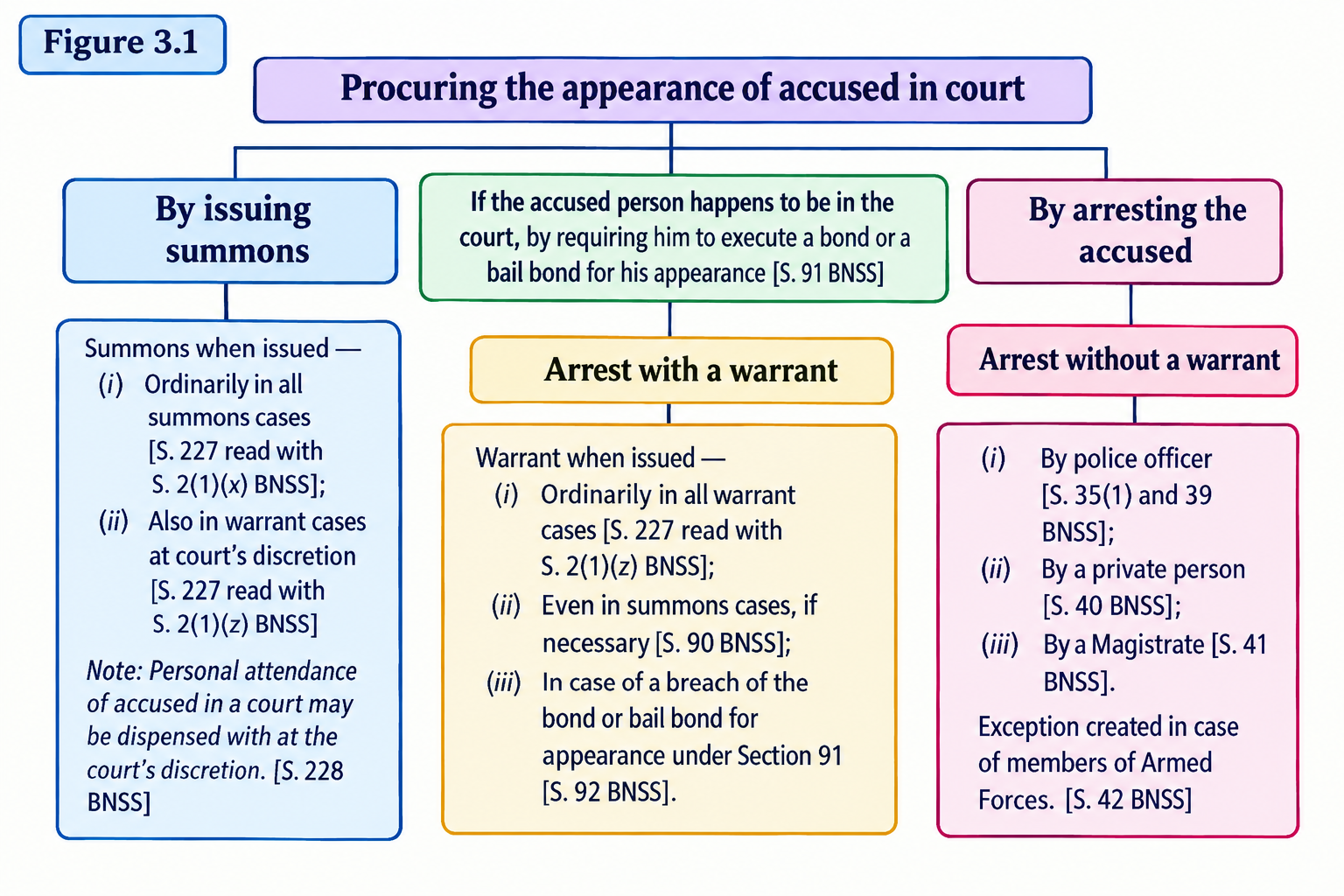
Consequently, statutory frameworks like the BNSS divide all legal arrests into two categories: those executed pursuant to a judicial warrant and those carried out directly by law enforcement under specific statutory exceptions.
3. ARREST WITH A WARRANT
Arrest with a warrant is a legal process by which a person is arrested under the authority of a warrant issued by a Magistrate or court.
Generally, a person involved in a non-cognizable offence cannot be arrested without a warrant, except in situations provided by law.
A Magistrate may issue a warrant after taking cognizance of an offence, whether cognizable or non-cognizable.
In a summons case, the accused is normally first required to appear through a summons, whereas in a warrant case, a warrant may be issued to bring the accused before the court.
If the Magistrate believes that the accused has absconded or will not obey the summons, a warrant may be issued.
Under Sections 72–75 BNSS, a warrant must be in writing, signed by the Presiding Officer, and bear the seal of the court, remaining effective until cancelled or executed.
The court may also provide for release on bail when the required bond and sureties are furnished.
Non-bailable warrants may be issued, but courts must exercise this power with great caution as they affect the accused’s personal liberty under Article 21 of the Constitution.
They should generally be used only when summons or bailable warrants are unlikely to secure attendance, such as where the person is likely to avoid appearing, cannot be found, or may cause harm if not immediately taken into custody.
Finally, Sections 76–83 BNSS deal with the execution of warrants, which may be carried out anywhere in India.
At the time of arrest, the substance of the warrant must be communicated to the arrested person and, where required, the warrant must be shown to him.
The arrested person must ordinarily be brought before the Magistrate within 24 hours of arrest, excluding the necessary travelling time.
4. ARREST WITHOUT A WARRANT
In urgent or emergent situations, waiting to obtain a judicial warrant from a court can hinder justice, creating a clear legal necessity for immediate powers of arrest without prior judicial approval.
While these broad statutory powers are primarily entrusted to police officers to facilitate prompt law enforcement, the law also selectively extends warrant-free arrest authority to other individuals—including private citizens and Magistrates—under specifically defined circumstances.
A. Arrest without a warrant by a police officer
Section 35 of the Bharatiya Nagarik Suraksha Sanhita (BNSS) codifies the statutory parameters governing warrantless arrests by police, establishing a distinction based on offence severity, potential sentence, and investigative necessity.
Police possess broad authority to arrest without a warrant for cognizable offences carrying penalties exceeding seven years, as well as escapees, proclaimed offenders, or army deserters.
However, offences punishable by up to seven years require strict justification, such as preventing evidence tampering, witness intimidation, further criminality, or securing court attendance, along with mandatory written reasons for making or refraining from arrest.
Additional safeguards require DSP-level approval before arresting infirm or elderly persons above 60 years for minor offences, while non-cognizable cases permit warrantless arrest only to ascertain identity under Section 39.
Grounded in constitutional liberty and reinforced by Supreme Court precedents such as Arnesh Kumar v. State of Bihar and Mohd. Asfak Alam v. State of Jharkhand, police are required to serve a notice of appearance rather than make automatic arrests, using a mandatory checklist that Magistrates must scrutinize before authorizing detention.
Judicial precedent establishes that the mere existence of the power to arrest does not justify its routine exercise, and failure by police or Magistrates to follow these safeguards may constitute contempt of court and grounds for immediate bail.
B. Arrest without a warrant by a private person
Under Indian criminal procedure (governed by the BNSS), a private citizen possesses limited statutory authority to make a warrantless arrest if a person commits a non-bailable and cognizable offence in their direct presence, or if the individual is a proclaimed offender.
To prevent unlawful detention or abuse, the law imposes a strict procedural duty on the private citizen to surrender the arrested individual to a police officer or the nearest police station without delay and within a maximum window of six hours.
Upon transfer of custody, the police evaluate the situation: if the person falls under warrantless arrest parameters for serious crimes under Section 35 BNSS, police custody is formally taken; if the act constitutes a minor, non-cognizable offence, Section 39 BNSS protocols apply; and if no reasonable grounds exist to suspect any offence, the individual must be released at once.
C. Arrest without a warrant by a Magistrate
Under criminal procedure, both Executive and Judicial Magistrates possess statutory authority to arrest an individual without a warrant within their local territorial jurisdiction, either directly or through an order to another person, if an offence is committed in their presence or if they are legally competent to issue a warrant for that person’s arrest under the given circumstances.
However, this authority—along with the arrest powers granted to police officers and private citizens—is explicitly constrained when applied to military personnel.
Members of the Armed Forces are protected by a statutory immunity safeguarding them from arrest for acts performed or purported to be performed in the discharge of their official duties, unless prior formal consent is granted by the governing government overseeing that branch of the Armed Forces.
5. ARREST HOW MADE
Under the Bharatiya Nagarik Suraksha Sanhita (BNSS) and established judicial precedents, an arrest requires actual physical contact or confinement unless the individual submits to custody through words or actions.
Strict statutory safeguards exist to protect vulnerable groups, including prohibiting male officers from touching female arrestees and banning night arrests (sunset to sunrise) for women except under rare circumstances approved by a First Class Judicial Magistrate.
Law enforcement officers must maintain transparency by wearing visible identification badges, drafting an attested arrest memorandum, and respecting the arrestee’s right to inform a family member or friend.
While police have the authority to use proportional force to prevent escape or overcome resistance, lethal force is strictly limited to offences carrying life imprisonment or death penalties, and restraint must remain minimal.
Modern handcuffing practice under Section 43(3) BNSS balances Supreme Court restrictions with legislative provisions, limiting fetters primarily to habitual offenders, escapees, or serious crime suspects.
Furthermore, arresting judicial officers requires specialized procedures to protect judicial independence—including mandatory notifications to District and High Courts, avoiding standard station detention, and prohibiting statement recordings or handcuffing without strict safeguards.
Finally, police possess operational powers to force entry into premises, pursue suspects nationwide, command mandatory citizen assistance, delegate arrest execution through written subordinate orders, and immediately rearrest escapees across India.
6. AFTER ARREST PROCEDURES
Under the Bharatiya Nagarik Suraksha Sanhita (BNSS), procedures following an arrest establish clear steps to balance law enforcement duties with human rights protections.
When an arrested person cannot produce bail, police may search the arrestee, confiscate personal items with a receipt, and seize offensive weapons for presentation before the court; female suspects must be searched strictly by female personnel to ensure privacy and decency.
Under Sections 51 and 52, medical examinations may include necessary bodily tests such as blood, urine, or DNA collection by registered medical practitioners, with female doctors mandatory for female arrestees, while reasonable physical force must not violate protections against self-incrimination or become unjustified DNA fishing inquiries.
Further, Sections 54 and 349 allow courts to direct formal identification parades, with audio-video recording and Magistrate supervision where required, and compel specified persons to provide voice samples, fingerprints, and handwriting specimens.
To prevent illegal detention and maintain public oversight, BNSS prohibits discharging arrestees without formal bail or Magistrate orders, requires station officers to report warrantless arrests to the District Magistrate, and mandates State Governments to publicly display real-time arrest logs on digital boards at district headquarters and police stations.
7. RIGHTS OF THE ARRESTED PERSON
Indian procedural law and constitutional safeguards guarantee several fundamental protections to ensure fair treatment for anyone placed under arrest.
Upon being detained, an individual has the right to be informed immediately of the specific grounds for their arrest and, in bailable cases, notified of their entitlement to release on bail.
To prevent secret detentions, police are obligated under provisions like Section 48(1) BNSS to inform a designated relative or friend about the detention location, log this notification in a station register, and confirm compliance before a Magistrate.
Crucially, an arrestee must be produced before a judicial Magistrate within 24 hours of actual physical restraint (excluding travel time), as unauthorized detention beyond this window is unlawful and can lead to judicial sanctions or monetary compensation.
Throughout this process, the accused maintains the right to consult a lawyer of their choice—including private access during interrogations—and indigent individuals must be proactively informed of and provided with state-funded legal aid across all trial and remand stages.
Finally, every arrestee has the right to a prompt medical examination by a qualified practitioner (strictly female medical personnel for female arrestees) to document their physical condition and create an official record of any existing injuries, protecting them against potential mistreatment while in custody.
8. CONSEQUENCES OF NON-COMPLIANCE WITH THE PROVISIONS RELATING TO ARREST
The legal framework under Section 8, “CONSEQUENCES OF NON-COMPLIANCE WITH THE PROVISIONS RELATING TO ARREST,” details the precise consequences that follow when procedures governing detentions are breached.
While procedural errors or illegalities during an arrest do not render the primary criminal trial void, they play a crucial role if the accused is prosecuted for escaping or resisting custody, as an unlawful arrest validates the exercise of private defense under Sections 34 to 44 of the BNS.
Public officers who knowingly execute illegal arrests face criminal prosecution under Section 258 BNS, while any individual committing an unauthorized detention is punishable for wrongful confinement under Section 127 BNS.
Unlawful detentions also constitute civil torts of false imprisonment.
Supported by the Supreme Court precedent in Nilabati Behera, the law dictates that suspicion or prior criminal history never justifies procedural deviations; any violation of fundamental rights carries an absolute entitlement to monetary compensation alongside departmental disciplinary action against the offending officer.
Finally, police authorities cannot bypass statutory safeguards by labeling a restriction as “informal detention,” as any unauthorized restraint is strictly prohibited under Indian law.