OSM Checking in CBSE: A Complete Guide for Students and Teachers
The landscape of secondary and senior secondary schooling in India is undergoing its most massive technological evolution. If you are part of the K-12 academic ecosystem, you have likely heard whispers, concerns, or praise surrounding the new phrase dominating board exam discussions: OSM checking in CBSE.
Standing for On-Screen Marking, OSM represents a monumental shift away from traditional, red-pen-and-paper evaluation. Introduced at scale for the Class 12 board examinations, this digital transformation marks the end of physically transporting, bundle-tying, and manually totaling millions of answer booklets.
Whether you are an anxious student waiting for results, a parent trying to decipher how scores are calculated, or an educator logging onto the portal for the first time, this comprehensive guide unpacks everything you need to know about the modern CBSE digital evaluation system.
1. What is OSM Checking in CBSE?
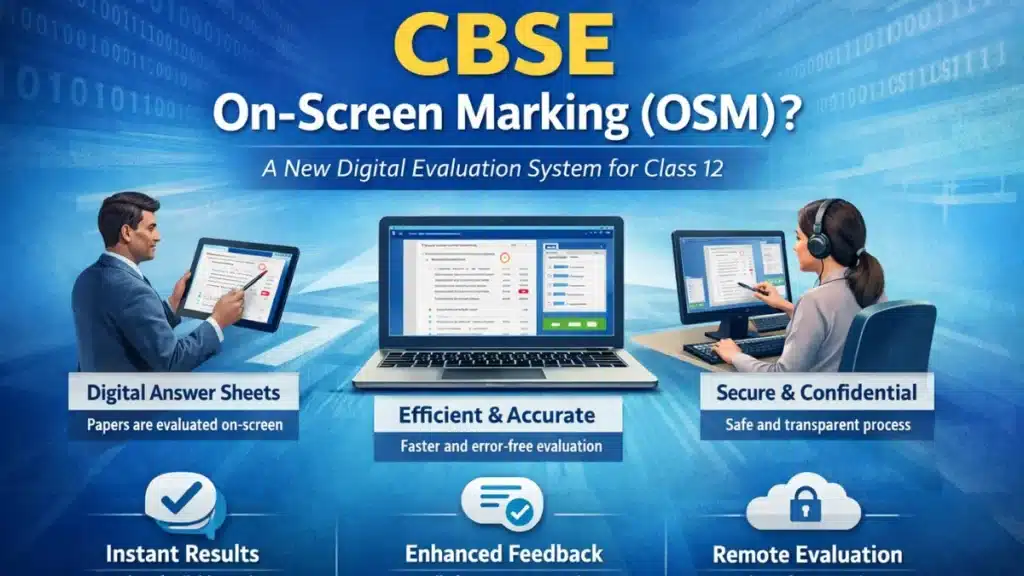
To put it simply, OSM checking in CBSE is a digital answer sheet evaluation framework where physical answer scripts are transformed into electronic files. Instead of an examiner physically flipping through pages at a designated evaluation center, the entire booklet is reviewed on a computer screen using highly secure, specialized software.
Official Definition: As per the Central Board of Secondary Education, On-Screen Marking (OSM) is an advanced technological workflow where actual answer books are digitally scanned and made available securely on screens for question-wise evaluation by authorized human examiners.
It is crucial to correct a common misconception right away: Computers or Artificial Intelligence (AI) do not grade the student’s answers. The intellectual task of reading, analyzing, and grading responses remains entirely in the hands of qualified, human teachers. The technology merely serves as the interface, removing human error from the logistical and administrative parts of the marking process.
2. Why Did CBSE Shift to the On-Screen Marking System?
For decades, evaluating board exam papers was an administrative nightmare. Managing nearly a crore of answer sheets across the length and breadth of India involved massive logistical risks, ranging from physical damage and transit delays to regional containment of evaluation talent.
The CBSE digital evaluation system was implemented to achieve three core goals:
Absolute Accuracy: To entirely eliminate clerical errors, such as a teacher accidentally skipping a page or making a mistake while adding up marks.
Enhanced Secrecy & Security: To protect student identities by ensuring papers are distributed randomly across regional boundaries without any physical indicators of the school or location.
Accelerated Timelines: To speed up the CBSE result evaluation process so students can receive their marks and transition into higher education counseling smoothly.
3. Step-by-Step: How Board Exam Copies are Checked Digitally
The journey from a student’s desk to the official digital mark sheet follows a strict, highly secure, multi-tier operational pipeline:
[Exam Centre: Students write physical scripts]
       │
       ▼
[Regional Offices: Security checks & spine scanning done]
       │
       ▼
[Quality Control Portal: Scans checked for clarity]
       │
       ▼
[OSM Portal: Random distribution to Evaluators]
       │
       ▼
[Final Grading: Question-wise marking & auto-summing]
Step 1: Secure Collection and Anonymization
Once the board examination concludes at designated centers, physical answer sheets are sealed and transported directly to CBSE Regional Offices. Here, rigorous secrecy work is completed, ensuring student roll numbers are completely masked.
Step 2: High-Fidelity Non-Destructive Scanning
Unlike early experimental models that required cutting the spines of booklets, modern evaluation infrastructure uses specialized lamp scanners. These scan the entire book cleanly without modifying the physical script, creating a flawless digital twin.
Step 3: Two-Tier Quality Control (QC)
Before an answer sheet enters the evaluation pool, a dedicated QC team conducts two layers of checks. If a scan is blurred, incomplete, or faint, it is flagged and rescanned immediately.
Step 4: Random Borderless Allocation
The digital files are uploaded to the secure CBSE on screen marking portal. The system then distributes these files randomly to registered teachers across different states. A teacher in Delhi might evaluate a script written by a student in Mumbai, completely eliminating regional biases.
Step 5: Screen Evaluation and Automated Aggregation
The examiner logs in via an encrypted terminal using mandatory static IP restrictions. They view the script page-by-page, cross-referencing answers with the official CBSE marking scheme displayed on a split screen. As they enter marks question-by-question, the software automatically aggregates the total.
4. The Architecture of the CBSE On-Screen Marking Portal
The digital interface utilized by evaluators is not a basic PDF reader; it is a highly secure, workflow-controlled enterprise platform. For a smooth operational cycle, schools operating as digital evaluation hubs must meet strict technological benchmarks.
System Prerequisites for Evaluation Centers:
Operating System: Windows 8 or above with dedicated administrative privileges.
Hardware: Minimum 4 GB RAM, 1 GB free space on the C-drive, and an uninterrupted power supply (UPS) backup.
Network Security: A dedicated internet connection running at a minimum speed of 2 Mbps, coupled with a mandatory Public Static IP address to block unauthorized external access.
Software Dependency: Latest updates of secure browsers (Chrome or Edge) equipped with standardized Adobe Reader environments.
The software layout is explicitly engineered to optimize a teacher’s focus. The screen features a distinct color-coding matrix that changes depending on whether the user is an Evaluator, an Additional Head Examiner (AHE), or a Head Examiner (HE), allowing transparent hierarchical checks.
5. Crucial Benefits of OSM for Students
Understandably, changes to exam grading systems can cause anxiety for students. However, the structural design of OSM checking in CBSE offers several clear protective advantages for candidates:
Zero Totalling Blunders: In the legacy paper format, a teacher manually summing up twenty different numbers on a cover sheet could occasionally make an error. Under the digital evaluation system, human totaling is completely removed; the software performs the calculation automatically.
No Left-Out Answers: The system prevents an evaluator from submitting a final grade score sheet if any written page or question remains unvisited or unmarked.
Objective Marking Scheme Integration: The portal forces strict alignment with step-by-step marking schemes. Evaluators cannot hand out arbitrary lump-sum marks; they must award grades progressively based on points, keywords, and specific steps.
Geographical Independence: Because digital scripts travel across state borders seamlessly, evaluation parameters remain uniform, objective, and standardized nationwide.
6. How OSM Transforms the Workflow for Teachers
For educators, transitioning to the CBSE digital evaluation system represents an initial learning curve that ultimately leads to long-term professional relief.
Old System: Physical handling, counting sheets, manually adding marks, clerical cross-checking.
New System: Digital login, split-screen guidelines, automated totals, zero clerical filing.
By taking away administrative tasks like filling out physical award sheets, double-checking page totals, and organizing paper bundles, the platform gives teachers more time to focus purely on reading and evaluating the student’s work.
Furthermore, senior moderators (AHEs and HEs) can monitor evaluation patterns in real time. If an examiner is marking too strictly or too leniently compared to standard expectations, the platform flags the trend immediately, allowing for quick corrections.
7. Addressing the Technical Controversies and Realities
Like any massive technological roll-out in a nation as vast as India, the deployment of OSM checking in CBSE has faced close public and media scrutiny. During recent result cycles, discussions surfaced online regarding minor technical glitches, slow portal loading times, and instances of faint handwriting scans.
To address these concerns transparently, the Ministry of Education and technical vendors clarified that the system contains robust built-in safeguards. Examiners have the explicit authority to reject any digital script that appears illegible or blurred, pushing it back to the regional office for physical verification or high-resolution scanning.
Isolated operational issues do not reflect systemic software failures. The board continuously updates its infrastructure based on field feedback, reinforcing public trust in the validity and security of digital grading.
8. Re-evaluation and Verification Rules under the Digital Era
A significant benefit of the digital system is how easy it makes post-exam transparency. If a student feels their final scores do not accurately reflect their performance, the process to request a review is smoother than ever.
To support students, the board provides affordable, step-by-step avenues for review:
Verification of Marks: A quick digital check to ensure all sections were successfully graded and no totaling anomalies occurred.
Access to Scanned Copies: Students can request a direct digital copy of their evaluated answer sheet for a minimal processing fee, allowing them to see exactly where marks were awarded.
Re-evaluation: If an answer matches the official model key but was marked incorrectly, students can challenge specific questions online. If the review changes their score, the processing fees are refunded directly to the student.
9. Essential Tips for Students Writing for Digital Evaluators
Knowing that your answer script will be scanned and read on a computer screen means you should adjust how you present your work. Students can optimize their answer sheets for digital scanning by keeping a few practical tips in mind:
Presentation Tip for the Digital Era:
Use high-quality blue or black ballpoint/gel pens that leave a crisp, bold mark. Faint, ultra-fine pens or light pencils can occasionally lose contrast during high-speed scanning.
Maintain Clear Margins: Write clearly within the designated boundaries of the answer booklet. Avoid cramming text into the extreme outer edges or corners of the page.
Box Your Final Answers: When solving complex math, physics, or accounting equations, clearly box your final numerical values. This makes it easy for an examiner reviewing your work on a screen to spot key milestones instantly.
Clean Corrections: If you make a mistake, simply draw a single clean line through the incorrect text. Avoid messy scribbling, heavy overwriting, or using fluid correctors, as these can look distorted or illegible on an evaluator’s monitor.
10. Summary: The Future Roadmap of K-12 Assessments
The transition to OSM checking in CBSE is more than a temporary update; it is a permanent step forward for India’s foundational education system. By combining human expertise with digital speed, security, and precision, the board is building an evaluation ecosystem that meets international benchmarks.
| Evaluation Feature | Traditional Paper Method | Modern OSM Digital System |
| Logistics Risk | High (Physical transit, damage) | Very Low (Encrypted cloud uploads) |
| Identity Secrecy | Manual masking patches | Automated borderless randomization |
| Calculation Errors | Possible during manual tallying | Zero (System-enforced auto-summing) |
| Skipped Pages | Risk of human oversight | Blocked by mandatory software checks |
As infrastructure continues to improve across schools nationwide, digital marking will pave the way for faster results, lower stress levels, and unmatched transparency—helping every student receive the fair, accurate, and objective evaluation they deserve.
External Resources and Official Links
To read official regulatory updates and access technical circulars, visit the Central Board of Secondary Education Portal.
For formal announcements from the Ministry of Education regarding school evaluation reforms, check the Press Information Bureau (PIB) India.
To look over comprehensive curriculum guides and download official model solution sets, browse the resource repository on Vedantu Learning Base.
Understanding the CBSE Paper Checking Process is an insightful video analysis that breaks down the structural mechanics, timeline shifts, and recent re-evaluation fee changes surrounding the digital portal transition.

How useful was this post?
Click on a star to rate it!
Average rating 5 / 5. Vote count: 4
No votes so far! Be the first to rate this post.