The Impact of AR and VR in Science Classrooms: Benefits and Applications
Introduction: The Spatial Computing Revolution in Science Classrooms
The traditional science classroom—long defined by static blackboards, two-dimensional textbook illustrations, and rigid physical laboratory sessions—is undergoing a fundamental transformation. As spatial computing accelerates, AR and VR in science classrooms are shifting the educational paradigm from passive information consumption to active visual discovery.
Educators around the globe are discovering that augmented reality in science education and virtual reality science applications can demystify complex theories, elevate student motivation, and create inclusive learning environments. By bringing invisible physical forces, microscopic biological structures, and distant astronomical bodies directly to students’ eyes, immersive learning in science education is bridging the gap between theoretical abstract concepts and tangible understanding.
1. Defining the Technologies: Differentiating AR, VR, and XR for STEM
To maximize the impact of AR and VR in science classrooms, school administrators and STEM educators must understand how these distinct spatial computing tools function within educational technology frameworks:
Augmented Reality (AR): Projects digital layers—such as 3D anatomical models, magnetic vector lines, or chemical bonds—onto the real-world environment through mobile devices, tablets, or smart glasses. AR enhances real physical classrooms without cutting students off from their teacher or peers.
Virtual Reality (VR): Completely replaces the physical surroundings with a fully synthetic, computer-generated 3D environment via dedicated head-mounted displays. VR immerses the learner inside a virtual space, allowing them to travel to places that are otherwise physically impossible to visit.
Extended Reality (XR): Serves as an inclusive industry term encompassing AR, VR, and Mixed Reality (MR), providing a complete spectrum of digital-to-physical integration for modern STEM instruction.
  PHYSICAL REALITY ◄────────────────────────────────────────► VIRTUAL REALITY
                            EXTENDED REALITY (XR)

    Real Classroom  ──►   Augmented Reality (AR)   ──►   Virtual Reality (VR)
   Physical desk &      Digital overlays added to        Complete 3D digital
    paper textbook        physical desk setup            environment immersion
For official research and whitepapers on spatial computing standards in educational technology, explore resources from the U.S. Department of Education on digital learning integration.
2. Deconstructing Abstract Concepts with 3D Spatial Visualization
A major hurdle in traditional STEM education is conveying abstract, non-visible phenomena. Concepts like quantum mechanics, atmospheric pressure systems, or molecular bonding are difficult to capture through static textbook drawings. Spatial learning with AR and VR solves this by turning two-dimensional diagrams into fully interactive, scalable 3D models.
┌─────────────────────────────────────────────────────────────┐
│                 2D TRADITIONAL LEARNING                     │
│  Static Diagrams  ──►  Abstract Thinking  ──►  Memory Decay │
└──────────────────────────────┬──────────────────────────────┘
                               │
                               ▼
┌─────────────────────────────────────────────────────────────┐
│                  3D IMMERSIVE AR/VR LAB                     │
│  Spatial Interaction ──►  Active Discovery ──► Deep Recall  │
└─────────────────────────────────────────────────────────────┘
When studying molecular orbital theory, students using AR science software can project dynamic atomic models directly onto their laboratory desks. They can physically walk around the molecule, examine electron cloud distributions from multiple angles, and witness chemical bonding interactions in real time. Similarly, VR astrophysics simulations allow astronomy students to stand inside solar systems, manipulate planetary axes, and observe gravitational field interactions firsthand.
3. Virtual Chemistry Laboratories: Risk-Free, Scalable Scientific Experimentation
Conducting physical chemistry experiments involves operational risks, expensive chemical reagents, strict safety precautions, and waste management overhead. Virtual reality chemistry labs offer a safe, scalable, and highly effective environment for student-led experimentation.
Through VR chemistry simulations, learners can mix volatile compounds, adjust ambient temperature controls, and observe thermal reactions without hazardous exposure or material costs. If a student makes an operational mistake during a virtual lab experiment, the software triggers a realistic, non-hazardous visual simulation of the chemical consequence. This safe environment encourages curiosity-driven learning through trial and error.
Primary Benefits of Virtual Chemistry Environments:
Risk-Free Science Experiments: Eliminates direct exposure to corrosive acids, toxic gases, open flames, and flying glass shards.
Unrestricted Laboratory Access: Enables students to repeat complex chemical reactions as many times as needed to grasp reaction mechanics.
Dramatic Cost Reduction: Decreases school operational expenditures on single-use chemicals, specialized ventilation, and glass laboratory equipment.
Environmental Sustainability: Eliminates chemical waste disposal, aligning science education with eco-friendly laboratory practices.
4. Transforming Biology Instruction: Interactive Dissections and Cellular Exploration
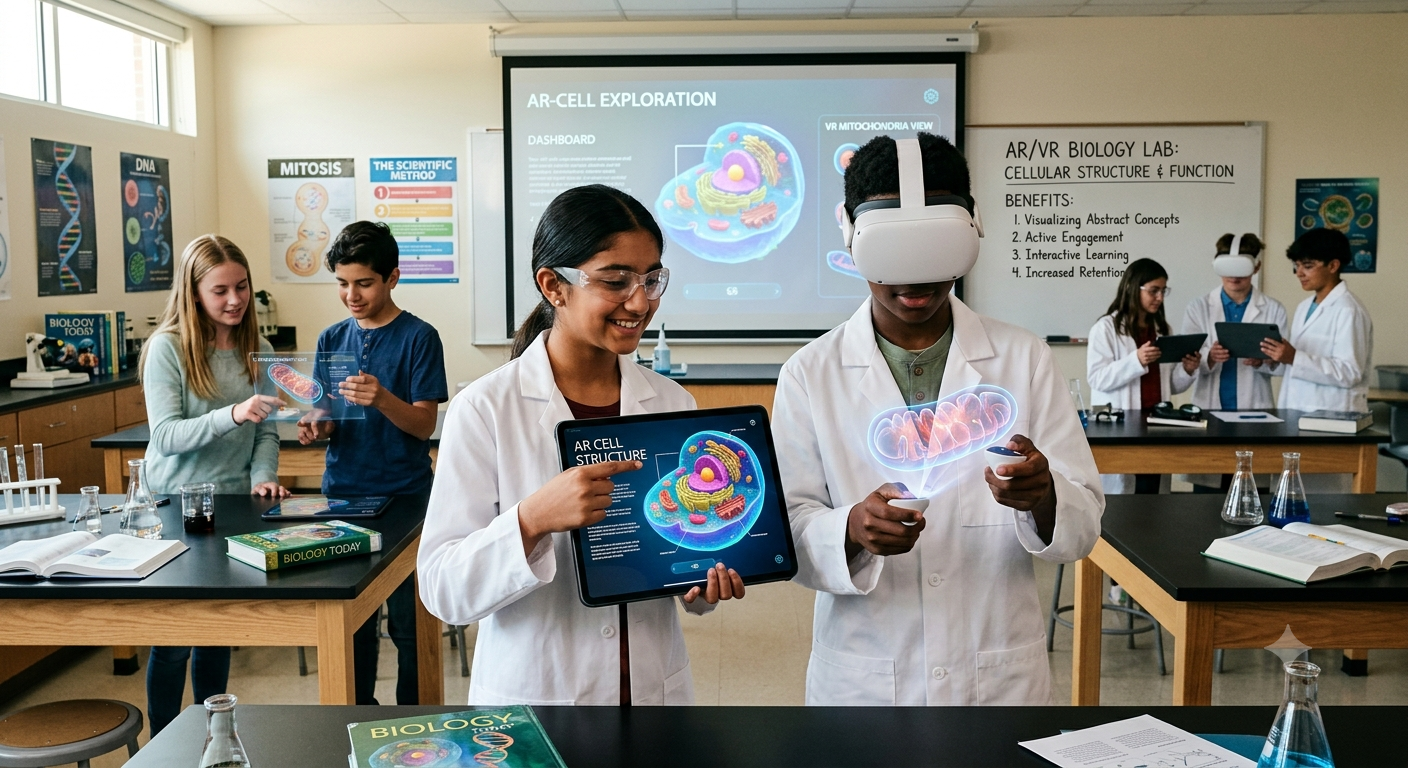
Biology and human anatomy instruction have relied heavily on physical dissections or synthetic plastic models. However, ethical concerns, material availability, and one-time-use constraints limit traditional biology labs. AR and VR in biology education offer dynamic, ethically sound, and fully repeatable alternatives.
Using AR biology applications, students can superimpose layered anatomical systems—such as cardiovascular, nervous, and digestive networks—onto human anatomical mannequins or table surfaces. Learners can isolate specific organs, examine simulated blood flow patterns through heart valves, and trace nerve pathways interactively.
Furthermore, VR cellular exploration modules shrink students down to microscopic scales. Learners can navigate through human vascular systems, watch cell membrane transport mechanisms in action, and observe cellular division firsthand. This micro-level spatial perspective instills a deep conceptual understanding that textbook illustrations simply cannot replicate.
For peer-reviewed research on technology-enhanced learning and spatial cognitive development, visit the National Science Foundation STEM education research portal.
5. Immersive Virtual Field Trips: Exploring Earth Science and Remote Ecosystems
Extending learning beyond classroom walls through field trips enriches science education by connecting theory with natural phenomena. However, budget limits, insurance liabilities, transportation logistics, and geographic boundaries make frequent trips unrealistic for most schools. Virtual field trips with VR technology eliminate these physical boundaries completely.
Through immersive VR field trips, earth science and environmental biology classes can explore extreme locations worldwide:
Deep-Sea Oceanography: Dive to oceanic trenches to analyze hydrothermal vent ecosystems, marine bioluminescence, and coral reef health.
Volcanology and Geology: Stand on active volcanic rims, walk inside lava tubes, and examine tectonic fault lines safely.
Polar Glaciology: Inspect melting ice sheets, study ice-core sampling techniques, and analyze climate change indicators in real time.
Planetary Geology: Traverse the surface of Mars or the Moon using high-resolution spatial terrain data mapped by space exploration rovers.
By removing geographic and economic hurdles, virtual reality field trips level the playing field, granting every student equal access to global ecosystems.
6. Elevating Student Engagement and Long-Term Knowledge Retention
Active involvement is essential for effective science learning. Passive lectures and textbook readings often lead to low information retention. In contrast, interactive AR and VR learning tools require active participation, leading to stronger knowledge retention and deeper conceptual mastery.
  Traditional Lecture / Reading  ───►  Low Knowledge Retention (~10% - 20%)
  Interactive AR/VR Experiments  ───►  High Knowledge Retention (Up to 75%)
Cognitive science shows that when students manipulate 3D objects, move through virtual space, and make choices during a simulation, their brains process the activity as an authentic physical event. This multi-sensory engagement builds strong neural pathways, improving memory recall during assessments.
Additionally, gamified AR/VR science programs integrate achievement systems, interactive problem-solving quests, and real-time visual feedback. Gamification turns challenging science topics into exciting discovery journeys, inspiring genuine student interest in STEM fields.
7. Improving Inclusive Science Education and Special Needs Accessibility
Inclusivity remains a core goal for modern educational institutions. AR and VR technologies in inclusive education offer adaptable interfaces that accommodate diverse physical abilities, cognitive profiles, and learning styles.
For students with mobility limitations who cannot participate in traditional physical field trips or laboratory exercises, accessible VR science simulations offer complete, barrier-free participation. Kinesthetic and visual learners benefit from hands-on 3D manipulation, while neurodivergent students—including those with ADHD or autism—often thrive in distraction-free, controlled virtual environments.
Educators can review national digital accessibility standards and inclusive education frameworks via the International Society for Technology in Education (ISTE) platform.
8. Addressing Implementation Challenges: Cost, Training, and Curriculum Integration
While the advantages of AR and VR in science classrooms are clear, widespread adoption faces practical operational hurdles. School leadership and technology directors must address several key implementation challenges:
1. Hardware Costs and Infrastructure Readiness
High-performance VR headsets require upfront capital investment, robust Wi-Fi networks, and ongoing hardware management. However, the rise of standalone headsets and smartphone-compatible AR educational software is dramatically lowering entry costs.
2. Curriculum Alignment and Quality Educational Software
For immersive technology in STEM education to deliver meaningful outcomes, digital content must align directly with state and national educational standards. Software developers are increasingly building standard-compliant science units across physics, chemistry, biology, and earth science.
3. Educator Training and Professional Development
Educational technology is only as effective as the teachers guiding its use. Continuous professional development is essential to equip educators with the skills to incorporate AR and VR tools smoothly into daily lesson plans without disrupting class workflow.
9. Future Trends: AI Integration and Multimodal Haptic Feedback in Immersive Learning
As spatial computing advances, the convergence of Artificial Intelligence (AI) in education and spatial AR/VR environments will open new horizons for personalized science instruction.
  AI Behavioral Analytics + Immersive 3D Spatial Labs
                       │
                       ▼
  Adaptive Science Content Customized to Individual Student Pace
Future smart AR/VR educational platforms will feature real-time AI lab assistants. These intelligent virtual tutors will monitor student choices inside 3D lab simulations, spot misconceptions immediately, and adjust simulation parameters to match each student’s learning pace.
Furthermore, advancements in haptic feedback technology will soon allow students to physically feel tactile resistance during virtual dissections, sense molecular forces, or feel magnetic field pushes within simulated vector spaces. The line between physical and digital science learning will continue to blur, making scientific inquiry more intuitive, engaging, and impactful than ever before.
10. Conclusion: Shaping the Future of STEM Education
The integration of AR and VR in science classrooms marks a major evolution in how scientific principles are taught and understood. By turning passive lectures into active, three-dimensional discovery experiences, spatial computing demystifies complex theories, eliminates laboratory safety risks, and makes high-quality experiential learning available to all students.
As hardware becomes more affordable and curriculum-aligned software expands, immersive learning technologies will transition from novel teaching aids to core foundations of modern science pedagogy. By empowering students to explore the microscopic world, travel to deep-sea ecosystems, and experiment without fear of failure, educators are inspiring the next generation of scientific leaders and innovators.

How useful was this post?
Click on a star to rate it!
Average rating 0 / 5. Vote count: 0
No votes so far! Be the first to rate this post.