
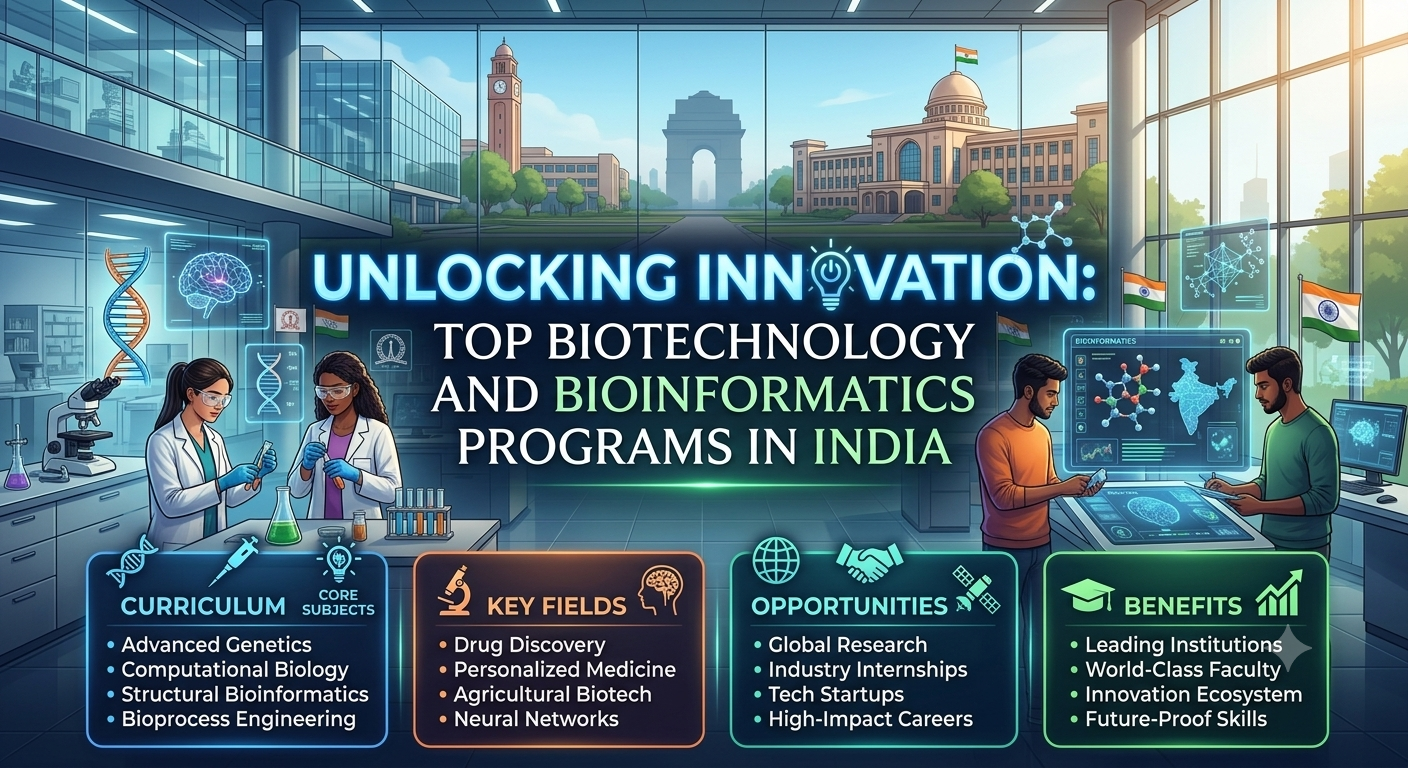
Unlocking Innovation: Top Biotechnology and Bioinformatics Programs in India
The natural world is governed by a highly sophisticated, organic software code: deoxyribonucleic acid, or DNA. For generations, the study of biological sciences was primarily observational and descriptive. Students memorized the anatomical structures of plants, classified animal species, and ran basic petri-dish cultures in school laboratories. However, as we progress through the highly automated, tech-driven landscapes of 2026, the study of life has transformed from an observational science into an active engineering discipline.
Today, we are no longer just observing nature; we are actively rewriting it.
This biological revolution has catalyzed the explosive rise of two highly interdisciplinary, high-growth fields: Biotechnology and Bioinformatics. For students who possess a deep curiosity for biological systems but want to avoid the intense clinical stress of traditional MBBS pathways, these branches offer the ultimate launchpad. Securing a seat in the top biotechnology programs in India or enrolling in advanced bioinformatics courses in India has emerged as a premier career strategy, putting young professionals at the absolute forefront of global medical, agricultural, and technological breakthroughs.
1. The Biological Revolution: Why Biotech and Bioinformatics are Dominating in 2026
The global demand for biological innovators has escalated to unprecedented heights. The rapid development of mRNA vaccines, the emergence of targeted gene therapies, and the necessity for climate-resilient, genetically modified crops have proven that national security and economic prosperity are directly tied to biological capabilities.
In India, this realization has triggered massive public and private investments. The government is actively building regional biotech parks, funding research cleanrooms, and establishing specialized startup incubators.
By choosing these modern disciplines over legacy sciences, students are entering a dynamic job market characterized by rapid growth, substantial research funding, and international career mobility. It represents a major paradigm shift, transforming biology from a classical textbook subject into a highly practical, software-integrated engineering domain.
2. Understanding Biotechnology: From Cellular Labs to Industrial Scale
Biotechnology is an applied science that utilizes living organisms, cellular components, and biological systems to develop products and technologies aimed at improving human life and the health of the planet.
The discipline is highly diverse, spanning multiple functional areas:
Red Biotechnology (Medical): Designing customized biopharmaceuticals, synthesizing monoclonal antibodies, and developing gene therapies to target complex diseases like cancer.
Green Biotechnology (Agricultural): Engineering crops that can survive extreme droughts, resist localized pests, and deliver higher nutritional value without relying on chemical pesticides.
White Biotechnology (Industrial): Utilizing enzymes and micro-organisms to design eco-friendly biofuels, biodegradable plastics, and sustainable chemical manufacturing processes.
Students pursuing this pathway spend their time mastering cell biology, molecular genetics, bioprocess engineering, and immunology, learning to scale laboratory discoveries into mass-market industrial solutions.
3. Understanding Bioinformatics: The Convergence of Biology and Big Data
While biotechnology deals with the physical, wet-lab manipulation of biological materials, Bioinformatics is the digital brain that makes those physical manipulations possible.
Bioinformatics is an interdisciplinary field that develops and utilizes specialized software tools, databases, and algorithms to analyze, visualize, and interpret massive volumes of biological data.
With the advent of high-throughput next-generation sequencing, a single human genome analysis generates terabytes of raw data. A human researcher cannot analyze this mountain of genetic information manually. This is where bioinformatics professionals step in. They use computer programming, advanced statistics, and database management to:
Map and Sequence Genomes: Identifying the exact sequence of DNA base pairs to locate disease-causing mutations.
Model Protein Structures: Predicting how proteins fold to design customized drug molecules that fit perfectly into target cellular receptors.
Analyze Evolutionary Trends: Tracking how viruses mutate in real time to update vaccine designs before outbreaks spread.
If your interests lie at the intersection of biological science and software programming, bioinformatics is your natural academic home.
4. Top Biotechnology Programs in India: Premier Public and Private Institutions
Securing admission to the best biotech colleges in India is the first step to building a globally competitive career. The country houses several elite public and private institutions offering world-class training:
Indian Institute of Science (IISc), Bengaluru
IISc is the undisputed crown jewel of scientific research in India. The institute’s Department of Biochemistry and Department of Molecular Reproduction, Development and Genetics run cutting-edge undergraduate, integrated Ph.D., and post-doctoral programs that focus heavily on translational medicine and cellular biology. To explore their active research projects, laboratory infrastructures, and academic curricula, you can consult the official Indian Institute of Science (IISc) Portal.
Indian Institutes of Technology (IITs)
The premier IITs—most notably IIT Bombay, IIT Delhi, IIT Madras, and IIT Kharagpur—offer highly prestigious B.Tech and Dual Degree programs in Biotechnology and Biochemical Engineering. These programs combine the structural discipline of engineering with advanced molecular biology, preparing graduates for high-level research or corporate bioprocess roles.
Rajiv Gandhi Centre for Biotechnology (RGCB), Thiruvananthapuram
Operating as an autonomous national institute under the Department of Biotechnology, Government of India, RGCB is exclusively dedicated to advanced disease biology research and molecular medicine, offering stellar post-graduate and doctoral opportunities.
5. Leading Bioinformatics Courses in India: Unlocking Genomic Data
Because bioinformatics requires a highly specialized blend of biology and computational training, choosing an institution with a dedicated data-science infrastructure is crucial.
Jawaharlal Nehru University (JNU), New Delhi: JNU’s School of Computational and Integrative Sciences is a pioneer in bioinformatics education, offering highly rated M.Sc. and Ph.D. programs that train students in molecular modeling, database design, and systems biology. To check active entrance exam schedules, eligibility criteria, and syllabus breakdowns, candidates can refer to the centralized GAT-B Admission Portal managed by the RCB.
University of Pune (SPPU), Pune: The Bioinformatics Centre at Savitribai Phule Pune University is globally recognized for its academic excellence. The center maintains state-of-the-art supercomputing facilities, allowing students to run complex molecular dynamics simulations and big data analyses.
Institute of Bioinformatics and Applied Biotechnology (IBAB), Bengaluru: Situated in India’s tech capital, IBAB offers highly specialized post-graduate diplomas and master’s degrees that bridge the gap between academic theory and the practical demands of the pharmaceutical and data analytics industries.
6. Key Selection Criteria: How to Spot a High-Quality Biotech & Bioinformatics College
With hundreds of colleges claiming to offer “industry-ready” programs, parents and students must remain highly selective to protect their career investments. Avoid colleges that offer purely theoretical courses, and evaluate potential institutions using these three critical pillars:
State-of-the-Art Laboratory Infrastructure: Biotechnology cannot be learned from a whiteboard. The college must house operational cleanrooms, advanced spectrophotometers, DNA sequencers, cell culture hoods, and high-capacity bioreactors. For bioinformatics, check if they have dedicated computer labs with access to advanced genomic databases, molecular docking software, and cloud-computing resources.
Active Research Funding and Grants: Exceptional colleges do not rely solely on tuition fees; their faculty members regularly secure competitive research grants from national and international funding agencies. This funding directly translates into advanced lab equipment and opportunities for students to work on active, cutting-edge projects.
Industry-Integrated Internships: The program must feature a mandatory, structured internship block where students spend several months working inside corporate pharmaceutical companies, agricultural tech centers, or bioinformatics data offices. This real-world exposure is the most reliable bridge to secure full-time placements.
To evaluate and cross-reference institutional quality standards, national rankings, and infrastructural scores on a standardized scale, students can consult the National Institutional Ranking Framework (NIRF) Official Directory.
7. Career Opportunities and Placement Scenarios for Indian Graduates
Graduating from the top biotechnology programs in India or completing specialized bioinformatics courses in India opens up a highly diverse, lucrative array of professional pathways:
Clinical Research and Biopharmaceuticals
Graduates are recruited by leading global and domestic pharmaceutical giants (such as Biocon, Dr. Reddy’s Laboratories, Serum Institute of India, and Cipla) to work as clinical trial managers, research scientists, drug safety associates, and quality control analysts.
Genomic Data Science and Computational Biology
Bioinformatics specialists are highly sought after by IT giants, specialized healthcare analytics firms, and genetic testing startups to write algorithms that interpret consumer DNA tests, run molecular docking simulations, and manage large clinical databases.
Agricultural Technology and Food Security
Working with corporate seed companies, fertilizer manufacturers, and agricultural research hubs to design high-yielding, climate-resilient crops, bio-pesticides, and organic soil enhancers.
Intellectual Property Rights (IPR) and Patent Law
Every new biological discovery, drug molecule, or genetically modified seed must be legally protected. Graduates who transition into patent law, biosafety compliance, or technology transfer offices secure highly prestigious, high-paying corporate advisory roles.
8. Regulatory Bodies, Funding, and Government Schemes in India
The rapid expansion of the biological sector in India is guided and funded by a highly supportive network of national agencies. Understanding these bodies is essential for students looking to secure research scholarships and project funding:
The Department of Biotechnology (DBT): Operating under the Ministry of Science and Technology, the DBT is the primary promoter, regulator, and funding agency for biotechnology in India, managing national laboratories, international collaborations, and academic fellowships. To review active scholarship schemes, research grants, and policy frameworks, you can consult the official Department of Biotechnology (DBT) India Portal.
Biotechnology Industry Research Assistance Council (BIRAC): A non-profit public sector enterprise set up by the DBT, BIRAC acts as an interface agency to support and fund high-risk, innovative biotech startups and facilitate product commercialization.
National Institute of Biomedical Genomics (NIBMG): Located in Kalyani, West Bengal, NIBMG is an autonomous institute under the DBT dedicated exclusively to research in human genetics, genomic medicine, and disease susceptibility. Students and researchers can track genomic databases, academic publications, and training workshops via the official NIBMG Academic Portal.
9. Fostering Innovation: The Synergy of Indian Startups and Global Research
The transition from academic theory to commercial success requires a highly active startup ecosystem. Through the support of BIRAC and national incubators, India is witnessing a massive boom in deep-tech biological startups:
MedGenome: A global leader in genomics-driven diagnostics, specializing in genetic testing, genomic sequencing, and bioinformatics solutions to identify rare hereditary disorders and personalized oncology markers.
Pandorum Technologies: A tissue-engineering startup that designs bio-printed human tissues, including artificial cornea scaffolds and liver tissue patches, to reduce the reliance on animal testing and address organ shortage crises.
String Bio: Utilizing advanced fermentation and synthetic biology to convert methane gas (a greenhouse pollutant) into high-quality, sustainable protein feeds for agriculture and aquaculture.
These innovative enterprises demonstrate that a biological sciences degree in 2026 is no longer restricted to traditional classroom teaching; it is a powerful vehicle to build disruptive, multi-million dollar technological solutions that can heal, feed, and protect the entire planet.
10. Conclusion: Paving Your Path in the New Era of Biological Sciences
The definitive verdict of the modern educational landscape is highly encouraging: excellent medical and scientific careers are no longer restricted to traditional hospital consulting rooms.
By stepping into the fast-growing fields of biotechnology and bioinformatics—ranging from the physical precision of genetic engineering and bioprocess scaling to the digital power of genomic data science and molecular modeling—you can build an exceptionally rewarding, globally competitive career.
Do not let societal stereotypes, peer pressure, or administrative confusion dictate your professional destiny. Audit your academic strengths honestly, select colleges with robust laboratory infrastructures, utilize state-sponsored research fellowships, stay informed via official national databases, and step confidently onto a career path that will empower you to translate your scientific curiosity into life-saving innovations for the entire world.

How useful was this post?
Click on a star to rate it!
Average rating 0 / 5. Vote count: 0
No votes so far! Be the first to rate this post.