
Section 3 Evidence May Be Given of Facts in Issue and Relevant Facts.
Section 3 establishes the foundational boundary of courtroom proof, dictating that evidence can only be introduced for facts in issue or other facts expressly declared relevant by law, and for no others.
In plain terms, this means a court will strictly confine its admissibility decisions to what the statute permits, filtering out any extraneous arguments, common-sense assumptions, or outside notions of public policy unless they fit squarely within the legal framework.
Consequently, litigants cannot rely on plausibility or general fairness alone; every piece of evidence tendered must find explicit justification under the Act while remaining compliant with procedural laws that govern how and when proof can be presented.
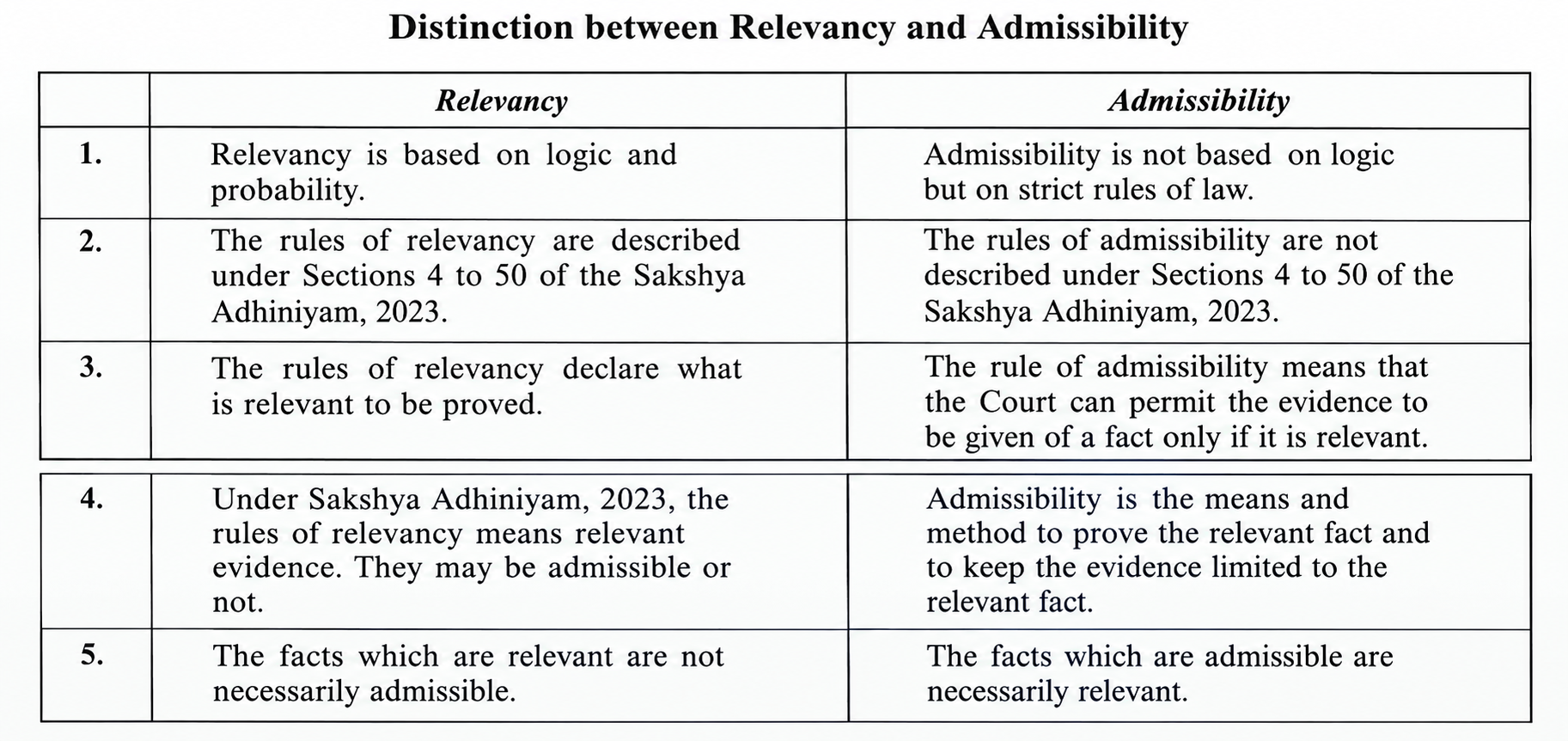
Distinction between relevancy and admissibility.
The distinction between relevancy and admissibility highlights that while relevancy is rooted in logical probative value to determine what facts may be proved before a court, admissibility is governed strictly by law and procedural rules dictating the specific forms of evidence that are allowed or excluded.
Under the statutory framework, relevancy is addressed in earlier sections (Sections 4 to 50) as synonymous with facts that can be proved, whereas admissibility is handled from Section 51 onward as the procedural means and method of proving those relevant facts.
Consequently, relevancy and admissibility are neither synonymous nor co-extensive, meaning a fact’s logical connection to a case does not automatically guarantee its legal admission into court without meeting the strict statutory rules of evidence.
Ram Bihari Yadav v. State of Bihar
As established by the Supreme Court in Ram Bihari Yadav v. State of Bihar, although the terms “relevancy” and “admissibility” are frequently confused or used synonymously, their legal implications remain distinct because relevant facts are not automatically admissible, nor are admissible facts strictly required to be relevant.
A fact may be logically relevant to an issue yet barred from legal admission due to statutory privileges—such as spousal communications during marriage or privileged advocate-client consultations.
Conversely, procedural rules permit certain evidence to be legally admissible even when it lacks direct relevancy to the main issue, such as cross-examination questions intended solely to test a witness’s veracity or impeach their credibility.
Relevancy how decided.
The determination of whether evidence is relevant is strictly a question of law reserved for the Judge, who must rule on relevancy immediately when the issue arises rather than postponing the decision until final judgment.
In situations where the court experiences doubt regarding a specific piece of evidence, judicial guidance dictates leaning in favor of relevancy to ensure potential proof is not improperly discarded.
Furthermore, Indian courts carry an absolute legal obligation to exclude irrelevant evidence proactively, ensuring that non-relevant facts are rejected regardless of whether an objection is formally raised by either party.
Objection to relevancy and admissibility.
Objections regarding evidence draw a strict legal line between questions of law (relevancy) and questions of procedure (mode of proof), determining when and how challenges can be raised.
Because relevancy is a fundamental question of law that cannot be waived, an objection to entirely irrelevant evidence can be brought up at any stage of litigation—even for the first time in the highest appellate court—regardless of whether an omission to object occurred at trial.
Conversely, matters concerning the mode of proof or procedural irregularities (such as admitting secondary evidence without immediate challenge) are subject to waiver; a party must object to the irregular method of proof before a document is marked as an exhibit, as they cannot remain silent at trial and later complain on appeal, nor can an exhibited document be de-exhibited later on the grounds of insufficient legal proof.
Furthermore, while relevant evidence is generally permitted under Section 3, its adduction remains subject to any disqualifications imposed by civil procedure laws.
Section 4. Relevancy of facts forming part of same transaction.
Section 4 incorporates the doctrine of res gestae, establishing that collateral facts—even if not directly in issue—become legally relevant when they are so intrinsically linked to a main fact in issue as to constitute part of the same overall transaction, irrespective of whether they occurred at identical or different times and places.
Under this statutory rule, immediate statements, reactions of bystanders, continuous correspondence chains, or step-by-step intermediate acts are treated as admissible components that explain or complete the main event.
This provision serves as the starting point for the broader scheme of relevancy under Sections 4 to 50 of the Sakshya Adhiniyam, systematically organizing admissible evidence into clear categories ranging from transaction-connected facts and admissions to expert opinions, judicial decisions, and character evidence.
Basis of the rule.
The underlying rationale of Section 4 relies on the principle that human affairs are deeply interconnected, meaning no event occurs in total isolation from preceding or surrounding circumstances.
Rooted in the doctrine of res gestae, this rule recognizes that facts encompass physical events, mental states, and intentions, bridging the gap between the main fact to be proved (factum probandum) and the evidentiary facts supporting it (factum probans).
By allowing acts, declarations, and even relevant hearsay statements that accompany the transaction to be admitted into evidence, the law ensures that courts can evaluate the full context of the dispute rather than viewing an isolated snapshot.
Same transaction.
Although the term “same transaction” is left undefined in the Sakshya Adhiniyam, it is understood based on Stephen’s definition as a group of interconnected facts comprising a crime, contract, or wrong, and is interpreted broadly in its ordinary sense as an “affair” or “carrying through”.
The primary test for determining whether distinct acts form part of the same transaction relies on continuity of purpose, cause and effect, or logical association rather than strict physical proximity in time.
Consequently, neither does close timing automatically guarantee that actions are part of the same transaction, nor do time intervals destroy continuity, provided the various acts remain intrinsically linked into a continuous whole under Section 4.
Res gestae.
The doctrine of res gestae, underlying Section 4, literally translates to “things done” and encompasses that specific portion of real-world events out of which a legal right or liability arises.
Used in a restricted sense, it requires facts, acts, and contemporaneous declarations to be so intimately interwoven with the transaction under investigation that they form an inseparable part of it, reflecting automatic and undersigned reactions rather than calculated or manufactured testimony.
Consequently, while spontaneous remarks and actions occurring during the continuation of the incident are fully admissible as verbal acts speaking for themselves, statements made by a complainant after the event has concluded and time has elapsed are excluded from res gestae.
Facts forming part of same transaction.
A transaction encompasses both physical actions and the accompanying words spoken during the event, regardless of whether those words originate from the perpetrator, the victim, or any other participating individuals.
Because verbal expressions uttered simultaneously with physical deeds form an integral part of the overall occurrence, they are legally recognized as component facts of the same transaction.
Physical acts forming a part of a transaction.
Under Section 4, physical acts and surrounding circumstances that form part of the same transaction are fully relevant and admissible, encapsulating the entire scope of an event from its inception to its completion.
Because the chain of evidence must remain unbroken, courts will not exclude relevant facts or surrounding circumstances merely because they incidentally reveal that the accused committed another separate crime, provided those acts are intimately connected, blended with the main facts, and bound together by proximity of time, place, continuity of action, or community of purpose.
Consequently, whether the connected background circumstances appear entirely innocent or involve separate elements of guilt, they remain admissible to establish the complete narrative and probability of the principal fact in issue.
Statements as res gestae.
The admissibility of verbal statements under the doctrine of res gestae strictly hinges on the element of temporal continuity, requiring declarations to occur simultaneously with the crime or immediately thereafter without an appreciable time gap.
As illustrated in Gentela Vijay Vardhan Rao v. State of Andhra Pradesh, statements recorded by a Magistrate after a significant interval following a bus-burning incident failed to constitute res gestae due to the delay.
Similarly, in State of Andhra Pradesh v. Panna Satyanarayan, a phone call conveying news of a murder was excluded under Section 4 because the prosecution failed to prove that the communication occurred at the exact time of the offense or immediately following it, demonstrating that any break in time or lack of temporal proof strips a statement of its status as part of the same transaction.
The time.
Section 6 [section 4, BSA] serves as a crucial exception allowing hearsay evidence under the doctrine of res gestae, provided that the statements are made contemporaneously with the acts or immediately thereafter to eliminate any opportunity for fabrication.
While these statements require strict temporal proximity to the event, the overarching duration of a “transaction” itself possesses no fixed uniformity, varying entirely based on the circumstances.
Depending on the nature of the case, a transaction may span merely a few seconds—such as an unexpected street collision—or extend across weeks, months, or even years through ongoing circumstances, rival group conflicts, or extended business negotiations.
Space.
Under the legal principles governing transactions, no rigid spatial or territorial limitations can be imposed to restrict where a transaction takes place.
The physical extent of a transaction depends entirely on its nature, ranging from localized incidents—such as a sudden quarrel, shooting, or stabbing confined to a single room—to large-scale events like rebellions or widespread movements that stretch across entire countries or continents.
Consequently, as long as acts remain functionally connected as part of a single transaction, the law permits evidence across any geographical area, regardless of how narrow or vast the territorial boundaries may be.
Psychological acts forming part of the transaction, or—"words accompanying physical acts.
Words accompanying physical acts—whether spoken by the perpetrator, victim, or onlookers—constitute psychological reactions that form an integral part of the transaction under Section 4 of the Sakshya Adhiniyam.
For such declarations to be admissible as res gestae, they must be strictly contemporaneous with the event, capturing immediate perception unmodified by memory or recollection.
If any time interval—however slight—allows opportunity for reflection, fabrication, or narrative explanation of a past occurrence, the declaration ceases to be part of the transaction and is reduced to an inadmissible complaint.
Consequently, while immediate exclamations function as psychological counterparts to physical reactions, their legal admissibility relies on being an inseparable, constituent element of the transaction itself rather than relying on spontaneity alone.
R. v. Bedingfield
In the landmark case R. v. Bedingfield, Chief Justice Cockburn established a famously strict standard for the doctrine of res gestae, ruling that a statement made by a victim whose throat was slashed—exclaiming “Aunt see what Bedingfield has done to me” upon exiting a room—was inadmissible because the physical act was already concluded.
This ruling demonstrates that under a rigid application of the rule, any declaration made after the principal transaction has terminated fails the test of contemporaneity, reducing the statement to an inadmissible narration of a past event regardless of how brief the time gap may be.
R. v. Christie
In R. v. Christie, the court reinforced the strict temporal and situational boundaries of the res gestae doctrine by ruling that a young boy’s statement to his mother shortly after suffering an indecent assault was legally inadmissible as part of the transaction.
Because the declaration was separated from the actual commission of the crime by time and intervening circumstances, it failed the legal test of contemporaneity and could not be considered an integral element of the offense itself, thereby reducing it to an inadmissible post-incident narrative.
Ratten v. Regina
In the milestone case Ratten v. Regina, the court expanded the application of res gestae by admitting an incomplete, distressed telephone call made by a woman requesting the police shortly before she was found shot to death.
Overruling the husband’s defense that the shooting was accidental, the court established that a victim of an accident would not seek police intervention immediately prior to the event, thereby utilizing her spontaneous call and accompanying statements as admissible evidence forming part of the continuous transaction.
Furthermore, as noted by Lord Wilberforce, this decision shifted judicial approach away from the overly rigid standards set in Bedingfield’s case, highlighting that earlier precedents serve more as a foundation for legal discussion than strict factual limits on admissibility under res gestae.
Res gestae as an exception to hearsay.
Serving as a fundamental exception to the rule against hearsay, the doctrine of res gestae allows statements recounting an event to be admitted into evidence even when testified to by someone who did not witness the core incident.
This is exemplified in the landmark case R. v. Foster, where a witness who missed the actual collision but saw the speeding truck was legally permitted to testify about what the injured victim immediately told them regarding how the accident occurred.
Consequently, statements made under the immediate impact of a transaction bypass hearsay restrictions because they form an integral part of the continuous event (res gestae), ensuring vital contemporaneous testimony is not lost.
Statements in Answer to a Question.
Under Section 4 of the Bharatiya Sakshya Adhiniyam, a verbal statement only qualifies as admissible res gestae if it is uttered spontaneously as an immediate reaction during or right after the transaction, rather than as a narrative elicited by subsequent questioning.
While instantaneous exclamations—such as a victim crying for help or an abducted minor revealing details immediately upon rescue—are fully admissible as concurrent psychological components of the event, statements prompted by third-party queries after a time lapse (as demonstrated in the Pratap Singh murder case and K’s hotel firing case) fail the test of contemporaneity.
Because intervening time and deliberate questioning introduce memory and reflection, such statements cease to be part of the continuous transaction and are excluded as non-spontaneous post-incident narratives.
Noor Mohd v. Imtiaz Ahmad
In the case of Noor Mohd v. Imtiaz Ahmad, the court reinforced that statements recounting prior grievances long after an offense has taken place are legally inadmissible under the doctrine of res gestae.
Where a victim (‘M’) spoke to a witness (‘S’) at various intervals about being defrauded of Rs. 8,000, being harassed, and ultimately choosing to let the matter go, the court held that these declarations lacked contemporaneous connection to the criminal act.
Because the communications were merely retrospective discussions and a narrative of past occurrences rather than spontaneous psychological reactions during the commission of the crime, they failed the requirements of Section 4 and were excluded from evidence.
Richard Gillie v. Posho Ltd.
Under Section 4 of the Bharatiya Sakshya Adhiniyam, statements and declarations are legally relevant as res gestae only when they are contemporaneous with the principal act and function as immediate reactions to the event, whereas subsequent written recitals lacking proof of immediate temporal connection—such as the letter to a solicitor in Richard Gillie v. Posho Ltd.—are inadmissible.
Admissible declarations include immediate psychological reactions caused by shock (such as a passerby crying out upon witnessing a stabbing), spontaneous shouts of bystanders during an ongoing assault, immediate accounts given by onlookers to witnesses arriving at a crime scene right after a shooting, and reports made to authorities while a beating is actively in progress.
Because these verbal expressions occur in direct, unbroken connection with the physical acts, they constitute essential components of the same continuous transaction.
Rape.
Under Section 4 of the Bharatiya Sakshya Adhiniyam, statements made by a victim after a crime has concluded do not qualify as admissible res gestae if they lack temporal contemporaneity with the principal act.
Specifically, where a victim of rape makes a statement to her mother only after the assailant has fled and she has returned home from the scene of the occurrence, the declaration is legally inadmissible as part of the transaction.
Because the physical offense has terminated and intervening time has allowed for reflection and movement away from the crime scene, such statements are classified as retrospective post-incident narratives rather than immediate, constituent parts of the continuous transaction.
Statements of by-standers.
Under Section 4 of the Sakshya Adhiniyam, statements made by bystanders are admissible as part of the transaction, provided the speaker was genuinely present at the time of the incident rather than merely arriving after the fact.
To satisfy the legal standard, the bystander must be a direct eye-witness who uttered the remark simultaneously with the event or closely enough thereafter to remain under the immediate stress and excitement of witnessing the crime.
Consequently, statements from individuals who did not witness the occurrence firsthand are excluded as inadmissible hearsay because they merely represent second-hand information gathered from others.
Nasiruddin v. Emperor
In Nasiruddin v. Emperor, the court emphasized the strict requirement of firsthand eye-witness presence for crowd statements to be admitted as res gestae.
When a witness testified that people in a crowded market identified the murderers after she arrived at the scene of a daylight killing, the statement was ruled legally inadmissible because the prosecution failed to establish that the individuals making those declarations were physically present and saw the crime as it was being committed.
Consequently, statements from an anonymous or post-event crowd that cannot be definitively linked to direct eye-witnesses lack the requisite reliability of a continuous transaction and are excluded as mere hearsay.
Chhotka v. State
In Chhotka v. State, the court reaffirmed that statements heard from a post-incident crowd cannot be admitted as res gestae unless it is affirmatively established that the speakers were actual eye-witnesses present during the commission of the crime.
In this case, where a witness (Kiran Bala) learned from bystanders at the scene that the accused had stabbed the deceased and subsequently informed the victim’s mother, the court held the statement to be legally inadmissible.
Because the crowd from whom the information was gathered could not be presumed to have witnessed the actual stabbing—having assembled or spoken after the victim had already been pulled from the drain—the declaration lacked the requisite contemporaneity and constituted unverified hearsay rather than an integral part of the continuous transaction.
Mahendra Pal v. State
In Mahendra Pal v. State, the court reinforced that while statements given to persons arriving immediately after an incident by eyewitnesses are generally admissible, any statement failing the strict test of temporal immediacy and spontaneity must be excluded.
Although multiple witnesses exchanged information regarding the murders of the accused’s wife and daughters throughout the night, the majority judgment held the accused not guilty because the statements made by the appellant’s mother (P.W.6) and subsequent reports were not made closely enough to the incident to form part of the same transaction under Section 4 of the Bharatiya Sakshya Adhiniyam.
Because true spontaneity and immediacy are mandatory prerequisites for res gestae, the court rejected the dependent testimony and found the remaining witness and forensic evidence insufficient to sustain a conviction.
FIR when res gestae.
Under Section 4 of the Bharatiya Sakshya Adhiniyam, a First Information Report (FIR) can amount to res gestae if it stems from a continuous chain of reporting originating directly from a primary eye-witness.
When an eye-witness who observed an entire crime from beginning to end immediately cries out to arriving neighbors, recounts the incident, and subsequently proceeds to the police station to file an FIR, the making of that report is deemed part of the same transaction.
Consequently, under these specific circumstances where the reporting process is seamlessly linked back to the initial continuous reaction at the crime scene, the time elapsed between the occurrence and the filing of the report is immaterial.
Section 5. facts which are the occasion, cause, or effect of facts in issue or relevant facts.
Under Section 5 of the Bharatiya Sakshya Adhiniyam, facts that serve as the occasion, cause, or effect—immediate or remote—of a fact in issue, or that establish the surrounding state of things and provide an opportunity for an occurrence, are legally relevant.
As illustrated by a victim showing money before a robbery, physical struggle marks left at a murder scene, or a victim’s health habits exploited by an accused in a poisoning case, this provision establishes that events are connected through an underlying chain of causation where certain antecedents or physical consequences make the main event highly probable.
Ultimately, by relying on the logical consistency of cause and effect in human affairs, Section 5 allows courts to examine background opportunities, preparatory facts, and physical aftermaths to accurately test the truth of assertions in a trial.
Section 5 based on induction.
Grounded in human experience and logical induction, Section 5 of the Bharatiya Sakshya Adhiniyam extends far beyond the strict boundaries of Section 4 by admitting classes of facts that—even if they do not form part of the same immediate transaction—are logically connected to the fact in issue through causation.
By evaluating facts based on whether they serve as an occasion, cause, effect, opportunity, or the prevailing state of things, the law recognizes that certain causes predictably produce specific effects, such as inferring a severe injury from a pool of blood.
Ultimately, this provision equips courts with a broader framework to test the truth of assertions by examining the entire chain of background conditions, preparatory opportunities, and physical consequences surrounding an event.
Occasion, Cause, Effect, and Opportunity.
Under Section 5 of the Bharatiya Sakshya Adhiniyam, facts establishing the cause, occasion, opportunity, effect, or the surrounding state of things are fully admissible to reconstruct how and why an incident occurred.
This is exemplified in murder trials where financial indebtedness serves as the underlying cause, and a victim’s visit and overnight stay provide the occasion and opportunity for the crime.
Furthermore, courts rely on logical deductions from effects to causes—such as inferring a storm from fallen trees, utilizing footprints to place an accused at a crime scene, or citing injuries on participants to prove involvement in a riot.
Finally, admitting evidence regarding the prevailing state of things (such as a sudden blackout during a stormy night when a murder took place) enables the court to comprehensively evaluate the environmental context surrounding the facts in issue.
Distinction between possibility, capacity, tendency, and cause.
As analyzed by Wigmore under Section 5 of the Bharatiya Sakshya Adhiniyam, terms like cause, tendency, capacity, and possibility are not distinct concepts but rather expressions of varying degrees of probability and certainty within the same logical category.
While absolute certainty rarely exists outside of universal conditions, human experience evaluates events through high probability (such as a bullet wound causing death), strong tendency (such as seeds producing a harvest under ordinary conditions), or rare capacity (such as gunpowder exploding under exceptional circumstances).
This logical framework is applied in landmark judicial contexts—such as evaluating medical expert testimony regarding whether a drowning victim’s stomach must contain water in Spencer Cowper’s trial, or establishing the prevailing “state of things” by proving other customers contracted an infection from a negligent barber—thereby allowing courts to assess collateral facts through the lens of natural causation and probabilities.
Similar Facts.
As a fundamental rule of evidence, the prosecution is barred from proving a fact in issue or establishing an accused person’s guilt by introducing evidence of similar acts or prior criminal conduct intended merely to show a general propensity or bad character.
However, this exclusionary rule is subject to crucial exceptions where similar facts are intimately connected to the matter at hand—such as establishing identity.
For instance, to prove that an accused person authored a libellous document, other letters written by them to third parties are legally admissible for handwriting and stylistic comparison, allowing courts to utilize similar instances when they directly serve to identify the perpetrator rather than merely vilify their character.
Cases.
Under Section 5 of the Bharatiya Sakshya Adhiniyam, a wide array of collateral circumstances, historical patterns, and physical conditions are admissible to establish probability, opportunity, or conduct.
This is demonstrated through diverse judicial applications: a defendant can show thousands of safe passages over a disputed staircase or multiple drivers’ experiences with a frightening roadside debris heap; prior behavioral patterns can be admitted, such as tracking an accused’s footprints via an expert or proving a dog’s history of attacking sheep; commercial and documentary realities are recognized, such as utilizing the mere receipt of a reply letter or the absence of a transaction entry in regular account books to prove non-payment; and shared living arrangements with interconnecting doors are treated as highly relevant facts that afford the physical opportunity required for offenses like domestic poisoning or night theft.
Tape-recorded conversation.
Under Sections 4, 5, and 6 of the Bharatiya Sakshya Adhiniyam, tape-recorded conversations are treated as relevant facts and comparable to photographic evidence of an incident.
However, because audio recordings are vulnerable to manipulation, their admissibility is strictly conditioned upon satisfying three mandatory safeguards: the dialogue must be directly relevant to the matter in issue, the voices must be positively identified, and the accuracy of the recording must be rigorously established by eliminating any possibility of tampering, erasing, or editing.
Section 6. Motive, Preparation, and Previous or Subsequent Conduct.
Under Section 6 of the Bharatiya Sakshya Adhiniyam, facts that establish motive, preparation, or the previous and subsequent conduct of parties, agents, or victims are legally relevant whenever they influence or are influenced by a fact in issue.
Motive serves as the underlying psychological driver or emotional catalyst for an offense—such as blackmail, greed, or revenge—and is typically proved through surrounding circumstances and preparatory steps like acquiring poison.
Furthermore, subsequent actions such as absconding, concealing or fabricating evidence, tampering with witnesses, or possessing stolen property powerfully demonstrate a guilty mind.
While pure verbal statements are generally excluded from the definition of “conduct” unless they accompany physical acts or prompt an immediate behavioral reaction, prompt post-incident complaints in offenses like rape or robbery remain admissible to establish the immediate context and conduct of the victim.
Motive, conduct and statements.
Virtually every human act is driven by an underlying force, motive serves as the primary moving power and inducement behind an action.
Under the framework of the Bharatiya Sakshya Adhiniyam, evaluating the presence or absence of a motive, along with evidence of prior preparation, previous attempts, and the antecedent or subsequent conduct of both the accused and the victim, is essential for proving or disproving facts in controversy.
By examining whether a defendant had a personal interest or reason to commit an offense, what preparations they made beforehand, and how they behaved before and after the incident, courts are provided with invaluable guidance in determining guilt.
Lakshmi v. State
In the landmark case of Lakshmi v. State, the court extensively applied Section 6 of the Bharatiya Sakshya Adhiniyam by holding that a comprehensive spectrum of background facts, behavioral history, and trial conduct is legally admissible to establish guilt and dismantle a plea of unsound mind.
The continuous financial friction, the accused’s addiction-driven demands, and his resentment after being physically restrained by the deceased served as the direct motive for the murder.
Furthermore, his subsequent actions—such as fleeing the scene with a pharsa, attempting to win over witnesses while in jail, and strategically tailoring his defense statements during the proceedings—constituted highly relevant antecedent, subsequent, and procedural conduct that thoroughly proved his calculated intent and criminal culpability.
State of M.P. v. Dhirendra Kumar
Under Section 6 of the Bharatiya Sakshya Adhiniyam, establishing a clear motive and examining the subsequent conduct of parties involved are vital for determining the truth of an allegation.
This is demonstrated in State of M.P. v. Dhirendra Kumar, where a tenant’s resentment after being ordered to vacate a house following his harassment of the female landlord constituted a valid motive for murder, just as an accused’s suspicion regarding the teasing of female family members serves to prove underlying intent.
Conversely, examining the subsequent conduct of a complainant—such as a rape prosecutrix who exhibits unnatural post-incident behavior by remaining near the scene, accepting food from her attackers, and continuing financial dealings with them—can reveal ulterior motives like frustration over unfulfilled financial promises, thereby proving false implication and leading to the dismissal of the prosecution’s case.
Intention and Motive.
Under criminal jurisprudence, intention must be strictly distinguished from motive.
While intention represents an act of the will directing an immediate physical action or deliberate omission reflecting what a person believes they are doing—such as aiming at a tiger or striking a victim with a sword—motive is the underlying reason or inducement that prompts that intention.
As illustrated when a debtor kills a creditor to escape financial pressure or when a hunter accidentally kills a human while trying to shoot a tiger for its hide, motive serves as the ultimate catalyst or driving force that brings about the state of mind required for the intentional act.
Importance of motive.
Motive is legally relevant and holds significant weight in a criminal trial, as establishing whether a catalyst or underlying reason existed for committing an offense is vital.
Consequently, a defense counsel can effectively leverage the complete lack of an apparent motive as a compelling argument to raise reasonable doubt regarding their client’s guilt.
Existence of motive not an absolute requirement.
While the existence of a motive is not an absolute legal prerequisite for proving a crime, it remains a relevant factor whose absence heavily favors the accused.
The evidentiary weight of motive depends entirely on the nature of the proof: when a case relies on positive, clear, and reliable ocular testimony from eye-witnesses, motive becomes completely insignificant.
Conversely, in the absence of direct eye-witnesses or scientific links connecting the accused to the offense, establishing a clear motive becomes crucially important in circumstantial cases.
Proof of motive.
Although proof of motive provides vital corroboration in criminal trials, its establishment is not a mandatory prerequisite for conviction when direct, cogent evidence conclusively proves that the accused committed the crime.
In cases dependent entirely on circumstantial evidence, however, motive becomes a crucial element; if the alleged motive is discredited or rendered doubtful, it severely weakens the prosecution’s case and operates in favor of the accused.
Although the prosecution is not strictly bound to prove a motive, any failed or absent proof of motive in the presence of weak evidence warrants an acquittal.
Nevertheless, if the chain of circumstantial evidence is so complete and compelling as to leave no doubt of guilt, the court may still convict, treating the absence of motive not as an automatic bar to conviction, but as a mandate to subject all remaining evidence to heightened judicial scrutiny.
Adequacy of motive.
Regarding the adequacy of motive, there is no universal standard because sufficiency depends entirely on the moral character of the accused; while an honest person cannot be induced to commit a crime, an immoral individual may resort to murder over trivial matters, such as killing a child for cheap ornaments.
Consequently, the presence of a weak motive is not fatal to the prosecution, nor does a strong motive automatically guarantee a conviction.
Ultimately, the sufficiency or insufficiency of motive holds limited legal significance in a trial, as a conviction can only rest upon whether the prosecution has proven its case beyond a reasonable doubt.
State v. Mahendra Singh Dahiya
In the case of State v. Mahendra Singh Dahiya, the court examined the critical role of motive within a circumstantial evidence framework involving the alleged murder of a wife by her husband on their honeymoon.
Although the prosecution attributed the motive to the husband’s resentment over the deceased’s behavior with male friends at a family birthday party, both the High Court and the Supreme Court rejected this theory as illogical and insufficient, noting that an individual harboring such deep animosity would not have proceeded to solemnize a marriage.
Ruling that it was entirely inconceivable for someone to marry solely to execute a murder on the first night of a honeymoon, the Supreme Court emphasized that an implausible and unproved motive severely weakens a circumstantial case, ultimately leading to the acquittal of the accused.
Motive, absence of Motive, or sufficiency OR importance or significance of motive.
Motive is not an indispensable legal requirement for proving a criminal offense, and the presence of a weak motive or complete absence of motive is entirely immaterial when the direct evidence against the accused is overwhelming.
However, the legal weight of motive shifts depending on the nature of the proof: in cases based solely on circumstantial evidence, the absence of motive actively undermines the prosecution’s case and can result in the accused’s acquittal.
Conversely, as affirmed by the Supreme Court in State of Uttar Pradesh v. Nahar Singh, when a crime is established by direct ocular testimony from eye-witnesses, motive pales into complete insignificance and cannot serve as a valid ground to acquit the accused.
Importance and significance or motive in circumstantial evidence
As affirmed by the Supreme Court in State of U.P. v. Babu Ram, there is no legal basis to restrict the importance of motive solely to circumstantial evidence cases, as motive remains a relevant factor in all criminal trials regardless of whether they rely on eye-witness testimony or circumstantial proof.
While proving a motive adds significant weight to the prosecution’s case by serving as a vital circumstantial link, courts recognize the inherent difficulty of uncovering a suspect’s inner state of mind.
Consequently, even when investigating officers discover a suspect’s motive during interrogation, legal prohibitions prevent them from introducing those statements directly into evidence.
Munish Mubar v. State of Haryana
In the case of Munish Mubar v. State of Haryana, the court recognized how entanglements like illicit relationships can furnish a compelling motive to commit robbery and murder.
Elaborating on this principle, the court emphasized that in cases resting entirely on circumstantial evidence, motive assumes immense significance because its absence acts as a warning sign, compelling judges to scrutinize every piece of evidence with extreme care to prevent suspicion or conjecture from replacing hard proof.
Although a criminal’s inner motive often remains hidden from others—and sometimes even unknown to the victim—the presence of sufficient evidence pointing to a logical motive allows the court to reasonably infer the guilt of the accused.
Yunus v. Kariya
In Yunus v. Kariya, the Supreme Court reaffirmed that when positive, clear, and continuous eye-witness testimony conclusively establishes the active participation of the accused, a failure by the prosecution to prove a motive is of no legal consequence.
Conversely, where underlying animosity exists—such as long-standing election rivalries and bitter localized disputes over diverted wastewater and blocked drainage leading to ongoing legal proceedings—these accumulated grievances constitute a robust and compelling motive capable of driving individuals to eliminate their rival.
Motive not a Substantive Evidence.
Under Section 6 of the Bharatiya Sakshya Adhiniyam, motive does not constitute substantive evidence capable of sustaining a conviction on its own, but serves a strictly corroborative role to reinforce other proof.
Conversely, evidence of preparation is inherently admissible because taking preparatory steps—whether gathering burglary tools, orchestrating the absence of potential witnesses to prevent discovery, or setting up evasion schemes—demonstrates a persistent criminal design and intention that continued until executed.
Furthermore, the section makes the conduct of any party to a proceeding highly relevant, defining conduct as the outward behavioral expression—including deliberate acts, omissions, and qualifying explanatory statements—that provides clear traces from which the court can infer the underlying cause and state of mind of the accused.
The conduct of any person an offence against whom is the subject of any proceeding.
Under Section 6 of the Bharatiya Sakshya Adhiniyam, the conduct of the victim—defined as the person against whom an offense is committed—is explicitly made relevant alongside that of formal litigating parties.
Because criminal prosecutions are technically instituted by the State rather than individual victims, this statutory inclusion resolves potential procedural ambiguity by ensuring the victim’s conduct is legally recognizable.
Consequently, physical behaviors such as non-verbal gestures made by a deceased victim in response to questioning are fully admissible as relevant conduct showing their state of mind or circumstances surrounding the crime.
The conduct in reference to the fact in issue or relevant thereto.
Under Section 6 of the Bharatiya Sakshya Adhiniyam, the conduct of a party is only legally relevant if it directly references a fact in issue or a fact relevant to the suit or proceeding.
Suspicious or secretive behavior that lacks a direct nexus to the specific subject matter of the crime cannot be admitted into evidence.
This principle is exemplified in a dacoity case where an accused pointed out hidden money to the police, but because the recovered money was proven not to be the actual stolen property involved in the charged dacoity, the evidence of his conduct was ruled inadmissible due to the absence of a legal connection to the matter in issue.
Conduct in reference to the proceeding.
Under Section 6 of the Bharatiya Sakshya Adhiniyam, the conduct of a party in relation to the legal proceeding itself is fully admissible, meaning that any attempt by an accused to stifle, obstruct, or thwart an investigation is treated as highly relevant evidence.
This principle is clearly demonstrated when a suspect tries to block the medical examination of a poisoned victim or fiercely objects to digging up a floor where a missing person’s body is subsequently discovered.
Furthermore, any post-crime behavior—such as concealing or destroying evidence, making witnesses disappear, or procuring false testimony—serves as admissible conduct reflecting a consciousness of guilt and an effort to manipulate the course of justice.
The conduct of a party only admissible.
Under Section 6 of the Bharatiya Sakshya Adhiniyam, the rule of admissibility regarding conduct is strictly confined to parties to the suit or proceeding, meaning that the behavior of any person who is not an official party is entirely inadmissible.
This principle ensures that courts do not rely on extraneous actions, as demonstrated by judicial rulings holding that the conduct of a deceased co-conspirator who was never joined as an accused at trial cannot be legally admitted into evidence.
Against whom admissible.
Under Section 6 of the Bharatiya Sakshya Adhiniyam, the rule of admissibility dictates that an individual’s conduct is strictly admissible only against that specific person.
Consequently, the behavioral conduct or actions of one accused party cannot be used as relevant evidence to establish the guilt of a co-accused in a joint trial.
Influences or is influenced by.
Under Section 6 of the Bharatiya Sakshya Adhiniyam, an individual’s conduct is legally relevant only if it directly influences or is influenced by a fact in issue or a relevant fact.
This maintains the essential boundary of a criminal trial, which is strictly an inquiry into whether the accused is guilty of the charged offense rather than an unrestricted investigation into general conduct or character.
Previous or subsequent conduct.
Under Section 6 of the Bharatiya Sakshya Adhiniyam, relevant conduct is not restricted to actions occurring contemporaneously with the event, as behavior that takes place either prior to or subsequent to the fact in issue is fully admissible.
This temporal flexibility allows courts to evaluate actions such as subsequent behaviors in adoption disputes—even when the core document is not entirely conclusive—as well as pre-crime expressions of fear, such as complaints made by a deceased person to the police months before their death.
The conduct of the accused.
Under Section 6 of the Bharatiya Sakshya Adhiniyam, the conduct and immediate reactions of an accused person are highly relevant, as demonstrated when an accused leads authorities to hidden evidence or physically uncovers a corpse.
Even if verbal statements made during joint interrogations face restrictions regarding formal discovery, the physical acts of leading police to a burial site and digging up the remains are fully admissible as conduct.
Furthermore, courts rely on benchmarks of normal human behavior to evaluate the plausibility of actions, establishing that anomalies—such as wearing blood-stained garments days after a murder, conspiring with strangers, or executing crimes in broad public view—run contrary to ordinary human conduct and provide meaningful context in assessing guilt.
Last seen evidence.
Under Section 6 of the Bharatiya Sakshya Adhiniyam, “last seen” evidence is legally relevant when an accused is observed in the company of the deceased prior to a crime, though it is generally insufficient on its own to sustain a conviction.
However, as demonstrated in the canal murder illustration where the accused was last seen with his wife at the scene of the occurrence and offered no explanation as to how they parted company, this close temporal and spatial proximity—combined with an inability to account for the separation—fully incriminates the accused and provides a lawful basis to uphold a murder conviction.
FIR by accused.
Under Section 6 of the Bharatiya Sakshya Adhiniyam, specific post-crime and prior behaviors—such as an accused person lodging the First Information Report themselves or having made previous attempts to commit the crime—serve as relevant evidence of conduct.
Additionally, while fleeing or absconding immediately after an offense constitutes incriminating evidence against the accused, it cannot independently establish legal guilt.
Courts recognize that an innocent individual may experience intense panic and nervousness, leading them to run away, meaning absconding must be weighed cautiously rather than treated as conclusive proof of a crime.
Chaitu Lal v. State of Uttarakhand.
As illustrated in Chaitu Lal v. State of Uttarakhand, an accused person’s aggressive behavioral conduct during an assault—such as breaking into a home at night and persisting despite pleas until villagers intervene—provides definitive proof of criminal design and intent to support a conviction for attempted rape.
Furthermore, post-crime behavior such as giving false information to witnesses to derail search efforts, lying about a victim’s whereabouts, and subsequently absconding creates a robust chain of circumstantial evidence.
Finally, under Section 6 of the Bharatiya Sakshya Adhiniyam, spontaneous verbal complaints made upon discovering a deception—such as an illiterate person reacting to a fraudulently substituted gift deed instead of an intended will—are legally admissible as conduct that explains and contextualizes a party’s reaction.
Sardul Singh v. State of Bombay
In Sardul Singh v. State of Bombay, the court addressed whether an individual, $P$, could be held legally liable as a partner for contracts entered into by the firm Dawn and Co..
To determine his status and responsibility, the court examined a written letter sent by $P$ to a bank agent explicitly confirming that he had severed his business connection and partnership with the firm as of May 1, 1922.
The court held that this written statement and communication are legally relevant as part of the party’s conduct and declarations regarding their business relations.
Bhamara v. State of M.P.
In Bhamara v. State of M.P., the court evaluated the admissibility of an accused’s immediate post-assault reactions as conduct under Section 6 of the Bharatiya Sakshya Adhiniyam.
After a verbal altercation erupted into a physical fight where the accused, Bhamara, struck a farming victim on the head with a stone, he attempted to flee the scene upon noticing approaching bystanders before being apprehended.
The court held that this sudden attempt to escape the scene of the assault upon the arrival of witnesses constitutes relevant and admissible conduct reflecting guilty mind and awareness of wrongdoing.
In re Murugan.
In In re Murugan, the court affirmed that when an accused person leads police officers to a specific location and points out the exact spot from which incriminating evidence is subsequently recovered, the physical act of leading authorities and revealing the place constitutes admissible conduct under Section 6 of the Bharatiya Sakshya Adhiniyam.
This physical behavior serves as relevant evidence establishing the accused’s conscious knowledge and connection to the crime scene or hidden articles.
Mistri v. King Emperor
In Mistri v. King Emperor, where an accused individual named $M$ was charged with murder, his post-crime actions of leading the police to a hidden location and producing the victim’s ornaments worn at the time of death were examined.
The court ruled that both showing the hiding place and physically handing over the victim’s jewelry constitute relevant post-occurrence conduct of the accused, making them fully admissible and provable under Section 6 of the Bharatiya Sakshya Adhiniyam.
Emperor v. Nanua
In Emperor v. Nanua, where an accused was tried for a murder discovered circumstantially without eye-witnesses after a victim’s body was found in a well, the accused led police officers to hidden stashes containing the victim’s silver ornaments, coins, and personal belongings buried in a sugarcane field.
The court ruled that these physical acts of guiding authorities and producing the deceased’s pre-existing possessions constitute relevant post-crime behavior, and were fully admissible as the conduct of the accused under Section 6 of the Bharatiya Sakshya Adhiniyam.
Emperor v. Moti Ram
In Emperor v. Moti Ram, the court evaluated the admissibility of non-verbal communications and physical gestures made by a critically injured victim as conduct under Section 6 of the Bharatiya Sakshya Adhiniyam.
After sustaining a profuse, life-threatening throat wound that prevented clear speech, the victim utilized head nods, whispered names, and hand gestures—both at the crime scene and before a Magistrate at the hospital—to point out the weapon (vili), identify her attacker as Moti Ram, and demonstrate how he pinned her down to inflict the injury.
The court established that these physical acts, signs, and accompanying verbal efforts constitute admissible conduct of the victim (the person against whom the offense was committed) in an inquiry, serving as direct, reliable evidentiary conduct explaining the circumstances of the crime.
Prakash Chand v. State (Delhi Admin.)
In Prakash Chand v. State (Delhi Admin.), where an accused individual was tried for bribery, the court examined the admissibility of involuntary behavioral reactions during a police raid.
Testimony showed that when confronted by trap witnesses and police officers with the direct question of whether he had accepted a bribe, the accused became stunned, remained silent, appeared confused, began to apologize, and started trembling.
The court held that these immediate physical and psychological responses constitute highly relevant and admissible conduct under Section 6 of the Bharatiya Sakshya Adhiniyam, as such reactions serve as telling indicators of a guilty conscience during a sudden confrontation.
Kuldeep Singh v. State of Punjab
Under Section 6 of the Bharatiya Sakshya Adhiniyam, while statements are generally distinct from conduct, Explanation 1 permits words to be admitted when they seamlessly accompany and explain physical acts—such as a wounded victim fleeing and shouting an assailant’s name—provided they qualify as a genuine, spontaneous complaint made for redress rather than a delayed, casual statement or the result of leading questions.
This principle is reinforced by judicial precedents like Kuldeep Singh v. State of Punjab, where fabricating a false alibi is treated as relevant conduct, and is further complemented by Explanation 2, which allows statements made in a party’s presence to be admitted as foundational groundwork to decode and explain otherwise equivocal behavioral conduct.
Bai Khatija v. State
In Bai Khatija v. State, the court examined how external statements interact with an accused person’s behavior under Section 6 of the Bharatiya Sakshya Adhiniyam.
When a bystander (C) announced in the presence of the accused (A) that the police were coming to arrest the murderer of B, A immediately fled.
The court held that C‘s statement and A‘s subsequent conduct of running away are relevant only when considered together, because without the spoken words, the act of fleeing would remain ambiguous and meaningless, thereby illustrating that statements affecting and providing the necessary groundwork for an accused’s behavioral conduct are fully admissible.
Emperor v. U. Daranpara
In Emperor v. U. Daranpara, the court established that an accused person’s silence when directly confronted and rebuked with a serious murder accusation constitutes relevant conduct, as remaining quiet in the face of such a charge serves as an incriminating behavioral response.
Similarly, as demonstrated in the missing wife case where an accused exhibited a disturbed state of mind, urged a colleague to inspect a newspaper photograph of a recovered corpse, and frantically tried to take leave to flee his office, an individual’s anxious statements and nervous post-incident actions are fully admissible under the statutory explanations to Section 6 of the Bharatiya Sakshya Adhiniyam as contextual conduct revealing a guilty conscience.
Section 7. Facts necessary to explain or introduce a fact in issue or relevant fact
Under Section 7 of the Bharatiya Sakshya Adhiniyam (corresponding to Section 9 of the Indian Evidence Act, 1872), background and contextual information becomes legally admissible through seven specifically defined categories: facts necessary to explain or introduce a fact in issue, facts that support or rebut inferences, facts establishing identity, facts fixing time or place, and facts demonstrating the relationship between transacting parties.
As illustrated by statutory provisions governing introductory family conditions for wills, explanatory reasons for sudden travel, and contemporaneous statements made during transactions or riots, these categories are not granted open-ended admissibility.
Instead, they are strictly restricted and relevant only in so far as they are necessary to fulfill their precise explanatory or contextual purpose within the trial.
Facts necessary to explain a fact in issue or relevant fact.
Under Section 7 of the Bharatiya Sakshya Adhiniyam, explanatory evidence encompasses facts that may appear insignificant when viewed in isolation, yet become highly relevant when connected with other proven facts in a case.
Although such evidence does not constitute direct proof or part of the res gestae, its primary function is to clarify, illustrate, and contextualize facts in issue—thereby strengthening a party’s position or diminishing the force of opposing evidence.
Noor Mohammad v. Emperor
In Noor Mohammad v. Emperor, the court addressed the evidentiary value of a third-party witness’s testimony regarding a victim’s spontaneous identification under Section 7 of the Bharatiya Sakshya Adhiniyam.
When an abduction victim spontaneously identified the accused on the street in the presence of her brother and a constable—leading to his immediate arrest—but subsequently turned hostile during trial, the prosecution called her brother to testify about her initial outburst.
The court held that the brother’s testimony describing how the victim denounced the accused on the spot was fully admissible, as it served both to explain the surrounding circumstances of the accused’s sudden arrest and to establish his identity as one of the abductors.
Rahan Lalu v. Emperor
In Rahan Lalu v. Emperor, the court examined the admissibility of statements made by an unrecorded child witness under Section 7 of the Bharatiya Sakshya Adhiniyam.
When a 5-year-old child witnessed his father kill his mother with an axe and screamed out, his cries and spoken words drew neighbors to the scene, where they discovered the accused holding the weapon next to the body.
The court held that although the child’s direct testimony was not recorded, witnesses were fully permitted to testify about what the child said because those words served to explain their subsequent conduct of rushing to the location—drawing a direct parallel to cases like Noor Mohammad, where statements provide the necessary explanatory context for subsequent actions and arrests.
Emperor v. Abdul Ghani Bahadur Bhai
Under Section 7 of the Bharatiya Sakshya Adhiniyam, introductory and explanatory facts serve as essential legal context, bridging preliminary background with core issues to give the court a complete and coherent narrative of events.
As demonstrated in Emperor v. Abdul Ghani Bahadur Bhai, where an urgent telegram alerting a bank to stolen drafts explained why a clerk stalled an accused and why police intervened to make an arrest, such evidence is fully admissible because without it, the operational conduct of key actors would remain unexplained and meaningless.
Consequently, introductory facts are legally recognized for their capacity to supply missing links and reveal the true character of a transaction without forcing a court to evaluate a crime in an artificial vacuum.
Hunt v. Swyney
Under Section 7 of the Bharatiya Sakshya Adhiniyam, facts that set the stage as introductory background or serve to support or rebut logical inferences drawn from conduct are legally admissible.
As demonstrated in Hunt v. Swyney, preliminary questions regarding prior agency relationships are allowed as introductory facts necessary to establish context for property ownership disputes.
Furthermore, while an act such as fleeing to another city immediately after a crime creates a supporting inference of guilt, Section 7 permits the accused to produce evidence of urgent, legitimate business to directly rebut and overturn that adverse inference.
R. v. Egestor
In R. v. Egestor, the court evaluated the admissibility of an accused’s subsequent uncharged conduct to support an inference under Section 7 of the Bharatiya Sakshya Adhiniyam.
Where a prisoner was on trial for robbing a complainant’s coat through intimidation, evidence demonstrating that he attempted a similar coat robbery against a different victim on the subsequent night was admitted by the court.
Although the second robbery attempt was not a direct fact in issue, it was ruled admissible specifically because it reinforced and supported the inference that the accused possessed the requisite intent and had committed the robbery charged on the date in question.
Emperor v. Wahiduddin
In Emperor v. Wahiduddin, the court examined the admissibility of prior association evidence under Section 7 of the Bharatiya Sakshya Adhiniyam in trials involving charges of dacoity.
When multiple defendants are accused of gang robbery, evidence demonstrating that they were closely associating with the state’s approver prior to the crime is held to be fully relevant.
Such evidence serves a crucial supporting function, as it corroborates the approver’s statements and lends credence to the inference that a criminal conspiracy to commit dacoity genuinely existed.
Corpnin. of Calcutta v. Province of Bengal
In Corporation of Calcutta v. Province of Bengal, the court established the evidentiary admissibility of comparative records when determining property valuation.
Specifically, it was held that when assessing the fair letting value of a building, official returns and accepted tax assessments from neighboring premises are entirely relevant and admissible.
Such comparative data serves as a valid logical basis to support inferences regarding property worth by establishing standard benchmarks from surrounding context.
The facts which establish the identity of anything or person.
Under Section 7 of the Bharatiya Sakshya Adhiniyam, facts establishing the identity of persons or things are crucial in judicial proceedings and can be proved through circumstantial evidence, including physical characteristics, personal peculiarities, background history, and behavioral traits.
As established by judicial precedent, identification of an accused remains reliable whether conducted in broad daylight or during the dusk hours—provided there is sufficient visibility and prior familiarity between the parties—and minor omissions such as failing to specify a source of light in the FIR will not invalidate otherwise credible testimony from injured or related eyewitnesses.
Furthermore, appellate tribunals like the Supreme Court decline to re-evaluate factual findings regarding identity unless exceptional circumstances are demonstrated, thereby deferring to trial courts on the weight assigned to identifying evidence.
Test Identification Parade (TIP).
Under Section 7 of the Bharatiya Sakshya Adhiniyam, a Test Identification Parade (TIP)—now formally structured under Section 54 of the Bharatiya Nagarik Suraksha Sanhita, 2023—serves as a vital investigative tool used to test and corroborate the trustworthiness of a witness’s ability to identify an unknown accused.
While police are not strictly bound to hold a TIP, and it becomes redundant when witnesses are already familiar with the accused, a court-ordered parade is fully constitutional under Article 20(3) because an accused’s passive attendance in a lineup does not constitute a self-incriminating volitional act.
Ultimately, TIP evidence functions to strengthen the credibility of substantive courtroom testimony, provided it is conducted at the earliest opportunity with proper precautions during the investigative phase.
Ahmad Bin Salam v. State of Andhra Pradesh
Under Section 7 of the Bharatiya Sakshya Adhiniyam, a Test Identification Parade (TIP) functions primarily as an investigative tool serving a two-fold purpose: enabling witnesses to confirm their suspicion and satisfying investigating authorities that the correct suspect has been apprehended.
As emphasized by the Supreme Court in Ankush Maruti Shinde v. State of Maharashtra, minor technical flaws or “potholes” in a Magistrate’s parade should not automatically vitiate the proceedings, because an overly rigid standard would render every TIP unusable.
Furthermore, formal procedural safeguards—such as conducting the parade away from police presence to avoid the exclusionary bar of Section 162 CrPC / Section 181 BNSS, utilizing respectable dummies, and preventing prior exposure—ensure that the identification process remains robust and legally valid.
Credibility of Identification.
The legal validity and credibility of a Test Identification Parade (TIP) depend heavily on contextual factors such as the nature of observation, the impact of trauma, and procedural integrity.
As demonstrated by judicial rulings, minor delays in holding parades do not invalidate them unless tutoring is proven, and during harrowing, violent incidents—such as a 90-second armed robbery and murder—the intense trauma permanently etches the perpetrators’ faces into memory, overcoming arguments regarding the fading of recollection over years.
However, artificial alterations or tampering during a lineup, such as covering facial scars with paper on all participants, vitiates the TIP due to the risk of prior exposure.
Ultimately, while a flawless TIP reinforces reliability, a lack of a prior parade does not bar conviction, as courts can find dock identification made during trial to be entirely conclusive.
Ramanbhai Naranbhai Patel v. State of Gujarat
In Ramanbhai Naranbhai Patel v. State of Gujarat, the court evaluated the evidentiary weight of eyewitness identification following a daylight assault.
Where eyewitnesses sustain serious injuries during a daylight attack, their prolonged and direct observation ensures that the faces and appearances of the assailants remain well-imprinted in their memory.
Consequently, the court held that a conviction can be legally sustained even when based on the solitary, uncorroborated testimony of a witness identifying the accused for the first time directly in court.
Mustak v. State of Gujarat
In Mustak v. State of Gujarat, the Supreme Court evaluated the reliability of eyewitness identification and weapon recovery following a targeted drive-by shooting where a victim was shot through a car window.
The Court rejected defense contentions that brief rear-view mirror glances, dark glasses, or minor discrepancies over time invalidated identification, emphasizing that witness testimonies must be read comprehensively rather than in isolation.
Crucially, this case reinforces the foundational evidentiary principle that a Test Identification Parade (TIP) does not constitute substantive piece of evidence in its own right; rather, its legal function is strictly corroborative, serving to reinforce and validate the primary substantive testimony given by a witness during trial.
State of H.P. v. Lekh Raj and Heera v. State of Rajasthan
As affirmed by the Supreme Court in State of H.P. v. Lekh Raj and Heera v. State of Rajasthan, a Test Identification Parade (TIP) serves as a vital rule of prudence meant to corroborate the sworn in-court testimony of a witness identifying a stranger.
However, because TIPs belong strictly to the investigative stage and do not constitute substantive evidence, police are under no legal obligation to conduct them, and an accused has no automatic right to demand one.
Consequently, the failure to hold a TIP does not render a witness’s courtroom identification inadmissible.
Courts retain the discretion to accept and act upon uncorroborated eyewitness identification when a witness is found exceptionally credible, or dispense with a TIP entirely when the accused and witnesses are mutually acquainted neighbors.
Noorahammad v. State of Karnataka
As established in Noorahammad v. State of Karnataka and related jurisprudence under Section 7 of the Bharatiya Sakshya Adhiniyam, the necessity of a Test Identification Parade (TIP) becomes paramount when an FIR is lodged against unknown persons under conditions lacking proper visibility, such as a nighttime attack.
While police are under no mandatory obligation to hold a TIP and accused persons possess no absolute right to demand one, the failure to conduct a prompt TIP when dealing with strangers drastically reduces the probative value of an uncorroborated, first-time courtroom identification years later, rendering it unsafe to base a conviction upon.
Conversely, where victims or witnesses are already familiar with the accused from before, or where immediate identification occurs, the omission of a TIP remains inconsequential, affirming that the primary function of a parade is to test witness reliability and eliminate the risks of pre-trial coaching or tainted exposure.
Pammi alias Brijendra Singh v. Govt. of Madhya Pradesh
In Pammi alias Brijendra Singh v. Govt. of Madhya Pradesh, the court addressed the legal effect of omitting a Test Identification Parade (TIP) when the accused are already known to the witnesses.
Where an eyewitness is not seeing the perpetrators for the first time and promptly names them in the FIR lodged immediately after the incident, a failure to conduct a TIP does not vitiate or weaken the eyewitness’s testimony.
This establishes that formal identification parades are legally unnecessary when prior acquaintance and immediate naming eliminate the risk of mistaken identity.
George and others v. State of Kerala
In George and others v. State of Kerala and others, the Supreme Court affirmed the legal admissibility of eyewitness identification made during trial, ruling that the absence of a prior Test Identification Parade (TIP) does not affect or invalidate the admissibility of the accused being identified directly in court.
This establishes that while a TIP serves as a helpful investigative tool, the lack of prior parade evidence does not render subsequent in-court identification legally inadmissible.
Rony alias Ronald James Alwaris v. State of Maharashtra
As illustrated in Rony alias Ronald James Alwaris v. State of Maharashtra and established under Section 7 of the Bharatiya Sakshya Adhiniyam, while an eyewitness who had a direct opportunity to interact with the accused can be relied upon to identify them in court without a prior Test Identification Parade (TIP), the broader legal rule requires caution.
Ordinarily, uncorroborated first-time dock identification inside a trial court carries minimal weight and is generally unacceptable without a prior jail TIP or independent supporting material.
Although the complete absence of a TIP is not automatically fatal to the prosecution, some form of independent corroborative evidence must always be present to substantiate the identification and ensure judicial reliability.
Rajesh Govind Jagesha v. State of Maharashtra
As illustrated in Rajesh Govind Jagesha v. State of Maharashtra and related jurisprudence under Section 7 of the Bharatiya Sakshya Adhiniyam, a Test Identification Parade must be conducted with strict procedural integrity; significant delays, untrustworthy explanations for postponement, and manipulated lineup conditions (such as altering distinguishing features like beards or hair without matching participants) vitiate the parade and entitle the accused to the benefit of the doubt.
Furthermore, while a TIP serves a corroborative function, failing to conduct one becomes a fatal flaw and serious lacuna in cases where eyewitnesses had fleeting opportunities to observe fleeing culprits or where crimes occurred amidst large crowds, leaving the prosecution’s identification evidence critically undermined.
Kulwinder Singh v. State of Punjab
As demonstrated in Kulwinder Singh v. State of Punjab and established legal principles under Section 7 of the Bharatiya Sakshya Adhiniyam, courtroom identification remains substantive evidence, and the absence of a Test Identification Parade does not invalidate a case when eyewitnesses maintain consistent testimonies under cross-examination—such as identifying fleeing suspects by torchlight.
Furthermore, regarding procedural delays, there is no fixed statutory deadline for conducting a TIP; minor or reasonable delays (such as a one-month gap) are not fatal to the prosecution’s case unless bad motives, improper police tampering, or pre-parade exposure can be proven.
Ultimately, courts retain the discretionary power to weigh the facts and accept identification evidence, provided witnesses had sufficient opportunity to observe the accused during the commission of the crime.
Brij Mohan v. State of Rajasthan
In Brij Mohan v. State of Rajasthan, the Supreme Court emphasized that the hallmark of a fair and reliable Test Identification Parade (TIP) is its prompt execution immediately following the arrest of the culprits.
Although a crime may have occurred months prior, conducting a TIP within 24 hours of apprehension eliminates claims of pre-parade exposure or coaching, establishing the genuineness of the procedure.
The Court noted that while the prosecution is duty-bound to act swiftly, no absolute statutory time limit can be imposed from the date of the crime itself, provided the parade follows promptly upon arrest, thereby rendering the identification evidence legally sound and reliable.
Daya Singh v. State of Haryana
Under Section 7 of the Bharatiya Sakshya Adhiniyam, the reliability of a Test Identification Parade (TIP) depends heavily on the absence of pre-trial tampering, coaching, or excessive delay.
As established in Prahlad Singh v. State of Madhya Pradesh, identification becomes entirely inadmissible if witnesses have been tutored by authorities or shown the suspect beforehand.
Conversely, minor delays, newspaper photo publications, or joint lineups do not automatically vitiate a TIP if the parade is conducted fairly; severe delays combined with fleeting, chaotic observations entitle the accused to the benefit of the doubt.
Furthermore, while joint parades are permissible, a witness’s inability to identify an accused inside a courtroom due to intimidation or fear will not derail a prosecution if a prior jail TIP was cleanly executed and corroborated by the presiding Magistrate.
Ram Nath Mahto v. State of Bihar
In Ram Nath Mahto v. State of Bihar, the Supreme Court addressed a situation where a witness successfully identified an accused in a Magistrate-conducted Test Identification Parade (TIP) but turned hostile or faltered out of fear inside the trial court due to intimidation by the accused’s stare.
The Court held that the valid evidence from the earlier identification parade, corroborated by the Magistrate’s testimony and the trial court’s observations regarding the witness’s terrified courtroom demeanor, constitutes reliable proof.
Consequently, the Supreme Court ruled that a conviction based on such identification proceedings remains entirely proper and legally sound, even when a witness buckles under pressure during trial.
Ashish Batham v. State of Madhya Pradesh
In Ashish Batham v. State of Madhya Pradesh, the court addressed the proper procedural requirements for the identification of recovered property, such as personal ornaments belonging to a deceased victim.
Where police recover an item with a unique distinguishing feature (like an iron wire replacing a hook) but fail to mix it with several similar objects during the identification process, showing the single isolated item to a witness renders the procedure tainted.
Consequently, the court held that identifying property without a proper lineup is legally doubtful and unreliable, emphasizing that property identification requires the same procedural fairness and mixing safeguards as a Test Identification Parade.
No Conviction on the basis of TIP
As illustrated in Surendra Singh Rahtela v. State of Bihar, a successful Test Identification Parade (TIP) cannot salvage a conviction when an eyewitness has explicitly stated in the initial FIR that they were unable to identify the assailant.
Conversely, procedural obstacles like the death of the presiding Magistrate before trial do not automatically invalidate a TIP, provided the eyewitnesses can provide detailed and trustworthy testimony that all necessary precautions and fair practices were observed during the parade.
Furthermore, under Section 7 of the Bharatiya Sakshya Adhiniyam, a person’s identity can be effectively proven and corroborated through distinct physical traits and characteristics, including age, height, complexion, build, and specific physical marks or impairments.
Rajesh Govind Jagesha v. State of Maharashtra
Under Section 7 of the Bharatiya Sakshya Adhiniyam, establishing identity extends beyond visual recognition into specialized scientific and circumstantial domains.
While identifying an unknown person solely by their voice or gait is generally treated with judicial caution, courts readily accept voice and speech recognition when the witness is closely related or deeply familiar with the accused, even during nighttime incidents where visual clarity is absent; conversely, voice identification involving strangers remains highly unreliable.
Furthermore, infallible scientific methods provide the highest standard of proof: fingerprint matching constitutes the strongest form of identification due to the negligible statistical chance of duplicate ridge patterns.
This is reinforced by admissible corroborative evidence such as verified footprint comparisons by trackers and scientific matching of crime scene tyre impressions with recovered vehicles.
Shaikh Umar Ahmad Shaikh v. State of Maharashtra
Under Section 7 of the Bharatiya Sakshya Adhiniyam, establishing identity extends beyond visual recognition into specialized scientific and circumstantial domains.
While identifying an unknown person solely by their voice or gait is generally treated with judicial caution, courts readily accept voice and speech recognition when the witness is closely related or deeply familiar with the accused, even during nighttime incidents where visual clarity is absent; conversely, voice identification involving strangers remains highly unreliable.
Furthermore, infallible scientific methods provide the highest standard of proof: fingerprint matching constitutes the strongest form of identification due to the negligible statistical chance of duplicate ridge patterns.
This is reinforced by admissible corroborative evidence such as verified footprint comparisons by trackers and scientific matching of crime scene tyre impressions with recovered vehicles.
Abdul Razzak v. State of Maharashtra
As established by the Supreme Court in Abdul Razzak v. State of Maharashtra and G. Lakshmi Man Raju alias Ramesh v. State of Andhra Pradesh, while tracker and sniffer dog evidence is technically admissible under Section 7 of the Bharatiya Sakshya Adhiniyam, it carries minimal evidentiary weight and cannot be relied upon to establish guilt.
The Court emphasized that canine tracking is fraught with scientific uncertainty and inherent risks of misinterpretation or misunderstanding between the dog and its handler.
Consequently, while investigating agencies may utilize sniffer dogs as a helpful tool during the preliminary stages of investigation, criminal courts must refrain from basing judicial convictions on canine evidence.
Surinder Pal Jain v. Delhi Administration
As demonstrated in Surinder Pal Jain v. Delhi Administration, sniffer dog tracking pointing toward an accused who naturally resided at the crime scene and was found next to the body is insufficient to establish guilt, as it cannot exclude other reasonable possibilities and may merely generate misguided suspicion.
Furthermore, under Section 7 of the Bharatiya Sakshya Adhiniyam, facts that fix the precise time and place of an occurrence are vital and fully admissible, particularly when evaluating a plea of alibi.
Establishing the exact temporal and spatial parameters of a crime is indispensable; as illustrated by the principle that an accused proven to be at a distant location (such as Kolkata) at the exact hour a murder was committed elsewhere (such as Allahabad) cannot legally be the perpetrator.
Bhim Singh v. State of Haryana
As illustrated in Bhim Singh v. State of Haryana, when eyewitness testimonies conflict regarding the time of death, the physical evidence of stomach contents found in a post-mortem report becomes crucial and can be relied upon as conclusive proof to determine when the victim consumed their last meal.
Furthermore, interpreting the phrase “so far as they are necessary for that purpose” under Section 7 of the Bharatiya Sakshya Adhiniyam establishes that collateral, explanatory, or introductory facts are generally inadmissible unless they possess a direct and vital connection to the facts in issue.
This statutory restriction ensures that courts focus strictly on background and introductory evidence only when it has a direct, necessary bearing on resolving the main criminal charge.