
Standards of Proof in Civil and Criminal Proceedings
In legal systems, the standard of proof required in civil cases is satisfied by a mere preponderance of probabilities, whereas criminal proceedings demand a much rigorous threshold where guilt must be established to a moral certainty under the guiding principle that it is better for ten guilty persons to escape than for one innocent person to suffer.
Reinforcing this, criminal jurisprudence is anchored by the presumption of innocence, which dictates that an accused is presumed innocent until proven guilty, and any reasonable doubt must be resolved in their favor, as grave suspicion can never substitute for concrete legal proof.
While minor defects in a police investigation do not automatically warrant an acquittal if the core prosecution case is proved beyond a reasonable doubt, any investigative flaws substantial enough to generate a reasonable doubt will entitle the accused to an acquittal.
Distinction between Facts and Evidence
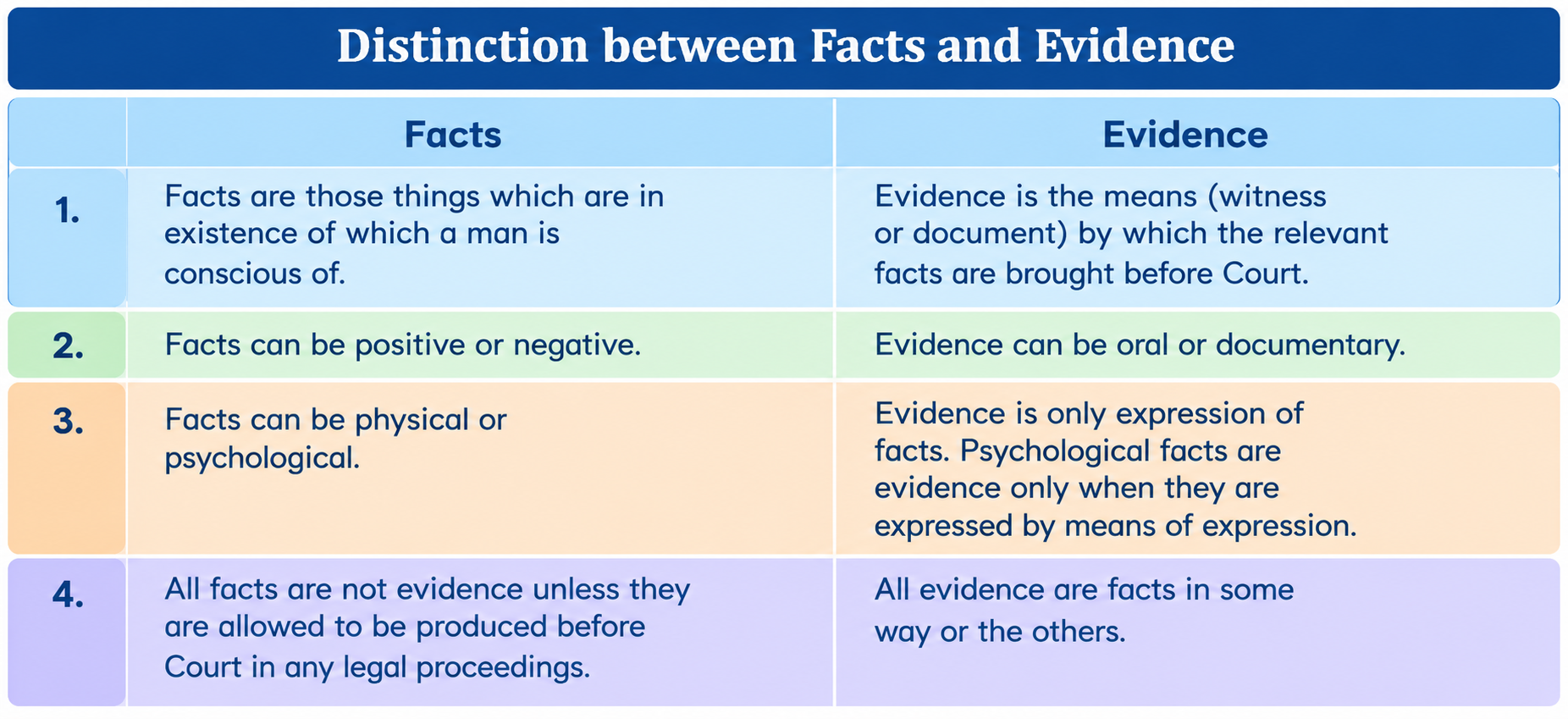
Under Section 2(1)(f) of the Bharatiya Sakshya Adhiniyam, the legal definition of a “fact” extends far beyond the popular conception of a purely tangible or visible physical object.
Legally, a fact encompasses not only external, sensory circumstances but also internal psychological conditions, including a person’s state of mind, feelings, opinions, and statements.
These legal facts are broadly classified into physical and psychological facts, as well as positive and negative facts.
(1) Physical Facts and Psychological Facts
In legal classification, facts are divided into physical and psychological categories.
Physical facts represent external circumstances perceptible by the five senses, encompassing material objects and the outward appearance of animate or inanimate entities, such as a man or a horse.
In contrast, psychological facts pertain to internal mental conditions existing solely within an individual’s consciousness, including subjective states of mind such as intention, knowledge, fraud, good faith, desires, and personal recollections.
(2) Positive and Negative Facts
In legal classification, facts are further divided into positive facts, which represent the actual existence of a state of things, and negative facts, which represent their non-existence.
Furthermore, a fundamental distinction exists between a “matter of fact” and a “matter of law“: a matter of fact encompasses anything subject to testimony that must be established through evidence, whereas a matter of law pertains to the general law of the land, which the court takes judicial notice of without requiring formal proof by evidence.
Facts in Issue [Section 2(1)(g)]
Under Section 2(1)(g) of the Bharatiya Sakshya Adhiniyam, “facts in issue” comprise any fact that, by itself or alongside other facts, leads to the necessary existence, non-existence, nature, or extent of any right, liability, or disability asserted or denied in a legal proceeding, with courts framing these disputed matters on a case-by-case basis from civil pleadings or criminal charges.
Broadly categorized alongside facts in issue are “relevant facts,” which encompass a wide array of logically connected circumstances—such as parts of the same transaction, motive, preparation, conduct, contextual background, inconsistent facts, expert opinions, admissions, and statements—that serve as evidentiary building blocks to establish or refute the central facts in issue.
Disproved and Not Proved
Under Sections 2(1)(c) and 2(1)(i) of the Bharatiya Sakshya Adhiniyam, a fact is “disproved” when the court believes it does not exist based on the standard of a person of ordinary prudence, whereas “not proved” occupies the middle ground where a fact is neither conclusively established nor refuted, leaving the court in a state of doubt.
Operating alongside these evidentiary definitions is the rejection of the maxim falsus in uno, falsus in omnibus in Indian jurisprudence.
Courts have clarified that this maxim—the notion that a witness false in part must be disbelieved in whole—is not a rigid rule of law in India, but merely a rule of caution; hence, courts are fully empowered to separate the grain from the chaff, believing a witness’s testimony regarding certain accused individuals or facts while discarding it as to others.
N. Jayaraman v. State of Tamil Nadu
In N. Jayaraman v. State of Tamil Nadu, the Supreme Court affirmed that in criminal cases stemming from trade union enmity involving multiple accused persons, the acquittal or release of certain co-accused due to insufficient witness testimony does not legally compel the total rejection of the prosecution case or the remaining witness statements.
Reaffirming established evidentiary doctrines, the Apex Court held that the legal maxim falsus in uno, falsus in omnibus is not applied in toto in Indian jurisprudence; hence, courts remain duty-bound to separate truth from falsehood and can lawfully rely on credible portions of witness testimony to convict specific accused individuals while acquitting others.
Harischandra and others v. State of Delhi
In criminal jurisprudence, courts are mandated to sift grain from the chaff rather than apply the rejected maxim falsus in uno falsus in omnibus, meaning that even if an eyewitness exaggerates or overimplicates certain individuals, the court can carefully scrutinize and rely upon the truthful, corroborated residue of evidence to convict an accused despite the acquittal of co-accused persons.
Reinforcing this standard of testimonial evaluation, Section 139 of the Bharatiya Sakshya Adhiniyam establishes that no minimum number of witnesses is required, allowing courts to base a valid conviction on the uncorroborated testimony of a single, fully reliable eyewitness.
Furthermore, under Section 2(1)(j) of the BSA, “proof” does not require rigid mathematical certainty, which is practically impossible in human affairs; rather, it demands such evidence as would convince a person of ordinary prudence and reasonable judgment to act upon a high degree of probability.
M. Narsingha Rao v. State of Andhra Pradesh
In M. Narsingha Rao v. State of Andhra Pradesh, the Supreme Court affirmed that a fact is legally proved when the court, upon evaluating the materials before it, considers its existence so probable that a prudent person would act upon that supposition, anchoring the standard of proof on common sense and judicial conscience rather than absolute mathematical precision.
The convincing strength of this material—known as probative force—must be sufficient to sway a conscientious mind, while strictly adhering to the principle that suspicion and conjecture can never substitute for legal proof.
Furthermore, in determining whether a fact is proved, courts examine the broader scope of “matters before it” under Section 2(1)(j) and 2(1)(c) of the Bharatiya Sakshya Adhiniyam, which encompasses not only strict formal evidence under Section 2(1)(e) but also supplementary materials such as witness demeanor, material objects, local judicial inquiries, and commissioner reports.
Relevant
Under Section 2(1)(k) of the Bharatiya Sakshya Adhiniyam, a “relevant fact” denotes a fact connected through cause or effect that possesses sufficient probative force to influence the determination of a case.
The classic circumstantial case of R. v. Richardson demonstrates how a complete chain of relevant facts—encompassing physical evidence like marsh-soiled stockings, unique shoe impressions, left-handed wound characteristics, motive, and demonstrably false statements—can collectively eliminate every hypothesis of chance or coincidence.
By satisfying multiple concurrent evidentiary tests, the cumulative convergence of these circumstances establishes proof beyond reasonable doubt, making any alternative theory of innocence statistically and logically impossible.
'Relevant' under the Bharatiya Sakshya Adhiniyam
Under the Bharatiya Sakshya Adhiniyam, the statute does not provide a rigid definition of the term “relevant,” but instead prescribes that a fact achieves relevancy exclusively when it is connected to the facts in issue or other relevant facts through the specific statutory parameters outlined under Chapter II (Sections 3 to 50), failing which it remains legally irrelevant.
The structural scheme of the Adhiniyam is designed to ensure that any fact meeting these statutory tests of connection is deemed admissible in judicial proceedings.
Logically relevant and Legally Relevant.
The law draws a clear boundary between logical relevancy and legal relevancy, establishing that while logical relevancy refers to a natural, common-sense connection between facts, legal relevancy requires express statutory authorization under the Bharatiya Sakshya Adhiniyam.
Unapproved facts remain inadmissible regardless of their logical weight, as the law dictates that while every legally relevant fact is logically relevant, not every logically relevant fact is legally relevant.
Consequently, under the Adhiniyam, a fact becomes admissible only when it strictly satisfies the statutory conditions specified within its prescribed relevancy provisions, including Sections 4 to 14, the Proviso to Section 22, the Proviso to Section 23, Section 24, and Sections 34 to 50.
Chamberlayne's Modern Law of Evidence
According to Chamberlayne’s Modern Law of Evidence, evidence is legally relevant when it directly addresses the specific issues framed by the parties through their formal pleadings, thereby assisting the court in discovering the truth concerning disputed facts.
Consequently, any evidence that successfully satisfies this standard of connection and truth-seeking is admissible and should not be subjected to legal objections.
Shall presume
While the foundational rule of litigation mandates that every fact relied upon for a judgment must be strictly proved according to the rules of the Sakshya Adhiniyam, the law permits courts to utilize “presumptions“—defined under Section 2(1)(l) as judicial inferences or things taken for granted—whereby the existence of a fact is deduced through probable reasoning from other established, admitted, or judicially noticed facts.
These presumptions derive from human experience regarding the regular course of nature and ordinary human affairs, allowing courts to accept logical realities, such as the delivery of a posted letter or the possession of recently stolen property, without requiring independent formal proof.
Kinds of Presumption.
Presumptions in law are systematically categorized into natural presumptions of fact and mandatory presumptions of law.
Presumptions of fact are discretionary inferences derived from human experience and the course of nature which can generally be rebutted.
In contrast, presumptions of law are mandatory legal rules divided into irrebuttable (conclusive) presumptions—such as the incapacity of a child under seven or rules of estoppel—which bar any contrary evidence, and rebuttable presumptions—such as legitimacy, survivorship, or the seven-year absence rule under Sections 110, 111, and 116 of the BSA—which hold true as conclusive proof unless successfully disproved by opposing evidence.

Mixed Presumptions
While mixed presumptions remain largely confined to English real property law and require no extended focus, the Bharatiya Sakshya Adhiniyam, 2023, systematically structures evidentiary presumptions through distinct statutory phrasing.
The Adhiniyam utilizes the discretionary standard of “the Court may presume“, the mandatory directive of “the Court shall presume“, and the absolute standard where a circumstance constitutes “conclusive proof” of another.
Overall, Section 2 of the Sakshya Adhiniyam governs these provisions, functioning as a legislative directive that controls how courts must interpret and proceed under these statutory presumptions.
"May Presume"
Under Section 2(1)(h) of the Bharatiya Sakshya Adhiniyam, the phrase “may presume” grants the court discretionary authority either to accept a fact as existing without requiring formal proof or to direct a party to establish it through evidence.
This discretionary power is exemplified in provisions like Section 92, where courts may dispense with formal proof for documents older than thirty years produced from proper custody, and Section 90, which permits a discretionary presumption regarding the transmission integrity of electronic messages while barring any presumption as to sender identity.
"Shall Presume"
Under Section 2(1)(l) of the Bharatiya Sakshya Adhiniyam, the phrase “shall presume” imposes a mandatory legal command stripping the court of its discretion, compelling it to treat a specific fact as proved unless it is successfully challenged.
While the court must initially accept the presumption as true, the opposing party is permitted to present evidence to rebut and disprove it.
This mandatory standard is illustrated by provisions such as Section 91, which requires the court to presume that any document called for but withheld after notice was duly attested, stamped, and executed in accordance with the law.
Expressions "Shall" and "May" Explained
Under the Bharatiya Sakshya Adhiniyam, a fundamental distinction exists between the expressions “may presume” and “shall presume” regarding judicial authority.
Section 2(1)(h) defines “may presume” as a discretionary power enabling the court to either accept a fact or require the parties to formally prove it with evidence.
Conversely, the use of “shall presume” imposes a strict legislative command that strips the court of discretion, mandating that the court treat the fact as proved unless and until it is successfully disproved by the opposing party, thereby eliminating the need for initial formal proof.
Presumption and Proof distinguished.
“Proof” represents the formal establishment of material facts necessary for judicial judgment, which a court achieves through multiple legal means including evidence, admissions, judicial notice, and presumptions.
While the foundational rule requires every judgment-critical fact to be proved, the law permits courts to utilize presumptions—defined as logical inferences or things taken for granted—as an effective legal vehicle to reach that proof without requiring independent evidentiary steps for every individual fact.
"Conclusive Proof"
Under Section 2(1)(b) of the Bharatiya Sakshya Adhiniyam, “conclusive proof” acts as an absolute statutory command that strips the court of all discretion, prohibiting any party from introducing evidence to contest, vary, or disprove the established fact.
Grounded in public policy and societal interests to prevent endless litigation, provisions like Section 35 give certain judicial determinations—such as matrimonial judgments establishing legal character—conclusive finality, meaning that once established, the law bars any contradictory claims or counter-evidence.