
AI in Medical Diagnosis in India: Latest Research, Applications, and Limitations
The integration of artificial intelligence into India’s healthcare landscape is fundamentally reshaping how diseases are detected, monitored, and treated. India faces a severe deficit in specialist doctors, particularly in rural regions where access to quick and precise diagnostic facilities remains a persistent hurdle. With an estimated ratio of fewer than one doctor per thousand citizens in many tier-2 and tier-3 locations, the reliance on automated screening tools has shifted from a futuristic luxury to an immediate necessity. Artificial intelligence algorithms are bridging this gap by equipping primary care providers with clinical decision support tools that analyze medical scans, lab test results, and clinical notes in real time. The rapid rise of digital infrastructure, supported by national initiatives like the Ayushman Bharat Digital Mission (ABDM), has created a fertile ecosystem for innovative healthcare technologies. In this blog post, we dive into the latest research, groundbreaking real-world applications, and critical limitations shaping the adoption of diagnostic AI across India.
1. The Growing Need for Intelligent Diagnostic Solutions in Indian Healthcare
The unprecedented demand for accessible medical care across urban and rural India has created substantial stress on existing hospital facilities. Early detection of conditions such as cardiovascular disorders, diabetic retinopathy, and infectious illnesses like tuberculosis significantly increases the likelihood of successful interventions. However, traditional clinical workflows are often bottlenecked by manual evaluation backlogs, leading to delayed medical reports and prolonged treatment waiting times.
By introducing machine learning models capable of high-throughput visual evaluation, Indian diagnostic centers can process thousands of routine patient scans daily with minimal human fatigue. To learn more about national policy guidelines supporting digital health integration, explore the official framework provided by the National Health Authority of India. These initiatives aim to unify patient data streams so that diagnostic machine learning engines can access standardized electronic health records safely and effectively.
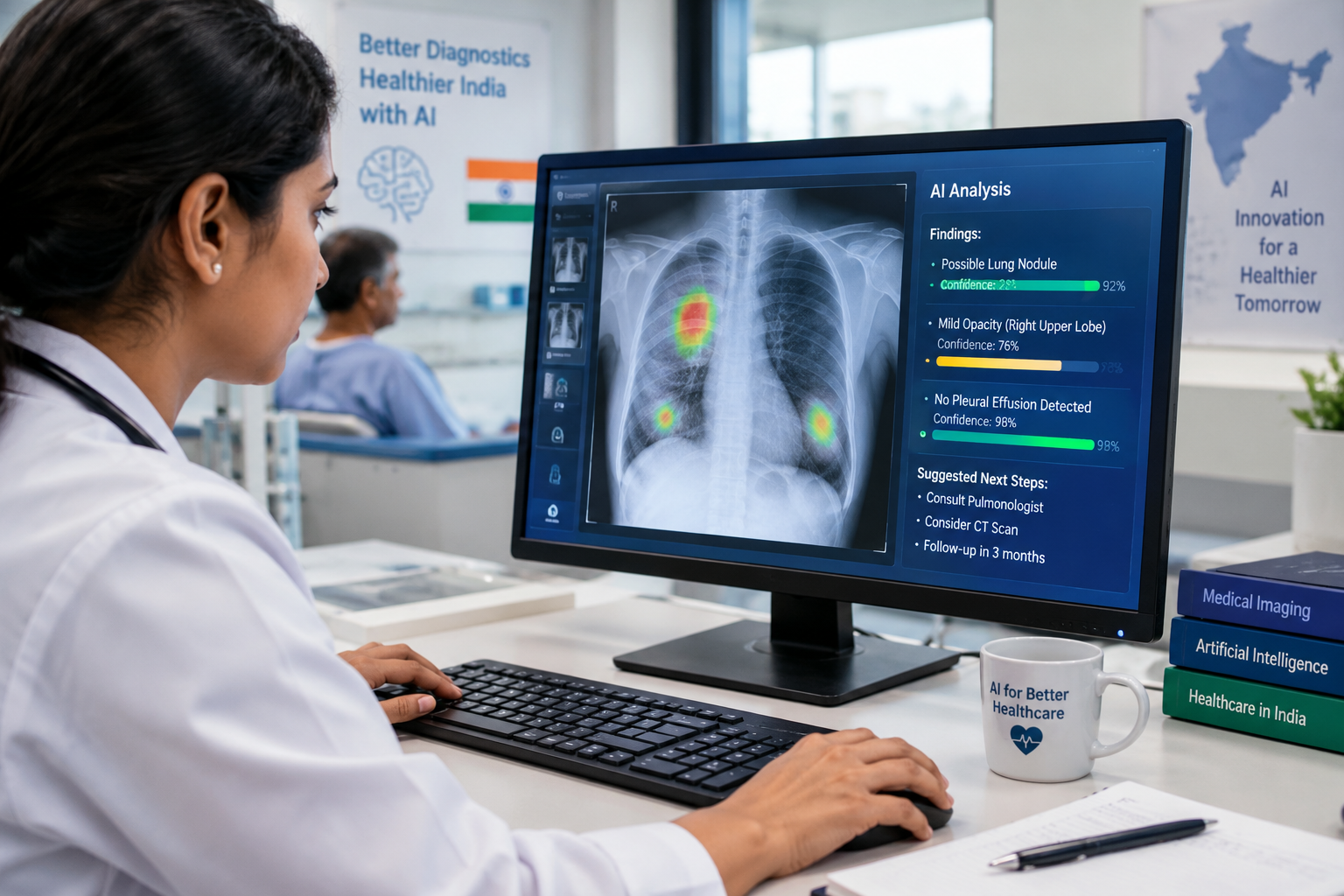
2. Latest Breakthroughs in Medical Imaging and Radiology Research
The field of radiology has seen remarkable advancements driven by deep learning algorithms trained on complex medical images. Indian researchers and tech startups have led the development of sophisticated convolutional neural network models customized for high-density chest X-rays, magnetic resonance imaging scans, and computed tomography procedures.
┌─────────────────────────────────────────────────────────┐
│              Raw Diagnostic Data Input                  │
│       (X-Rays, CT Scans, Pathology Slides, Blood)       │
└────────────────────────────┬────────────────────────────┘
                             │
                             ▼
┌─────────────────────────────────────────────────────────┐
│            Artificial Intelligence Engine               │
│   (Pattern Detection, Segmentation & Risk Scoring)      │
└────────────────────────────┬────────────────────────────┘
                             │
                             ▼
┌─────────────────────────────────────────────────────────┐
│               Clinician Review & Approval               │
│         (Validated Reports & Actionable Insights)       │
└─────────────────────────────────────────────────────────┘
These computational tools scan radiographs to locate subtle opacities, soft tissue lesions, micro-fractures, and early-stage tumors that might escape casual human observation during busy shifts. Research teams at institutions like the Indian Institute of Science and Indian Institutes of Technology are publishing peer-reviewed findings on lightweight algorithms optimized to run on low-power devices in community clinics. The scientific community actively disseminates these innovations through academic portals like the Indian Journal of Medical Research, showcasing how specialized algorithms assist radiologists in prioritizing emergency trauma cases based on automated severity scoring.
3. Revolutionizing Tuberculosis and Pulmonary Disease Screening
The widespread prevalence of pulmonary diseases, particularly tuberculosis, poses a significant public health challenge across the Indian subcontinent. Traditional sputum culture testing can take days or weeks, whereas chest X-ray evaluations depend heavily on the availability of skilled radiologists. AI-powered thoracic diagnostic software has stepped in to analyze chest X-rays within seconds, pinpointing indicators of active tuberculosis, pneumonia, and chronic obstructive pulmonary disease.
The deployment of portable X-ray machines equipped with edge-AI software enables mobile health vans to conduct mass screening drives in remote tribal belts and dense urban slums. These systems flag suspected cases instantly, allowing field health workers to initiate diagnostic confirmation and therapy without long delays. Detailed research on global strategies for disease elimination is curated by the World Health Organization, which underscores the role of automated digital screening tools in curbing communicable infections.
4. Screening for Diabetic Retinopathy in Primary Care Centers
The rising rate of diabetes across the Indian population has led to a parallel surge in diabetic eye complications, including vision-threatening diabetic retinopathy. Because early stages of retinopathy are frequently asymptomatic, millions of diabetic individuals remain unmonitored until permanent vision loss occurs. Optical intelligence solutions utilize high-resolution fundus cameras combined with deep learning architectures to capture and analyze retina images automatically.
These non-invasive retinal scanners classify microaneurysms, hemorrhages, and hard exudates directly at local primary health centers. Paramedical staff with basic training can operate the cameras, while the algorithm generates immediate risk assessments that highlight patients requiring urgent ophthalmologist consultations. For extensive clinical literature regarding eye care protocols and technology adoption, consult the All India Ophthalmological Society guidelines.
5. Pathological Innovations and AI-Driven Digital Histopathology
The transformation of traditional pathology laboratories into digital ecosystems represents another crucial leap for diagnostic accuracy. Digital pathology involves scanning tissue biopsy slides into ultra-high-definition digital files that neural networks analyze to identify cellular abnormalities, mitotic figures, and cancerous margins.
+------------------------+-------------------------------------------------------+
| Diagnostic Discipline  | Primary AI Application in Indian Healthcare           |
+------------------------+-------------------------------------------------------+
| Radiology              | Rapid automated chest X-ray and CT scan triage        |
| Ophthalmology          | Automated fundus image screening for diabetic vision  |
| Digital Pathology      | Microscopic cell profiling and tumor cell grading     |
| Cardiology             | Algorithmic ECG analysis and arrhythmia detection     |
+------------------------+-------------------------------------------------------+
Pathologists frequently utilize these automated counting and segmentation mechanisms to speed up tissue profiling for oncology cases. Algorithmic slide grading reduces inter-observer variability, ensuring that cancer stage classifications remain consistent regardless of geographical lab location. Research highlights from the Indian Council of Medical Research emphasize how standardized digital workflows support tele-pathology links between suburban diagnostic centers and central cancer research institutes.
6. Real-Time Cardiovascular Diagnostic Support Tools
The burden of ischemic heart disease and acute coronary syndromes highlights the urgent need for rapid cardiac evaluations in emergency rooms. Portable electrocardiogram (ECG) handheld devices powered by machine learning algorithms analyze heart rhythms on the spot, detecting subtle ST-segment changes, atrial fibrillation, and complex arrhythmias instantly.
Emergency medical responders in rural clinics can attach compact sensors to a patient’s chest and receive an algorithmic diagnostic flag within seconds. If an acute myocardial infarction is suspected, the system alerts nearby cardiology centers and suggests immediate stabilization protocols, saving precious minutes during the critical golden hour of care.
7. Natural Language Processing for Clinical Documentation and Records
The administrative work associated with clinical diagnostic procedures often distracts doctors from direct patient interaction. Generative AI platforms and natural language processing engines are changing this dynamic by converting spoken doctor-patient interactions into structured diagnostic summaries, prescription drafts, and electronic health logs.
[Doctor-Patient Audio] ──► (NLP Speech-to-Text) ──► (Medical Entity Extractor) ──► [Structured EHR Log]
These sophisticated systems convert conversational regional dialects into standardized medical terminologies, populating diagnostic histories cleanly. This reduces clinical burnout while creating complete digital health histories that feed into downstream diagnostic algorithms for preventive risk modeling.
8. Data Privacy, Governance, and Regulatory Standards
The secure handling of sensitive personal medical data is essential when deploying diagnostic algorithms across large populations. India’s evolving data protection framework requires strict compliance regarding patient consent, anonymization, and data storage standards. Health tech developers are adopting privacy-preserving strategies, such as federated learning, to train algorithms across multiple hospital datasets without physically moving sensitive records off-site.
Regulators continuously assess algorithm safety to prevent diagnostic errors and guard against algorithmic drift over time. Detailed regulatory oversight standards and digital data protection guidelines are maintained by the Ministry of Health and Family Welfare. Ensuring that data architectures respect patient privacy remains foundational for building public trust in digital diagnostic platforms.
9. Overcoming Data Bias and Algorithmic Diversity Challenges
The performance of diagnostic artificial intelligence models relies heavily on the diversity and quality of the datasets used during training. A major limitation of early diagnostic software was its reliance on medical imaging datasets sourced primarily from Western populations. When applied to Indian demographics, variations in anatomy, disease presentation, and co-morbidities led to lower diagnostic precision.
Researchers are actively addressing this issue by building diverse multi-center Indian medical datasets that encompass variations in age, ethnicity, socioeconomic status, and regional disease patterns. Ensuring balanced training data prevents algorithmic bias, guaranteeing that screening tools remain accurate for urban and rural patients alike.
10. The Human Element: Clinician Trust and Implementation Resistance
The successful adoption of diagnostic technology depends on seamless collaboration between human experts and automated systems. A common misinterpretation among healthcare personnel is the fear that automated tools aim to replace medical practitioners entirely. In reality, these platforms serve as intelligent clinical decision support systems designed to assist, validate, and accelerate human decision-making.
                     ┌─────────────────────────────┐
                     │   High Diagnostic Volume    │
                     └──────────────┬──────────────┘
                                    │
                                    ▼
                     ┌─────────────────────────────┐
                     │ AI Preliminary Pre-Screening│
                     └──────────────┬──────────────┘
                                    │
                                    ▼
       ┌────────────────────────────┴────────────────────────────┐
       │                                                         │
       ▼                                                         ▼
┌─────────────────────────────┐           ┌─────────────────────────────┐
│  Normal / Low Risk Scans    │           │  Abnormal / High Risk Scans │
│  (Automated Verification)   │           │  (Priority Expert Review)   │
└─────────────────────────────┘           └─────────────────────────────┘
Building sustainable clinician trust requires transparent “explainable AI” architectures that provide visual heatmaps and logical confidence scores alongside diagnostic suggestions. Medical colleges across India are incorporating digital health modules into their curricula to train future doctors on working alongside algorithmic assistants effectively.
11. Infrastructure Deficits and Resource Constraints in Rural Regions
The widespread deployment of sophisticated diagnostic software encounters physical challenges in peripheral healthcare centers. Reliable high-speed internet connectivity, stable power grids, and modern hardware are often lacking in remote primary health posts.
To overcome these limitations, hardware developers are engineering lightweight edge-computing devices that run diagnostic models locally without requiring continuous cloud access. These offline-capable systems store diagnostic logs locally and sync with centralized medical databases whenever network connectivity is restored.
12. Ethical Considerations and Accountability in AI-Assisted Diagnoses
The question of legal liability remains a complex topic when an algorithmic recommendation contributes to a misdiagnosis or missed finding. Because machine learning models function through complex statistical patterns, establishing clear accountability between software developers, medical device vendors, and treating physicians is vital.
Current ethical consensus maintains that the final diagnostic decision and treatment prescription must rest solely with the licensed medical professional. Diagnostic software acts as an advisory tool, leaving ultimate clinical responsibility in human hands. Academic discussions on medical ethics and liability are regularly updated on portals like the National Center for Biotechnology Information, serving as a global reference for evolving healthcare governance.
13. Future Outlook: Integrated Multi-Modal Diagnostics in India
The future of medical diagnostics in India lies in integrated multi-modal platforms that combine radiology scans, genetic profiles, pathology slides, and patient history into a single predictive profile. Rather than relying on isolated detection tools, future health systems will offer holistic disease forecasting, identifying chronic conditions long before physical symptoms appear.
Through continued collaboration between research institutions, government bodies, healthcare providers, and technology developers, India is positioned to become a global leader in affordable, AI-driven diagnostic solutions. By addressing existing limitations around data bias, infrastructure, and regulatory frameworks, intelligent diagnostic technologies will continue expanding access to high-quality healthcare for millions.

How useful was this post?
Click on a star to rate it!
Average rating 0 / 5. Vote count: 0
No votes so far! Be the first to rate this post.