B.Tech in AI & Data Science vs. Core Computer Science, Which Degree Offers Better Jobs?
Selecting an undergraduate engineering program is one of the most critical decisions for aspiring tech professionals. With the rapid expansion of artificial intelligence, machine learning, and big data, prospective engineering students often find themselves split between two premier degree paths: B.Tech in Artificial Intelligence & Data Science (AI & DS) and Core Computer Science Engineering (CSE).
Both degree choices offer lucrative modern career pathways, but they differ significantly in focus, curriculum breadth, market flexibility, and long-term career trajectories. Choosing between specialized AI studies and foundational software engineering requires evaluating how each degree aligns with your personal goals, learning style, and target industry roles.
1. Introduction to B.Tech in AI & Data Science vs. Core Computer Science Degree Paths
Core Computer Science Engineering is the traditional foundation of the technology industry. It encompasses the broad principles of computing, including software development, hardware-software integration, system design, and algorithmic problem-solving.
In contrast, B.Tech in Artificial Intelligence and Data Science is a modern, specialized branch. It focuses specifically on enabling machines to emulate human intelligence, analyze massive datasets, automate decision-making, and construct predictive mathematical models.
While Core CSE acts as a master degree that covers every layer of computing, AI & DS zeroes in on high-level mathematical algorithms, statistical modeling, machine learning pipelines, and specialized data engineering applications.
2. Curriculum Breakdown: Specialized AI & Data Science Studies vs. Broad Core Computer Science Coursework
The structural difference between these two undergraduate engineering paths lies in the depth versus breadth of their academic course modules.
Core Computer Science Engineering: Emphasizes foundational computing infrastructure. Students study Operating Systems, Computer Architecture, Database Management Systems (DBMS), Computer Networks, Compiler Design, Web Development, and Object-Oriented Programming (OOP).
AI & Data Science Engineering: Tailors coursework specifically to data handling and intelligence. Students focus heavily on Applied Linear Algebra, Probability & Statistics, Machine Learning, Deep Learning, Natural Language Processing (NLP), Computer Vision, Big Data Analytics, and Data Visualization tools.
| Curriculum Feature | Core Computer Science (CSE) | B.Tech in AI & Data Science (AI & DS) |
| Primary Focus | Systems, software development, networks, and hardware concepts | Data analysis, machine learning algorithms, and predictive systems |
| Mathematics Depth | Discrete mathematics, basic calculus, and general logic | Advanced linear algebra, multivariable calculus, and applied probability |
| Elective Flexibility | High (choose web dev, security, game dev, or AI modules) | Moderate (focused mostly on specialized AI/ML tools and applications) |
| Practical Output | Full-stack software applications, operating tools, and mobile apps | Trained machine learning models, statistical dashboards, and data pipelines |
For students who thrive on learning a little bit of everything in technology before picking a niche, Core CSE provides maximum flexibility. For those who know early on that they want to build predictive tools and neural networks, AI & DS offers direct specialization from year one.
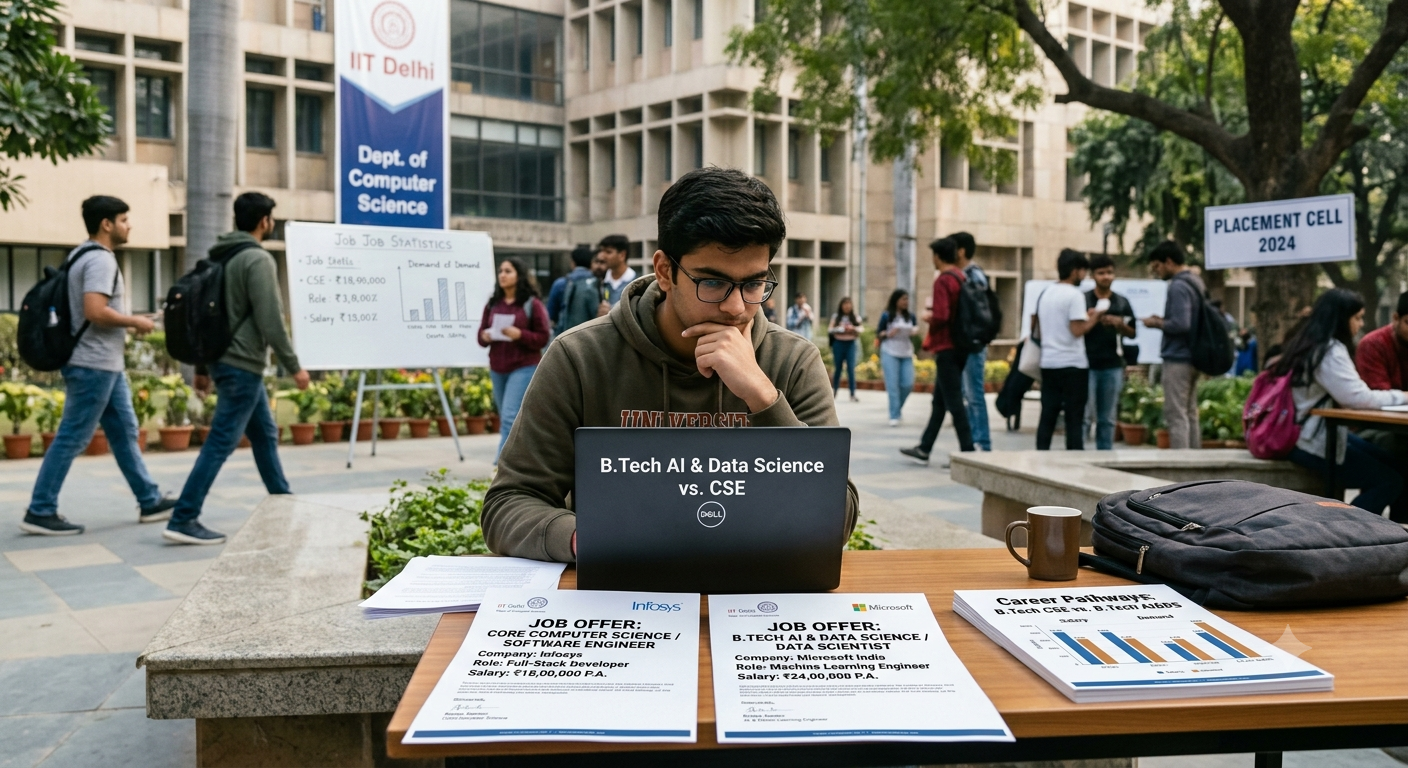
3. High-Demand Career Paths and Job Roles for B.Tech AI & Data Science Graduates
Specializing in AI and Data Science directly prepares graduates for cutting-edge roles driving modern automation, generative tools, and corporate data strategies. Industry reports from organizations like NASSCOM highlight an expanding demand for talent skilled in specialized data architectures and machine learning.
+-------------------------------------------------------------------+
|               KEY ROLES FOR AI & DATA SCIENCE GRADUATES           |
|                                                                   |
|  [Machine Learning Engineer] ---> Designs & deploys ML models      |
|  [Data Scientist]            ---> Extracts actionable business insights|
|  [AI Research Scientist]     ---> Creates new algorithms & neural nets |
|  [Data Engineer]             ---> Builds big data pipelines & DBs |
|  [NLP / Vision Specialist]   ---> Trains text, voice & image models  |
+-------------------------------------------------------------------+
Graduates entering these positions typically work with Python, R, TensorFlow, PyTorch, Spark, and cloud-based AI environments. These roles often command premium entry-level salaries due to the specialized skills required to manage complex data ecosystems.
4. Versatile Career Opportunities and Job Roles for Core Computer Science Engineers
While AI specialist roles are growing rapidly, Core Computer Science graduates enjoy an extraordinarily broad spectrum of employment opportunities across every sector of the global economy.
+-------------------------------------------------------------------+
|                 KEY ROLES FOR CORE COMPUTER SCIENCE               |
|                                                                   |
|  [Software Development Eng.] ---> Builds scalable software systems |
|  [Full-Stack Developer]      ---> Handles front-end & back-end code|
|  [DevOps / Cloud Engineer]   ---> Manages cloud deployment & CI/CD|
|  [Systems Architect]         ---> Designs enterprise tech frameworks |
|  [Cybersecurity Analyst]     ---> Secures networks & enterprise data|
+-------------------------------------------------------------------+
Because Core CSE covers foundational programming and system design, these engineers can adapt to almost any tech role. A Core CSE graduate can easily pivot into web development, mobile application development, cloud computing, database administration, or even transition into AI roles later by picking up relevant machine learning certifications.
5. Job Market Dynamics, Placement Trends, and Hiring Preferences for AI vs. Core CSE
The global tech hiring ecosystem demands both broad software engineering skills and targeted domain expertise. According to the World Economic Forum Future of Jobs Report, technological literacy, big data analytics, and artificial intelligence rank among the fastest-growing skill requirements globally.
However, tech recruiters and hiring managers often evaluate these degrees through distinct lenses:
Corporate Hiring Preferences: Many large tech companies, IT services firms, and legacy enterprises still lean toward Core Computer Science degrees for entry-level Software Development Engineer (SDE) roles. They prioritize candidates with strong fundamentals in Data Structures, Algorithms, and System Design.
Startup & Specialized Hiring: Tech startups, research labs, and data-driven enterprises actively seek out AI & Data Science graduates to immediately deploy predictive models, build generative AI applications, and optimize business intelligence workflows without needing extensive initial retraining.
                  JOB MARKET FLEXIBILITY VS SPECIALIZATION

       High Flexibility  |===========================| Core CSE
                         | (Broad Software Roles)
                         |
  High Specialization   |===========================| B.Tech AI & DS
                         | (Targeted ML & Data Roles)
Core CSE offers a safety net through its market versatility, while AI & DS trades that broader safety net for earlier access to high-value, specialized technology roles.
6. Higher Education Scope, M.S. Overseas, and Long-Term Global Mobility
When evaluating long-term educational mobility—such as pursuing a Master of Science (M.S.) or Ph.D. abroad—degree structure plays an important role:
Graduate School Prerequisites: Many foreign university master’s programs in Computer Science require prerequisite credits in core computing topics like Operating Systems, Computer Architecture, Theory of Computation, and Compiler Design. Core CSE automatically satisfies these academic criteria.
Specialized Research Pursuits: Graduates with a B.Tech in AI & DS have a distinct advantage when applying directly to specialized master’s programs in Data Science, Robotics, Computational Statistics, or Artificial Intelligence, as their undergraduate transcripts reflect extensive advanced coursework in those precise fields.
If you plan to keep your higher education options open across various domains like cybersecurity, software engineering, or business analytics, Core CSE provides an easier academic foundation to build upon.
7. Industry Salary Benchmarks, Entry Packages, and Career Growth Potential
From a compensation perspective, both degrees offer strong earning potential, but their pay trajectories scale differently throughout a tech professional’s career.
Entry-Level Salaries: Fresh graduates in AI & DS often secure slightly higher average starting packages for niche roles like Machine Learning Associate or Data Engineer, driven by specialized demand and a shortage of trained data talent.
Mid-to-Senior Level Progression: Over a 5 to 10-year horizon, compensation gaps usually even out. Salary levels become tied to individual problem-solving skills, system architecture expertise, leadership abilities, and real-world project impact rather than the specific name of an undergraduate degree.
A strong Software Engineer with a Core CSE background who learns machine learning on the job can achieve identical compensation to an AI & DS graduate.
8. AI Integration and Automation Risks: How Generative Tech Impacts Degree Value
The rapid rise of generative tools and automated code generators has shifted what tech recruiters value most in entry-level hires. Understanding how AI impacts job security for both branches is essential for prospective students:
Impact on Core Computer Science: Standard, repetitive coding tasks are increasingly being automated by AI developer tools. As a result, companies are looking for software engineers who understand high-level system architecture, security, and cloud scalability rather than basic syntax writing.
Impact on AI & Data Science: While AI & DS engineers build and tune these models, basic data cleaning and basic model fitting are also becoming automated by AutoML tools. To remain competitive, AI & DS graduates must understand deep mathematical principles rather than just calling pre-built library functions.
                AUTOMATION RISK VS HYBRID VALUE ACROSS DEGREES

  Low Value Tier   | Basic Syntax Coding & Manual Data Wrangling (Automated by AI)
                   |
  High Value Tier  | Hybrid Engineers: System Architecture + Applied AI Models
Ultimately, engineers who combine strong core programming fundamentals with practical AI integration skills will enjoy the highest long-term job security regardless of their original degree branch.
9. Making the Final Decision: Strategic Decision Roadmap for Undergrads
Choosing the right degree depends entirely on your personal strengths, mathematical aptitude, and long-term career preferences.
1.Assess Your Mathematical and Coding Preferences:Choose based on your interest in general coding vs data math.If you enjoy building functional web apps, software interfaces, and solving logical puzzles, choose Core CSE. If you thrive on statistics, matrix mathematics, data trends, and training predictive models, choose AI & DS.
2.Evaluate Your Risk Tolerance and Career Goals:Decide between broad job versatility or early career specialization.If you want the maximum number of job opportunities across every sector of tech, opt for Core CSE. If you are passionate about entering the artificial intelligence field immediately, choose AI & DS.
3.Inspect College-Specific Syllabi and Industry Collaborations:Review college curriculum maps and faculty depth.Examine the exact course syllabus of the universities you are considering. Ensure their AI & DS program offers real hands-on lab work and cloud lab credits rather than just theoretical classroom lectures.
Neither degree is inherently superior to the other; instead, they serve different strategic entry points into the technology landscape. Core Computer Science Engineering remains the ultimate versatile degree, providing an adaptable foundation that keeps every career door open. On the other hand, B.Tech in AI & Data Science is a streamlined express lane into the data economy, ideal for students who are clear about their desire to work directly with machine learning, data engineering, and automated systems.
Whichever route you select, focus heavily during your undergraduate years on building real-world software projects, contributing to open-source repositories, mastering data structures, and completing industry internships to ensure long-term career success.

How useful was this post?
Click on a star to rate it!
Average rating 0 / 5. Vote count: 0
No votes so far! Be the first to rate this post.