
The "Cell Phone vs Classroom" War: A Modern Battle for Student Focus
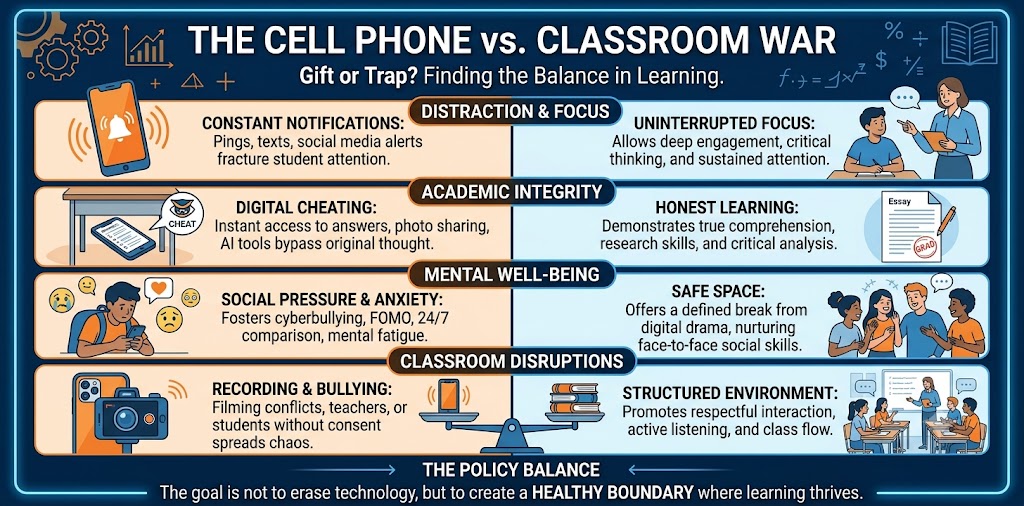
The battle lines are drawn, and the frontline isn’t a distant landscape—it’s the modern classroom. In one corner, we have the traditional educational system, striving to maintain a stable learning environment and preserve student academic performance. In the opposite corner is the smartphone, a portal of endless entertainment, constant social media notifications, and algorithmic traps.
The cell phone vs. classroom war has officially escalated. Educators are no longer just competing with daydreaming or note-passing; they are competing with billions of dollars of engineering designed to capture and hold human attention. As we navigate this complex digital age, school districts worldwide are facing a critical crossroads: how do we balance the undeniable utility of modern technology with the urgent need for a distraction-free learning environment?
1. The Rise of the Screen: How Mobile Devices Conquered the Classroom
To understand the cell phone vs. classroom conflict, we have to look back at how we got here. A decade ago, bringing a mobile device to school was a privilege. Today, smartphone ownership among teenagers is nearly universal. For many students, these pocket-sized computers are considered essential tools for daily life, bridging the gap between social circles, safety, and digital literacy.
However, this rapid integration of technology occurred without a universal rulebook. What began as a tool for emergency communication quickly evolved into an all-day digital tether. Students now walk into classrooms with devices that buzz, beep, and vibrate continuously. The classroom, once a sanctuary for focus and deep thought, has been thoroughly saturated by screens.
2. The Psychology of Distraction: What Happens to the Brain on Notifications
2. The Psychology of Distraction: What Happens to the Brain on Notifications
It’s easy to tell a student, “Just put your phone away.” But psychologically, it isn’t that simple. Every social media notification, text message, or video like triggers a hit of dopamine in the brain. This creates a powerful feedback loop that makes resisting the screen incredibly difficult, especially for the developing brains of adolescents.
The Brain Drain Hypothesis: Research shows that the mere physical presence of a smartphone—even if it is turned off and face down on a desk—consumes cognitive capacity. A portion of the student’s brain must actively work to ignore the device, leaving less mental bandwidth for the actual lesson.
When a phone vibrates during a math lecture or a history reading, the student’s attention is instantly fractured. The time it takes to refocus on the teacher after checking a notification is called “task-switching cost,” and it drastically undermines a student’s ability to retain complex information.
3. Academic Performance Under Fire: The Cost of Free-Range Phone Use
The ultimate casualty in the cell phone vs. classroom war is often the report card. Multiple global studies have highlighted a direct correlation between high screen time during school hours and a decline in academic performance.
| Area of Impact | Impact of Unrestricted Phone Use |
| Test Scores | Noticeable decline, particularly in subjects requiring deep sequential logic like mathematics. |
| Retention | Reduced ability to transfer information from short-term working memory to long-term memory. |
| Integrity | An increase in digital cheating, with students using devices to look up answers during assessments. |
4. The Mental Health Toll: Social Media and the Anxious Generation
Beyond grades, the psychological well-being of our youth is heavily tied to the cell phone vs. classroom debate. The school day used to provide a natural break from social pressures. Now, thanks to 24/7 connectivity, the drama, anxiety, and comparison of the digital world follow students right through the schoolhouse gates.
The rise of a “phone-based childhood” has brought significant rises in youth anxiety and depression. Instead of relaxing during lunch or recess, many students sit side-by-side, staring at their respective screens, scrolling through highly curated feeds. This lack of mental downtime leaves students emotionally exhausted before they even sit down for their next class period.
5. The Dark Side of Schoolyard Tech: Cyberbullying and Classroom Chaos
The physical safety and emotional security of the school environment change when unrestricted cameras and internet access are everywhere. Cell phone use in school hallways and locker rooms has unfortunately given rise to new forms of conflict:
Instantaneous Cyberbullying: A rumor or embarrassing photo taken in the morning can be distributed to the entire student body by lunchtime.
Recording Conflict: Rather than defusing fights, students frequently use their devices to schedule, record, and broadcast physical altercations to gain viral traction on social media platforms.
Privacy Violations: Both students and teachers face the risk of being recorded without consent, turning minor classroom disruptions into public spectacles online.
6. The Global Shift: The Momentum Toward Phone-Free Schools
Recognizing these severe disruptions, governments and school boards across the globe are moving away from the pandemic-era push for total digital integration. We are witnessing a massive structural policy shift toward phone-free schools.
According to recent UNESCO data, the number of education systems restricting or outright banning mobile devices in schools has doubled globally. From Europe to North America, policymakers are drawing a hard line. In the United States alone, the vast majority of states have enacted statewide bans or instituted strict regulations requiring local school districts to heavily restrict phone use during instructional hours. The message is becoming uniform: to protect learning, we must secure the screens.
7. Deciphering the Policies: "Bell-to-Bell" vs. Instructional-Time Bans
As schools implement restrictions, they generally choose between two primary policy models, each with its own set of logistics:
The Instructional-Time Only Ban
This policy dictates that phones must be put away or placed in a hanging wall caddy only during active class time. Students are free to check their devices during hallway transitions, lunch breaks, and study halls. While easier to sell to students, critics argue it fails to stop the distraction, as students spend class time anticipating the next bell.
The “Bell-to-Bell” Phone Ban
This is the gold standard for advocates of phone-free schools. Under a bell-to-bell framework, personal devices must be completely powered off and securely stored from the moment the morning bell rings until the final dismissal. Devices are often kept in lockers or specialized locked pouches (like Yondr bags). This completely removes the digital temptation for the entirety of the school day.
8. The Parent Paradox: Balancing Safety Concerns with Academic Focus
While teachers overwhelmingly support these restrictions, the cell phone vs. classroom war often faces its fiercest resistance from parents. This creates what educators call the parent paradox. Parents want their children to be focused and successful, but they also experience intense anxiety regarding communication, particularly in the event of a school emergency.
Many parents have grown accustomed to having a direct line of communication to their child at any given second. They text their kids reminders about doctor appointments, ask what they want for dinner, or check in on their moods between classes. Educators point out that this constant parental contact actually hinders a child’s developing independence and resilience. In a true emergency, school administrators emphasize that emergency protocols are safer when students are listening to instructions rather than panic-texting or clogging cellular networks.
9. Reclaiming the Culture: What Happens When the Screens Go Dark
When a school successfully transitions to a phone-free environment, the transformation is often immediate and profound. It is a digital reckoning that pays massive dividends for the entire school community.
[Phones Power Off] ───> [Eye Contact Returns] ───> [Classrooms Calmer]
       │                                                   │
       ▼                                                   ▼
[No Notification Pings] ──> [Deeper Learning] ───> [Social Skills Improve]
Teachers report a renewed sense of instructional freedom. They spend their time actually teaching rather than policing devices. More importantly, the school hallways come alive again with the sound of laughter, face-to-face conversations, and genuine peer interaction. Students are allowed to just be kids again, safely insulated from the relentless pressures of the digital landscape for seven hours a day.
10. Striking a Balance: Digital Literacy in a Screen-Filled World
Ultimately, winning the cell phone vs. classroom war doesn’t mean becoming entirely anti-technology. We must acknowledge that smartphones are a permanent fixture of modern society. Completely banning them without teaching students how to manage their digital lives would be a missed educational opportunity.
The goal of a distraction-free learning environment is not to erase technology, but to create a healthy boundary. By establishing clear, protected spaces where human connection and deep focus can thrive, we teach students an invaluable life skill: how to unplug. The classroom must remain a place where minds power on because the screens have finally powered off.
What are your thoughts on this digital tug-of-war? Do you think a total “bell-to-bell” ban is the right move for our schools, or is there a better way to co-exist with our devices?

How useful was this post?
Click on a star to rate it!
Average rating 0 / 5. Vote count: 0
No votes so far! Be the first to rate this post.