
Why Supreme Court Rejected the PIL to Reduce 5-Year Integrated LLB Course Duration?
The structure of professional legal education in India has become a major talking point for students, law aspirants, and academic policy experts. A massive debate was sparked across the country when a Public Interest Litigation (PIL) was filed seeking to shorten the current 5-year integrated law degree down to a 4-year program. The petition aimed to align legal education directly with the provisions of the National Education Policy (NEP) 2020.
However, the highest court in the land has made its stance explicitly clear. A Supreme Court Bench consisting of Chief Justice of India Surya Kant and Justice Joymalya Bagchi expressed strong reluctance to interfere with the current model. The decision has left many wondering exactly why the judiciary chose not to modify the existing system.
Below, we dive into the deep legal, structural, and institutional reasons behind the historic decision, providing a comprehensive look at why the Supreme Court rejected the PIL to reduce 5-year integrated LLB course duration.
The Origin of the Debate: What Did the PIL Actually Seek?
The Public Interest Litigation, filed by advocate Ashwini Kumar Upadhyay, raised a series of arguments challenging the efficiency of the 5-year integrated LLB framework. The core argument was built around a direct comparison with other prestigious professional courses in India. The petitioner pointed out that premier technical programs, such as a B.Tech from an Indian Institute of Technology (IIT) or a Chartered Accountancy (CA) qualification, are effectively completed within four years.
The PIL contended that the extra year in a 5-year integrated law program acts as an artificial barrier. According to the plea, this setup creates an unnecessary financial and time burden on students, particularly those hailing from middle- and lower-income families. By adding a fifth year filled with humanities subjects like Sociology, Political Science, History, and English, the current system allegedly delays a young graduate’s entry into the workforce, causing a loss of productive years.
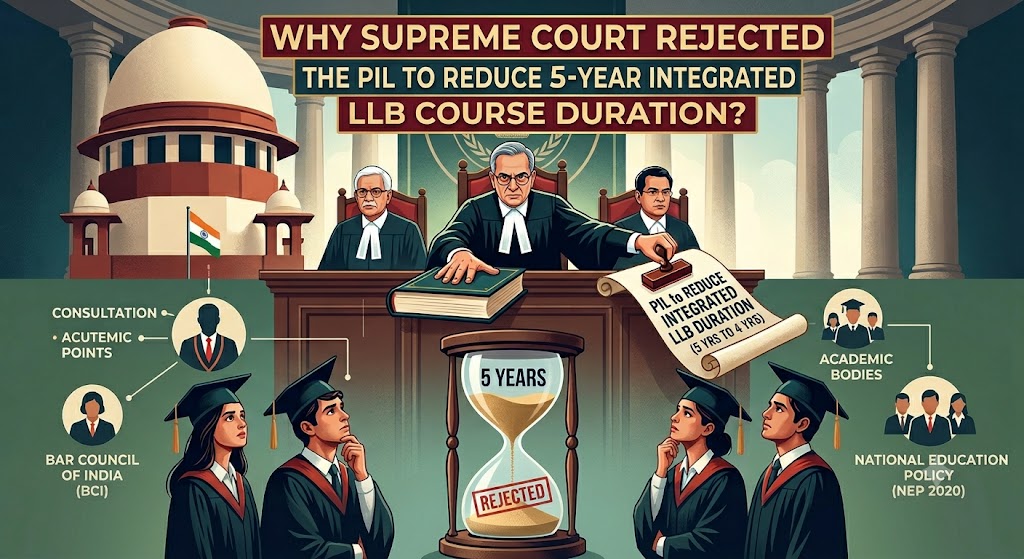
1. Separation of Powers: Why Courts Cannot Impose Educational Policy
The foremost reason why the Supreme Court rejected the PIL to reduce 5-year integrated LLB course duration traces back to the constitutional doctrine of the separation of powers. During the court proceedings, Chief Justice Surya Kant emphasized that the judiciary is only one of the many stakeholders in the vast educational ecosystem of the country.
The Bench observed that courts do not possess the specialized expertise required to draft university curricula, design syllabi, or dictate the chronological length of professional degrees. Passing a sweeping judicial order to slash a year from a professional degree would amount to judicial overreach. The court firmly stated that it cannot and will not “thrust its views” on complex policy decisions that belong purely in the academic and legislative domains.
2. The Statutory Authority of the Bar Council of India (BCI)
Under the Advocates Act of 1961, the Bar Council of India (BCI) is the supreme statutory body empowered to regulate legal education and lay down the standards of professional conduct in India. The Supreme Court highlighted that any structural modification to a law degree must originate from the BCI rather than a court mandate.
[Academic Institutions] \
[Universities]           \
[Legal Scholars]          +---> [BCI Consultation Process] ---> Policy Decision
[Policy Researchers]     /
[The Bar & Judiciary]   /
When the petitioner argued that certain university chancellors expressed dissatisfaction with the 5-year model, the Bench asked a sharp question: “Then why can’t they reduce the term? Why is a court order needed?” The counter-argument instantly revealed that individual universities cannot make independent structural changes because they are legally bound by the overarching guidelines and approvals managed by the Bar Council of India. Therefore, the Supreme Court ruled that the BCI is the appropriate forum to address such curricular grievances
3. The Need for Wider Stakeholder Consultation
A professional program that shapes the future officers of the court cannot be altered overnight based on a single petition. The Supreme Court underscored that determining the ideal duration of a professional program requires massive, multi-tiered deliberations.
The Bench noted that a comprehensive review must involve deep consultation among multiple vital groups:
Academic Institutions and Universities: To evaluate credit structures and teaching hours.
The Bar Council of India (BCI): To maintain the minimum standards required for a license to practice.
Legal Scholars and Jurists: To assess whether a shortened timeline compromises deep legal insight.
Social and Policy Researchers: To analyze the true demographic and economic impacts on student communities.
Without a thorough, data-driven report from a specialized commission, executing a sudden reduction in course duration would be counterproductive and short-sighted.
4. Why the Integration of Non-Law Subjects Matters in a 5-Year Framework
A major criticism raised in the PIL was that the initial two years of a BA-LLB or BBA-LLB course are cluttered with non-law subjects like Economics, History, and Sociology. The petitioner argued that these subjects dilute legal proficiency, especially for students coming from science backgrounds.
However, the established legal philosophy behind the 5-year integrated model is that law does not operate in a vacuum. A great lawyer cannot just memorize sections of the Indian Penal Code or the Civil Procedure Code; they must understand the socio-economic and historical realities that birthed those laws.
Learning Sociology helps a lawyer understand systemic inequalities, while studying Economics provides foundational clarity for complex corporate litigation, intellectual property rights, and taxation laws. The integration of humanities ensures that by the time a student enters an active courtroom, they possess a well-rounded, mature perspective of human behavior and societal governance.
5. Historical Precedent: The Success of the Integrated Model
During the hearing, the Supreme Court took a brief detour into legal history to reflect on the roots of the integrated program. Chief Justice Surya Kant corrected a common misconception, noting that the pioneer of the 5-year law course was not the National Law School of India University (NLSIU) in Bengaluru, but Maharshi Dayanand University (MDU) in Rohtak, which successfully introduced the model back in the early 1980s.
For over four decades, this integrated system has transformed Indian legal education. It elevated law from a “fallback degree” that students took up when they couldn’t get into engineering or medicine, into a highly competitive, premier professional stream. The historical success of this framework proves that the additional time spent inside an institutional framework builds a standard of academic rigor that cannot be easily replicated in a rushed, compressed timeline.
6. Balancing Student Financial Burdens with Educational Quality
While the Supreme Court acknowledged the petitioner’s concern regarding the financial strain a 5-year program places on middle-class families, the Bench subtly drew a line between two distinct concepts: the accessibility of education and the quality of education.
The Court maintained that while ensuring affordable legal education is a critical issue, compromising the quality and duration of professional training is not the correct solution. To produce competent advocates who can defend citizens’ fundamental rights effectively, an institutional model must prioritize thorough training over shortcuts. Financial challenges are better addressed through government scholarships, seed funding for state universities, and institutional aids rather than diluting the standard curriculum length.
7. The National Education Policy (NEP) 2020 and Legal Exceptions
The petitioner strongly relied on the National Education Policy (NEP) 2020, pointing out that the policy promotes flexible 4-year undergraduate programs across most academic disciplines. The plea argued that the BCI’s inaction created an unnecessary disparity.
What must be understood is that professional regulatory bodies like the BCI, the National Medical Commission (NMC), and the Council of Architecture often maintain distinct frameworks tailored to the specialized demands of their respective fields. A standard undergraduate arts or science degree operates on a different cognitive trajectory than a professional degree that grants an immediate license to litigate in a court of law. The Supreme Court’s decision acknowledges that professional legal education requires an extra layer of specialization that may justify an exception to standard undergraduate timelines.
Conclusion: The Path Forward for Indian Legal Education
Ultimately, the Supreme Court’s reluctance to entertain the PIL highlights a profound institutional truth: legal reform must be systematic, academic, and administrative—not purely judicial. By directing that the matter be looked at through the lens of competent regulatory authorities, the apex court has preserved the structural integrity of the legal profession.
The 5-year integrated LLB course remains the gold standard for producing world-class legal minds in India. While discussions regarding syllabus updates, virtual court simulations, and reducing unnecessary academic fluff will continue to happen within the halls of the Bar Council of India, the foundational length of the program stands secure for now, ensuring that the next generation of lawyers is built on deep, comprehensive, and patient legal training.
The initial court exchange highlights the historical origins of this educational model and explains why the judiciary prefers regulatory bodies to make curriculum decisions rather than passing sudden orders. You can watch a detailed breakdown of the hearing in this Supreme Court Law Course Case Analysis.

How useful was this post?
Click on a star to rate it!
Average rating 0 / 5. Vote count: 0
No votes so far! Be the first to rate this post.