
Best Research Careers for Students After BSc Degree
Completing a Bachelor of Science degree opens doors to a universe of scientific exploration and technological innovation. If your curiosity drives you to uncover natural laws, discover life-saving medications, or develop next-generation technologies, stepping into scientific discovery is the right choice. Scientific investigation powers global progress, addressing challenges ranging from renewable energy transition to disease eradication.
Many graduates believe a doctoral degree is mandatory before launching a research pathway, but entry-level scientific positions are widely available for bachelor’s degree holders. Laboratories, research institutions, and corporate R&D wings recruit young scientists to support experiment designs, analyze samples, and execute clinical protocols. Understanding the diverse research pathways available after graduation empowers you to select an environment that aligns with your passions and goals.
Below is an in-depth breakdown of the most promising scientific career choices, strategic entry points, top organizations, and practical steps to transition from an undergraduate student to a professional investigator.
1. Junior Research Fellow (JRF) and Graduate Research Assistant
Stepping into an official fellowship or assistantship remains the standard entry point for ambitious scientists. Junior Research Fellowships provide structured training within university labs, government organizations, and specialized scientific institutes. In these roles, you assist primary investigators by performing assays, synthesizing chemical compounds, keeping detailed lab notebooks, and operating analytical instruments.
Graduate research assistants gain valuable hands-on technical skills while building strong relationships with leading scientists. Fellowships frequently grant monthly stipends along with housing allowances, allowing you to focus entirely on scientific inquiry. Success in these roles often leads directly to co-authorship on peer-reviewed research papers and creates clear pathways toward advanced master’s or doctoral programs.
Key Focus Areas: Experimental assistance, instrument operation, data logging, wet-lab testing.
Top Hiring Bodies: University research faculties, national laboratories, and private scientific foundations.
To explore available national research fellowships and scientific projects, visit the official portal of the Council of Scientific and Industrial Research.
2. Pharmaceutical and Biomedical Research Scientist
The pharmaceutical and healthcare sectors depend heavily on basic and applied research to bring life-saving drugs to market. Pharmaceutical Research Roles focus on formulation development, target discovery, drug stability analysis, and preclinical safety testing. Graduates with degrees in chemistry, biochemistry, biotechnology, or microbiology thrive in these corporate research environments.
Biomedical scientists work on understanding disease mechanisms, developing diagnostic kits, and creating targeted cellular therapies. The global investment in biotechs and biological therapies ensures strong demand for diligent laboratory researchers. Joining a pharmaceutical R&D facility grants access to cutting-edge equipment, including high-performance liquid chromatography systems and mass spectrometers.
Key Focus Areas: Drug development, assay optimization, microbiological testing, molecular diagnostics.
Core Industries: Biotechnology firms, contract research organizations (CROs), and pharmaceutical corporations.
Learn more about biomedical research initiatives and laboratory standards through the Indian Council of Medical Research.
3. Clinical Research Associate (CRA) and Trial Coordinator
Before any new medical therapy reaches patients, it must undergo multi-phase testing to confirm safety and efficacy. Clinical Research Management connects experimental laboratory findings with human health applications. As a Clinical Research Associate or Coordinator, you oversee clinical trial protocols, monitor patient data integrity, enforce Good Clinical Practice (GCP) guidelines, and act as a liaison between medical centers and sponsoring companies.
This career path is ideal for biology, physiology, and life sciences graduates who enjoy combining analytical evaluation with regulatory oversight. Clinical trials require absolute accuracy, structured audit trails, and strict compliance with global health standards. The field offers rapid career growth, shifting into trial management, regulatory affairs, or medical writing.
Key Focus Areas: Protocol compliance, clinical trial auditing, patient recruitment oversight, regulatory reporting.
Core Industries: Clinical trial management organizations, hospital research units, global pharmaceutical enterprises.
4. Government Defense and Aerospace Research Scientist
National defense research facilities and space agencies offer extraordinary research platforms for physical science, electronics, and chemistry graduates. Defense Research Careers involve working on radar technology, ballistics, advanced materials, satellite systems, and propulsion mechanisms.
Scientists in government laboratories tackle complex technological challenges with significant real-world impact. These roles provide excellent job security, structured progression pathways, and access to unique facilities like wind tunnels, supercomputers, and cleanroom environments. Entry typically requires passing standardized national recruitment examinations or scientific officer entrance tests.
Key Focus Areas: Avionics testing, material characterization, space physics, sensor technology.
Top Hiring Bodies: Defense labs, national space agencies, atomic energy research centers.
Check competitive entrance tests and research openings directly at the Defence Research and Development Organisation.
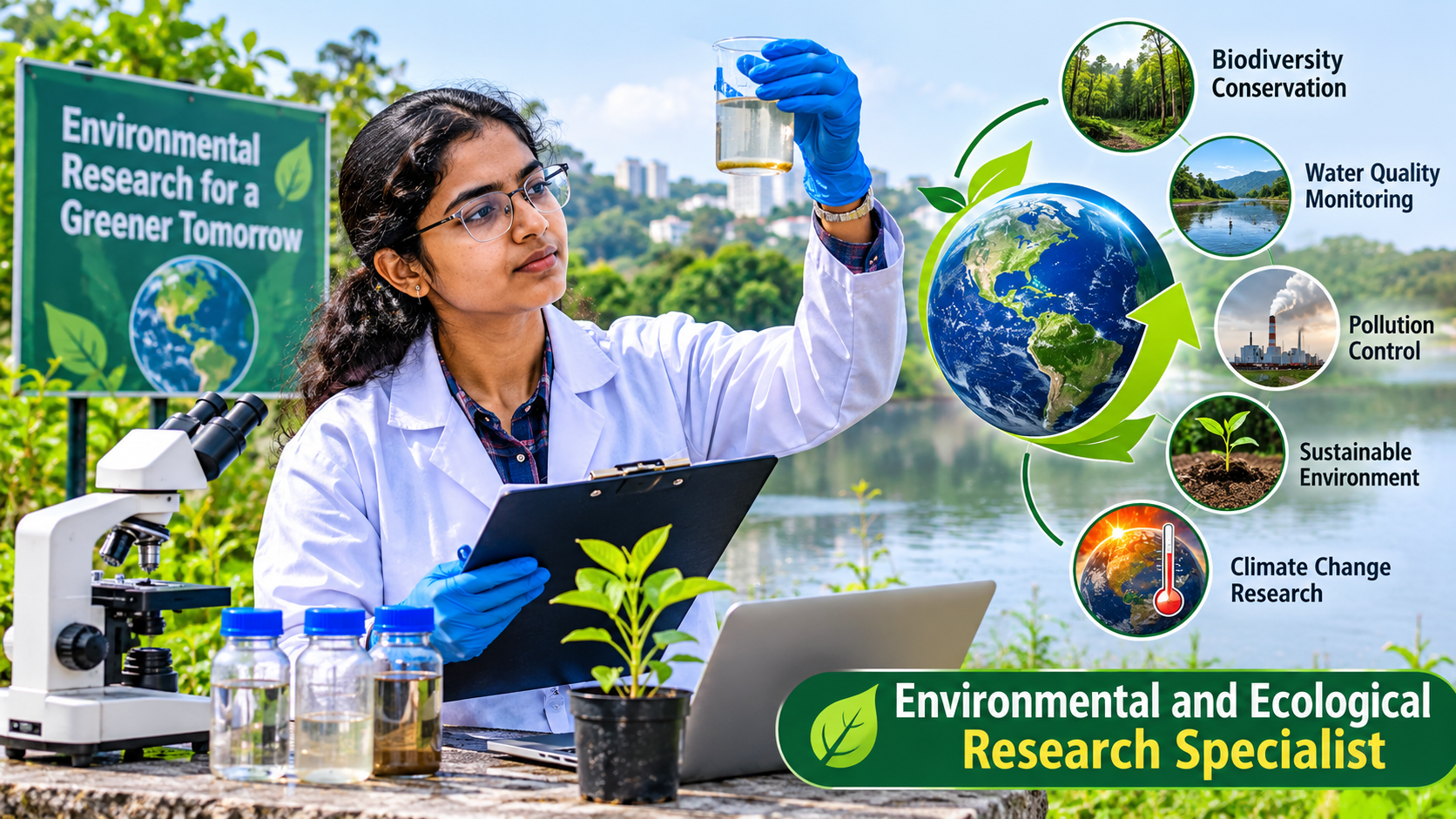
5. Environmental and Ecological Research Specialist
Addressing climate change, biodiversity loss, and environmental pollution requires dedicated field and lab scientists. Environmental Science Careers focus on monitoring ecosystem dynamics, assessing soil and water quality, evaluating impact studies, and restoring degraded habitats. Graduates with backgrounds in botany, zoology, geology, or environmental science excel in these roles.
Environmental specialists split their time between field sampling—collecting water samples, tracking wildlife, measuring forestry cover—and analyzing samples in environmental testing facilities. Corporate environmental compliance officers also inspect industrial operations to ensure zero-waste goals and pollution control standards are met.
Key Focus Areas: Water safety analysis, ecological survey methods, soil chemistry, conservation strategy.
Core Sectors: Forestry departments, environmental consultancies, non-governmental organizations, conservation trusts.
6. Data Research Analyst and Scientific Bioinformatician
Modern scientific investigation produces vast amounts of raw electronic information, creating strong demand for data experts. Scientific Data Analytics bridges computer technology with core laboratory disciplines. Bioinformaticians and computational analysts use specialized software pipelines to analyze genetic sequences, structure complex proteins, map epidemiological models, or track astronomical datasets.
For science graduates with strong analytical thinking skills, picking up programming languages like Python or R creates immediate high-paying career avenues. You get to solve biological, physical, or chemical problems using code, computational tools, and statistical models.
Key Focus Areas: Genome sequencing analysis, protein modeling, clinical data trends, pattern identification.
Core Industries: Genomics companies, agricultural biotech firms, health tech startups, quantitative research groups.
Explore global open-access biological datasets and computational tools hosted by the National Center for Biotechnology Information.
7. Materials Science and Renewable Energy Investigator
The world’s transition toward sustainability depends on creating better energy storage, super-conductive materials, and efficient solar cells. Materials Science Exploration focuses on studying, modifying, and synthesizing substances to craft novel consumer and industrial products. Physics and chemistry graduates play vital roles in evaluating battery degradation, developing biodegradable polymers, and improving semiconductor manufacturing.
Renewable energy labs hire junior scientific associates to test fuel cells, evaluate wind turbine blade strength, and analyze photovoltaic efficiency. This sector provides high satisfaction by directly addressing energy efficiency and global carbon reduction goals.
Key Focus Areas: Battery cell chemistry, polymer synthesis, semiconductor prototyping, solar efficiency testing.
Core Industries: Renewable energy providers, automotive battery developers, electronics manufacturing facilities.
8. Food Technology and Agricultural Research Associate
Ensuring global food security and developing sustainable agriculture practices relies heavily on applied scientific discovery. Agricultural Research Careers involve developing climate-resilient crops, improving soil fertility, optimizing crop yields, and fighting plant pathogens. Botany, agriculture, and microbiology graduates lead innovation in tissue culture labs, seed development companies, and ag-tech startups.
In food technology labs, research associates test food safety, formulate plant-based alternatives, enhance shelf-life stability, and optimize nutritional profiles. Quality testing ensures commercial products satisfy stringent public health guidelines before reaching grocery shelves.
Key Focus Areas: Hybrid seed production, plant tissue culture, food pathogen screening, nutritional preservation.
Core Sectors: Commercial seed corporations, food processing giants, agricultural universities, food safety agencies.
9. Forensic Science Technician and Crime Lab Investigator
If you want to apply physical and biological evidence to the legal system, forensic science offers a compelling career path. Forensic Research Specialists examine crime scene physical evidence using analytical chemistry, DNA profiling, ballistics testing, and toxicological screening.
Forensic technicians work in government crime laboratories, law enforcement evidence branches, and specialized private investigation labs. The job demands meticulous attention to detail, strict custody documentation, and precise objective reporting, as findings are frequently presented as court testimony.
Key Focus Areas: DNA extraction, chemical toxin identification, trace evidence analysis, finger-print pattern identification.
Core Hiring Bodies: State forensic science laboratories, law enforcement bureaus, cyber forensic agencies.
10. Quality Control Analyst and Industrial R&D Chemist
Manufacturing industries depend on rigorous chemical and physical testing to maintain quality control. Quality Assurance Careers place science graduates at the heart of industrial production lines. Quality Control Analysts verify that incoming raw materials and finished commercial goods conform precisely to safety regulations and purity targets.
Industrial chemical researchers work on refining chemical manufacturing processes, scaling lab reactions to factory levels, and minimizing toxic byproduct creation. This field offers consistent employment, clear career progression into laboratory management, and opportunities across diverse manufacturing sectors.
Key Focus Areas: Purity testing, raw material validation, industrial batch sampling, instrument calibration.
Core Sectors: Chemical manufacturing, cosmetics producers, consumer packaged goods companies, paint and coatings plants.
11. How to Transition from a BSc Degree into a Research Career
Successfully launching research careers after BSc requires deliberate planning, skill acquisition, and active academic networking.
| Transition Step | Key Objectives | Practical Action Items |
Skill Enhancement | Develop specialized technical and analytical skills | Complete certifications in programming (Python/R) or lab techniques |
Practical Experience | Gain hands-on exposure to active laboratory protocols | Apply for summer internships, JRF positions, and university lab roles |
Higher Studies Planning | Prepare for postgraduate research qualification | Research MSc, Integrated PhD, and GATE/NET examination pathways |
Academic Networking | Build connections with active researchers and mentors | Attend scientific conferences and review publications on ResearchGate |

How useful was this post?
Click on a star to rate it!
Average rating 0 / 5. Vote count: 0
No votes so far! Be the first to rate this post.