
Essentials of Defamation
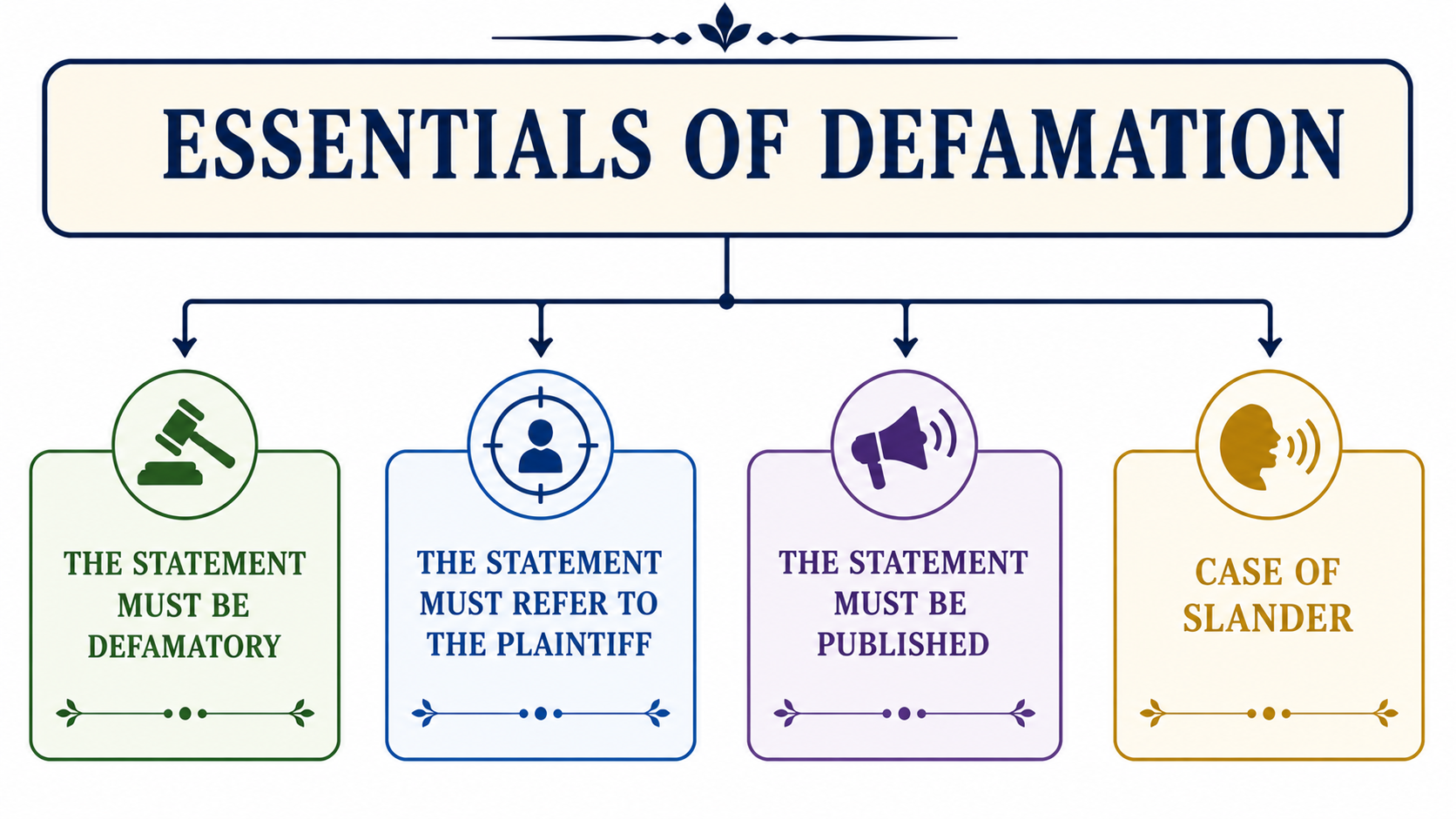
To establish civil defamation, four essential requirements must be satisfied:
1. The statement must be defamatory, lowering the plaintiff’s reputation in the eyes of reasonable people;
2. The statement must refer to the plaintiff, directly or indirectly;
3. The statement must be published
4. Case of Slander, the plaintiff must prove special damage or show that the statement falls within a recognized exception actionable per se.
Thus, a successful defamation claim requires a defamatory statement that identifies the plaintiff, is communicated to others, and, in slander cases, satisfies the rule on special damage or an established exception.
The statement must be defamatory
The first essential requirement of defamation is that the statement or conduct must be defamatory, tending to injure the plaintiff’s reputation, lower them in the estimation of right-thinking members of society, or expose them to hatred, contempt, ridicule, or avoidance.
Defamation may be oral, written, visual, or by conduct, and is judged by the standard of a reasonable person rather than a hypersensitive audience.
As stated in “Salmond on the Law of Torts”, a statement is defamatory if its natural tendency is to lower a person’s reputation among reasonable people.
Thus, a statement or act is defamatory if it harms a person’s reputation in the eyes of ordinary reasonable people, regardless of the defendant’s intention.
Deepak Kumar Biswas v. National Insurance Co. Ltd.
In Deepak Kumar Biswas v. National Insurance Co. Ltd., the Gauhati High Court held that a statement alleging delay by a lawyer in legal proceedings was not defamatory.
The insurance company, seeking condonation of delay, stated that the appeal was delayed due to the laches of the lawyer handling the arbitration case.
The Court ruled that such statements in court pleadings do not amount to an attack on personal integrity or reputation, particularly in the absence of malice or ill will.
Thus, explaining a genuine professional lapse in legal proceedings, without malicious intent, is not defamation.
Ram Jethmalani v. Subramaniam Swamy
In Ram Jethmalani v. Subramaniam Swamy, the Delhi High Court held that false allegations against an opposing advocate in legal proceedings are ex facie defamatory and may exceed qualified privilege.
The defendant falsely alleged that Ram Jethmalani had accepted money from the LTTE, a banned organization.
The Court ruled that such irrelevant personal attacks showed actual malice, exceeded legal privilege, and awarded ₹5 lakhs in damages.
Thus, false and malicious allegations made in legal proceedings are not protected by privilege and are actionable as defamation.
S.N.M. Abdi v. Prafulla Kumar Mohanta
Under the Law of Torts, as held in S.N.M. Abdi v. Prafulla Kumar Mohanta, a statement is defamatory if it lowers the plaintiff’s reputation in the eyes of a substantial and respectable section of society, even if it is only a minority.
The Court awarded ₹50,00,000 in damages for false allegations against the former Assam Chief Minister.
The law also distinguishes defamation from mere vulgar abuse: angry or abusive words that only hurt feelings are not actionable, but as held in Ramdhara v. Phulwatibai, words imputing unchastity or attacking moral character are actionable.
Thus, a statement becomes defamatory when it seriously harms a person’s reputation or moral character, not when it is merely abusive or insulting.
South Indian Railway Co. v. Ramakrishna
In South Indian Railway Co. v. Ramakrishna, the Court held that a bona fide statement of suspicion made by a railway guard in the ordinary course of his duties was not defamatory.
When the guard remarked, “I suspect you are travelling with a wrong (or false) ticket,” the plaintiff later produced a valid ticket.
The Court ruled that the statement was made in good faith during routine ticket inspection, relieving the railway company of vicarious liability.
Thus, a genuine expression of suspicion made without malice while performing official duties does not amount to defamation, even if it causes temporary embarrassment.
The Innuendo
Under the Law of Torts, a statement may be prima facie defamatory by its ordinary meaning or become defamatory through innuendo, where an apparently innocent statement carries a hidden defamatory meaning.
In such cases, the plaintiff must plead and prove the innuendo, showing that reasonable people understood the statement in its defamatory sense.
Examples include describing someone as a “saint” to imply membership of a criminal gang, sarcastically saying “X is an honest man who never stole my watch,” or stating that an unmarried woman gave birth to imply unchastity.
Thus, even innocent or sarcastic words are actionable if their hidden meaning damages the plaintiff’s reputation.
Capital and Counties Bank v. Henty & Sons
In Capital and Counties Bank v. Henty & Sons, the Court considered whether a business circular carried an innuendo of insolvency.
After a dispute with the bank manager, the defendants informed customers that they would no longer accept cheques drawn on the plaintiff bank.
Although the bank claimed the notice implied insolvency, the Court held it was not libellous, as its natural meaning did not suggest financial instability and a reasonable person would not draw such an inference.
Thus, a statement is not defamatory merely because others reach unreasonable conclusions beyond its ordinary meaning.
Tolley v. J.S. Fry & Sons Ltd.
In Tolley v. J.S. Fry & Sons Ltd., the Court held that an innuendo can make an apparently innocent publication defamatory.
A chocolate manufacturer published an unauthorized caricature of a famous amateur golfer, implying that he had used his amateur reputation for advertising and monetary gain.
The Court found the innuendo proved and held the advertisement defamatory, as it damaged the plaintiff’s amateur status and reputation.
Thus, an innocent image or statement becomes defamatory when its hidden meaning harms a person’s reputation.
Cassidy v. Daily Mirror Newspapers Ltd.
Under the Law of Torts, defamation is a tort of strict liability, and intention to defame is not essential.
In Cassidy v. Daily Mirror Newspapers Ltd., a newspaper innocently published an engagement announcement of a man already married, leading the lawful wife to establish an innuendo that she was living in immoral cohabitation.
The Court of Appeal held that innocence, good faith, or absence of malice is no defence if the publication injures the plaintiff’s reputation.
Thus, a publisher is liable for defamation when a statement harms a person’s reputation, even if it was published without knowledge or malicious intent.
B.M. Thimmaiah v. T.M. Rukimini
In B.M. Thimmaiah v. T.M. Rukimini, the Karnataka High Court held that defamatory statements in written pleadings are actionable when they attack a person’s moral character.
The defendants alleged in their written statement that the relationship between Smt. Rukimini and her co-plaintiff was “questionable and of doubtful activities.”
The Court ruled that such allegations naturally lowered her reputation and further held that proof of malice or evil intention is not necessary to establish defamation.
Thus, false allegations attacking a person’s moral character in court pleadings amount to actionable defamation, even without proof of malice.
Morrison v. Ritchie & Co.
In Morrison v. Ritchie & Co., the Court held that defamation is governed by strict liability, and a publisher’s good faith or ignorance of extrinsic facts is no defence.
The defendants innocently published a birth notice stating that the plaintiff had given birth to twins, but because she had been married for only two months, the notice carried an innuendo affecting her chastity and reputation.
The Court held the defendants liable for defamation.
Thus, even an innocent publication is defamatory if extrinsic facts cause it to damage a person’s reputation.