
Repetition of the Defamantory Matter
Under tort law, every repetition or republication of a defamatory statement is a fresh publication, making the repeater equally liable as the original publisher.
Authors, editors, printers, and publishers are strictly liable, while booksellers, newspaper vendors, and librarians are protected if they neither knew nor could reasonably have known that the material was defamatory.
Thus, repeating defamation creates fresh liability, but innocent distributors are exempt if they acted without knowledge or negligence.
Emmens v. Pottle
In Emmens v. Pottle, the Court recognized the defense of innocent dissemination, holding that newspaper vendors and other secondary distributors are not liable for selling defamatory publications if they had no knowledge of the libel and were not negligent in failing to discover it.
Thus, innocent distributors acting in the ordinary course of business are protected, while liability remains with the original publisher.
Indemnity from the supplier of wrong information
In Gurbachan Singh v. Babu Ram, the Court held that an editor who publishes defamatory material cannot claim indemnity from the informant unless a contract of indemnity exists.
The Court emphasized that the duty to verify defamatory information rests on the editor, and failure to do so amounts to negligence, making the editor solely liable for the consequences.
Thus, an editor cannot shift liability to the source without a contractual right of indemnity.
DEFENCES
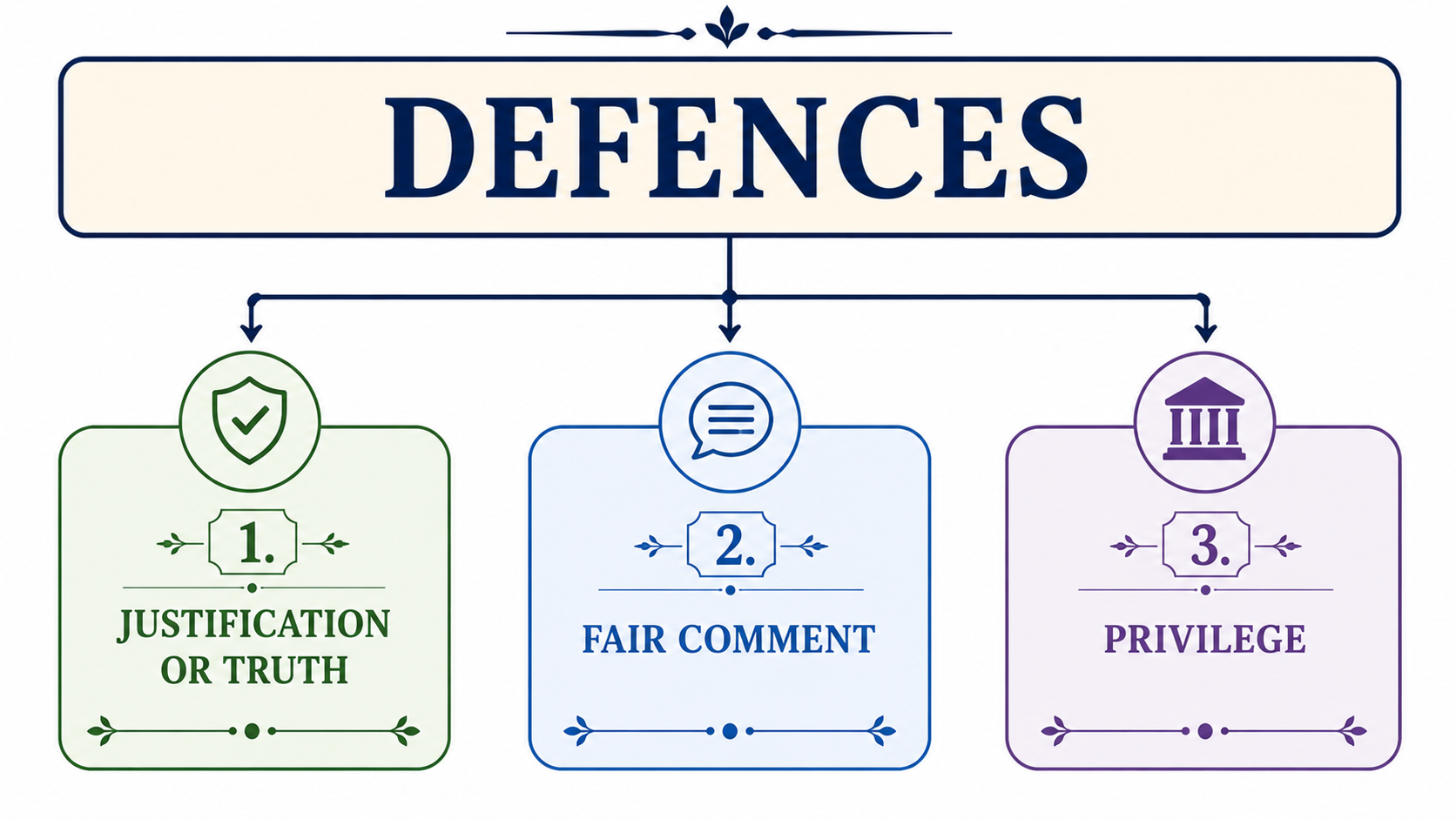
The defences to an action for defamation are :
1. Justification or Truth.
2. Fair Comment.
3. Privilege, which may be either absolute or qualified.
Justification or Truth
In defamation law, truth (justification) is a complete defence in civil actions, even if published maliciously, because the law does not protect an undeserved reputation.
However, under Section 499 of the Indian Penal Code, truth is a defence only when published for the public good.
Further, under the doctrine of substantial truth, as illustrated in Alexander v. North Eastern Ry., minor inaccuracies do not defeat the defence if the main imputation is true.
Thus, truth is a complete civil defence, while criminal law additionally requires proof of public good.
Radheshyam Tiwari v. Eknath
In Radheshyam Tiwari v. Eknath, the Court held that the defence of justification by truth fails if the defendant cannot prove the truth of the defamatory allegations.
A newspaper editor who published corruption allegations against a public officer was held liable because he produced no supporting evidence.
The Court further held that police reports or freedom of the press under Article 19(1)(a) do not justify publishing unverified or distorted allegations.
Thus, truth must be proved with evidence, and reckless reporting is not protected.
Salena Dandasi v. Gajjala Malla Reddy
In Salena Dandasi v. Gajjala Malla Reddy, the Andhra Pradesh High Court held that publishing distorted or exaggerated versions of an FIR without verification constitutes defamation, and freedom of the press does not protect reckless reporting.
Further, Section 5 of the English Defamation Act, 1952 provides that the defence of justification does not fail merely because every allegation is not proved, so long as the unproved charges do not materially add to the injury caused by the true allegations.
Thus, reckless journalism is actionable, while substantial truth remains a valid defence.
Fair Comment
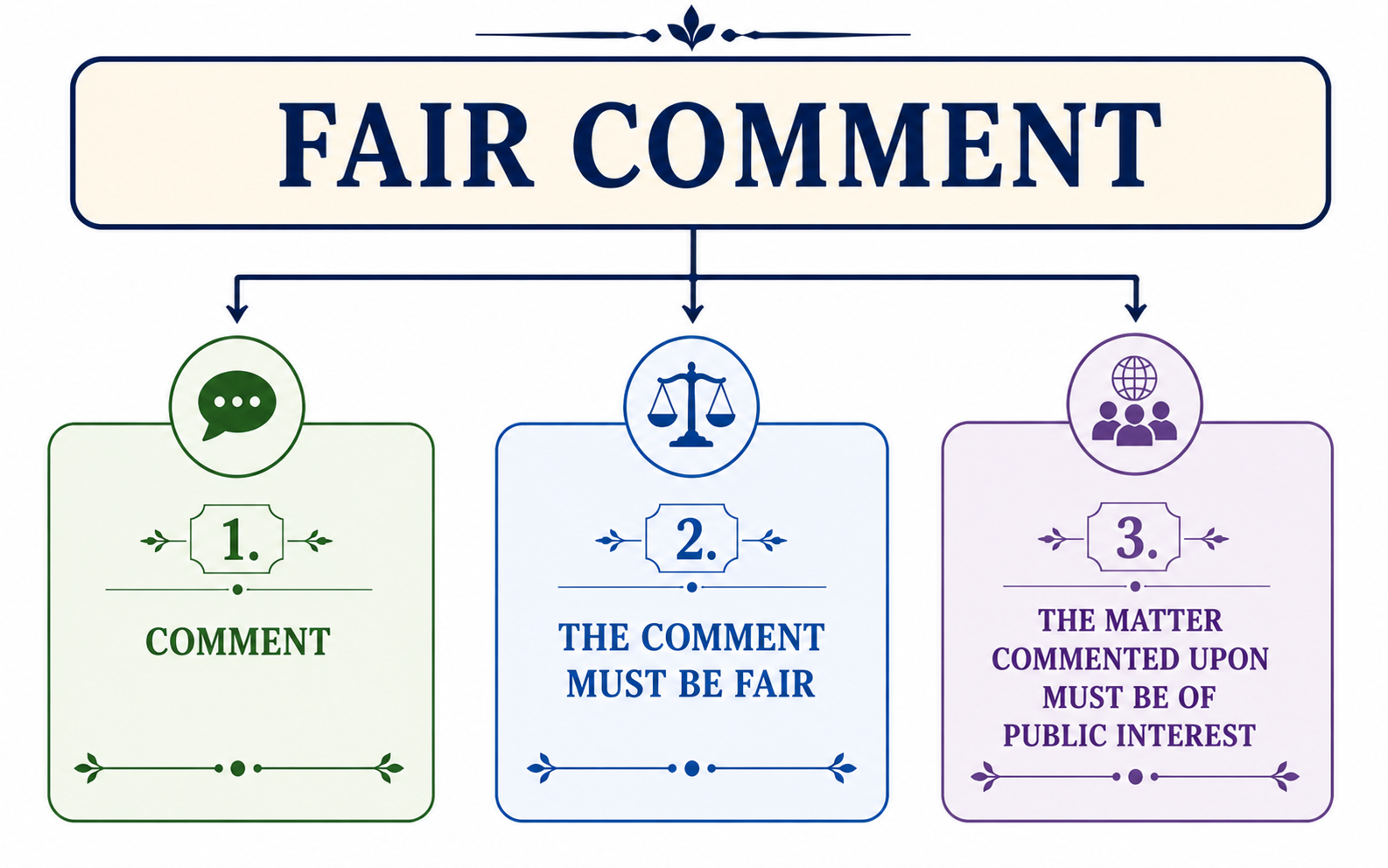
Making fair comment on matters of public interest is a defences to an action for defamation. For this defences to be available, the following essentials are required :
1. It must be a comment, i.e., an expression of opinion rather than assertion of fact
2. The comment must be fair
3. The matter commented upon must be of public interest.
Comment
In defamation law, the defence of fair comment protects genuine opinions based on true or known facts, not independent statements of fact.
A comment is protected only when the underlying facts are stated or already known, whereas a bare allegation like “A is a dishonest man” or a personal attack unrelated to the subject becomes an actionable statement of fact.
Thus, fair comment applies only to honest opinions founded on disclosed facts, not unsupported factual accusations.
The comment must be fair
Under tort law, the defence of fair comment requires that an opinion be based on true or substantially true facts; comments founded on false or unprovable facts are not protected.
Under Section 6 of the English Defamation Act, 1952, the defence does not fail merely because every supporting fact is not proved, if the core facts justify the opinion.
In Silkin v. Beaverbrook Newspapers Ltd., Justice Diplock held that the test is subjective—even exaggerated or biased opinions are protected if honestly held.
Thus, fair comment protects honest opinions based on substantially true facts, not fabricated allegations.
K.S. Sundram v. S. Viswanathan
In K.S. Sundram v. S. Viswanathan, the Madras High Court held that articles criticizing a company’s management and performance amounted to fair comment, not defamation.
As the plaintiff failed to prove personal malice or ill will, the Court dismissed the suit for damages and injunction.
Thus, honest criticism of a company’s performance is protected as fair comment unless motivated by personal malice.
Gregory v. Duke of Brunswick
In Gregory v. Duke of Brunswick, the Court held that malice defeats the defence of fair comment.
The defendants conspired to hiss and hoot an actor during a performance, causing him to lose his engagement, which the Court ruled was not an honest criticism but a malicious attempt to injure the plaintiff.
Thus, fair comment protects honest opinion, but not comments motivated by malice or personal ill will.
The matter commented upon must be of public interest
Under tort law, the defence of fair comment applies only to matters of public interest.
It covers comments on government departments, public officials, courts, public companies, local authorities, and works exposed to the public, such as books, plays, pictures, and other public entertainments.
Thus, honest opinions on matters affecting the public or works submitted for public review are protected as fair comment.
Privilege
In defamation law, the defence of privilege protects certain statements where freedom of speech outweighs the right to reputation.
It is divided into Absolute Privilege, which gives complete protection regardless of motive, and Qualified Privilege, which protects statements made without malice.
Thus, privilege provides complete or conditional immunity from defamation liability on recognized occasions.
Absolute Privilege
Under tort law, Absolute Privilege provides complete legal immunity for defamatory statements, meaning no action lies against the speaker even if the statement is false or made with malice.
This absolute defense is based on public policy, which holds that in certain vital contexts, an individual’s right to reputation must give way to freedom of speech to ensure uninhibited official proceedings.
In simple terms, the law grants total protection from defamation lawsuits in critical settings, such as courts or parliamentary proceedings, because free and fearless communication is considered more important than protecting personal reputation.
Parliamentary Proceedings
Under constitutional law, legislative speeches and official publications enjoy Absolute Privilege under Article 105(2) (Parliament) and Article 194(2) (State Legislatures).
These provisions protect members from defamation proceedings for statements made inside the House or published in authorized legislative reports.
In simple terms, MPs and MLAs have complete legal immunity for official legislative statements, allowing them to speak freely without fear of defamation lawsuits.
Judicial Proceedings
Under the doctrine of Absolute Privilege, judges (protected by the Judicial Officers Protection Act, 1850), counsels, witnesses, and parties enjoy immunity from libel and slander actions for statements made during judicial proceedings, even if made with malice.
However, this protection is subject to relevance.
In Jiwan Mal v. Lachhman Das, a witness made an irrelevant defamatory allegation against a non-party, and the court rejected the defense of absolute privilege, holding the defendant liable because the statement had no relevance to the matter in issue.
In simple terms, courtroom participants are protected only for relevant statements made during proceedings; irrelevant defamatory attacks are not protected.
Rajinder Kishore v. Durga Sahi
Under the law of defamation, Absolute Privilege extends to judicial and certain pre-judicial proceedings, including relevant statements made in police complaints, preliminary witness preparations, and cross-examinations involving a counsel acting as both party and advocate.
In Rajinder Kishore v. Durga Sahi, the Allahabad High Court held that a witness’s statement against such a counsel was relevant and therefore privileged.
Absolute privilege also applies to police complaints the complainant is willing to support on oath and to preliminary statements made by prospective witnesses.
In simple terms, the law protects people who genuinely report crimes, prepare for trials, or give relevant statements in legal proceedings, allowing them to act without fear of defamation lawsuits.
T.G. Nair v. Melepurath Sankunni
Under the law of defamation, Absolute Privilege extends beyond formal judicial proceedings to necessary preliminary legal steps, including petitions under Section 107, Cr.P.C. and official copies submitted to the police.
In T.G. Nair v. Melepurath Sankunni, the court held that both a petition filed before an Executive Magistrate and its copy sent to the Sub-Inspector of Police were protected by absolute privilege, resulting in the dismissal of the defamation claim.
In simple terms, official petitions to a magistrate and copies sent to the police as part of legal proceedings are completely protected from defamation lawsuits because they form an essential part of the legal process.
V. Narayana v. E. Subbanna
Under the doctrine of Absolute Privilege, statements made in official complaints to the police are protected from civil defamation suits as preliminary steps in the administration of justice.
In V. Narayana v. E. Subbanna, the court held that even a false complaint alleging robbery was absolutely privileged, preventing a civil defamation action.
In simple terms, a person cannot be sued for defamation for statements made in an official police complaint, as the law grants complete immunity to encourage the reporting of alleged crimes without fear of litigation.
State Communication
Under the law of torts, State Communications enjoy Absolute Privilege on grounds of public policy.
Statements made by one State officer to another in the discharge of official duty are completely immune from civil liability for defamation.
This protection also extends to official military and naval reports and communications between Ministers or from a Minister to the Crown or Head of State.
In simple terms, government officers, military officials, and Ministers are protected from defamation lawsuits for official communications made in the course of their duties, ensuring the effective administration of government without fear of litigation.
Qualified Privilege
Under the law of defamation, Qualified Privilege provides conditional immunity from liability, unlike absolute privilege, because it applies only when a statement is made without malice on a privileged occasion.
To establish this defense, the defendant must prove two essentials:
(1) the statement was made in the discharge of a legal, moral, or social duty, for the protection of a legitimate interest, or as a fair and accurate report of parliamentary, judicial, or public proceedings
(2) it was made bona fide, without express malice or improper motive.
In simple terms, qualified privilege protects people who honestly share information out of duty or legitimate interest, provided they act in good faith and without personal malice.
Statements should be made in discharge of a duty or protection of an interest
Under the law of torts and criminal law, Qualified Privilege applies when a statement is made on a privileged occasion in the discharge of a legal, social, or moral duty or for the protection of an interest.
The law requires reciprocity, meaning the maker must have a duty or interest to communicate the information, and the recipient must have a corresponding duty or interest to receive it.
This principle is reflected in the Ninth Exception to Section 499, I.P.C., which protects imputations made in good faith for the protection of the maker, another person, or the public good.
In simple terms, a person is protected from defamation when they honestly communicate necessary information to someone who has a legitimate need to know, provided they act in good faith and without malice.
Illustrations
Under the law of defamation and the Ninth Exception to Section 499, I.P.C., Qualified Privilege protects imputations made in good faith for self-interest, official duty, or the public good.
Thus, a shopkeeper warning a manager, a Magistrate submitting an official report, a former employer giving a job reference, or a creditor informing another creditor are protected when acting in good faith on a privileged occasion.
However, this protection is lost if the statement is made with malice or an intent to harm.
R.K. Karanjia v. Thackersey
Under the law of torts, a newspaper claiming Qualified Privilege for a libellous publication must prove a legal duty to communicate the information, as mere public interest is insufficient.
In R.K. Karanjia v. Thackersey, the Bombay High Court rejected this defense because the newspaper failed to establish such a duty and acted with express malice arising from a personal grudge.
In simple terms, a newspaper cannot rely on qualified privilege simply because a story concerns public interest; if it publishes without a legal duty or acts with malice, it loses the defense and remains liable for defamation.
Radheshyam Tiwari v. Eknath
Under the law of defamation, Radheshyam Tiwari v. Eknath held that newspapers cannot claim Qualified Privilege, justification, or fair comment for publishing false and mala fide defamatory statements.
Qualified privilege requires actual reciprocity of duty or interest, and the defense is lost if the statement is communicated to an unrelated third party.
However, good-faith communications made to persons with a legitimate interest, such as internal employer reports or parental advice, remain protected.
In simple terms, qualified privilege protects only honest, good-faith communications shared with people who have a genuine need to know.
Reports or parliamentary, Judicial or other Public Proceedings
Under the law of defamation, reports of legislative proceedings published by or under the authority of Parliament or State Legislatures enjoy Absolute Privilege, while reports published by the media or other third parties are protected by Qualified Privilege if they are fair, made without malice, and serve the public interest.
Qualified privilege also extends to fair reports of judicial, quasi-judicial, public meetings, and official inquiry proceedings.
However, it does not apply to confidential or in-camera proceedings or matters lacking public interest.
In simple terms, fair reports of open legislative and judicial proceedings are protected from defamation claims, but reports published maliciously or from closed-door proceedings are not.