
Act done by an Independent Contractor
While general tort law provides that an employer is not liable for wrongful acts of an independent contractor, hiring one is no defense under the rule of strict liability in Rylands v. Fletcher.
In T.C. Balakrishnan Menon v. T.R. Subramanian, a fireworks organizer engaged an independent contractor for an exhibition, but an explosive device (Minnal Gundu) strayed into the crowd and injured a spectator.
The Kerala High Court held that explosives are “extra hazardous” objects involving exceptional danger, making the duty to keep them safely a non-delegable duty.
Therefore, employers cannot escape strict liability for injuries caused by an independent contractor.
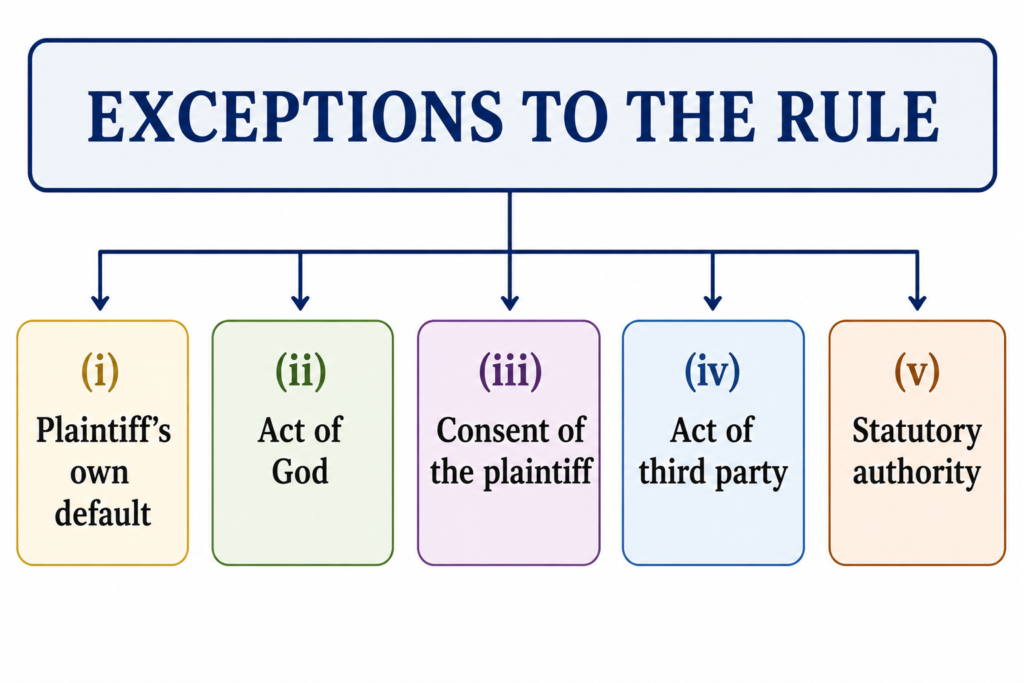
Exceptions to the rule
The following exceptions to the rule have been recognized by Rylands v. Fletcher and some later cases :
(i) Plaintiff’s own default
(ii) Act of God
(iii) Consent of the plaintiff
(iv) Act of third party
(v) Statutory authority
Plaintiff’s Own Default
Under tort law rules governing strict liability, a defendant is excused when damage is caused by the plaintiff’s own intrusion or the unusual sensitivity of the plaintiff’s property.
In Ponting v. Noakes, a horse died after reaching onto a neighbour’s land to eat poisonous leaves; the landowner was not liable because the harm resulted from the plaintiff’s trespass, not an escape of a dangerous element.
Similarly, in Eastern and South African Telegraph Co. Ltd. v. Capetown Tramways Co., a plaintiff could not claim for minor environmental disruptions, such as low-level electrical current, where harm occurred only because the plaintiff’s equipment was exceptionally sensitive.
Thus, individuals cannot expand their neighbours’ legal duties through extraordinary or hyper-delicate uses of their property.
Act of God
Under the law of torts, particularly the doctrine of strict liability established in Rylands v. Fletcher, a person who brings dangerous elements onto their property is responsible if they escape and cause harm; however, classic principles recognize defenses such as plaintiff’s own default, unusual sensitivity, and an “Act of God” (vis major).
First, liability is excluded where damage results from the plaintiff’s own intrusion or trespass, as in Ponting v. Noakes, where a horse died after reaching onto a neighbour’s land to eat poisonous yew leaves without any dangerous element escaping.
Second, under Eastern and South African Telegraph Co. Ltd. v. Capetown Tramways Co., no damages are recoverable where harm results only from the hyper-sensitivity of the plaintiff’s equipment, as a person cannot expand a neighbour’s legal duties through extraordinary uses of property.
Third, an “Act of God” may excuse liability where an escape is caused by an unprecedented force beyond human foresight or control, as in Nichols v. Marsland, where artificial lakes overflowed during an extraordinary storm and washed away bridges despite strong embankments.
However, modern standards restrict these defenses for inherently hazardous activities, particularly electrical power management.
In S.K. Shangrung Lamkang v. State of Manipur and M.P. Electricity Board v. Shail Kumar, courts held that entities conducting high-risk operations may face absolute strict liability for injuries caused during their operations, regardless of negligence or precautions.
Since extreme weather such as lightning and storms may be reasonably anticipated by power utilities, courts do not allow them to escape liability by relying on an “Act of God,” “Act of a Stranger,” or snapped lines caused by severe winds.
Thus, unlike negligence, strict liability for hazardous enterprises ensures compensation even where precautions were taken or unexpected events contributed to the harm.
Consent of the plaintiff
Under the principle of volenti non fit injuria, strict liability under Rylands v. Fletcher does not apply if the plaintiff consents to the accumulation of a dangerous substance, particularly where the danger serves the “common benefit” of both parties.
This principle applies in shared buildings where occupants implicitly agree to common utilities such as plumbing, gas pipes, and electrical wiring.
In Carstairs v. Taylor, a landlord was not liable when a water tank leaked onto a tenant’s goods because the water system was maintained for their mutual benefit and no negligence occurred.
However, “common benefit” is strictly limited and does not generally extend to public utility companies or public entertainment such as firework displays.
Festival spectators do not consent to the risk of stray explosives entering the crowd, so event organizers remain liable for resulting injuries.
Act of third party
Under strict liability principles, an “act of a third party” or stranger traditionally absolves a defendant when harm is caused by an uncontrolled third person, as shown in Box v. Jubb and Rickards v. Lothian.
However, this defense fails where the stranger’s actions were reasonably foreseeable and preventable.
In Northwestern Utilities v. London Guarantee, M.P. Electricity Board v. Shail Kumar, and U.P. Power Corpn. v. Bijendra Singh, entities managing hazardous activities such as electricity or high-pressure gas were held to an extra duty of care and could not rely on power theft or third-party interference when fallen wires or gas leaks caused harm.
The financial risk of such accidents is treated as an overhead cost of high-risk business.
Similarly, in State of J. & K. v. Mohd. Iqbal, states could not shift blame to road users or minors in electrocution cases near public equipment.
The defense remains limited to truly unpredictable events, as in Meghalaya State Electricity Board v. Edentinora Mawthoh, where another government body raised a park structure beneath high-tension wires without notice, making the accident unforeseeable to the power board.
State of Mizoram v. H. Lalrinmawia
In State of Mizoram v. H. Lalrinmawia, the Gauhati High Court held that electricity departments remain liable for negligence when transformer faults cause severe voltage fluctuations, property damage, and loss of life.
Here, a current spike from faulty transformer equipment destroyed the victim’s television and refrigerator and caused fatal electrocution.
The court awarded compensation to the deceased’s family, holding that the accident occurring inside a private residence rather than a public area was legally immaterial to establishing the department’s negligence and liability.
Statutory Authority
Under tort law, statutory authority serves as a valid defense against liability, including under Rylands v. Fletcher, for acts authorized or mandated by law.
However, this defense applies only where there is no negligence; statutory authority cannot protect a defendant when harm results from carelessness.
In Green v. Chelsea Waterworks Co., a company legally required to maintain a continuous water supply was not liable when a main pipe burst and flooded the plaintiff’s premises, as the burst occurred without negligence while performing its statutory duty.
Position in India
The rule of strict liability under Rylands v. Fletcher is widely recognized in Indian jurisprudence, though modified by judicial interpretations and modern statutes to suit local social and economic conditions.
As highlighted in Varghese v. Kerala State Electricity Board, liability for extra-hazardous activities such as power distribution, nuclear operations, gas, and pollution shifts the inquiry from “whose fault caused the accident?” to “whose risk was it that such an accident might occur?”, making authorities liable for electrocutions even without conclusive proof of negligence.
Supreme Court decisions including M.C. Mehta v. Union of India, Charan Lal Sahu v. Union of India, and Kaushnuma Begum v. New India Assurance Co. Ltd. have reinforced this principle.
This “no-fault liability” is also reflected in Section 140 of the Motor Vehicles Act, 1988, which provided fixed compensation for death or permanent disability without requiring proof of negligence.
Similarly, amendments to the Indian Railways Act and the Carriers Act, 1865 increased the liability of railways and common carriers for goods in transit.
However, Indian courts have limited strict liability by recognizing an exception for large-scale agricultural water storage, treating irrigation as a vital necessity in India’s agricultural context.
Madras Railway Co. v. Zamindar
In Madras Railway Co. v. Zamindar, the Privy Council recognized that India’s unique agricultural conditions create an exception to the strict liability rule in Rylands v. Fletcher for water storage.
Two ancient irrigation tanks on a Zamindar’s estate burst, and the escaping water destroyed three railway bridges.
The Privy Council held that strict liability did not apply because the tanks were essential for the sustenance of thousands of local farmers (ryots) and served a great public necessity.
It would therefore be inequitable to impose absolute liability; landowners need only take ordinary precautions.
As the Zamindar was not shown to be negligent, he was held not liable for the flood damage.
K. Nagireddi v. Government of Andhra Pradesh
In K. Nagireddi v. Government of Andhra Pradesh, the Andhra Pradesh High Court applied the public-necessity exception for agricultural water projects and cleared the State Government of liability.
The plaintiff lost 285 fruit-bearing trees after water seeped into his land from Branch Canal ‘ten’ of the Nagarjunsagar irrigation project.
He alleged negligence for failing to cement or line the canal floor.
The court rejected the claim, following earlier Privy Council rulings that public reservoirs and irrigation dams are essential to life in India.
It also held that the State was not negligent because the plaintiff failed to prove through engineering standards that lining or cementing the canal floor was technically necessary.