
Tort and Crime Distinguished
i) Nature of Wrongs, Scale, and Defenses
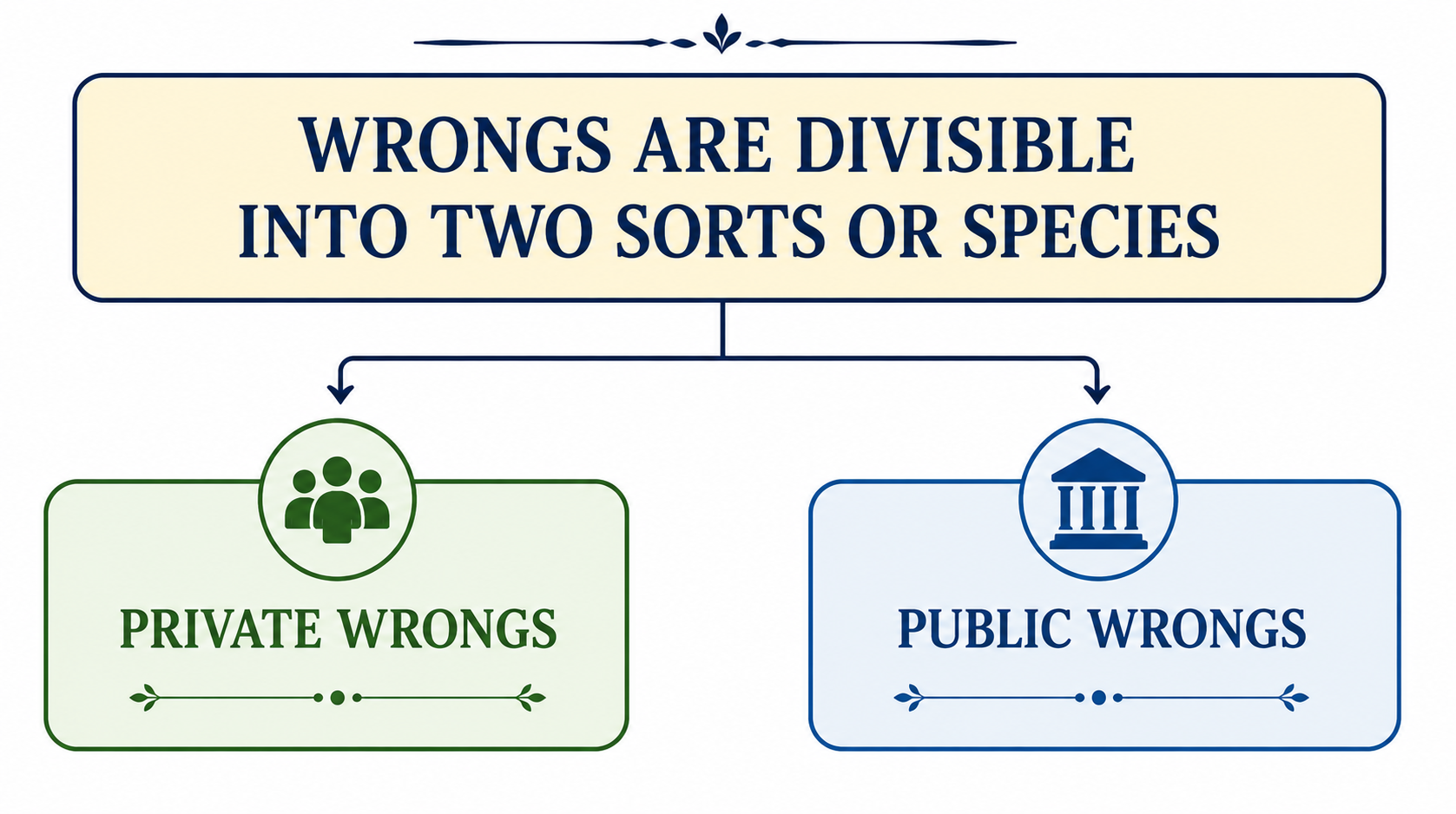
Wrongs are divisible into two sorts or species: private wrongs and public wrongs, where the former represents an infringement on the rights of individuals (civil injuries) and the latter is a violation of duties that affect the whole community considered as a community.
While certain actions like assault, defamation, negligence, conspiracy, and nuisance exist concurrently under both systems, the applicable legal rules depend entirely on whether you are establishing civil liability under the law of torts or criminal liability under criminal law.
The determining factor often boils down to scale: causing a localized block outside an apartment complex affects few people and remains a tort of private nuisance, whereas causing that same obstruction in the middle of a public highway escalates to the offense of public nuisance stated in sec. 268, I.P.C.
Additionally, the operational defenses change between fields; for instance, in a civil tort action for defamation, truth is in itself a defense, but in a criminal prosecution for the same act, the defence of truth can be taken if the publication was made for public good, showing how criminal standards demand a much higher burden of community justification than private civil disputes.
ii) Court Control, Compromise, and Settlements
Since a tort is considered to be a private wrong, the injured party himself has to file a suit as a plaintiff and maintains the right to agree to a compromise with the tortfeasor and withdraw the suit at any time.
In sharp contrast, a crime is viewed as a public wrong against the State, meaning the case is brought by public prosecutors rather than the victim.
Because criminal acts threaten the community as a whole, the law does not permit a settlement in criminal cases between the wrongdoer and aggrieved party, meaning that settling a crime outside of court—known as the compounding of an offence is, as a general rule, considered to be unlawful.
iii) Objectives of Justice, Remedies, and Detention
In the case of tort, the ends of justice are met by awarding compensation to make good the loss suffered, which stands in stark contrast to criminal law where the wrongdoer is punished to protect society and establish a visible deterring effect.
Although compensation is primarily a civil remedy, section 357, Cr. P.C. 1973 creates an exceptional bridge allowing a criminal court to order that an injured party be paid compensation directly out of a criminal fine.
If that amount is small and a subsequent civil suit is filed, the civil court must take into account any sum paid or recovered under that criminal order to prevent double recovery.
Additionally, bodily confinement serves completely opposite functions across fields: criminal imprisonment is made by way of penalty for a completed offense, while civil arrest under mechanisms like sec. 57 is a coercive tool intended to put pressure upon the defendant to perform a certain duty, guaranteeing their release the moment the underlying decree is satisfied.
Ultimately, because the same set of facts may constitute both a tort and a crime, a singular action like blocking a street can concurrently trigger a state prosecution for a public nuisance as defined in section 268, IPC alongside an independent civil obligation to compensate under the law of torts for any distinct private injury caused.
Privity of Contract and Tortious Liability
The privity of contract fallacy—which was introduced into the law by the old case of Winterbottom v. Wright to establish the rule that a stranger to an agreement cannot sue for injuries arising from its breach—has been discarded as highly irrelevant and unjust.
Established by the historic case Donoghue v. Stevenson, an action in tort is independent of a contract, meaning a manufacturer owes a legal duty of care to the end consumer even if the formal sales contract was strictly between the manufacturer and a retail shop.
As Lord Macmillan observed, a contractual setup does not block the co-existence of a right of action founded on negligence, allowing the same incident to trigger independent claims in both contract and tort.
This dual liability was heavily reinforced by the Delhi High Court in Klaus Mittelbachert v. East India Hotels Ltd., where a co-pilot was paralyzed due to a defectively designed hotel pool.
The court flatly rejected the hotel’s defense that the pilot was a stranger to the stay contract signed by his airline employer, confirming that a plea of stranger to contract was irrelevant under the Law of Torts.
The court subsequently invoked the rule of absolute liability to award 50 lac rupees in exemplary damages for the hazardous premises.
Tort and Quasi-contract Distinguished
The core overlapping feature is that the duty in each case is imposed by the law independently of any private agreement, yet a quasi-contract specifically serves to remedy an unjust benefit where the law implies an obligation to pay back a windfall received by mistake.
This distinction is fundamentally marked by the nature of the recovery: the law of quasi-contract grants a right strictly with respect to a fixed, liquidated sum of money, whereas the law of torts always pursues an unliquidated sum of money determined at the court’s discretion.
Additionally, while a quasi-contractual duty is narrowly directed towards a particular person, a tortious obligation demands lawful behavior towards persons generally.
Ultimately, when a wrongdoer profits from an infraction like conversion or trespass, the injured plaintiff is granted an election of remedies and can choose to have ‘waived the tort’, allowing them to bypass tort litigation entirely and bring an action in quasi-contract to successfully claw back the exact value of the financial advantage the defendant unfairly gained.