
Liability for Misstatements
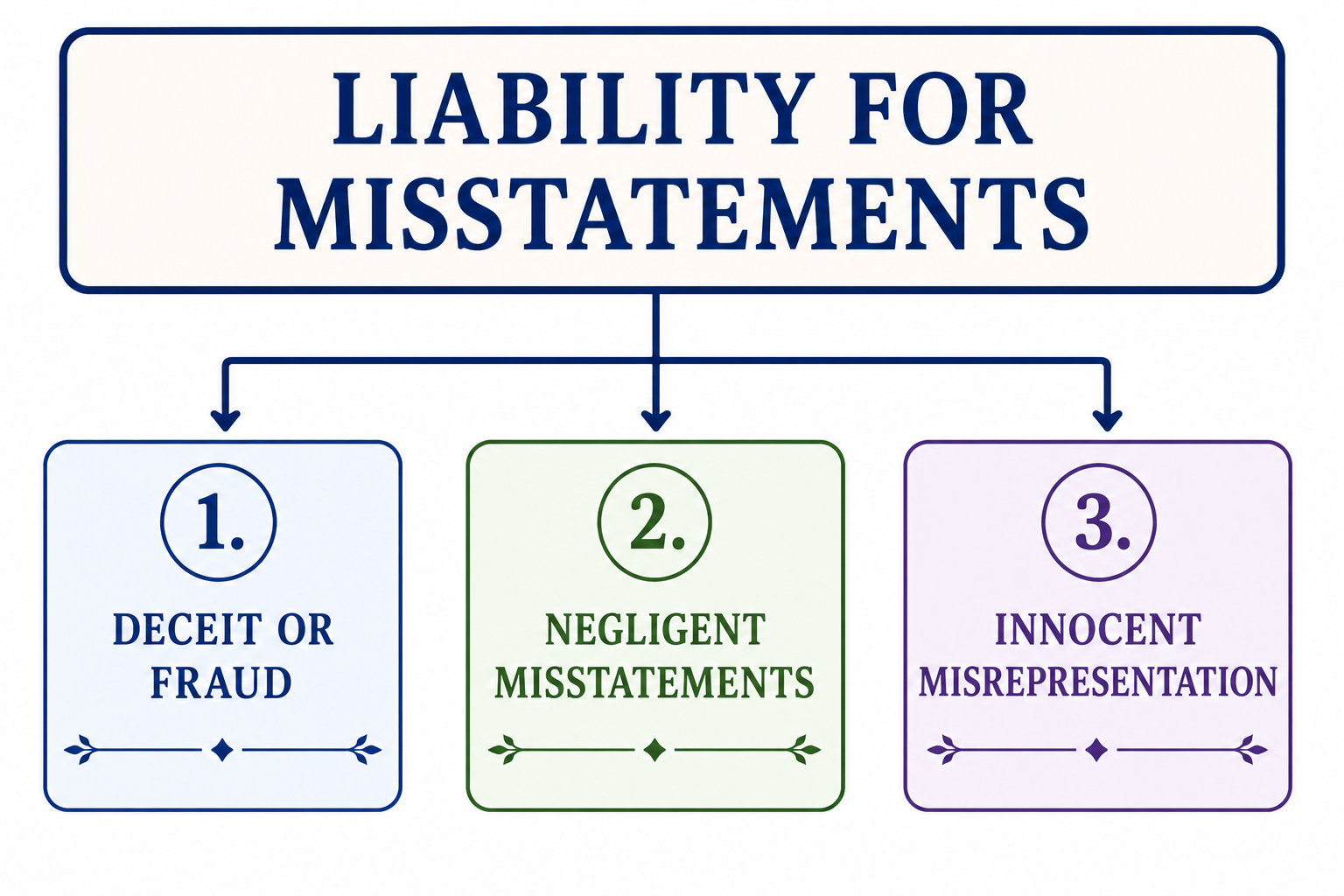
In this Chapter, we will discuss the liability of a person, arising in three different ways for false statements made by him.
- Liability for “Deceit or Fraud”. when a person knowingly makes a false statement of fact making another person to suffer loss by acting on the statement, it may amount to the tort of Deceit or Fraud.
- Liability for Negligent Misstatements. If a statement has been made honestly but negligently, that is, without caring to see whether the same is true or not, liability for such negligent misstatement may also arise.
- liability for Innocent Misrepresentaions.
1. DECEIT OR FRAUD
The legal tort of deceit or fraud occurs when a party willfully makes a false statement with the intentional goal of persuading another person to rely on it, becoming legally actionable once that reliance results in actual injury or loss.
To successfully establish a legal claim for deceit, four key elements must be proven.
First, the defendant must have made a false representation.
Second, the defendant must have known the statement was false or lacked an honest belief in its truth.
Third, the statement must have been made with the clear intent to deceive the plaintiff.
Finally, the plaintiff must have actively relied on the false representation and suffered measurable legal damage as a consequence.
(1) False Statement of Fact
To establish legal liability for fraud, a defendant must make a false statement of fact, either through express words or non-verbal conduct.
In Edgington v. Fitzmaurice, company directors issued debentures claiming that borrowed funds would complete company buildings and expand the business, while the money was actually intended to pay urgent debts.
The court held them liable for fraud, as misrepresenting one’s true intention constitutes a false statement of fact.
Similarly, in R. v. Barnard, an individual wore an academic cap and gown without authorization to falsely present himself as a university student and obtain goods on credit.
The court held that creating a misleading impression through personal conduct can also amount to actionable fraud.
Mere silence
Under the law, the principle of mere silence establishes that remaining silent or failing to disclose certain facts does not automatically constitute fraud.
To establish legal fraud, the defendant must make an affirmative, positive false statement of fact.
For example, if a seller sells an unsound horse without disclosing its hidden defects, the seller’s failure to speak does not amount to fraud.
Thus, simple non-disclosure, without an active representation or an obligation to speak, does not create legal liability for fraud.
Sri Krishan v. Kurukshetra University
In Sri Krishan v. Kurukshetra University, the Supreme Court established that mere non-disclosure does not amount to fraud where there is no legal obligation to speak.
A law student who failed to mention his attendance shortage on an examination form was not liable for fraud because the university authorities had the means and duty to verify their own records.
However, non-disclosure constitutes fraud where a positive duty to speak exists, as silence in such circumstances may create a false impression.
Key exceptions include contracts of utmost good faith (uberrimae fidei), such as insurance policies where the insured must disclose all material facts, and commercial transactions governed by trade customs, where withholding known defects may be treated as a false representation that the goods are free from defects.
Kiran Bala v. B.P. Srivastava,
In matrimonial law, there is a clear legal duty to disclose facts regarding a party’s unsoundness of mind, particularly when a prior marriage has been annulled on the same grounds.
This principle was demonstrated in Kiran Bala v. B.P. Srivastava, where the appellant’s first marriage was annulled due to her mental condition.
Neither Kiran Bala nor her parents disclosed her history of unsoundness of mind or the earlier annulment when arranging her second marriage.
The court held that the bride and her family had a strict duty to disclose these material facts, and withholding them meant the bridegroom’s consent was procured through fraudulent non-disclosure.
Consequently, the second marriage was annulled under Section 12(1)(c) of the Hindu Marriage Act.
With v. O’Flanagan
Under the law of fraud, a duty to disclose arises when initial representations become inaccurate due to changed circumstances or newly discovered facts.
As illustrated in With v. O’Flanagan, a doctor negotiated the sale of his medical practice by representing its annual income as £2,000, but failed to disclose that his earnings had fallen significantly due to illness before the contract was signed.
The court held that initial representations are continuing obligations, creating a duty to inform the buyer of the change, and that failure constituted fraud.
This duty extends to correcting statements that become untrue, avoiding half-truths that withhold qualifying details, and refraining from the active concealment of product defects.
Ward v. Hobbs
To establish legal liability for fraud, the underlying statement of fact must be demonstrably false, as fraud cannot be committed through a true representation, even if reliance on it proves harmful to the plaintiff.
This principle is illustrated in Ward v. Hobbs, where a seller sold pigs suffering from typhoid fever without disclosing the illness but expressly stated that the sale was “with all faults”.
When the infection spread and killed many of the buyer’s other pigs, the court held that the seller was not liable for fraud.
Since there was no false statement and the animals were sold on an “as-is” basis, the buyer assumed the risk, leaving no false representation on which to base a claim.
(2) Knowledge about the falsity of the statement
To establish legal liability for deceit or fraud, it must be shown that the defendant knew the statement was false or lacked an honest belief in its truth, as mere negligence does not constitute fraud where an honest belief exists.
This principle was established in Derry v. Peek, where company directors published a prospectus stating that they were authorized to use steam power for their tramways, genuinely believing that the required Board of Trade approval was a mere formality.
When the permit was refused and the company failed, an investor sued for fraud, but the House of Lords held the directors not liable because they honestly believed their representation was true.
Lord Herschell explained that actionable fraud requires a false statement made knowingly, without belief in its truth, or recklessly without caring whether it was true or false.
(3) Intention to deceive the plaintiff
To establish legal liability for fraud, the defendant must make a false representation intending that the plaintiff will rely and act upon it.
Liability may also extend to a third party if the defendant knew or had reason to believe that the statement made to one person would be communicated to and acted upon by another.
This principle is illustrated in Langridge v. Levy, where a father purchased a gun for himself and his son based on the seller’s fraudulent claim that it was safe and made by a renowned manufacturer.
When the gun exploded and injured the son, the court held the seller liable because he knew the representation was intended to reach and be acted upon by the son.
Conversely, if a false statement was not intended for the plaintiff to act upon, no liability for fraud arises.
In Peek v. Gurney, company directors were not liable to a plaintiff who purchased shares on the open market because the prospectus was intended only to induce original allottees subscribing directly through the company.
(4) The plaintiff must be actually deceived
For an action in fraud to succeed, the plaintiff must be actually deceived and suffer resultant damage, as a mere unexecuted attempt to deceive is insufficient to establish fraud.
This requirement is illustrated in Horsfall v. Thomas, where a seller fraudulently inserted a metal plug to hide a defect in a gun barrel before selling it.
The buyer, who purchased the gun without examining it, later refused to pay on the ground of fraud.
The court held that no legal fraud had occurred because the seller’s attempt to conceal the defect had no effect on the buyer’s mind or purchasing decision.
Thus, without actual deception influencing the plaintiff’s conduct and consequential harm arising from reliance on the misrepresentation, an attempted deceit is not actionable.
2. Negligent Misstatements
The legal framework surrounding liability for negligent misstatements underwent a significant historical evolution.
Initially recognized in Cann v. Wilson (1888), courts held that professionals such as property valuers owed a duty of care when preparing documents relied upon by third parties.
However, following Derry v. Peek (1889) and Le Lievre v. Gould (1893), the judiciary shifted toward a restrictive view, ruling that careless words were not actionable in tort without a contractual or fiduciary relationship or proof of deliberate fraud.
This strict standard persisted even after Donoghue v. Stevenson (1932), as decisions like Candler v. Crane, Christmas & Co. maintained a clear distinction between physical goods and spoken or written words.
A major transformation occurred with Hedley Byrne & Co. Ltd. v. Heller & Partners, where the House of Lords established that individuals possessing special skills owe a duty of care when providing information or advice if they know or should know that the recipient will reasonably rely upon their judgment.
Although the defendant bank in Hedley Byrne avoided liability due to an explicit “without responsibility” disclaimer, the case established that negligent misstatements causing pure economic loss can give rise to liability in tort.
3. INNOCENT MISREPRESENTATIONS
Under general tort law, an innocent misrepresentation—made without intent to deceive or negligence—does not give rise to legal liability because it fits neither ‘Fraud’ nor ‘Negligent Misstatement’.
However, in England, Section 2(1) of the Misrepresentation Act 1967 alters this rule by allowing compensation when an innocent misrepresentation induces a contract causing financial loss.
Under the Act, the representor is held liable as if the representation were fraudulent unless they prove they reasonably and honestly believed the statement was true up until the time the contract was formed.
Because the statutory remedy under the 1967 Act applies exclusively when a contract is formed between the parties, non-contractual false statements must rely on the tortious principles of negligent misstatement established in Hedley Byrne.
Additionally, the Act allows courts the discretion to award financial damages instead of rescinding the contract in cases involving non-fraudulent misrepresentations.