
The Problem of Remoteness
In the Law of Torts, the doctrine of remoteness of damage limits a defendant’s liability by preventing responsibility for an endless chain of consequences arising from a wrongful act.
As illustrated by the example of a cyclist’s negligent collision causing a bomb to explode, the law draws a practical boundary on liability.
As Lord Wright observed, the law selects only those consequences that are legally relevant rather than tracing an infinite chain of causes.
Thus, a defendant is liable only for damage that is not too remote or reasonably foreseeable, not for every unexpected consequence of the original wrong.
Remote and Proximate Damage
To determine liability in tort law, courts distinguish between remote damage and proximate damage.
A defendant is liable only when the wrongful act is the proximate cause of the injury, even if there are intermediate steps.
In Scott v. Shepherd, the defendant threw a lighted squib into a crowd, and it was instinctively passed on by others before exploding and blinding the plaintiff.
The Court held the defendant liable, ruling that natural acts of self-preservation do not break the chain of causation, so the original wrongful act remained the proximate cause of the injury.
Haynes v. Harwood
In Haynes v. Harwood, the defendant’s servants negligently left a horse van unattended in a crowded street.
After a child threw stones at the horses, they bolted, and a policeman was injured while rescuing women and children.
The defendant argued that the child’s act was a novus actus interveniens, breaking the chain of causation.
The Court rejected this defence, holding that the child’s mischief and the rescue attempt were natural and foreseeable consequences of the defendant’s negligence.
Therefore, the defendant remained liable, as the chain of causation was not broken.
Lynch v. Nurdin
In Lynch v. Nurdin, the defendant negligently left a horse and cart unattended on a public road.
While children were playing with it, one child set the horse in motion and another was injured.
The defendant argued that the child’s act was a novus actus interveniens, but the Court held that the defendant’s negligence remained the proximate cause because such child mischief was reasonably foreseeable.
Therefore, the chain of causation was not broken, and the defendant was held liable for the child’s injuries.
Lampert v. Eastern National Omnibus Co.
In Lampert v. Eastern National Omnibus Co., a married woman who suffered facial disfigurement due to the defendant’s negligence claimed additional damages after her husband deserted her.
The Court held that the defendant was not liable for the desertion, finding that the real cause was the couple’s pre-existing strained relationship, not the injuries caused by the accident.
Thus, a defendant is liable only when their wrongful act is the true and effective cause of the damage claimed.
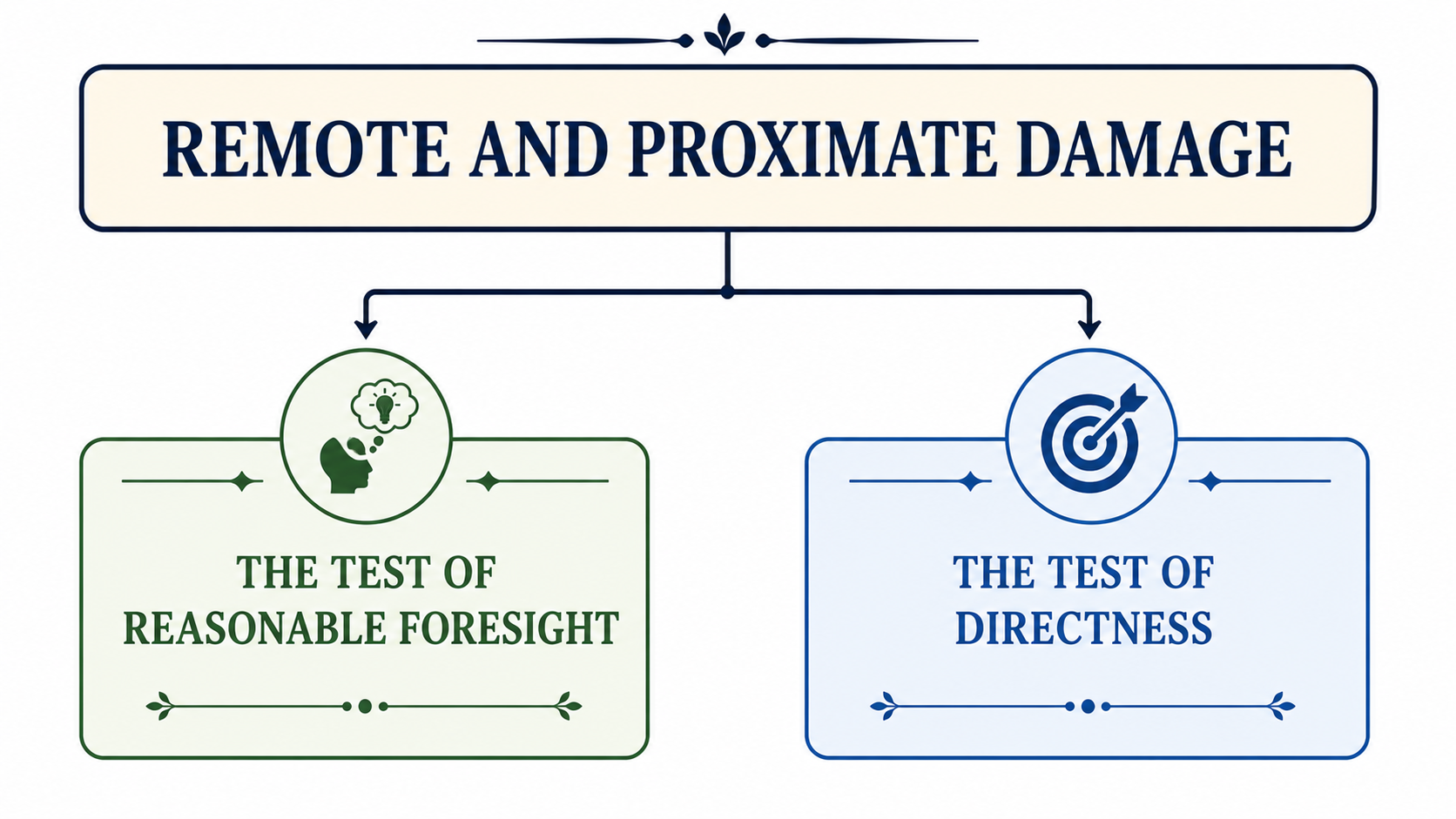
1. The test of reasonable foresight
To determine whether damage is actionable or too remote, courts apply the test of reasonable foresight, as stated by Pollock C.B. in Rigby v. Hewitt and Greenland v. Chaplin.
Under this test, a defendant is liable only for those consequences that a reasonable person could have foreseen at the time of the wrongful act; unforeseeable consequences are treated as too remote.
Thus, liability arises only for damage that is reasonably foreseeable, not for unexpected or extraordinary consequences.
2. The test of directness
In Re Polemis and Furness, Withy & Co. Ltd., the Court of Appeal rejected the test of reasonable foresight and adopted the test of directness.
The Court held that a defendant is liable for all direct consequences of a negligent act, whether foreseeable or not, provided initial negligence is established.
Once harm is foreseeable, the defendant is responsible for every direct consequence flowing from the act unless the chain of causation is broken by an intervening cause.
Thus, under the test of directness, liability extends to all direct damage, even if the extent of the harm was unexpected.
Smith v. London & South Western Railway Co.
In Smith v. London & South Western Railway Co., Channell B. established the test of directness, holding that reasonable foresight determines whether a defendant was negligent, but once negligence is proved, the defendant is liable for all direct consequences, whether foreseeable or not.
In this case, the railway company negligently left dry hedge trimmings near the track, which caught fire from engine sparks and, carried by the wind, destroyed the plaintiff’s cottage.
The Court held the railway company liable because the damage was a direct consequence of its negligence, even though the spread of the fire was not reasonably foreseeable.
Re Polemis and Furness, Withy & Co. Ltd.
In Re Polemis and Furness, Withy & Co. Ltd., the Court applied the test of directness where charterers negligently dropped a wooden plank into a ship’s hold containing leaked petrol vapours, causing a spark that destroyed the ship by fire.
Scrutton L.J. held that while foreseeability determines whether an act is negligent, once negligence is established, the defendant is liable for all direct consequences, even if the exact damage was unforeseeable.
Since the fire was directly caused by the negligent act without any intervening cause, the defendants were held liable for the entire £200,000 loss.
Liesbosch Dredger v. S.S. Edison
In Liesbosch Dredger v. S.S. Edison, the House of Lords limited the test of directness in Re Polemis, holding that a plaintiff’s financial impecuniosity (poverty) is an independent factor that can make additional losses too remote.
After the defendant negligently sank the Liesbosch, the owners hired a replacement dredger at high cost because they lacked funds to buy a new one.
The Court awarded damages for the market value of a replacement dredger and normal rental losses, but rejected the claim for prolonged rental expenses caused by the owners’ poverty.
The House of Lords held that those additional losses resulted from their financial condition, not the defendant’s negligence.
Overseas Tankship (U.K.) Ltd. v. Morts Dock & Engineering Co. Ltd. (The Wagon Mound Case)
In Overseas Tankship (U.K.) Ltd. v. Morts Dock & Engineering Co. Ltd. (The Wagon Mound Case), the Judicial Committee of the Privy Council rejected the test of directness in Re Polemis and held that the test of reasonable foresight is the correct test for determining remoteness of damage.
The Court ruled that a defendant is liable only for consequences that a reasonable person could have foreseen, and not for every direct but unforeseeable consequence.
Thus, liability is limited to reasonably foreseeable damage, protecting defendants from responsibility for unexpected or extraordinary consequences.