
VICARIOUS LIABILITY
The doctrine of vicarious liability is an exception to the general rule that a person is liable only for their own wrongful acts.
Based on the deep pocket theory, it ensures that injured parties can recover compensation from a financially capable defendant.
Vicarious liability arises only where there is a recognized legal relationship and the tort is committed within the scope of that relationship.
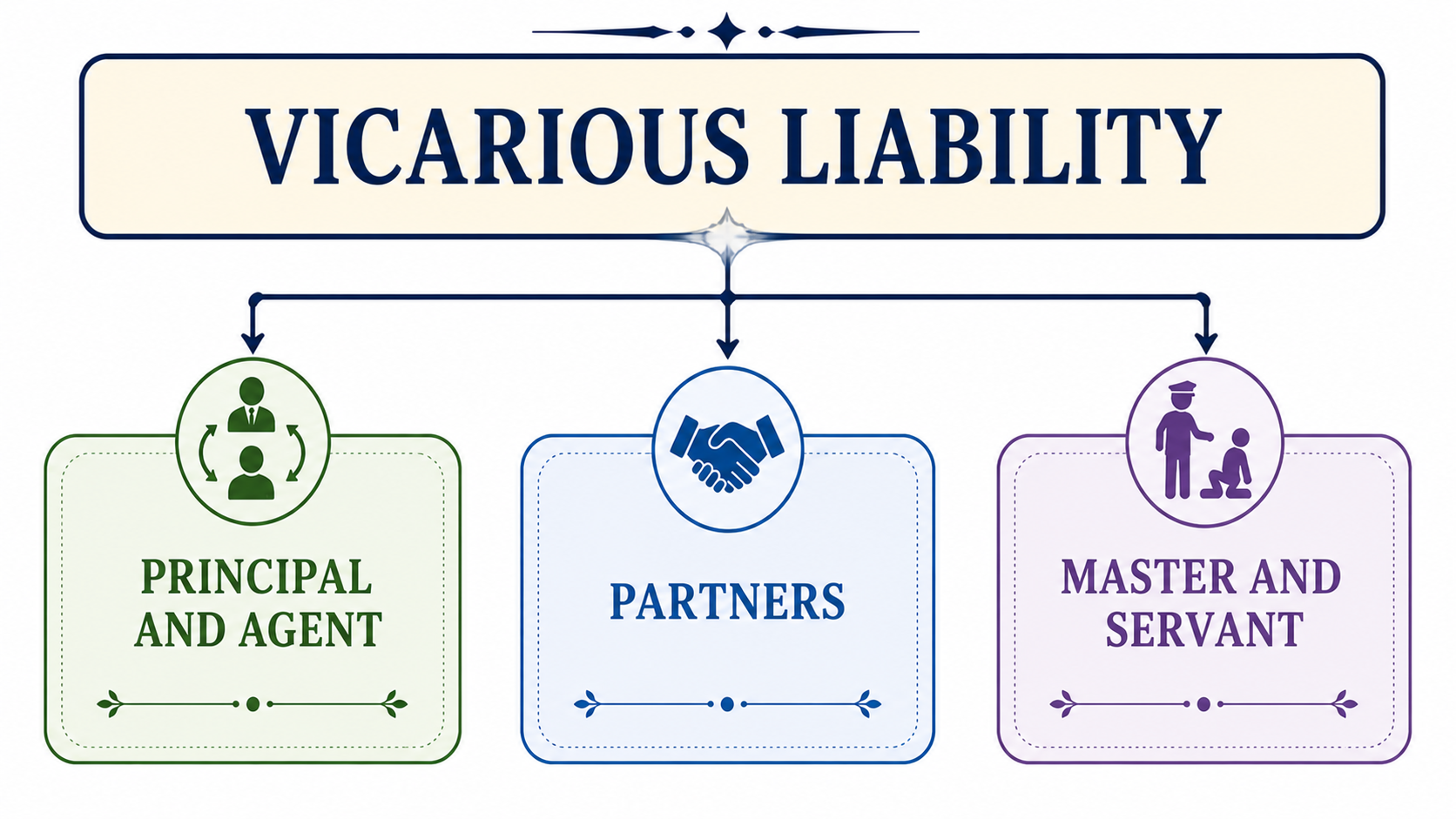
Accordingly, in Principal–Agent, Partnership, and Master–Servant relationships, the principal, partners, or employer are vicariously liable for torts committed in the course of duty or business.
Since both the primary wrongdoer and the superior party are joint tortfeasors, their liability is joint and several, allowing the plaintiff to recover full compensation from either or both.
1. Principal and Agent
The principle governing Principal-Agent liability in tort law is founded on the legal maxim Qui facit per alium facit per se (“he who acts through another acts himself”).
Where a principal authorizes an agent to commit a wrongful act, the law treats the act of the agent as the act of the principal himself.
Since the principal authorizes the wrongful act and the agent carries it out, both participate in the commission of the tort.
Consequently, they are regarded as joint tortfeasors, and their liability is joint and several, enabling the injured party to recover the entire damages from either or both of them.
Lloyd v. Grace, Smith & Co.
An agent’s authority may be express or implied, but a principal is rarely authorized to commit a wrongful act.
Nevertheless, vicarious liability arises when an agent commits a tort within the ordinary course of employment.
As established in Lloyd v. Grace, Smith & Co., a principal is liable for an agent’s fraudulent acts committed within their apparent or ostensible authority, even if the agent acts without the principal’s knowledge and solely for personal benefit.
The law imposes liability because the principal placed the agent in a position that enabled the fraud under the guise of official authority.
State Bank of India v. Shyama Devi
Under the law of torts, vicarious liability arises only when an employee commits a tort within the course and scope of employment.
As held in State Bank of India v. Shyama Devi, where a customer hands money to a bank employee through a private arrangement, without following official banking procedures or obtaining a receipt, the employee acts as the customer’s personal agent rather than the bank’s agent.
Therefore, because the fraudulent misappropriation occurs outside the scope of employment, the bank is not vicariously liable.
Ormrod v. Crosville Motor Service Ltd.
In the law of torts, vicarious liability extends to motor vehicle operation through the principle of casual agency, where a non-employee, such as a friend, drives as the owner’s agent.
As held by Lord Denning in Ormrod v. Crosville Motor Service Ltd., a vehicle owner is vicariously liable when the vehicle is driven wholly or partly for the owner’s purpose.
In such cases, an agency relationship is established, making the owner liable for the driver’s negligence.
However, the owner is not vicariously liable where the vehicle is lent or hired solely for the driver’s own purpose, in which the owner has no legal interest or practical concern.
Tirlok Singh v. Kailash Bharti
Under the law of torts, a vehicle owner cannot be held vicariously liable for a driver’s negligence unless an agency relationship exists through authorization or consent.
As held in Tirlok Singh v. Kailash Bharti, where a vehicle is driven without the owner’s express or implied permission, knowledge, or consent, the driver cannot be regarded as the owner’s agent.
Since the essential element of authorization is absent, no principal-agent relationship arises, and the owner is not vicariously liable for the resulting tort or accident.
2. Partners
In partnership law, each partner acts as both a principal and an agent under the doctrine of mutual agency.
Under the law of torts, all partners are vicariously liable for torts committed by a co-partner in the ordinary course of the firm’s business or within the scope of their ostensible authority.
As established in “Hamlyn v. Houston & Co.”, where one partner commits an intentional tort, such as bribing a third party to induce a breach of contract for the benefit of the firm, all partners become joint tortfeasors with joint and several liability, allowing the injured party to recover full compensation from the firm or any partner.
3. Master and Servant
The doctrine of Master and Servant liability holds an employer vicariously liable for torts committed by an employee in the course of employment, treating both as joint tortfeasors with joint and several liability.
This principle is based on the maxims Qui facit per alium facit per se (“he who acts through another acts himself”) and Respondeat Superior (“let the principal be liable”).
Grounded in social policy and the deep pocket theory, it recognizes that employers are better able to bear and distribute the loss.
An employer remains vicariously liable even when the employee acts against express instructions or without benefiting the employer, provided that
(1)The tort was committed by the ‘servant’ .
(2) The servant committed the tort in the ‘course of his employment’ .
Who is a servant
Under the law of torts, a servant is an employee who works under the direction, command, and control of the master regarding both the work to be done and the manner of its performance.
This degree of control forms the foundation of vicarious liability.
A master is vicariously liable for torts committed by a servant within the course of employment, but no such liability arises for the acts of an independent contractor, who performs the work independently using their own skill and discretion.
Therefore, determining whether a worker is a servant or an independent contractor is the key legal test for deciding an employer’s liability for civil wrongs.
Servant and Independent Contractor Distinguished
The distinction between a servant and an independent contractor depends on the degree of control and supervision over the manner of performing the work.
A servant works under the employer’s direction regarding both the work and its execution, giving rise to vicarious liability.
In contrast, an independent contractor undertakes to produce a specific result while retaining independent discretion over its execution.
Therefore, an employer is vicariously liable for the negligence of a personal driver (servant), whereas a passenger hiring a taxi (independent contractor) is not liable for the driver’s negligence, since the driver retains independent control and legal responsibility for their acts.
Liability of the employer for the acts of an independent contractor
Under the general principles of tort law, vicarious liability attaches to an employer for torts committed by a servant within the scope of employment, based on the employer’s right of control and supervision.
However, an employer is generally not liable for the torts of an independent contractor.
Since an independent contractor works independently and is not subject to the employer’s direct control over the manner of performance, the law treats them as a separate entity, making the contractor solely liable for any actionable damage caused.