
Essentials of Negligence
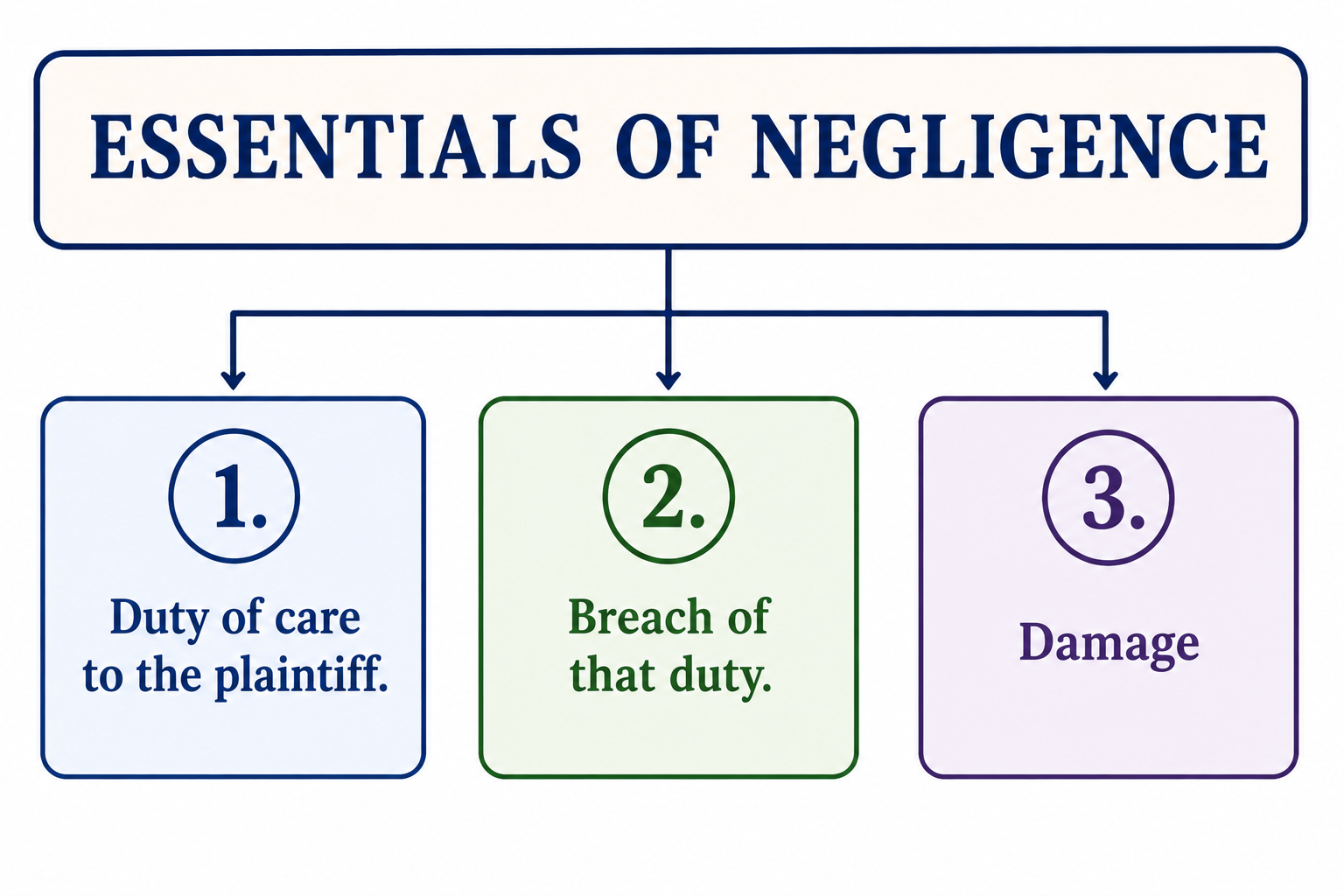
In an action for negligence, the plaintiff has to prove the following essentials :
1. That the defendant owed duty of care to the plaintiff.
2. The defendant made a breach of that duty.
3. The plaintiff suffered damage as a consequence thereof.
Duty of care to the plaintiff
In Donoghue v. Stevenson, the House of Lords held that actionable negligence requires a legal duty of care, distinct from a moral obligation.
Lord Macmillan observed that “the categories of negligence are never closed,” while Lord Atkin’s “neighbour principle” states that a duty is owed to persons who are reasonably foreseeable to be affected by one’s acts.
Accordingly, manufacturers owe a duty to ultimate consumers of sealed products that cannot be examined before use.
In simple terms, the law requires you to take reasonable care to avoid harming people who may foreseeably be affected by your actions; therefore, a manufacturer is liable if a sealed product, such as ginger beer containing a decomposed snail, injures the final consumer.
Winterbottom v. Wright
Historically, the “Privity of Contract” doctrine, reflected in Winterbottom v. Wright, prevented non-contracting third parties from suing for injuries caused by a breach of contract.
However, Donoghue v. Stevenson rejected this restriction by holding that a duty of care in tort exists independently of contract and extends beyond contractual relationships.
In simple terms, an injured person can sue a negligent manufacturer even without a direct contract, making manufacturers liable to the ultimate consumer for harm caused by defective products.
Duty depends on reasonable forseeability of injury
In Glasgow Corporation v. Muir, the court held that a duty of care arises where harm is reasonably foreseeable, judged by the standard of an ordinary prudent person.
Lord Macmillan explained that this objective test avoids individual idiosyncrasies by balancing between an overly timid and an overconfident person, though its application may vary with the facts of each case.
In simple terms, a person is legally liable if a reasonable person could have foreseen the harm, but what is considered “reasonable” may differ according to the circumstances.
Dr. M. Mayi Gowda v. State of Karnataka
In Dr. M. Mayi Gowda v. State of Karnataka, the complainant sought Rs. 9,90,000 in damages after losing eyesight when he was thrown from a panicked elephant during a joy ride.
The court found no actionable negligence, noting that the elephant had 13 years of safe service in festivals, film shoots, and VIP events.
In simple terms, the elephant’s sudden panic was considered an unforeseeable accident, not a failure of reasonable care, so the organizers were not held liable.
Booker v. Wenborn
In Booker v. Wenborn, the court established that a passenger boarding a moving train owes a legal duty of care to persons standing nearby on the platform to prevent creating foreseeable hazards.
When the defendant boarded a departing train and negligently left the outward-opening carriage door open, it struck a railway porter standing on the edge of the platform, causing him physical injury.
Consequently, the defendant was held liable in tort because common sense and legal standards dictate that anyone getting onto a moving train must take proper precautions so their actions do not endanger platform workers or bystanders who are in close proximity.
S. Dhanaveni v. State of Tamil Nadu
In S. Dhanaveni v. State of Tamil Nadu, the court held that public authorities maintaining utility infrastructure owe a duty of care to keep public property safe.
The deceased slipped into a rainwater pit at night and, while trying to balance himself, held an electric pole with electrical leakage, resulting in fatal electrocution.
The authority was held negligent and liable for failing to maintain the pole.
In simple terms, if a person is electrocuted because a public electric pole is not properly maintained, the responsible authority is liable for the foreseeable harm caused by its negligence.
T.G. Thayumanavar v. Secy., P.W.D., Govt. of Tamil Nadu
In T.G. Thayumanavar v. Secy., P.W.D., Govt. of Tamil Nadu, the Madras High Court held that public utility bodies owe a duty of care to ensure public infrastructure does not endanger road users.
When an overhead live wire snapped and struck a cyclist traveling below, causing fatal electrocution, the court attributed the accident to the negligence of the Electricity Board rather than an Act of God.
In plain terms, if a government power line snaps due to lack of upkeep and kills a cyclist on a normal road, the authorities cannot hide behind excuses of natural causes; they are legally accountable for their carelessness and must pay full compensation to the victim’s family.
Chairman, M.P. Electricity Board, Rampur v. Achhelal Lodhi
In Chairman, M.P. Electricity Board, Rampur v. Achhelal Lodhi, the court held that electricity authorities have a statutory duty to properly maintain high-voltage wires to prevent foreseeable harm.
When a she-buffalo was electrocuted by a broken live wire near a transformer, the Electricity Board was held liable for negligence because it failed to produce inspection records showing proper maintenance.
In simple terms, if a power company fails to maintain its electrical wires and a live wire kills a farm animal, it is legally responsible to compensate the owner for the loss.
M.P. State Electricity Board v. Ramlal Vishwakarma
In M.P. State Electricity Board v. Ramlal Vishwakarma, the court held the Electricity Board liable for negligence after a ten-year-old child died from contact with a live stay wire connected to an electric pole.
The M.P. High Court emphasized that utility authorities have a continuous duty to inspect and maintain electrical equipment to prevent hazardous leakage.
Holding that negligence is the breach of duty by omission, the court awarded compensation to the child’s father.
In simple terms, if a power board fails to carry out proper safety inspections and a child dies due to a live wire, it is legally responsible for the resulting harm and must compensate the victim’s family.
Ishwar Devi v. Union of India
In Ishwar Devi v. Union of India, the court held that starting a public conveyance before passengers are safely aboard amounts to actionable negligence.
The conductor signalled the driver to move while the passenger had only one foot on the footboard, and the driver’s reckless overtaking of a stationary bus caused the passenger’s death.
The court held both the conductor and driver negligent, emphasizing their duty to ensure passenger safety.
In simple terms, bus staff must not move the vehicle until passengers are safely on board; carelessly signalling and driving in such circumstances makes them liable for the resulting death.
Makbool Ahmed v. Bhura Lal
In Makbool Ahmed v. Bhura Lal, the Rajasthan High Court held that bus crew owe a strict duty of care to passengers.
While the passenger was boarding, the conductor remained inside issuing tickets and asked the cleaner to signal the driver, causing the bus to move prematurely, resulting in the passenger falling, being crushed under the rear wheel, and dying.
The court held that the conductor’s failure to ensure safe boarding and the driver’s negligent operation amounted to actionable negligence, making the driver, conductor, bus owner, and insurer jointly liable.
In simple terms, a conductor cannot delegate passenger safety to a cleaner; moving the bus before passengers are safely aboard is negligence, and all responsible parties must compensate the victim’s family.
Sushma Mitra v. Madhya Pradesh State Road Transport Corp.
In Sushma Mitra v. Madhya Pradesh State Road Transport Corp., the court held that drivers passing passenger vehicles owe a duty of care to maintain adequate side clearance.
A passenger’s elbow resting on a bus window was struck by an oncoming truck, causing serious injury, even though the vehicles did not collide.
The court presumed negligence against both drivers, observing that resting an elbow on a window is a common and foreseeable act, and neither driver proved they had maintained a safe distance.
In simple terms, drivers must expect passengers may rest their arms on bus windows and leave enough space while passing; if they drive too close and cause injury, they are liable unless they prove they exercised reasonable care.
Jauhri Lal v. P.C.H. Reddy
In Jauhri Lal v. P.C.H. Reddy, the court held that violating traffic rules affecting driver visibility amounts to actionable negligence.
The truck driver allowed a passenger to sit on his left side in violation of Section 83 of the Motor Vehicles Act, obstructing his view at a road junction and causing a collision that overturned a scooter rickshaw and injured the plaintiff.
The court held the driver negligent and liable for the resulting harm.
In simple terms, drivers must keep their view clear at all times; if they allow someone to block their vision and an accident occurs, they are legally responsible for the injuries and damage caused.
Y.S. Kumar v. Kuldip Singh Jaspal
In Y.S. Kumar v. Kuldip Singh Jaspal, the court held that motor vehicle drivers owe a duty of care to stationary road users exercising reasonable caution.
The respondent had safely moved his bicycle to the left edge of the road and looked back before crossing, but the appellant, riding at high speed, struck him from behind, causing serious injuries.
The court held that the respondent had acted prudently, while the appellant’s reckless driving amounted to negligence, making him fully liable for damages.
In simple terms, if a cyclist safely pulls to the roadside and checks for traffic, a speeding motorcyclist who hits him from behind is legally responsible for the resulting injuries.
Dhangauriben v. M. Mulchandbhai
In Dhangauriben v. M. Mulchandbhai, the court held that driving on the correct side of the road does not excuse negligence if the driver fails to maintain a safe speed.
A speeding car struck a scooter from behind, causing fatal injuries, and the driver applied brakes only after the collision.
The court found the driver guilty of rash and negligent driving, despite the claim that he was driving on the left side of the road.
In simple terms, following lane rules is not enough; if a driver speeds through a populated area and crashes into a vehicle from behind, they are legally responsible for the resulting death and injuries.
Carmarthenshire County Council v. Lewis
In Carmarthenshire County Council v. Lewis, the court held that breach of a duty of care creates liability to both the primary victim and a rescuer.
When a school negligently allowed a child onto a busy road, a lorry driver swerved to avoid the child, crashed, and died, making the school liable to the driver’s widow.
The law also provides that gratuitous conveyance does not relieve a driver of the duty to exercise reasonable care, and owners of property adjoining a public road must keep it in proper repair to prevent injury to passersby.
In simple terms, whether a school lets a child wander into traffic, a driver gives someone a free ride, or a property owner neglects a dangerous building near a road, each owes a legal duty of reasonable care and is liable for foreseeable harm caused by negligence.
Municipal Corporation of Delhi v. Sushila Devi
In Municipal Corporation of Delhi v. Sushila Devi, the court held that municipal authorities owe a duty of care to maintain public roads and remove dangerous roadside trees.
A pedestrian was killed by a falling branch, and expert evidence showed the tree was dead, dried, barkless, and hazardous.
The court held that leaving such a tree standing amounted to actionable negligence, making the municipality liable for the death.
In simple terms, if a municipality fails to remove a dead and dangerous roadside tree and it injures or kills a passerby, it is legally responsible for the resulting harm.
Municipal Corporation of Delhi v. Subhagwanti
Following Municipal Corporation of Delhi v. Subhagwanti, the court held that municipal authorities owe a non-delegable duty of care to keep public roads safe.
The Horticulture Department must conduct regular inspections and remove dead, dried, or dangerous branches that threaten the public.
Failure to do so amounts to negligence.
In simple terms, the municipality must regularly inspect roadside trees and remove dangerous branches or dead trees; if it fails to do so and someone is injured, it is legally liable.
Municipal Board, Jaunpur v. Brahm Kishore
In Municipal Board, Jaunpur v. Brahm Kishore, the court held that authorities carrying out road excavations owe a non-delegable duty of care to provide proper warnings, lights, notices, and barricades.
When the municipal board dug a ditch on a public road without any safety measures, a cyclist fell into it and was injured.
The court held the board liable for negligence and rejected the defence of contributory negligence, observing that a bicycle lamp would not have made the pit visible.
In simple terms, if a municipality digs a trench on a public road, it must provide proper warning signs and barriers; if someone is injured because these precautions are missing, the municipality is legally responsible.
Ramdas and Sons v. Bhuwaneshwar Prasad Singh
In Ramdas and Sons v. Bhuwaneshwar Prasad Singh, the court held that contractors working on public roads owe a high duty of care, especially when conditions increase the risk to pedestrians.
The defendants dug trenches outside a busy Government hospital during the Indo-Pakistan wartime blackout and failed to provide protective fencing or red warning lights.
The plaintiff fell into the open trench and was seriously injured, leading the court to hold the contractors liable for negligence.
In simple terms, contractors must properly fence and warn the public about open trenches, particularly in dark or dangerous conditions; failing to do so makes them legally responsible for resulting injuries.
Union of India v. Supriya Ghosh and Others
In Union of India v. Supriya Ghosh and Others, the court held that the Railway Administration owes a strict duty of care to keep level crossings safe.
A car was struck by a mail train because the crossing gate was left open and unmanned, causing the driver’s death.
The court rejected the defence of contributory negligence, noting that the driver’s view was obstructed and the train’s sound was muffled inside the vehicle, holding that leaving the gate open amounted to actionable negligence.
In simple terms, the Railways must close level crossing gates when a train approaches; if they fail to do so and an accident occurs, they are legally responsible for the resulting death or injury.
Orissa Road Transport Co. Ltd. v. Umakant Singh
In Orissa Road Transport Co. Ltd. v. Umakant Singh, the court held that operating a mechanically defective vehicle near a level crossing amounts to actionable negligence.
The driver attempted to cross as the gate was closing, but the bus stalled on the tracks due to a known mechanical defect, causing a collision with a train that killed two passengers and injured others.
The court held the driver negligent for taking the risk and the bus company liable for providing a defective vehicle and vicariously liable for the driver’s negligence.
In simple terms, if a driver knows a bus has engine trouble and still tries to cross railway tracks before an approaching train, both the driver and the bus company are legally responsible for the accident and resulting loss of life.
Prag Ice & Oil Mills v. Union of India
In Prag Ice & Oil Mills v. Union of India, the court held that the Railway Administration is not under an absolute duty to provide gatekeepers at every unmanned level crossing, particularly in isolated, low-traffic areas.
The plaintiff’s tractor became stuck on the tracks, and the driver abandoned it without warning an approaching train.
The court held that the primary duty of care at such crossings rests on road users to keep a proper lookout, and the damage resulted from the plaintiff’s own negligence.
In simple terms, the Railways need not place guards at every quiet rural crossing; if a driver gets stuck on an unmanned track and fails to warn an approaching train, they cannot recover compensation for the resulting damage.
Assam State Coop. Federation Ltd. v. Anubha Sinha
In Assam State Coop. Federation Ltd. v. Anubha Sinha, the court held that no liability for negligence arises where the loss results from an inevitable accident despite reasonable care.
The tenant had repeatedly warned the landlord about dangerous electrical wiring, but no repairs were made, leading to a fire likely caused by a short circuit that damaged the premises.
The court found no actionable negligence on the tenant’s part and dismissed the landlord’s claim.
In simple terms, a tenant who warns the landlord about faulty wiring is not liable if an unavoidable electrical fire later occurs, as the tenant exercised reasonable care.