
Capacity to be Sued
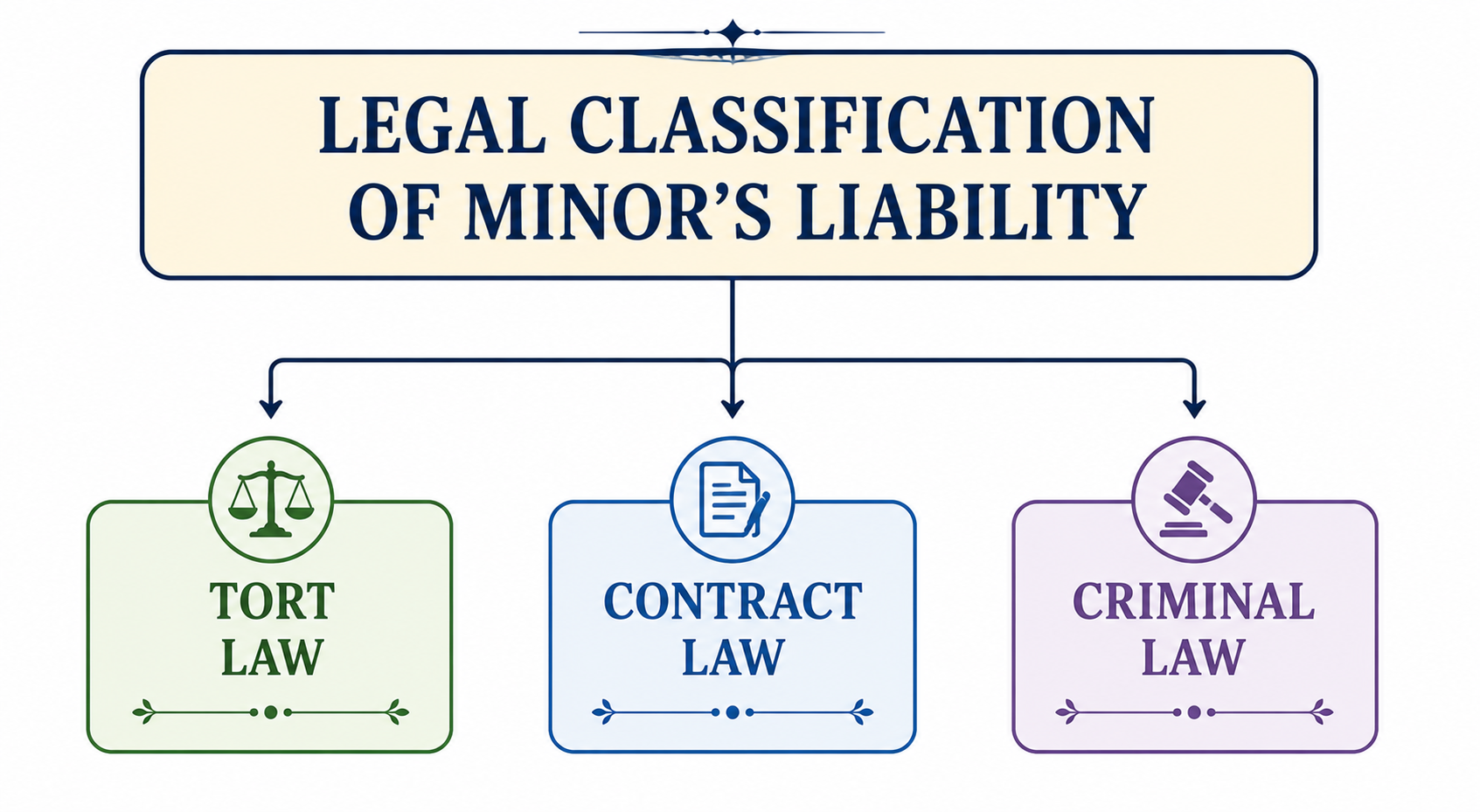
The law governing a minor’s liability draws a clear distinction between tort, contract, and criminal law.
While a minor is fully liable in tort like an adult to ensure compensation for civil wrongs, their contracts are void ab initio to protect them from exploitation.
In criminal law, the doctrine of doli incapax provides complete immunity to children under seven years and conditional liability for those between seven and twelve, depending on their maturity and understanding.
Thus, a minor’s liability varies according to the nature of the legal claim and their legal capacity.
Walmsley v. Humenick
The law of torts generally treats a minor like an adult, allowing a child to be sued for basic torts such as trespass.
However, liability depends on the minor’s mental capacity where a tort requires a special mental element, such as deceit or conspiracy.
As held in Walmsley v. Humenick, very young children, such as a five-year-old, are not liable for negligence because they lack the maturity to understand the duty of care or foresee the consequences of their actions.
Thus, while minors may be liable for ordinary physical wrongs, they are protected where liability depends on adult judgment or intent.
Tort and Contract
The overlap between tortious liability and contractual immunity creates a significant legal challenge when a minor’s single act amounts to both a tort and a contract.
While the law holds minors liable for their torts, it also declares their contracts void ab initio to protect them from financial liability.
The key issue is whether a tort claim would indirectly enforce a void contract or whether protecting the minor under contract law would unfairly exempt them from liability for an actionable civil wrong.
Johnson v. Pye and Jennings v. Rundall
The common law rule in Johnson v. Pye and Jennings v. Rundall gives priority to a minor’s contractual protection over tort liability where both overlap.
If the real substance of the dispute arises from a contract, a plaintiff cannot reframe it as a tort (ex delicto) to avoid the rule that a minor’s contract is void.
Whether the claim involves fraudulent misrepresentation of age, goods obtained on credit, or damage to hired property, the court examines the true nature of the claim.
If the tort action is merely an indirect attempt to enforce a void contract, the minor remains protected from liability.
Burnard v. Haggis
The rule in Burnard v. Haggis limits the protection normally available to minors in tort.
While a minor is protected when they merely perform a contract negligently, that protection ends when they commit an act expressly prohibited by the owner.
In such cases, the law treats the wrongful act as an independent tort, making the contract irrelevant.
Therefore, if a minor acts outside the scope of the agreement, they can be held fully liable in tort for the resulting damage to property.
Ballet v. Mingay
The rule in Ballet v. Mingay establishes that a minor’s protection is limited to acts within the scope of the contract.
While a minor cannot be sued for a mere breach of a rental contract, that protection ends when they commit an act outside the agreement, such as handing hired goods to a third party.
In such cases, the wrong becomes an independent tort of detinue, not a contractual breach.
Thus, the law protects minors from unfair contractual liability, but not from liability for independent civil wrongs.