NUISANCE
In the law of torts, Nuisance is an unlawful, indirect interference with a person’s use or enjoyment of land, whereas Trespass involves direct physical interference with possession of property.
Trespass is actionable per se, while nuisance generally requires proof of actual or special damage.
Unlike trespass, which involves tangible physical invasion, nuisance often arises through indirect interference such as noise, smoke, smell, vibrations, or encroaching roots.
In simple terms, trespass is a direct, unauthorized entry onto another’s property, while nuisance indirectly disturbs the owner’s use and enjoyment of the property and usually requires proof of harm.
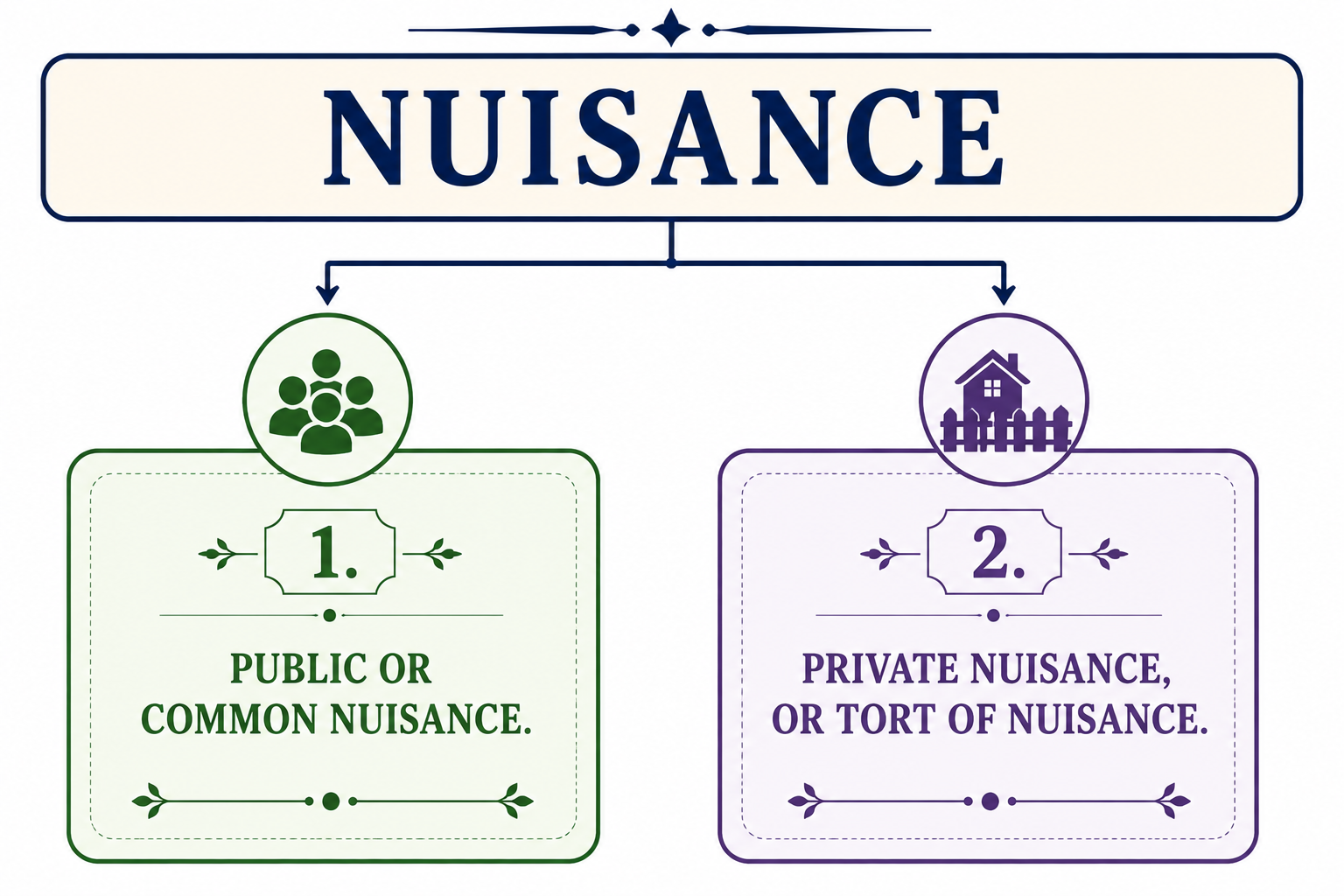
Kinds of Nuisance
Nuisance is two kinds :
1. Public or Common Nuisance.
2. Private Nuisance, or Tort of Nuisance.
Public Nuisance
Under the law of torts, Public Nuisance is a criminal offence involving unlawful interference with a public right, such as obstructing a highway, and is generally dealt with through criminal proceedings.
However, a civil action is allowed where an individual suffers special, direct, and substantial damage beyond that suffered by the public.
In simple terms, a person cannot usually sue for a public nuisance, but if it causes them a distinct personal injury or specific financial loss, they can bring a civil claim for compensation.
Dr. Ram Raj Singh v. Babulal
In the law of torts, Dr. Ram Raj Singh v. Babulal held that substantial interference with a person’s professional practice amounts to special damage.
The defendant’s brick grinding machine produced dust that entered the plaintiff’s medical clinic, causing discomfort to the doctor and patients and leaving dust on clothes.
The court found special damage proved and granted a permanent injunction against operating the machine.
In simple terms, when a neighbour’s activity directly harms your health or seriously interferes with your profession or business, the law treats it as actionable nuisance and may order the activity to stop.
Campbell v. Paddington Corporation
In the law of torts, Campbell v. Paddington Corporation held that an illegal obstruction on a public highway causing direct financial loss amounts to special damage arising from a public nuisance.
The defendant’s unauthorized viewing stand blocked the plaintiff’s property’s view during King Edward VII’s funeral procession, causing a loss of seat-letting income.
The court held that this specific financial loss entitled the plaintiff to compensation.
In simple terms, if an unlawful obstruction on a public road directly causes a person measurable business or financial loss, they can sue for damages.
Winterbottom v. Lord Derby
In the law of torts, Winterbottom v. Lord Derby reaffirmed that a plaintiff cannot recover damages for a public nuisance without proving special damage beyond the inconvenience suffered by the general public.
The Delhi High Court also held under the Delhi Prevention of Defacement of Property Act, 2009 that unauthorized posters, banners, or hoardings causing public visual nuisance may be lawfully regulated.
In simple terms, a person cannot sue for a public nuisance unless they suffer special harm, and even private property cannot be used to create a public visual nuisance through unauthorized displays.
Private Nuisance or Tort of Nuisance
Its Essentials
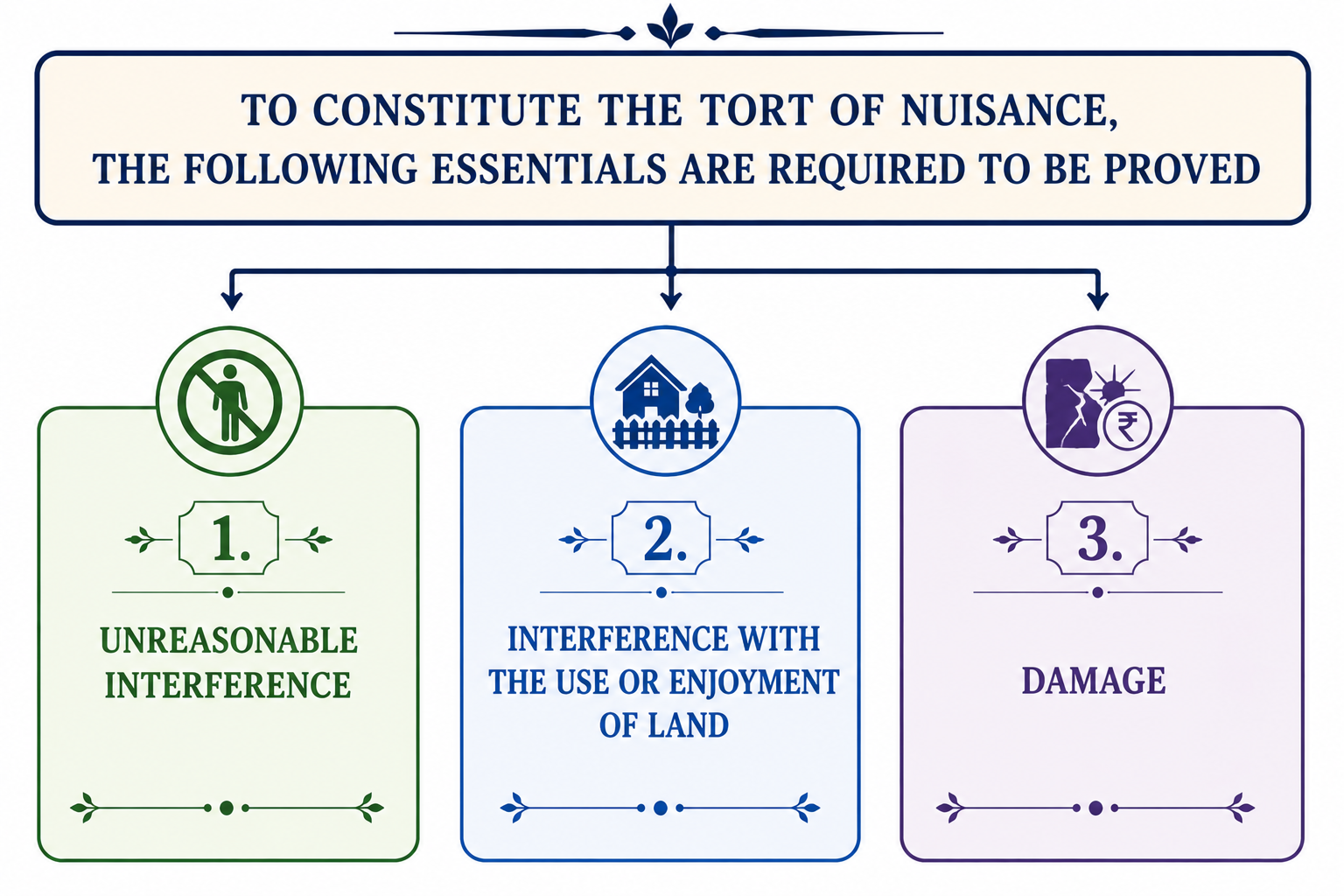
To constitute thew tort of nuisance, the following essentials are required to be proved :
Unreasonable interference
Interference with the use or enjoyment of land
Damage
Unreasonable Interference
In the law of torts, Private Nuisance arises from unreasonable interference with the plaintiff’s use or enjoyment of property, not from ordinary inconveniences that society is expected to tolerate.
Courts balance the defendant’s right to use property against the plaintiff’s right to quiet enjoyment, and neither public benefit nor reasonable care is a defense to an unreasonable nuisance.
As stated by Thesiger, L.J. in Sturges v. Bridgman, the question of nuisance depends on the character of the locality.
In simple terms, ordinary neighborhood disturbances are generally tolerated, but substantial interference that exceeds what is normal for the area amounts to an actionable private nuisance.
Radhey Shyam v. Gur Prasad
In the law of torts, Radhey Shyam v. Gur Prasad held that adding substantial noise, even in a noisy locality, may amount to private nuisance if it seriously interferes with the comfort and health of residents.
The court granted a permanent injunction restraining the defendants from operating a flour mill beneath the plaintiffs’ residence.
In simple terms, existing neighborhood noise does not justify creating excessive industrial noise that seriously disturbs a person’s peace, health, and enjoyment of their home.
J. Chandrasekaran v. V.D. Kesavan
In the law of torts, J. Chandrasekaran v. V.D. Kesavan held that attaching unauthorized fixtures, such as electric meters, to another person’s wall constitutes an actionable nuisance.
The Madras High Court ruled that mere acquiescence or passage of time does not create a legal right unless authorized by law.
In simple terms, a neighbour cannot gain a permanent right to install equipment on your wall simply because you did not object immediately; the unauthorized installation remains an actionable nuisance.
Ushaben v. Bhagya Laxmi Chitra Mandir
In the law of torts, Ushaben v. Bhagya Laxmi Chitra Mandir held that hurt to religious feelings is not an actionable wrong and does not constitute private nuisance.
The court refused to restrain the exhibition of Jai Santoshi Maa, holding that emotional or religious distress alone does not amount to legal nuisance, especially when watching the film is voluntary.
In simple terms, hurt religious sentiments do not create a claim for private nuisance, and courts will not stop the screening of a film merely because some viewers find it offensive.
In re: Noise Pollution
In environmental and tort law, the Supreme Court in In re: Noise Pollution held that while every person is entitled to enjoy life, no one has the right to disturb others through unwanted noise.
The Court ruled that no individual can be compelled to hear intrusive sounds and recognized noise pollution as a serious public nuisance, issuing directions for greater public awareness and stricter control.
In simple terms, a person’s right to make noise ends where another’s right to peace begins, and the law protects people from unwanted noise pollution.
Sensitive Plaintiff
In the law of torts, an objectively reasonable act does not become private nuisance merely because it causes greater harm to an unusually sensitive plaintiff or interferes with an exceptionally delicate use of property.
The test of nuisance is based on the standard of an ordinary person, not one with exceptional sensitivity.
In simple terms, if a neighbour’s conduct is normal and reasonable, an overly sensitive person cannot succeed in a nuisance claim simply because they are more affected than an average person.
Robinson v. Kilvert
In the law of torts, Robinson v. Kilvert held that a person carrying on an exceptionally delicate trade cannot increase the legal liability of neighbouring occupiers.
The defendant’s lawful business generated ordinary heat, which damaged the plaintiff’s unusually sensitive brown paper.
The court held that no nuisance was committed because the heat would not have affected ordinary goods.
In simple terms, a neighbour is not liable for nuisance when normal, lawful activities harm only unusually sensitive goods or businesses.
Heath v. Mayor of Brighton
In the law of torts, Heath v. Mayor of Brighton held that a minor disturbance is not an actionable private nuisance unless it would affect a person of ordinary sensibilities.
The court refused an injunction against a nearby power station because its faint buzzing noise disturbed only the incumbent and not ordinary persons attending the church.
In simple terms, a slight noise that affects only an unusually sensitive person does not amount to private nuisance.