Nuisance on Highways
Under the law of torts, obstructing a highway or creating hazards near it amounts to nuisance where the interference is unreasonable.
In Barber v. Penley, a theatre was held liable because large queues blocked access to a neighbouring boarding house.
In contrast, Dwyer v. Mansfield held that a shopkeeper was not liable for queues formed while lawfully selling rationed potatoes during an emergency.
In simple terms, unreasonable road obstructions that unnecessarily block public access are actionable, but temporary queues arising from lawful and reasonable business activities may not amount to nuisance.
Ware v. Garston Haulage Co. Ltd.
Under the law of torts, leaving a vehicle on a public highway for an unreasonably long time, or leaving an unlit vehicle at night, constitutes an actionable nuisance.
In Ware v. Garston Haulage Co. Ltd., the defendant left an unlit lorry and trailer on a highway at night, causing a motorcyclist to collide with it, and the court held the defendant liable because the unattended vehicle created a dangerous obstruction.
In simple terms, anyone who leaves a vehicle in a way that unreasonably obstructs or endangers a public road may be held liable for nuisance and the resulting accidents.
Leanse v. Egerton
Under the law of private and public nuisance, a property owner is presumed to know of hazards on premises adjoining a public highway.
In Leanse v. Egerton, the owner was held liable when broken window glass fell onto a passer-by because sufficient time had elapsed to discover and repair the danger.
Physical hazards near highways, such as excavations, overhanging trees, lamps, or slippery substances, constitute actionable nuisance.
However, lawful activities on private property that merely offend public or religious sentiments do not amount to nuisance.
In simple terms, property owners must remove physical dangers near public roads, but nuisance protects against real hazards, not mere emotional or religious offence.
Projection
Under the law of torts, objects projecting over a public highway, such as tree branches, clocks, or lamps, are not actionable unless they cause actual harm or obstruct public passage.
In Noble v. Harrison and Caminer v. Northern & London Investment Trust Ltd., no liability arose where trees fell due to hidden, undetectable defects.
However, Tarry v. Ashton held that an occupier who knows an artificial projection is dangerous remains liable, even if negligent repairs were carried out by an independent contractor.
In contrast, projections over private land constitute nuisance per se because they directly interfere with a neighbour’s property rights.
In simple terms, hidden natural defects may not create liability, but known dangerous structures must be made safe, and any projection onto a neighbour’s land is automatically an actionable nuisance.
Defences
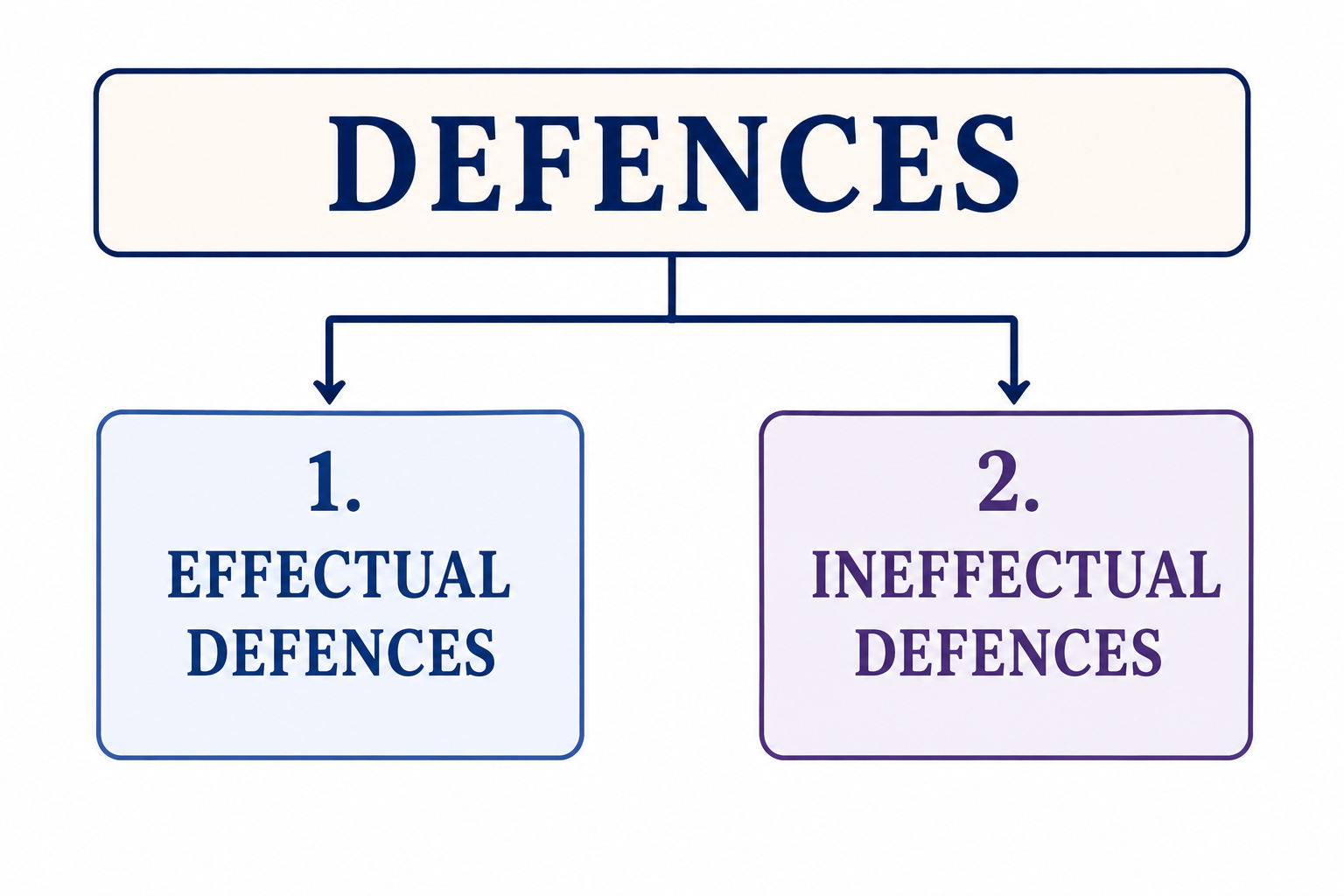
In an action for nuisance, a defendant may raise various defences, which are classified as effectual (valid) and ineffectual (invalid).
Effectual defences are legally recognized and completely protect the defendant from liability, whereas ineffectual defences are arguments consistently rejected by the courts as insufficient to defeat a nuisance claim.
In simple terms, the court examines the defendant’s legal excuses and accepts only those recognized by law, while rejecting invalid justifications.
Effectual defences
1. Prescriptive right to commit nuisance
A prescriptive right to commit nuisance is an effectual defence in tort law.
A person may acquire a legal easement if a private nuisance is enjoyed openly, peaceably, and without interruption for 20 years.
However, Sturges v. Bridgman established that the 20-year period begins only when the activity first becomes an actionable nuisance, not when it originally started.
Since the confectioner’s machinery became a nuisance only after the neighbouring doctor built a consulting room, no prescriptive right had been acquired.
In simple terms, the 20-year period runs from the time the activity first interferes with a neighbour’s legal rights, not from the day the activity began.
2. Statutory Authority
Under the law of torts, statutory authority is a complete defence where an act that would otherwise amount to a nuisance is expressly authorized by statute.
If the defendant acts with due care, any unavoidable consequences—such as noise, smoke, sparks, or property depreciation caused by a statutory railway—are legally protected.
In simple terms, when the law authorizes a public service, people cannot sue for its normal, unavoidable disturbances, provided the authority carries out its work carefully.
Ineffectual defences
1. Nuisance due to acts of others
Under tort law, claiming that a nuisance resulted from the combined acts of others is an ineffectual defence.
Where the independent acts of several persons together create an actionable nuisance, each contributor may be held liable.
As illustrated by the example of many people leaving wheelbarrows on a public road, no defendant can escape liability by arguing that their individual act alone caused no harm.
In simple terms, anyone who contributes to a nuisance remains legally responsible, even if their own contribution was small and the nuisance arose from the combined acts of many people.
2. Public Good
Under tort law, public good or general public benefit is an ineffectual defence to nuisance, as private rights cannot be infringed merely for public convenience.
In Shelfer v. City of London Electric Lighting Co., Adams v. Ursell, and R. v. Train, the courts rejected claims that public benefit justified nuisance.
In simple terms, an activity serving the public is not a valid defence if it causes unlawful interference with another person’s property, comfort, or safety.
3. Reasonable care
Under the law of torts, reasonable care or maximum possible skill is an ineffectual defence to nuisance, as liability depends on the unreasonable interference, not the defendant’s carefulness.
In Rapier v. London Tramways Co., the defendant was held liable for severe stench despite taking every possible precaution.
In simple terms, even if you take every reasonable step to prevent a nuisance, you remain liable if your activity continues to cause substantial interference, unless it is authorized by statute or accepted by the affected parties.
4. Plaintiff coming to nuisance
Under the law of torts, coming to the nuisance is an ineffectual defence.
A person does not lose the right to sue merely because they moved next to an existing nuisance, and the doctrine of volenti non fit injuria does not apply.
In Bills v. Hall, a candle-making business was held liable for noxious vapours even though it had operated before the plaintiff moved nearby.
In simple terms, “I was here first” is not a valid defence, and a person who buys property near an existing nuisance still has the right to seek legal relief.