
Liability for Dangerous Premises
An occupier controlling land, buildings, or structures such as cars, ships, airplanes, or elevators has a legal duty of care to ensure the personal safety and protection of property of individuals entering those spaces.
While the principles governing an occupier’s duty were historically complex, England streamlined them through the Occupiers’ Liability Act, 1957.
The extent of this duty varies according to the person’s status on the premises, including lawful visitors, trespassers, and children.
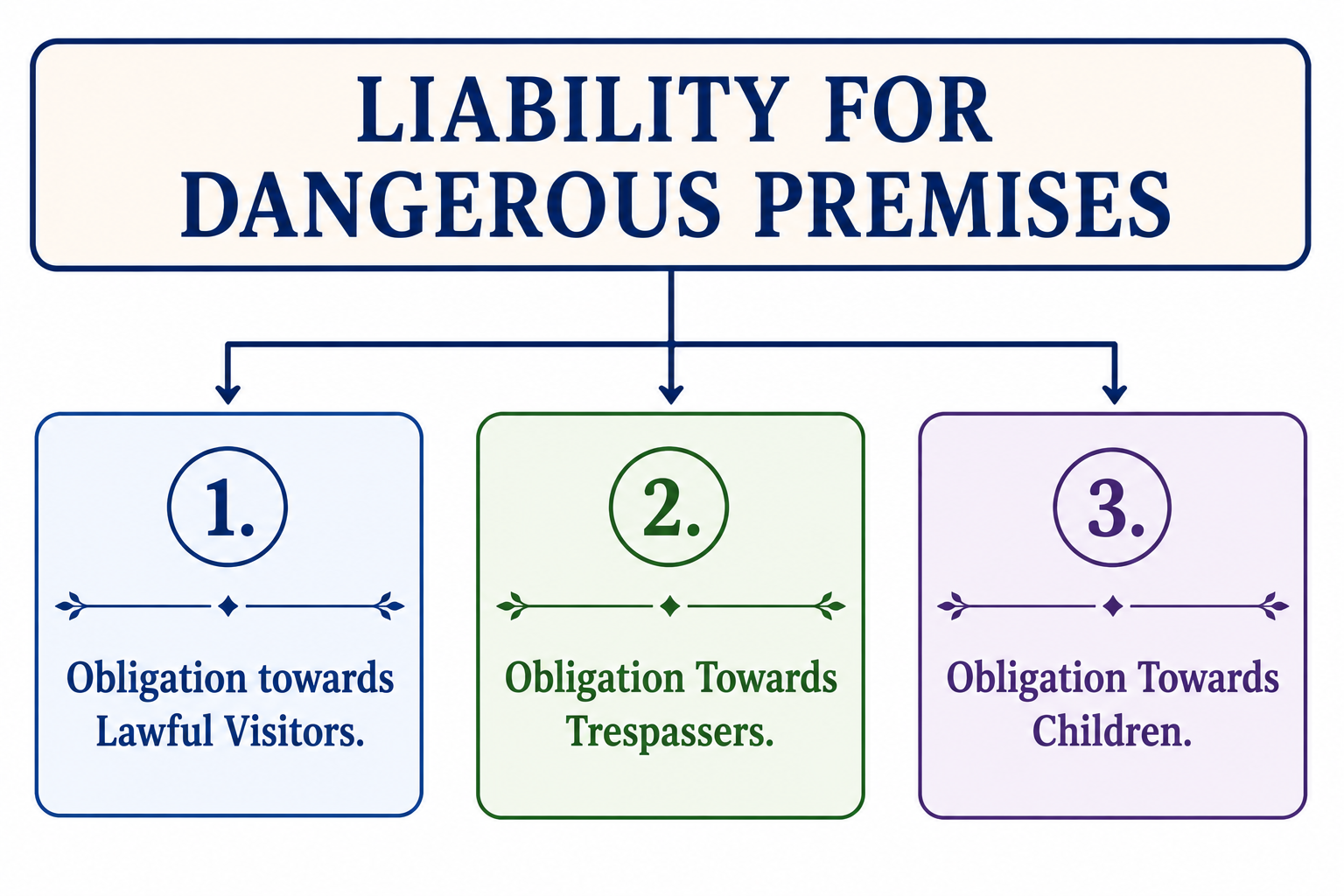
Obligation towards lawful visitors
Prior to the Occupiers’ Liability Act, 1957, obligations toward lawful visitors were governed by English Common Law, which classified visitors as invitees and licensees, with different duties of care.
An invitee was a visitor whose presence involved a mutual or direct interest of the occupier, such as a store customer, whether or not a purchase was made.
A licensee, however, was permitted to enter without such an interest for the occupier, such as a social guest invited to the occupier’s home.
Duty towards an invitee
Under traditional Common Law rules, an occupier owed a higher duty of care to an invitee, requiring reasonable care to protect the visitor from damage caused by any unusual danger on the premises that the occupier knew or ought to have known.
Thus, the occupier could be liable for non-obvious hazards, including risks of which they had actual or constructive knowledge and which should have been discovered through reasonable inspection and care.
Indermaur v. Dames
In Indermaur v. Dames, a gas fitter entered the defendant’s premises to inspect gas fittings but fell through an unfenced opening on an upper floor and was injured.
As a lawful visitor or “invitee,” he was owed a duty of care, and the owner was held liable for failing to secure the dangerous hole, establishing that occupiers must ensure safe conditions for invited visitors.
Cates v. Mongini Bros.
In Cates v. Mongini Bros., a restaurant customer was injured when a ceiling fan unexpectedly fell while she was having lunch.
The failure was caused by a latent defect in the suspension rod that could not have been discovered through reasonable inspection or ordinary care.
Since occupiers are liable only for hazards they knew or ought to have known, the court held the restaurant owners not negligent and not liable for the injury.
Pillutla Savitri v. G.K. Kumar
In Pillutla Savitri v. G.K. Kumar, a practicing Advocate in Guntur was killed when an under-construction first-floor structure suddenly collapsed, causing a sunshade and parapet wall to fall on him.
The court presumed negligence on the part of those responsible for the construction and noted that the work was unauthorized.
Consequently, the defendants were held fully liable for his death.
Duty towards a license
Under traditional Common Law principles, an occupier owed a licensee—a person permitted on the premises for their own purpose—a limited duty to warn of known, concealed dangers or latent defects, but was not liable for unknown hazards or obvious dangers.
In Fairman v. Perpetual Investment Building Society, a guest caught her heel in a worn-down depression on a common staircase, but the court held the owner not liable because the danger was open, obvious, and observable.
However, the Occupiers’ Liability Act, 1957 abolished the distinction between invitees and licensees and introduced a unified “Common duty of care” under Section 2(1), requiring occupiers to take reasonable care to keep all lawful visitors reasonably safe.
Roles v. Nathan
The common duty of care owed by an occupier may be modified, extended, or excluded according to the circumstances, with greater protection for children and reasonable expectations that skilled specialists will guard against risks related to their work.
In Roles v. Nathan, two chimney sweeps died from carbon monoxide poisoning after ignoring warnings not to work while a coke-fired boiler was lit.
The court held the occupier not liable under Section 2(3)(b), as specialists are expected to recognize and guard against dangers inherent in their trade.
In India, Sections 57 and 58 of the Indian Easements Act, 1882 similarly require a licensor to disclose known, concealed defects and avoid active steps making the licensed property hazardous.
Lakmichand Khetsy Punja v. Ratanbai
A licensor has a legal duty to inform a licensee of any known traps, latent defects, or hidden dangers unknown to the licensee.
In Lakmichand Khetsy Punja v. Ratanbai, a fourth-floor tenant was killed when a privy wall collapsed due to a structural defect.
As the landlord knew of the danger and retained control over repairs but failed to maintain the structure, the Bombay High Court held him liable under Section 57 of the Indian Easements Act.
The licensor also has a continuing duty to avoid conduct that may endanger the licensee or their property.
Swimming Pool Accidents
Under the principles governing swimming pool accidents and occupiers’ liability, installing a diving board implies an invitation to use it and a representation that diving is safe.
In City of Ferguson v. Marrow, a 21-year-old experienced swimmer suffered head injuries after striking the pool bottom, and the authorities were held liable because the water depth was insufficient.
Similarly, in Darrel I. Cummings v. Borough of Nazareth, pool operators were held liable when a swimmer was injured after hitting the bottom, establishing a duty to maintain safe water levels and operational conditions.
Klaus Mittelbachert v. East India Hotels Ltd.
In Klaus Mittelbachert v. East India Hotels Ltd., a Lufthansa Airlines co-pilot dived into a 5-star hotel swimming pool in New Delhi and struck the bottom due to insufficient water depth, suffering paralysis and later dying from his injuries.
The court held that the inadequate depth and defective pool design created a hidden “trap” for guests.
Consequently, the hotel was held liable for failing to maintain safe conditions and protect guests from hidden hazards.
M.C. Mehta v. Union of India
In cases of inherently defective and hazardous premises, legal principles impose strict or absolute liability, as recognized in M.C. Mehta v. Union of India (Oleum Gas Leak Case) and Indian Council for Enviro-Legal Action v. Union of India.
For luxury establishments, five-star hotels charging premium prices owe a higher duty of care regarding the safety and quality of their structures and services.
Hazardous latent defects may attract strict liability and exemplary damages.
A five-star hotel cannot avoid liability by claiming that its building met safety standards at construction; it has a continuing duty to maintain updated and advanced safety standards.
Maintenance of Sewar and Water System
Under public law and tort liability, statutory powers granted to public authorities carry a corresponding legal duty to exercise those powers properly.
As stated by Lord Cairns in Julius v. Lord Bishop of Oxford, the purpose, nature, and conditions of a statutory grant, along with the interests of beneficiaries, may create a binding obligation to act.
Thus, an authority empowered to dig streets for drains or water systems has an implied duty to refill and restore the road, just as an authority empowered to construct toll bridges must maintain them in proper repair.
Delhi Jal Board v. Raj Kumar
In Delhi Jal Board v. Raj Kumar, the Delhi High Court held the Delhi Jal Board liable for the death of Vikas Gupta, who suffered a fatal scooter accident after hitting a manhole positioned three inches below the road surface.
The court emphasized that civic authorities responsible for sewer and water systems have an affirmative duty to properly construct and maintain manholes, ensuring they are securely covered and flush with the surrounding road surface to prevent danger to commuters.
Koli Bhimabhai Vershibhai v. Surendranagar District Panchayat
In Koli Bhimabhai Vershibhai v. Surendranagar District Panchayat, the Gujarat High Court awarded ₹2,50,000 for property damage caused by a sudden flow of water and sand after an earthen dam breached due to improper construction and maintenance.
Rejecting the defence of vis major (Act of God), the court relied on Vohra Sadikbhai Rajakbhai v. State of Gujarat, holding that failure to properly release and regulate dam water during the rainy season amounts to statutory negligence.
Public authorities cannot escape liability by attributing dam failure or excessive water levels merely to monsoon rainfall.
Structure adjoining Highway
Property owners maintaining structures adjacent to public highways owe a heightened duty of care to ensure their buildings do not endanger pedestrians or road users.
In Municipal Corporation of Delhi v. Subhagwanti, the collapse of an 80-year-old Clock Tower in Chandni Chowk caused multiple deaths due to severely deteriorated mortar.
The Supreme Court held the Municipal Corporation of Delhi liable, presuming negligence because proper technical inspection could have revealed the danger, and emphasized the duty to conduct systematic safety inspections of potentially hazardous public structures.
Kallulal v. Hemchand
In Kallulal v. Hemchand, a homeowner’s first-storey wall adjoining a public highway collapsed during rainfall, killing the respondent’s six-year-old son and ten-year-old daughter near roadside thelas.
The Madhya Pradesh High Court held that the collapse itself indicated that the wall was deteriorated and unsafe.
Rejecting the defence of “Act of God,” the court held that 2.66 inches of monsoon rain was normal and foreseeable, making the homeowner liable for negligence.
Wringe v. Cohen
In the Court of Appeal case Wringe v. Cohen, the court ruled that if a building adjoining a highway falls into disrepair, becomes a dangerous nuisance, and subsequently collapses—causing harm to a passerby or a neighboring property owner—the party responsible for its upkeep (the occupier or the owner who undertook the duty of repair) is legally liable.
The court established a strict standard for maintenance adjacent to public roads, clarifying that the responsible party remains answerable for the resulting damage regardless of whether they actually knew or ought to have known of the underlying structural danger.
Nagamani v. Corporation of Madras
If a structure collapses without fault, the owner is not legally liable where they had no knowledge of the dangerous condition and could not have discovered it through reasonable inspection.
This principle was demonstrated in Nagamani v. Corporation of Madras, where a pedestrian was fatally injured by a falling iron ventilator post maintained by the city.
The post was only 30 years into its 50-year expected lifespan, securely anchored in concrete, and had been inspected and found sound less than a month before the accident.
The Madras High Court held that the Corporation had exercised reasonable care and caution, and the accident could not have been prevented through ordinary care, thereby absolving it of negligence.
Noble v. Harrison
In Noble v. Harrison, a branch from a large tree overhanging a public highway suddenly broke due to a hidden internal defect and struck the plaintiff’s vehicle.
As the defect was unobservable through reasonable inspection and the landowner had exercised proper care, the court held that the defendant was not liable for the resulting damage.
Liability of landlord
Under tort law regarding property safety, an occupying tenant is ordinarily responsible when a building’s dangerous condition causes injury, but liability may extend to the landlord if they have assumed or retained the duty to repair.
In Wilchik v. Marks and Silverstone, the court held that even without an express repair covenant, a landlord who reserves the right to enter and make repairs remains liable to third parties injured by lack of maintenance.
Justice Goddard emphasized that buildings naturally deteriorate without upkeep, so a landlord retaining access to correct known dangers owes a direct duty to protect passersby and visitors from preventable structural harm.
Mint v. Good
In Mint v. Good, the court held that a landlord may be liable for injuries caused by structural neglect even when the right to enter and repair is merely implied rather than expressly stated in the lease.
The plaintiff was injured when a wall of a property let under aweekly tenancy collapsed.
Although no written right of entry existed, the court implied such a right from the short-term tenancy and held the landlord liable for the resulting harm.