
Liability for Dangerous Chattels
When an individual (X) transfers a dangerous chattel to another party (Y), Y may suffer injury, or the item may be passed to a third party (Z) who ultimately suffers harm.
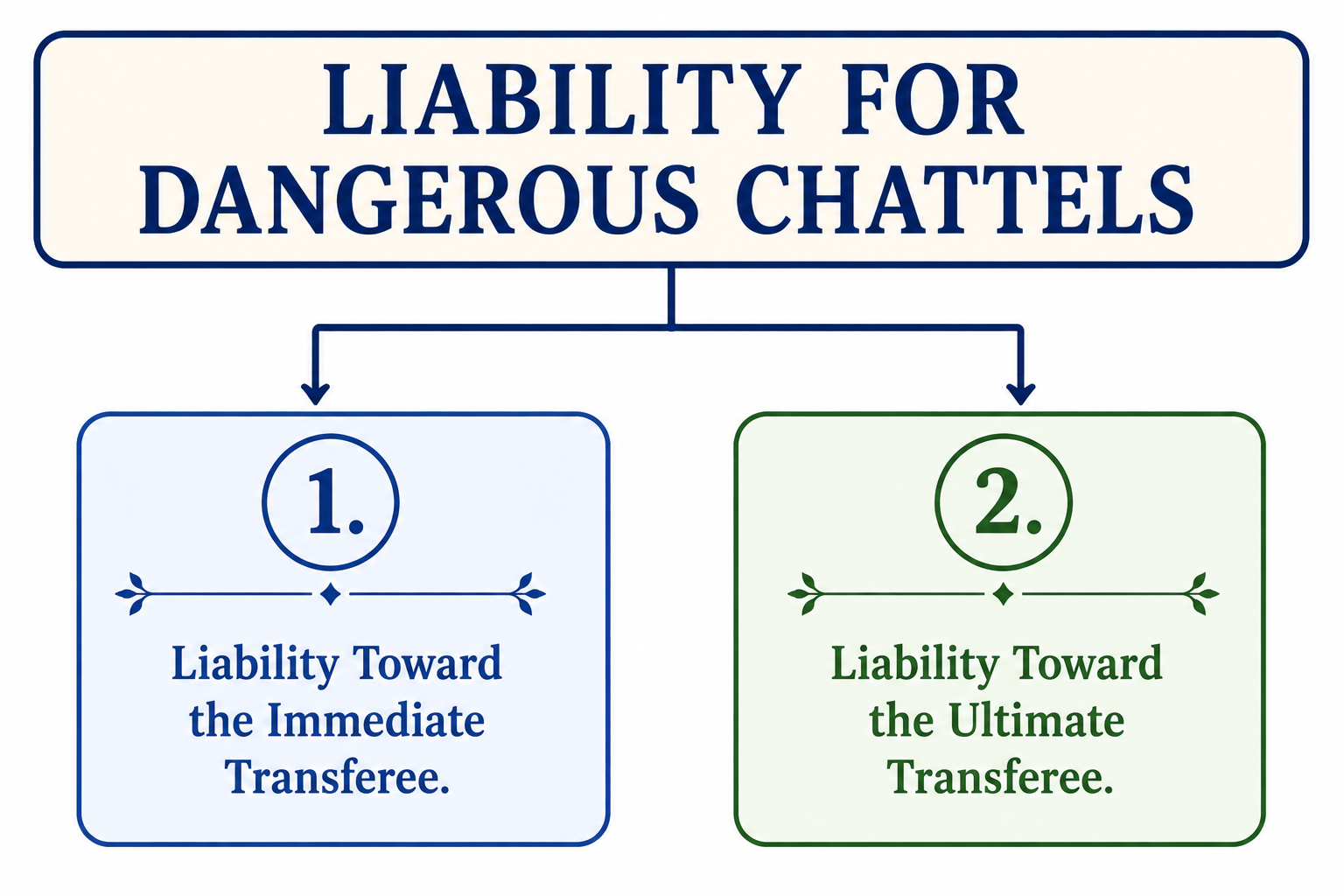
Under tort law, the original transferor’s liability is evaluated in two main categories:
1. liability toward the immediate transferee.
2. liability toward the ultimate transferee who later receives and is injured by the dangerous item.
1. Liability towards the immediate transferee
When goods or chattels are transferred directly under a contract, liability toward the immediate transferee is governed by express or implied contractual terms.
Sales contracts generally imply that goods must be reasonably fit for their intended purpose, making sellers responsible if defective products cause harm, such as chemical-laden woolen underwear causing dermatitis, a bursting hot water bottle, or typhoid-contaminated milk causing disease.
However, this liability may be disclaimed by express agreement, as in Ward v. Hobbs, where a seller sold typhoid-infected pigs under a “with all faults” condition.
Since the buyer agreed to take them as-is, the House of Lords held the seller not liable when the pigs died and infected the buyer’s remaining livestock.
Hyman v. Nye & Sons
When a dangerous article is transferred under a contract of bailment, the bailor’s liability depends on whether it is a paid bailment for hire or a free gratuitous bailment.
In a gratuitous bailment, the bailor must disclose dangerous defects of which they are aware.
In a commercial bailment for hire, the bailor is liable for extraordinary risks caused by defects, even without knowledge of them.
In Hyman v. Nye & Sons, a hired carriage overturned due to a defective bolt.
Lindley, J. held the defendant liable for failing to provide a carriage fit for its intended purpose, placing the burden on the person letting it out to show that the accident was unpreventable despite reasonable care and skill.
Clarke v. Army and Navy Co-operative Society Ltd.
When a person transfers goods under a contract, legal responsibility is not confined to contract law; concurrent liability in tort for negligence may also arise.
In Clarke v. Army and Navy Co-operative Society Ltd., the plaintiff purchased a tin of chlorinated lime and suffered severe eye injuries when its contents burst onto her face while opening it with a spoon in the ordinary manner.
As the defendants knew of the tin’s dangerous condition but failed to provide a safety warning, the court held the store liable in tort for breaching its duty of care.
Donoghue v. Stevenson
Historically, in cases involving gifts or gratuitous loans, courts held that a donor or lender faced no liability unless they failed to warn the recipient about dangerous defects actually known to them.
However, following the landmark ruling in Donoghue v. Stevenson, these decisions became obsolete.
Under modern tort principles, the gratuitous nature of a transfer does not automatically protect a transferor from liability; a donor or lender may still be liable under general negligence principles for failing to exercise reasonable care when providing an item.
Liability towards the ultimate transferee
When an original transferor (X) passes a dangerous chattel to an intermediate party (Y), who transfers it to an ultimate recipient (Z) who suffers injury, tort law determines the extent of X’s legal responsibility.
As there is no direct contractual relationship between X and Z, liability is evaluated through two specific legal framework situations.
(i) Liability for fraud
In tort law, liability for fraud arises when a person is misled by a false statement and suffers harm, even if the representation is not made directly to the victim.
If a party makes a false statement to an intermediary, knowing it may be acted upon by a third party, the original speaker remains liable if the third party relies on it and suffers injury.
In Langridge v. Levy, the defendant sold a dangerous gun to a father for his son’s use, falsely claiming it was safe and made by a renowned manufacturer.
When the gun exploded and injured the son, the court held the seller liable in fraud, as the representation was intended to be communicated to and acted upon by the son.
(ii) Liability for negligence
For the purpose of liability of the transferor towards the ultimate transferee for negligence, the chattels may be considered to be of the following three kinds :
(a) Things dangerous per se
(b) Things not dangerous per se, but actually dangerous and known to be so by the transferor
(c) Things neither dangerous per se, nor known to be dangerous by the transferor but dangerous in fact.
Liability of the transferor is being considered separately in respect of each one of these kinds of things.—
(a) Things dangerous per se
Legal doctrine distinguishes between items dangerous suo modo (hazardous due to specific circumstances) and per se (intrinsically hazardous, such as loaded firearms, explosives, and poisons).
Because inherently dangerous articles pose severe risks, the law imposes a special duty of precaution on those who distribute or install them.
In Thomas v. Winchester, a wholesale druggist negligently mislabeled poisonous “Belladonna” as safe dandelion extract.
Although it passed through a retailer and physician, the court held the druggist liable to the ultimate consumer, establishing that suppliers of inherently dangerous goods owe a direct duty of care to likely end users.
Dixon v. Bell
Under legal principles governing inherently dangerous objects, anyone who controls a thing dangerous per se owes a high duty of care to prevent harm to others.
In Dixon v. Bell, the defendant instructed his 13-year-old servant girl to take possession of a firearm.
While playing, she pointed it at a 9-year-old boy and pulled the trigger, causing severe injuries.
The court held the defendant liable for damages, as leaving an inherently dangerous weapon with an unqualified or young person breached the required standard of reasonable care.
Beckett v. Newalls Insulation Co.
The legal division of chattels into things dangerous per se and suo modo has faced judicial criticism because general negligence law, based on reasonable care in specific circumstances, is sufficient without rigid categories.
Scrutton, L.J. highlighted this flaw, observing that an item made dangerous through negligent construction may be more perilous than an intrinsically dangerous item like poison, describing a defective product as a “wolf in sheep’s clothing” compared to an “obvious wolf.”
This modern view, reflected by Singleton, L.J. in Beckett v. Newalls Insulation Co., emphasizes context and foreseeable risk rather than formal classifications in determining the transferor’s standard of care.
Read v. Lyons
As quoted from the arguments in Read v. Lyons, the law concerning dangerous objects is best understood not by asking whether an item is inherently dangerous in itself, but whether external circumstances make it hazardous.
Modern tort law rejects rigid categories of dangerous things, recognizing instead that different objects and situations simply demand varying degrees of caution—some requiring more care and others requiring less.
(b) Things not dangerous per se but known to be so by the transferor
When a transferor supplies goods that are not inherently dangerous per se but are known to possess dangerous qualities, the law imposes a duty to provide adequate warnings to protect the immediate recipient and foreseeable downstream handlers.
In Farrant v. Barnes, the defendant gave a carrier a carboy of nitric acid without warning of its hazardous contents; when it burst and severely burned the carrier’s employee, the defendant was held liable for failing to warn of the known danger.
Conversely, a manufacturer or supplier may avoid liability by providing sufficient and clear warnings.
In Holmes v. Ashford, a customer suffered dermatitis from hair dye after a hairdresser ignored the manufacturer’s warning brochure, which advised of skin risks and recommended a prior test.
Since adequate warnings had been provided, the court held the manufacturer not liable for the plaintiff’s injuries.
(c) Things neither dangerous per se nor known to be dangerous to the transferor but dangerous in fact
Prior to 1932, an original supplier (X) was generally protected from negligence claims by an ultimate consumer (Z) for items neither dangerous per se nor known to be dangerous, due to the requirement of privity of contract.
This restrictive doctrine was dismantled by Donoghue v. Stevenson, where a consumer became ill after drinking ginger beer from an opaque, sealed bottle containing a decomposed snail.
Although the plaintiff had no direct contract with the manufacturer, the House of Lords held the manufacturer liable.
Lord Atkin established the principle that a manufacturer who supplies products intended to reach the ultimate consumer without intermediate inspection owes a duty of care to ensure they are safely prepared, creating direct liability for injuries to the consumer’s life or property.
Application of the rule in Donoghue v. Stevenson
The rule established in Donoghue v. Stevenson has expanded beyond product manufacturers and food items to include repairers, builders, assemblers, and suppliers of goods such as motor vehicles, undergarments, hair dyes, tombstones, and elevators.
As illustrated in Brown v. Cotterill and Andrews v. Hopkinson, anyone involved in erecting or supplying goods owes a duty of care to ultimate users where failure to inspect or warn causes injury.
Items need not remain sealed, as shown in Grant v. Australian Knitting Mills, but the claimant must prove that the defect originated with the manufacturer and was not caused by intervening factors, as in Evans v. Triplex Safety Glass Co. Ltd.
Manufacturers may also avoid liability by providing clear instructions or warnings requiring intermediate testing, as demonstrated in Kubach v. Hollands and Holmes v. Ashford.
If an intermediary ignores such instructions, liability may shift from the manufacturer to the non-compliant intermediary.
Consumer Protection Legislation in England
It has been noted above that the manufacturers and distributors of goods can be made liable for their negligence under the rule in Donoghue v. Stevenson.
Unfair Contract Terms Act, 1977
Under the Unfair Contract Terms Act, 1977 in England, consumers receive statutory protection against manufacturers and distributors excluding or restricting liability for loss or damage caused by defective products.
Section 5(1) provides that, for goods ordinarily supplied for private use, loss or damage arising from defects caused by negligent manufacturing or distribution cannot be disclaimed through contractual terms, notices, or conditions attached to product guarantees.
This framework ensures businesses remain legally accountable for negligence and prevents fine-print disclaimers from depriving consumers of their right to recovery.
Consumer Safety Act, 1978
The Consumer Safety Act, 1978 was enacted in England to ensure the provision of safe goods to consumers by empowering the Secretary of State to formulate necessary safety regulations.
Breach of these regulations is a criminal offence, while affected consumers may also pursue civil actions for damages; any contract restricting or excluding such civil liability is void.
The text emphasizes that India similarly requires strong legislative measures for robust consumer protection, modeled after the English framework.