
Liability for Animals
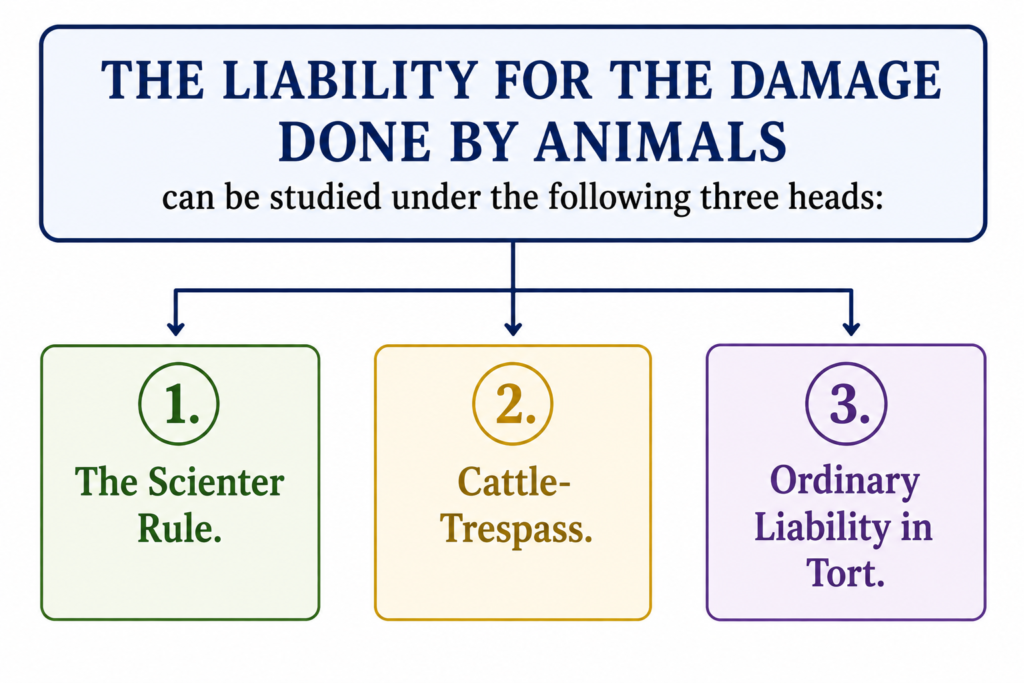
The liability for the damage done by animals can be studied under the following three heads:
1. The Scienter Rule.
2. Cattle-Trespass.
3. Ordinary Liability in Tort.
THE SCIENTER RULE
Under the Scienter Rule, a keeper’s liability for damage caused by an animal depends on knowledge of its dangerous character.
Animals are divided into ferae naturae (inherently dangerous species, such as lions, bears, and elephants) and mansuetae naturae (naturally harmless or domesticated animals, such as dogs, cows, and horses).
For wild animals, knowledge of danger is conclusively presumed by law, imposing strict liability on the owner regardless of personal fault, prior training, or third-party provocation, as established in Filburn v. People’s Palace and Behrens v. Bertram Mills Circus Ltd.
Conversely, keepers of domesticated animals are liable only when the specific animal has shown a vicious tendency and the owner had prior notice.
Indian cases such as Vedapuratti v. Koppan Nair, Nitin Walia v. Union of India, and Veeramani Chettiar v. Davis adopt these principles, holding that keeping inherently dangerous animals creates an obligation to compensate injured persons regardless of negligence or external interference.
Liability for keeping animals ‘ferae naturae’
Under the doctrine governing animals classified as ferae naturae, courts apply an irrebuttable presumption that keepers know the inherent dangers of wild animals, imposing strict liability for resulting damage without requiring proof of negligence.
In Behrens v. Bertram Mills Circus Ltd., the owner could not escape liability by claiming that the animal was tame, circus-trained, or acting from fright rather than aggression.
The circus was held strictly liable when a frightened Burmese elephant knocked over a booth and caused severe shock to an individual.
However, India recognizes an exception: elephants are not uniformly treated as ferae naturae in all circumstances.
Given their domestic and ceremonial roles, an owner who takes reasonable safety precautions may avoid liability for unexpected or unforeseeable harm caused by an elephant.
Persons having elephant joy-ride seriously injured
In Dr. M. Mayi Gowda v. State of Karnataka, a medical practitioner and five children purchased tickets for an elephant joy-ride at the Mysore Dasara Exhibition on January 7, 1992.
While dismounting after several rounds, the elephant panicked due to the rush-hour crowd and bolted forward, throwing the doctor to the ground and causing severe injuries that resulted in complete loss of sight in both eyes.
He claimed ₹9,99,000 in compensation.
Evidence showed that the female elephant was accustomed to crowds and had participated in rides, festivals, film shoots, and official functions for 13 years without incident.
The court therefore found no negligence by the organizers, attributing the accident to the elephant’s sudden and unexpected behavior, and dismissed the complaint.
Death or injury caused by wild animals
In State of Himachal Pradesh v. Halli Devi, the plaintiff, a resident of Rohla village in Chamba district, was severely attacked by a wild black bear on March 27, 1989, while going to her cattle shed, suffering multiple fractures and complete loss of sight in her left eye.
After receiving ₹5,000 as ex gratia relief, she filed a suit claiming ₹1,00,000 in damages, alleging that the Divisional Forest Officer had released bears under wildlife protection schemes.
The court held that statutory protection prohibiting the hunting of wild animals does not constitute State ownership or make the State liable for harm caused by such animals.
It also noted that the Wildlife Protection Act, 1972 contained no provision for mandatory victim compensation and that voluntary ex gratia payment does not amount to an admission of legal liability.