
1. DAMAGES
Damages is the most important remedy which the plaintiff can avail of after the tort is committed. They are of various kinds :
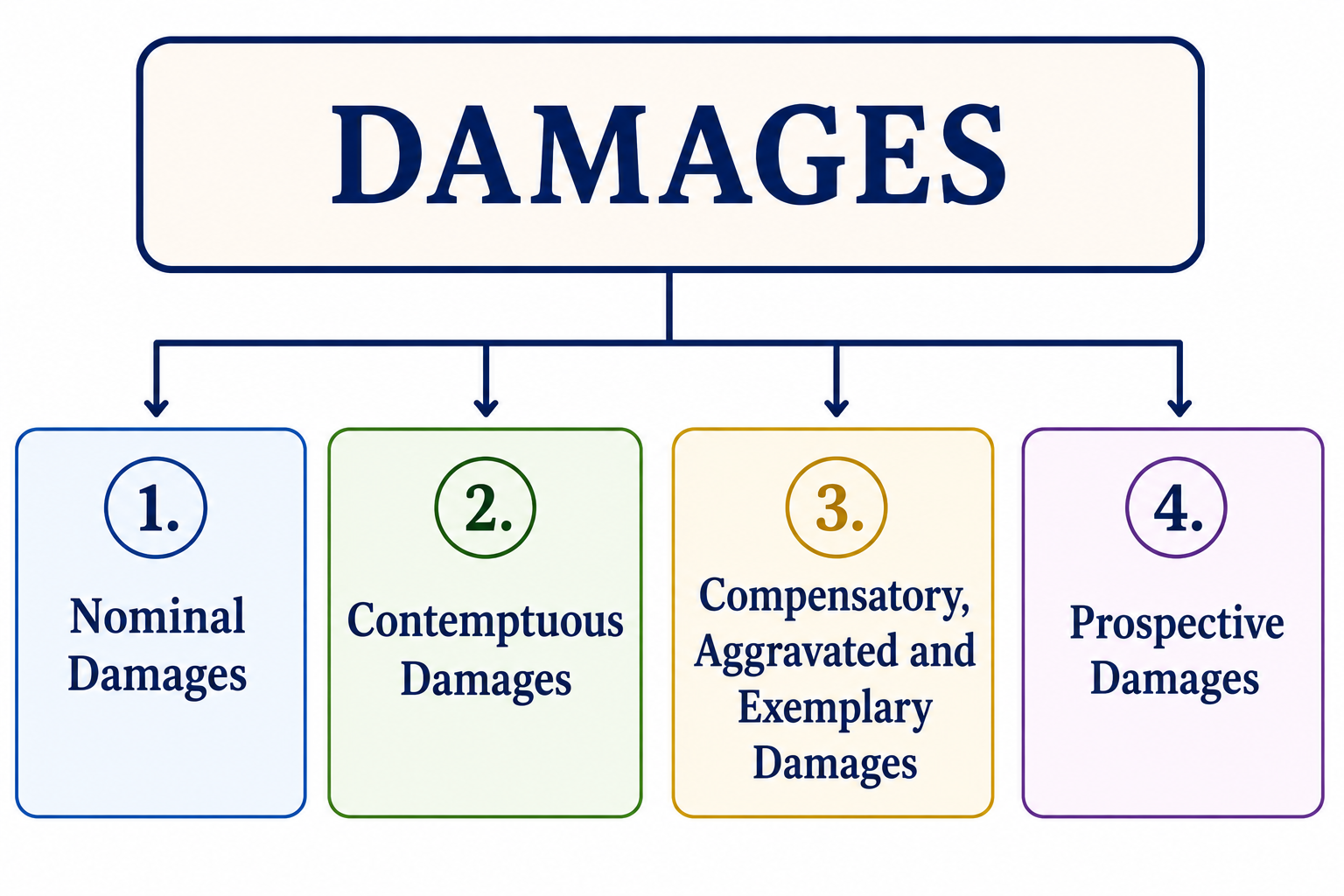
Nominal Damages.
Nominal damages are a legal remedy granted under the maxim injuria sine damno, where a plaintiff’s legal right has been infringed without causing actual financial or physical loss.
In such cases, courts award a symbolic sum—such as a token amount—to validate and protect the legal right itself.
This principle is illustrated in Constantine v. Imperial London Hotels Ltd., where a renowned cricketer was wrongfully denied lodging at a specific hotel despite being housed elsewhere, earning him nominal damages for the violation of his rights.
Furthermore, for wrongs that are actionable per se, such as trespass or denial of voting rights, harm is legally presumed regardless of financial damage.
As established in Ashby v. White, even if a voter’s preferred candidate wins despite the voter being unlawfully barred from voting, or if someone trespassed without damaging property, the law holds the wrongdoer liable because any unauthorized invasion of personal rights or property constitutes an actionable legal injury.
Contemptuous damages.
Contemptuous damages are a very small amount of compensation awarded where the plaintiff has suffered actual loss, but the court considers them undeserving of full compensation because of the nature of the claim or their conduct.
For example, if the defendant assaults the plaintiff after an offensive remark, the plaintiff may suffer genuine injury, but the court may award only a trifling sum because the plaintiff helped provoke the incident.
They differ from nominal damages, which are awarded when a legal right is violated without actual loss, whereas contemptuous damages apply where some loss occurred but only limited compensation is considered appropriate.
Compensatory, aggravated and exemplary damages.
Under the law of torts, financial remedies are categorized into compensatory, aggravated, and exemplary damages based on their purpose.
Compensatory damages restore the injured party by covering actual material loss.
Where a tort involves malice, insult, or emotional injury, courts may award aggravated damages, an increased compensatory amount reflecting the victim’s heightened distress rather than punishing the offender.
Exemplary or punitive damages, however, go beyond actual loss to penalize wrongdoers and deter future misconduct.
As established by Lord Devlin in Rookes v. Barnard, such damages are reserved for statutory authorization, cases where the wrongdoer seeks profit beyond compensation, or oppressive and unconstitutional conduct by government officials.
Indian cases such as Bhim Singh v. State of J. & K., Rudal Sah v. State of Bihar, and Sebastian M. Hongary v. Union of India further recognize exemplary damages as a constitutional remedy against illegal detention, imprisonment, and severe state misconduct.
Prospective damages.
Prospective or future damages represent compensation for anticipated losses reasonably expected to result from a defendant’s wrongful act, even though they have not yet occurred by the date of judgment.
Since civil litigation does not allow a plaintiff to repeatedly sue for the same injury, courts assess both immediate and long-term consequences in a single verdict.
For example, where a victim is crippled in an accident, damages may cover past lost income and medical expenses, along with future losses such as diminished earning capacity, ongoing care costs, and future medical treatment.
Subhash Chander v. Ram Singh
In Subhash Chander v. Ram Singh, a seven-year-old boy sustained severe injuries after being struck by a state-owned bus, resulting in permanent physical disability.
He was required to wear surgical shoes for walking, which impaired his mobility and restricted his future employment prospects.
The Motor Accidents Claims Tribunal initially awarded Rs. 3,000 for probable future loss due to incapacity and diminished work capacity.
Considering the prospective nature and lifelong impact of the injuries, the Delhi High Court enhanced the total compensation to Rs. 7,500.
Y.S. Kumar v. Kuldip Singh
In Y.S. Kumar v. Kuldip Singh, the respondent, an Excise and Taxation Officer, suffered severe ankle injuries after being hit by a motorcycle, resulting in permanent physical disability, impaired mobility, and reduced enjoyment of normal life.
To compensate for this long-term non-pecuniary harm, the court assessed the loss of amenities at Rs. 50 per month for 12 years, awarding a total of Rs. 7,200 for physical disability and loss of life’s enjoyment.
Fitter v. Veal
In tort law, all damages arising from a single wrongful act must generally be assessed in one lawsuit, as a plaintiff cannot bring multiple suits for the same cause of action.
In Fitter v. Veal, a plaintiff who recovered £11 for battery was barred from bringing a second suit when later complications required surgical removal of part of his skull, as all compensation had to be claimed at once.
However, two exceptions permit successive actions: where one act violates two distinct legal rights, and where the tort is continuing.
In Brunsden v. Humphery, a second suit for personal injuries was allowed after compensation for vehicle damage because property damage and personal bodily harm involved separate legal rights.
Measure of damages for personal injury
In tort law, damages for personal injury are broadly assessed under three categories: non-pecuniary loss, including pain, suffering, and loss of enjoyment of life; actual pecuniary expenses reasonably incurred; and prospective loss of future earnings due to temporary or permanent incapacity.
For pain and suffering, courts consider both past and future physical pain and mental agony, including the effects of shortened life expectancy.
However, a victim who remains continuously unconscious cannot claim under this head because no conscious pain was experienced.
If the victim dies before filing a suit, their legal representatives may claim such compensation on behalf of the estate.
Laxminarayan v. Sumitra Bai
In Laxminarayan v. Sumitra Bai, the defendant induced the plaintiff into a sexual relationship through a false promise to marry and later refused to fulfill it after she became pregnant.
The court held that she was entitled to substantial civil damages for physical pain, social stigma, humiliation, and reduced future marriage prospects caused by the defendant’s deceit.
The judgment also clarified that an acquittal in a related criminal case does not bar civil remedies or monetary compensation under tort law.
Rehana v. Ahmedabad Municipal Transport Service
In Rehana v. Ahmedabad Municipal Transport Service, a 16-year-old girl suffered severe injuries in an accident, resulting in a permanent limp and physical impairment.
The court awarded Rs. 10,000 for personal suffering caused by her disability, along with reimbursement of medical expenses.
It also granted additional compensation for loss of enjoyment of life, considering her inability to participate in sports and household activities and her diminished prospects for future marriage.
Union of India v. Savita Sharma
In Union of India v. Savita Sharma, an 18-year-old girl suffered severe injuries requiring amputation of her leg below the knee after the tempo she was traveling in was struck by a military vehicle.
Considering her physical agony, emotional distress, diminished marriage prospects, and lifelong medical burdens, the court awarded Rs. 10,000 for medical expenses, Rs. 15,000 for pain and suffering, and Rs. 12,000 for permanent disablement.
It also granted Rs. 6,000 for annual artificial-leg replacements, calculated at Rs. 150 per year for her projected 40-year life expectancy.
Karnataka State Road Transport Corporation v. Krishna
In Karnataka State Road Transport Corporation v. Krishna, two factory workers aged 26 and 40 lost their left arms below the shoulder in a bus collision.
Applying the framework of the Workmen’s Compensation Act, the court assessed damages for loss of limbs and future earning capacity.
The 26-year-old, earning Rs. 400 monthly, suffered 80% disability, resulting in a calculated loss of Rs. 38,400, which was finalized at Rs. 40,000 with special damages.
The 40-year-old, earning the same income, received Rs. 35,000 considering his age and shorter working life.
The court also emphasized that personal injury compensation includes future living expenses such as nursing, specialized transport, and extra nourishment.
Klaus Mittelbachert v. East India Hotels Ltd.,
In the benchmark case Klaus Mittelbachert v. East India Hotels Ltd., a 30-year-old Lufthansa co-pilot suffered permanent paralysis in all four limbs after diving into an insufficiently deep swimming pool at a 5-star hotel in New Delhi and later died 13 years after the accident.
The Single Judge held the hotel liable for severe negligence, noting that 5-star establishments owe a heightened standard of care and safety to guests.
Although damages were calculated at Rs. 1,03,25,245.98, the decree was capped at Rs. 50 lakhs as claimed.
On appeal in East India Hotels Ltd. v. Klaus Mittelbachert, the court held that the action was personal in tort and abated upon the plaintiff’s death, preventing his legal representatives from continuing the personal injury claim.
Attendant's expenses
Under tort law, personal injury compensation may extend to attendant expenses required for the victim’s essential care and assistance after an accident.
In Veeran v. Krishnamoorthy, a six-year-old boy was injured due to negligent bus driving and required hospitalization and constant attendant care from his mother.
As her presence was essential to his care, the court allowed Rs. 2 odd spent on a medicinal mixture for her when she became unwell, treating it as recoverable special damages directly linked to the accident.
Schneider v. Eisovitch
In the English precedent Schneider v. Eisovitch, a motor vehicle accident in France caused Mr. Schneider’s death and left Mrs. Schneider severely injured and hospitalized.
Her brother and sister-in-law traveled to France to provide urgent physical and logistical assistance.
Mrs. Schneider sought to recover the out-of-pocket expenses incurred by them, and the court held that their presence and supportive services were reasonably necessary consequences of the accident.
Therefore, she was entitled to recover those expenses as part of her overall damages.
Donnelly v. Joyce
In the landmark case Donnelly v. Joyce, a six-year-old child injured in an accident was awarded compensation for the wages lost by his mother after she gave up her employment to provide necessary medical care and attention.
The court held that the true loss belonged to the injured victim because the accident created a need for care services, measured by the caregiver’s cost or lost income.
It further clarified that any legal or moral obligation to repay the relative providing care is immaterial to the wrongdoer’s liability for damages.
Interest on damages
Under tort law, courts may grant interest on calculated damages to compensate the plaintiff for the time value of money lost due to judicial delays.
Interest generally accrues from the date of filing the lawsuit or petition until the compensation is fully paid.
Decisions of the Allahabad High Court and Jammu & Kashmir High Court demonstrate this principle by allowing 6% per annum interest on awarded compensation to ensure complete redress for the victim.
Effect of the receipt of disablement pension or insurance money on the right to compensation
Under English common law, accident benefits, such as disablement pensions or insurance proceeds, are not deducted from the compensation payable by a tortfeasor.
This rule is based on two principal grounds: first, the victim paid premiums or contributed funds for insurance, so deducting the proceeds would unfairly penalize prudent individuals; second, such deductions would give an improper windfall benefit to the negligent tortfeasor by reducing the damages owed for their wrongful act.
Perry v. Cleaver.
In the pivotal House of Lords decision Perry v. Cleaver, an injured worker received a disablement pension after being discharged from service, raising the issue of whether such collateral benefits should reduce the tortfeasor’s liability.
The court firmly rejected any deduction, with Lord Reid reasoning that the plaintiff had paid premiums or earned pension rights through service, so deducting the benefits would unfairly penalize financial foresight and give an unearned windfall to the wrongdoer.
Had the victim not purchased insurance, they would have retained the premiums with compound interest.
Based on equity, reasonableness, and natural justice, Indian courts have adopted this principle, preventing tortfeasors from reducing damages through a victim’s private insurance or pension benefits.