
Rohtas & Anr v State of Haryana with Bijender v State of Haryana
In Ahsan v State of Uttar Pradesh, Justice Abhay Manohar Sapre reviewed an appeal against the Allahabad High Court’s judgment affirming the appellant’s conviction under Sections 307/34, 316/34, 452, and 504 IPC, alongside a sentence of life imprisonment.
The Supreme Court detailed the statutory tiers of punishment under Section 307 IPC and emphasized that sentencing courts must evaluate key factors such as the nature of the offense, the vulnerability of the targeted body parts, and the severity of injuries.
Noting that the appellant and co-accused had acted with a common intention to kill, inflicting a devastating gunshot wound to the head and causing multiple severe injuries that would have proved fatal without emergency medical intervention, the Apex Court concluded that the case fell squarely within the provisions warranting life imprisonment.
Dismissing the appeal, the Supreme Court affirmed that the quantum of punishment was entirely proper and immune to appellate interference.
Sy. Azhar Sy. Kalandar v State of Maharashtra & Anr.
In Sy. Azhar Sy. Kalandar v State of Maharashtra & Anr., Justice Rastogi reviewed an appeal challenging the Bombay High Court’s judgment that upheld the appellant’s conviction under Section 307 IPC and a 10-year prison sentence for stabbing Chintaman Dange in the stomach during a 2016 procession over a prior dispute concerning construction near a Darga.
The trial court and High Court had relied firmly on the unimpeachable testimony of the injured victim and the treating doctor, Arvind Kisanrao Adhe.
However, the Supreme Court considered subsequent developments showing that both parties lived in the same village and had since restored peaceful relations, along with a voluntary, uncoerced apology tendered by the appellant.
Consequently, while upholding the conviction under Section 307 IPC, the Apex Court partly allowed the appeal by reducing the rigorous imprisonment from 10 years to 5 years while maintaining the Rs. 10,000/- fine.
8.8.2 Miscarriage (Abortion) and Injuries to the Unborn Child
In Section 312 of the Indian Penal Code, categorized under offenses relating to miscarriage and injuries to the unborn child, it is established that anyone who voluntarily causes a pregnant woman to miscarry faces imprisonment of up to three years, a fine, or both, unless the procedure is performed in good faith to save her life.
Furthermore, if the woman is “quick with child,” the severity of the offense increases, raising the potential imprisonment term up to seven years alongside mandatory liability to fine.
The statutory text explicitly clarifies through its explanation that a woman who causes her own miscarriage also falls directly within the scope and meaning of this penal provision.
8.8.3 Scope of Section 312
Examining the scope of Section 312 of the Indian Penal Code reveals that Indian abortion laws are modeled after English statutes and specifically deploy the term “miscarriage” to penalize unlawful termination.
The statute categorizes offenses based on the developmental stage of pregnancy—punishing termination when a woman is simply “with child” with up to three years of imprisonment, and escalating the penalty up to seven years when she is “quick with child,” signifying an advanced stage where fetal movement is perceptible.
Furthermore, judicial interpretations and associated provisions establish that criminal liability encompasses self-inflicted termination, abetment through third-party facilitation under Section 109 IPC, and attempts under Section 511 IPC—as demonstrated in cases like Arunia Bewa, where an attempted procedure resulting in a live birth still sustained a conviction for attempting to bring about a miscarriage.
8.8.3.1 Abortion Permitted on Medical Grounds
Under Section 312 of the Indian Penal Code, abortions are legally permitted on therapeutic grounds when performed in good faith to protect the mother’s life, a principle reinforced by rulings such as Sharif v State of Orissa and the historic English precedent Rex v Bourne, which shield medical practitioners from criminal liability even when the threat to life is not immediate or certain.
However, when abortions involve aggravating circumstances or lack consent, the law imposes rigorous penal consequences through Sections 313 to 316.
Specifically, causing a miscarriage without consent under Section 313 or causing the mother’s death during the process under Section 314 carries severe punishments extending up to life imprisonment or 10 years of confinement, while Sections 315 and 316 criminalize acts intended to prevent a child from being born alive or causing the death of a quick unborn child, underscoring a strict legislative framework that balances legitimate medical exceptions with heavy deterrence against unauthorized or harmful terminations.
8.8.3.2 Medical Termination of Pregnancy Act 1971
The introduction of the Medical Termination of Pregnancy Act 1971 marked a critical transition from historical abortion laws that were largely honored in breach rather than observance, establishing a structured framework to curb illegal procedures while upholding a woman’s constitutional right to privacy and bodily autonomy under Article 21 of the Constitution.
Beyond addressing population growth through the legal termination of unwanted pregnancies caused by contraceptive failure, the official policy objectives of the Act are categorized into three core grounds: serving as a health measure when physical or mental well-being is at risk, operating on humanitarian principles in cases of sexual violence or intercourse involving vulnerable individuals, and functioning on eugenic grounds where a child faces substantial risks of congenital deformities or disease.
8.8.3.3 Pre-Natal Diagnostic Techniques (Regulation of Misuse) Act 1994
The Pre-Natal Diagnostic Techniques (Regulation and Prevention of Misuse) Act 1994 was enacted by Parliament to combat the grave human rights violation of female foeticide driven by pervasive societal son preference, explicitly prohibiting genetic counselling centres and clinics from conducting ultrasonography or diagnostic tests for sex determination under Section 6, with violations carrying imprisonment of up to three years and fines for all participating parties.
Despite such statutory measures and grim discoveries highlighting the persistence of illegal practices, the legal framework is reinforced by rigorous judicial oversight regarding post-20 week pregnancy terminations.
As illustrated in landmark rulings like Savita Sachin Patil v UOI (2017), the Supreme Court established that once the 20-week statutory limit is crossed, exemptions for termination are narrowly restricted to situations involving direct danger to the mother’s life or severe, non-viable fetal abnormalities, denying permission when such strict criteria are unmet—even in cases of genetic conditions like Down’s Syndrome—thereby maintaining a strict balance between bodily autonomy, legislative limits, and the protection of life.
Indu Devi v State of Bihar
In Indu Devi v State of Bihar, the Supreme Court underscored that the fundamental purpose of life is human dignity, reinforcing state accountability toward victims of sexual violence when medical procedures cannot be safely executed.
In this case, a 35-year-old rape survivor carrying a 22-to-24-week pregnancy sought termination due to being HIV positive; however, based on an AIIMS medical board report indicating that the termination posed severe risks to both the mother and the fetus, the Court denied the procedure while directing the State of Bihar to cover her medical treatment costs and award 300,000 in compensation under Section 357A of the Code of Criminal Procedure 1973.
This judicial stance aligns with broader legal principles, such as the 1992 House of Lords precedent from Northern Ireland, which established that the mother’s right to life is superior to that of the unborn child.
Attorney General of Ireland v X
In the landmark case Attorney General of Ireland v X, a complex legal battle unfolded after a 14-year-old rape survivor pregnant with a pregnancy resulting from assault was barred from obtaining an abortion under Irish law, prompting the Attorney General to secure an injunction preventing her and her parents from leaving the jurisdiction.
While the High Court initially issued a permanent injunction by prioritizing the right to life of the unborn under Article 40.3.3 of the Irish Constitution over the psychological and mental distress of the minor, the Supreme Court of Ireland subsequently overturned this decision by a 4-to-1 majority.
The Supreme Court ruled that the constitutional provisions must be interpreted harmoniously and that a real and substantial risk to the mother’s life driven by suicidal tendencies, which could only be avoided through termination, justified permitting an abortion in Ireland—a pivotal precedent that eventually paved the way for the legislative legalization of abortion in Ireland in 2018, aligning with broader European human rights stances where an unborn fetus is not classified as a legal “person” under Article 2 of the ECHR.
Vo v France
In the landmark European case Vo v France, a doctor who negligently caused fatal injury to a viable foetus due to a mistaken identity was acquitted by a French criminal court because the foetus was not classified as a human being for the purpose of the criminal offense.
When the matter was brought before the European human rights mechanisms, the Court declined to explicitly define a foetus under Article 2 of the European Convention of Human Rights (ECHR), holding instead that the exact commencement of life and its protection under criminal law fall within the “margin of appreciation” of member states, and noting that the unborn is not regarded as a “person” directly protected by Article 2, meaning any implied right to life is subject to the mother’s rights and interests.
Conversely, domestic interpretations can vary significantly across legal domains; for instance, the Maharashtra State Consumer Commission allowed an appeal in 2007 establishing that a foetus qualifies as a “consumer” like other human beings and is entitled to an insurance claim.
Kanta Mohanlal Motecha v Branch Manager, United India Insurance Co Ltd
In the landmark judgment Kanta Mohanlal Motecha v Branch Manager, United India Insurance Co Ltd on March 6, 2007, the Maharashtra State Consumer Commission ruled that an unborn child killed in a tragic car crash is entitled to insurance coverage, overturning a lower district forum decision that had rejected the claim on the grounds that an unborn child could not be considered a passenger.
Drawing comparisons to international frameworks like the American Unborn Victims of Violence Act 2004 and traditional Hindu law principles recognizing an unborn child as a living human being capable of inheriting property, the Court emphasized that law is an instrument of socio-economic change and that during the second trimester (13th to 27th week) a foetus attains a recognizable human form, thereby qualifying as a separate consumer entity alongside the pregnant mother.
This progressive stance mirrors broader international legal shifts, such as a 1997 House of Lords precedent from the United Kingdom establishing that a child’s death resulting from injuries causing premature delivery constitutes manslaughter.
Attorney General's Reference (No 3 of 1994)
In the landmark case Attorney General’s Reference (No 3 of 1994), the House of Lords examined criminal culpability where a defendant stabbed a pregnant woman, resulting in a premature birth and the subsequent death of the child days later from complications of prematurity.
Although the trial judge initially acquitted the defendant on the grounds that murder or manslaughter was legally impossible, the Attorney General referred key questions regarding prenatal injury and maternal impact to the appellate courts.
Ultimately, the House of Lords allowed the appeal and ordered a retrial, ruling that because the defendant intentionally committed an unlawful and dangerous act by stabbing the mother, the requisite mens rea for manslaughter was fully established, and on public policy grounds, that criminal intent extended to the child once born alive, meaning that indirect injuries resulting from harm inflicted on the mother do not negate liability for manslaughter.
Rees v Darlington Memorial Hospital NHS Trust
In the landmark case Rees v Darlington Memorial Hospital NHS Trust, a severely visually disabled woman who gave birth to a healthy child following a negligently performed sterilization procedure sought damages for the costs of child-rearing.
While the Court of Appeal initially ruled that she could recover the “extra” costs associated with bringing up the child due to her disability, the House of Lords by a majority of 4 to 3 allowed the Hospital Trust’s appeal, holding that a claimant is not entitled to recover general or disability-related child-rearing costs for a healthy child, but is instead limited to a conventional award of 15,000 for the legal wrong inflicted upon her.
This discussion on reproductive autonomy and medical negligence parallels foundational constitutional milestones in comparative law, such as the 1973 US Supreme Court ruling establishing that criminal statutes prohibiting abortion violate the due process clause.
Roe v. Wade
The evolution of constitutional jurisprudence surrounding reproductive rights in the United States is anchored by two monumental Supreme Court decisions, prominently seen in the landmark case Roe v. Wade, where Jane Roe successfully challenged Texas abortion laws, leading the U.S. Supreme Court to rule that criminal statutes restricting abortion without regard to pregnancy stages violate the due process clause of the Fourteenth Amendment by infringing upon a woman’s right to personal privacy, thereby establishing a structured framework that granted women absolute decision-making freedom in the first trimester, permitted health-related regulations in the next six months, and allowed prohibitions in the final stage except to save the mother’s life.
Decades later, in Planned Parenthood of Southeastern Pennsylvania v. Casey (1992), the Supreme Court reaffirmed the essential holding of Roe v. Wade but replaced the rigid trimester structure with the “undue burden” standard, which upheld state-mandated requirements like 24-hour waiting periods, parental consent, and informed consent, while invalidating spousal notification as a substantial obstacle.
Reinforcing this regulatory authority, subsequent rulings such as Mazurek v. Armstrong established that state laws restricting the performance of abortions to licensed physicians are entirely constitutional because they do not impose an undue burden on a woman’s right to choose.
Dobbs, State Health Officer of the Mississippi Department of Health, Et Al. v. Jackson Women’s Health Organization Et Al.
In the monumental decision Dobbs v. Jackson Women’s Health Organization on June 24, 2022, the U.S. Supreme Court voted 6 to 3 to overturn the landmark Roe v. Wade precedent that had protected abortion rights for nearly half a century.
The case originated from a challenge to Mississippi’s Gestational Age Act—which prohibited abortions after 15 weeks except in medical emergencies or severe foetal abnormalities—a statute that lower courts had permanently blocked for violating pre-viability constitutional standards established under Roe v. Wade and Planned Parenthood of Southeastern Pa. v. Casey.
When the case reached the Supreme Court, the petitioners defended the 15-week ban by arguing that Roe and Casey were wrongly decided and that the restriction satisfied rational-basis review, ultimately allowing the Court’s conservative majority to dismantle the federal constitutional right to abortion and empower individual states to regulate or ban the procedure.
Decision of the Majority (6 Judges) which can concurred by the chief justice
In the majority opinion of the Supreme Court, backed by six judges and concurred with by Chief Justice John Roberts, the Court addressed the absence of any explicit textual reference to abortion in the Constitution, ultimately overturning the long-standing precedents of Roe v. Wade and Planned Parenthood v. Casey.
Drawing heavily upon the legal framework established in Washington v. Glucksberg, Justices Samuel Alito, Clarence Thomas, Neil Gorsuch, Brett Kavanaugh, and Amy Coney Barrett maintained that any unenumerated right protected under the Due Process Clause of the Fourteenth Amendment must be strictly “deeply rooted in this nation’s history and tradition and implicit in the concept of ordered liberty”.
Because abortion failed to meet this historical standard and found no implicit protection within constitutional provisions, Justice Alito observed that the right to abortion does not exist under federal law, prompting the Court to officially strip away federal constitutional protection and return the power to regulate or prohibit abortion entirely back to the individual states.
Freedom to Make "Intimate and Personal Choices"
In elaborating on the freedom to make intimate and personal choices, Justice Alito observed that no state constitutional provision, statute, judicial precedent, or scholarly treatise establishes any foundational constitutional right to abortion, emphasizing that the judiciary must remain insulated from public reactions and avoid arbitrary timeline demarcations like Mississippi’s 15-week rule that would only invite prolonged debate.
Because abortion is not deemed a fundamental right, the majority concluded that the lowest standard of review—rational-basis review—must apply, meaning state laws governing abortion must be upheld as long as they rationally relate to a legitimate state interest.
Furthermore, addressing the intangible societal reliance arguments put forth by the Casey plurality regarding the impact of abortion rights on women’s lives, the Court relied on Ferguson v. Skrupa to reaffirm that judicial bodies lack the expertise or authority to weigh the relative importance of the foetus against the mother, establishing that courts must not substitute their own social and economic judgments for those of elected legislative bodies.
Justices Breyer, Justice Sotomayor, and Justice Kagan, dissenting
In the concluding discussions surrounding the overturning of abortion precedents, Justices Breyer, Sotomayor, and Kagan issued a sharp dissent warning that the majority’s decision would allow states to instantly ban abortions, ignoring the harsh realities that contraceptives fail, sexual activity is not always consensual, and post-conception medical or family emergencies profoundly alter a woman’s life.
The dissent stressed that removing these protections would force women to endure unwanted pregnancies or risk their lives seeking illegal abortions, making the loss of Roe and Casey disastrous.
In response, the majority criticized Casey for attempting to impose a permanent settlement on a national debate, arguing that Roe had instead inflamed a bitterly divisive issue for half a century, and distinguished abortion from other privacy protections—such as contraception and same-sex relationships—explaining that abortion uniquely involves “potential life,” and therefore cannot be justified by analogies to other rights or broader appeals to personal autonomy.
The majority answering the dissent on 'right of abortion'
In the concluding discussions surrounding the overturning of abortion precedents, Justices Breyer, Sotomayor, and Kagan issued a sharp dissent warning that the majority’s decision would allow states to instantly ban abortions, ignoring the harsh realities that contraceptives fail, sexual activity is not always consensual, and post-conception medical or family emergencies profoundly alter a woman’s life.
The dissent stressed that removing these protections would force women to endure unwanted pregnancies or risk their lives seeking illegal abortions, making the loss of Roe and Casey disastrous.
In response, the majority criticized Casey for attempting to impose a permanent settlement on a national debate, arguing that Roe had instead inflamed a bitterly divisive issue for half a century, and distinguished abortion from other privacy protections—such as contraception and same-sex relationships—explaining that abortion uniquely involves “potential life,” and therefore cannot be justified by analogies to other rights or broader appeals to personal autonomy.
Status of Abortion in US States as of August 2022
As of August 2022, the immediate aftermath of the Supreme Court ruling led to abortion being banned in at least 12 U.S. states, with a total of 26 states expected to implement total or near-total bans.
Among these, 13 states—namely Arkansas, Idaho, Kentucky, Louisiana, Mississippi, Missouri, North Dakota, Oklahoma, South Dakota, Tennessee, Texas, Utah, and Wyoming—had “trigger laws” designed to take effect automatically upon the overturning of Roe.
While near-total bans took immediate root in states like Idaho, Tennessee, and Texas (where performing an abortion became a felony punishable by up to life in prison), ongoing legal challenges led judges in states like Idaho, North Dakota, and Utah to temporarily block or modify certain restrictions, while states such as Alabama, Arizona, Georgia, Florida, and others prepared similar restrictive measures, creating a sharp national contrast with states like California, New York, and Illinois where abortion remained legal, as well as jurisdictions like Colorado, Kansas, and Washington, D.C., where access stayed legal but conditional.
Status of Abortion in Other Countries
Based on the Centre for Reproductive Rights’ World Abortion Laws Map updated on August 9, 2022, global abortion regulations are categorized into five distinct groups: completely illegal blanket bans enforced by 24 countries with no exceptions for life, health, rape, or incest, including nations like El Salvador, Malta, and the Philippines.
Second, 41 countries permit the procedure strictly to save the pregnant person’s life, including Brazil, Iraq, and Uganda; third, 48 countries allow abortion to preserve physical and mental health based on the World Health Organization’s broader definition of well-being, encompassing countries like Poland, Pakistan, and Saudi Arabia; fourth, 13 countries—including India, Great Britain, and Japan—permit abortions by factoring in social and economic circumstances.
Fifth, 75 countries allow abortion on request up to at least 12 weeks of gestation, featuring nations like France, South Africa, Canada, and Australia, though many of these still incorporate regulations such as gestational caps, parental or spousal consent requirements, and bans on sex-selective practices.
8.8.4 Exposure of Infants and Concealment of Birth
concerning the exposure of infants and concealment of birth, Sections 317 and 318 of the Indian Penal Code (IPC), 1860 establish specific legal punishments.
Specifically, Section 317 penalizes the exposure and abandonment of any child under 12 years of age by their parents, while Section 318 punishes the concealment of a child’s birth through the secret disposal of a dead body.
HURT
Under section 8.9 of the Indian Penal Code, 1860, physical assault is systematically classified into simple and grievous hurt to ensure that offenders receive punishments commensurate with the gravity of their actions, with simple hurt—governed by sections 319, 321, and 323—occurring when someone intentionally or knowingly causes basic bodily pain, disease, or infirmity, carrying a penalty of up to one year in prison, a fine up to one thousand rupees, or both.
Conversely, grievous hurt is strictly defined under section 320 to include severe conditions such as emasculation, permanent loss of sight or hearing, joint privation, facial disfigurement, bone or tooth fractures, or any injury resulting in twenty days of severe bodily pain or inability to pursue ordinary activities.
Under section 322, voluntarily causing grievous hurt applies when an individual intends or knows they are likely to inflict severe harm and succeeds in doing so—such as when an assault intended to disfigure permanently instead inflicts twenty days of severe bodily pain—thereby upholding the legislative framework separating minor assaults from grave bodily injuries.
Lakshman Singh v State of Bihar (now Jharkhand) with Shiv Kumar Singh & Others, etc. v State of Bihar
In the landmark case Lakshman Singh v. State of Bihar, the Supreme Court addressed an appeal stemming from a violent election-day incident on November 26, 1989, where armed individuals attacked a booth worker for issuing voter slips in an attempt to engage in booth capturing and bogus voting.
The Apex Court dismissed the appeals and affirmed the trial and high court convictions under sections 323 and 147 of the IPC, sentencing the accused to six months of simple imprisonment, while emphasizing that freedom of voting and secrecy in elections are essential components of the basic structure of the Constitution, ruling that any attempt at booth capturing or voter intimidation directly threatens democracy and must be handled with “iron hands”.
Furthermore, the judgment aligns with statutory definitions under Sections 324 and 325 of the IPC, which impose rigorous imprisonment of up to three or seven years respectively for voluntarily causing hurt with dangerous weapons or inflicting grievous injuries.
8.9.1 Aggravated Form of Hurt and Grievous Hurt
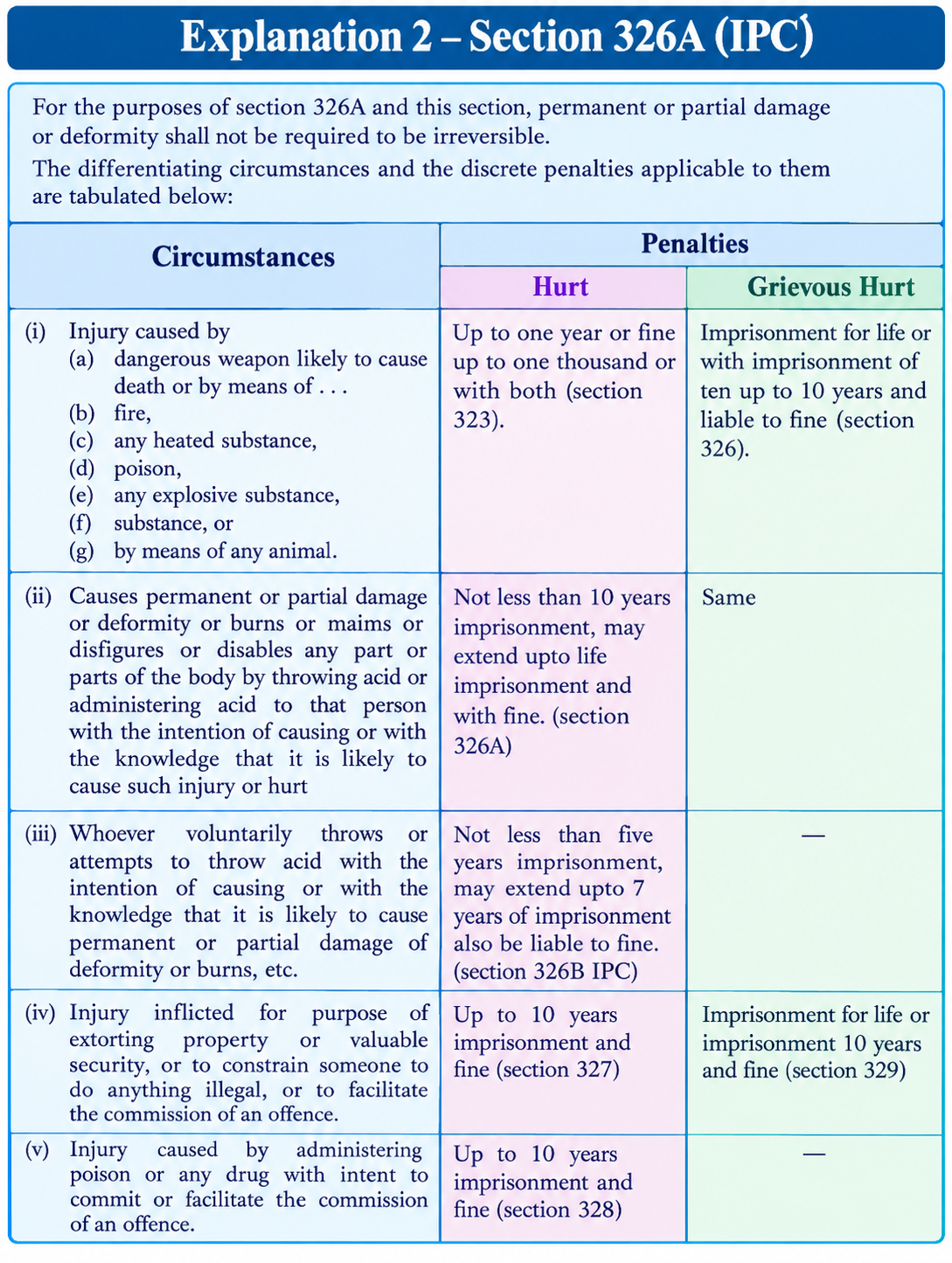
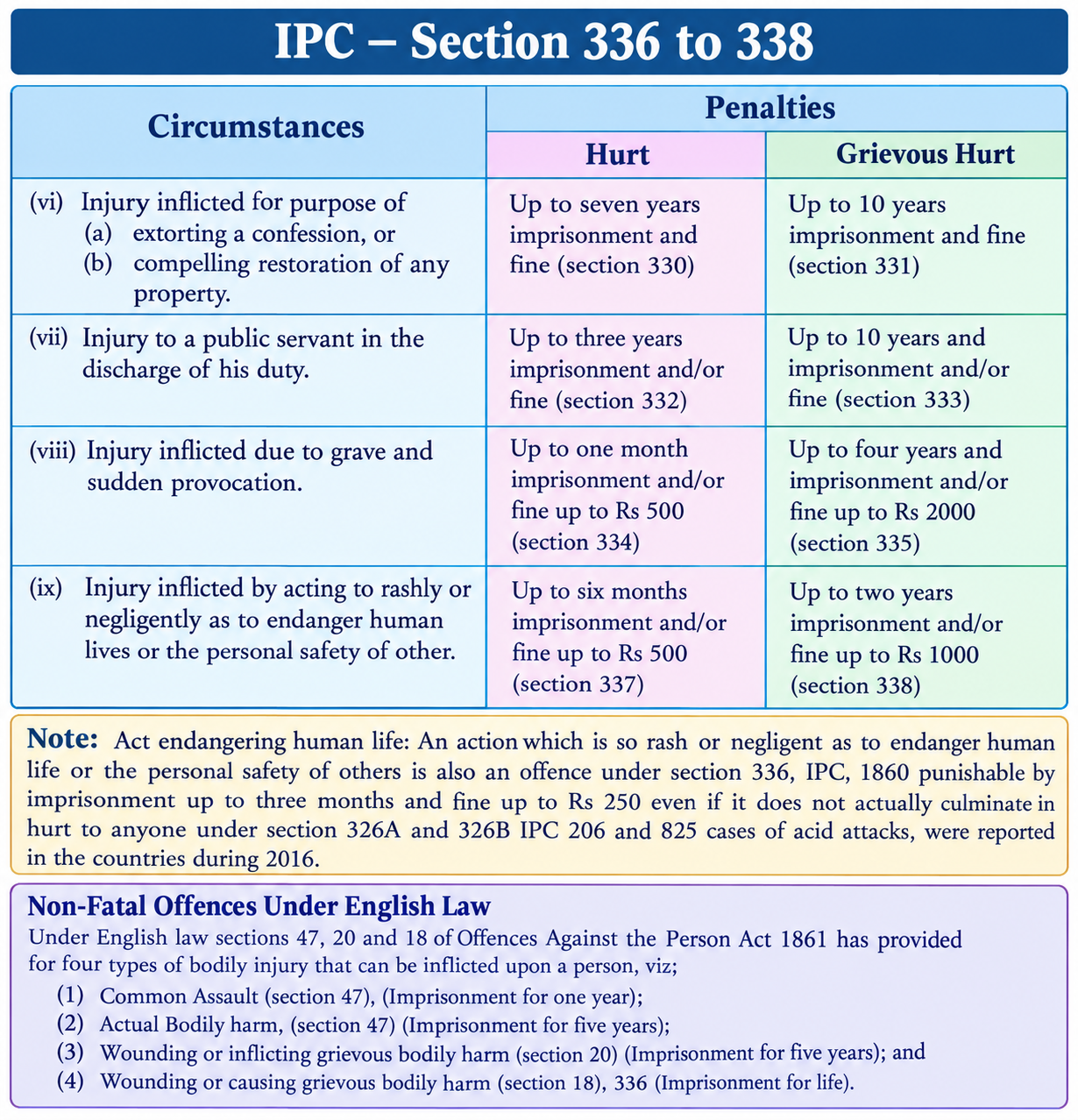
Under section 8.9.1 of the Indian Penal Code, Sections 324 through 338 outline aggravated forms of hurt and grievous hurt, establishing that offenses committed under severe circumstances carry much stiffer penalties.
Highlighting this legislative intent, the Criminal Law (Amendment) Act of 2013 introduced Sections 326A and 326B into the IPC to specifically combat acid attacks, with Section 326A penalizing the voluntary infliction of grievous hurt using acid with a rigorous minimum sentence of ten years extending to life imprisonment alongside a fine covering medical treatment, and Section 326B penalizing the mere act or attempt of throwing or administering acid with five to seven years of imprisonment and a fine.
Supported by a broad legal definition under Explanation 1—which defines acid as any substance of an acidic or corrosive nature capable of causing bodily injury or disfigurement—these provisions ensure that heinous acts of acid violence are met with uncompromising legal accountability.
Jashanmal Jhamatmal v Brahmanand Sarupanand
In the judicial decision of Jashanmal Jhamatmal v. Brahmanand Sarupanand, the court reviewed a case where the complainant’s wife suffered a severe nervous shock and fell seriously ill after the opponent confronted her in the dark by shouting and pointing a pistol to force her to vacate the premises.
Although the lower magistrate initially dismissed the complaint under the assumption that no physical hurt under Section 319 of the IPC, 1860, had occurred, Justice Sullivan set aside the discharge and held that the accused intentionally induced a state of acute fright and hysteria.
The court clarified that “infirmity” covers an unsound or unhealthy state of mind or body, meaning that temporary mental impairment, terror, or hysteria resulting from targeted intimidation constitutes legally recognized hurt under Section 319, with the severity determined by medical evidence.
Mohinder Singh v Emperor
In the judicial ruling of Mohinder Singh v. Emperor, the appellant had been sentenced under section 326 of the IPC to five years imprisonment and a fine after attacking Swaran Singh with a gandasa on August 22, 1922, which resulted in a severe calf wound and subsequent death from tetanus on September 3, 1922.
Justice Martineau held that the conviction under section 326 could not be sustained because the leg wound itself was not dangerous to life, and death was directly caused by the onset of tetanus, while noting that the magistrate’s reasoning—classifying the injury as grievous based on the assumption that the victim would have been unable to walk for twenty days—was legally flawed, as the twenty-day threshold defined in section 320 applies exclusively when the victim survives for that duration rather than dying beforehand.
Consequently, the court altered the conviction to fall under section 325 of the IPC, highlighting that an injury proving fatal does not automatically mandate a higher or alternative homicide conviction without meeting the precise statutory definitions.
Marcelino Fernandes v State
In the judicial ruling of Marcelino Fernandes v. State, the facts trace back to April 15, 1969, when the appellants confronted a vendor named Venkatesh for selling them a fake gold ring for Rs 25, ultimately beating and kicking him on his way back from his shop.
During the altercation, the first appellant struck Venkatesh with a broken tile causing him to fall, and though he died within three hours due to traumatic shock from head injuries, medical evidence indicated the trauma could have resulted from either the beating or the fall itself, leading the court to hold that because there was no prior enmity, no proven intention to kill or inflict life-threatening harm, and insufficient evidence linking the appellants directly to the fatal head wound as opposed to the accidental fall, a conviction for culpable homicide under Section 304 Part II was legally unjustified.
Consequently, the court set aside the heavier charges and convicted the appellants solely for voluntarily causing hurt under Section 323 of the Indian Penal Code.
R v Ireland, R v Burstow
In the landmark House of Lords decision of R v Ireland, R v Burstow (1997), the court addressed whether malicious harassment—such as nocturnal silent telephone calls in Ireland and persistent stalking and abuse in Burstow—that leads to severe psychiatric illness can constitute assault and bodily harm under sections 18, 20, and 47 of the Offences Against the Person Act 1861.
Counsel for the appellants argued that psychiatric injury fell outside Victorian legislative scope and that physical force or direct contact was a mandatory prerequisite for assault, but rejecting these contentions, Lord Steyn and Lord Hope ruled that the 1861 Act is an “always speaking” statute that must be interpreted through modern scientific understanding, establishing that “bodily harm” is not restricted to flesh, skin, and bones but encompasses the nervous system and brain.
Consequently, the House of Lords dismissed the appeal, holding that recognizable psychiatric illness amounts to actual or grievous bodily harm, and that direct physical contact by an assailant is entirely unnecessary to establish criminal liability for assault.
Haystead v Chief Constable of Derbyshire
In the judicial ruling of Haystead v. Chief Constable of Derbyshire, the appellant appealed his conviction for assaulting a child after he punched a woman in the face while she was holding her 12-month-old baby, causing the infant to fall and strike his head on the floor.
The appellant argued that he could not be convicted of battery because he had no direct physical contact with the child, but the appellate court dismissed the appeal, holding that direct physical contact by the assailant is not a mandatory requirement for battery.
The court reasoned that the infant’s fall was the immediate and direct result of the punch dealt to the mother, making the act a reckless battery equivalent to using a weapon.
Muhammad Raft v Emperor
In the judicial ruling of Muhammad Raft v. Emperor, the appellant had been convicted under Section 304 Part II of the Indian Penal Code, 1860, and sentenced to seven years of rigorous imprisonment for causing the death of Habibullah following a minor dispute over a loan of ten annas.
On 10 March 1929, the appellant struck the victim on the neck from behind with a pen-knife, and although the victim survived for 15 days, he ultimately died from septic poisoning because the wound was initially handled with unwashed hands and bandaged with a dirty cloth, leading Justice Plowden to note that medical testimony established the wound was not inherently fatal and that the victim would have survived had sepsis not set in, meaning the evidence failed to prove the appellant intended or knew his act would cause death.
Consequently, the court ruled that while the homicide conviction could not be sustained, a knife wound to the neck falls squarely under clause Eighthly of Section 320 as an injury “dangerous to life” and thus constitutes grievous hurt, prompting the court to alter the conviction to Section 326 of the IPC for voluntarily causing grievous hurt with a dangerous weapon.
R v Wilson
In the legal case of R v. Wilson, the defendant was charged with assault occasioning actual bodily harm after burning his initials onto his wife’s buttocks with a hot knife at her explicit request and instigation.
Although the branding was discovered by a doctor during a routine examination and reported to the police, the Court of Appeal dismissed the charges, holding that body modification activities such as tattooing and branding are lawful when executed with the informed consent of an adult, acting as a recognized exception to the principle that consent cannot legalize intentional harm.
Furthermore, Justice Russell LJ emphasized that consensual private acts between a husband and wife inside their home are inappropriate matters for criminal investigation and prosecution.
Director of Public Prosecutions v Smith
In the judicial ruling of Director of Public Prosecutions v. Smith (Michael Ross), the defendant cut off a substantial portion of his sleeping ex-partner’s hair with kitchen scissors without her consent, resulting in a charge under section 47 of the Offences Against the Person Act 1861.
Although the trial court initially acquitted the defendant on the grounds that hair is dead tissue and caused no skin bleeding or bruising, the Queen’s Bench Division allowed the appeal and convicted the accused.
The appellate court established that hair—whether living beneath the skin or dead tissue above it—forms an essential attribute of the human body and individual identity, meaning that non-trivial, unauthorized cutting constitutes actual bodily harm even in the absence of physical pain or skin trauma.
WRONGFUL RESTRAINT
Under Sections 339 and 340 of the Indian Penal Code, wrongful restraint and wrongful confinement establish clear legal boundaries regarding personal liberty of movement.
Wrongful restraint occurs when a person is voluntarily and unlawfully obstructed from proceeding in a direction they have a right to go—punishable under Section 341 with up to one month of imprisonment or a fine—whereas wrongful confinement takes place when an individual is completely restricted within a circumscribed boundary, such as a locked room or an area guarded by threats of violence.
Furthermore, physical barriers are not strictly required since psychological intimidation and credible threats can effectively produce the apprehension necessary to constitute wrongful confinement, which carries a more severe punishment under Section 342 of up to one year imprisonment.
Regina O'Brien v Independent Assessor
In Regina O’Brien v Independent Assessor, the House of Lords addressed how compensation under section 133 of the Criminal Justice Act 1988 should be calculated for individuals whose murder convictions were quashed after decades of wrongful imprisonment, upholding the principle that deductions for un-incurred living expenses like food and board are necessary to reflect actual pecuniary loss.
Transitioning to statutory criminal definitions, Section 351 of the Indian Penal Code establishes that an assault occurs when someone makes a gesture or preparation that causes another person to reasonably apprehend the use of criminal force.
Although spoken words alone do not legally qualify as an assault, accompanying words can contextualize actions and gestures—such as lifting a fist or brandishing a weapon—to successfully establish a punishable assault offense under Section 352.
R v O'Brien
In R v. O’Brien, the accused faced charges of uttering death threats during a phone call from jail, but was acquitted because the complainant testified she did not take the statements seriously.
Although the Crown appealed up to the Supreme Court of Canada, the appeal was dismissed by a 4 to 3 majority, with Justice Fish affirming that the trial judge correctly identified a reasonable doubt regarding the accused’s subjective intent to cause fear, contrasted against the dissenting view that a reasonable person’s standard should override the victim’s personal perception.
Transitioning to statutory protections under Section 354 of the Indian Penal Code, using criminal force or assault with the intent to outrage a woman’s modesty is a serious offense punishable by up to two years imprisonment, a framework further reinforced by judicial stance that reducing such sentences merely because an offender has no prior record is detrimental to public interest.
State of MP v Bablu
In the judicial ruling of State of MP v Bablu, the Supreme Court addressed the vital principle that criminal sentencing must account for social order and public interest, particularly in cases involving crimes against women and moral turpitude.
Although the trial court originally sentenced the accused to six months of rigorous imprisonment and a fine of Rs 500 for outraging a woman’s modesty, the High Court had casually reduced the punishment to time already served solely because he was a first-time offender.
The Supreme Court firmly set aside the High Court’s order, ruling that showing unmerited leniency or relying merely on the lapse of time is counter-productive, weakens legal deterrence, and emboldens offenders, thereby affirming that penalties must remain strictly commensurate with the gravity of the offense to protect both victims and society.
Chaitu Lal v State of Uttarakhand
In the case of Chaitu Lal v State of Uttarakhand, Justice N. V. Ramana addressed an appeal arising from the High Court of Uttarakhand at Nainital, which had previously upheld the judgment of the Sessions Judge of Chamoli convicting the accused under Section 354 and Section 511 read with Section 376 of the Indian Penal Code.
Reflecting the seriousness of these criminal acts, the court affirmed the sentence requiring the accused to serve one year of rigorous imprisonment for outraging a woman’s modesty under Section 354 IPC, alongside two years of rigorous imprisonment and a fine of Rs. 200 for the attempt to commit rape under Section 511 read with Section 376 IPC.
8.11.1 favouritism at work place is Sexual Harassment
The provided texts outline comprehensive legal and administrative frameworks designed to safeguard women against indecency, harassment, and assault, beginning with DoPT guidelines that categorize implicit or explicit workplace employment threats and promises of preferential treatment as sexual harassment across expansive definitions of professional environments.
To combat growing criminality, the Criminal Law Amendment Act introduced specific penal provisions such as Section 354B for assault with intent to disrobe, Section 354C penalizing voyeurism when observing or capturing images during private acts, and Section 354D criminalizing physical and electronic stalking.
Furthermore, Section 509 reinforces these protections by penalizing words, gestures, or intrusions intended to insult a woman’s modesty or privacy, ensuring that both individual rights and public decency are rigorously upheld by the law.
State of Punjab v Major Singh
In the landmark case of State of Punjab v Major Singh, Justice Mudholkar addressed whether an offense against a 7.5-month-old child—who suffered vaginal injuries through fingering—constituted outraging a woman’s modesty under Section 354 IPC rather than mere physical hurt under Section 323.
The Supreme Court firmly rejected the argument that a victim must consciously experience outrage, noting that such a subjective requirement would unjustly exclude infants, sleeping or unconscious persons, and those incapable of reaction, and instead established that the true legal test is objective: any act that is clearly suggestive of sex according to common societal standards falls within the scope of the provision.
Concluding that the accused’s deliberate actions carried the requisite intent to outrage modesty, the Supreme Court allowed the State’s appeal, altered the conviction to Section 354 IPC, and sentenced the offender to six months of imprisonment.
Ram Das v State of WB
In the legal case of Ram Das v State of WB, the accused faced charges under Section 354 IPC after removing his trousers to get comfortable on a night train journey, an act that provoked a heated argument and a push directed at one of the female passengers.
The court ruled that stripping down to undergarments for travel comfort is a natural preparatory act from which no criminal intention can be automatically inferred, establishing that ordinary travel routines cannot be misconstrued as criminal offenses without clear proof of wrongful intent.
Because there was no evidence of explicit gestures or proof that the accused intended or knew he would outrage the women’s modesty, the court held him not liable.
8.11.2 Indecent Assault under English Law
Under English law, the framework governing indecent assault diverges significantly from Indian legislation by being entirely gender-neutral, allowing women as well as men to be held criminally liable for committing assaults against either men or women under sections 14 and 15 of the Sexual Offences Act with penalties extending up to 10 years of imprisonment.
This legal framework encompasses both physical battery and psychological assault without touching, establishing that while psychic assault requires the victim’s conscious awareness of the indecency, battery does not strictly necessitate proof of the victim’s immediate realization.
Furthermore, as illustrated by the case Beal v Kelley, an act of physical force does not need to be inherently indecent on its own, provided it occurs within or is accompanied by circumstances of indecency—such as when an accused physically grabs a person after an unwelcome sexual proposition—thereby fulfilling the criteria for an indecent assault.
8.11.3 Indecent assault under Indian Penal Code
The text critiques current limitations within the Indian Penal Code, arguing for the introduction of a dedicated, gender-neutral provision for “indecent assault” modeled after English legislation to ensure that perpetrators who currently slip through legal loopholes do not go unpunished.
Asserting that existing laws are insufficient, the author proposes that the new provision should apply equally whether the offender or victim is a man or a woman, carrying penalties significantly more stringent than ordinary assault.
Specifically, the draft provision dictates that anyone committing an indecent assault against a woman or a man should face imprisonment extending up to five years, a fine, or both, thereby addressing a critical need for comprehensive legal reform in India.
8.12 Kidnapping and Abduction
The provided texts outline the legal architecture governing kidnapping and abduction under Sections 359 to 369 of the Indian Penal Code, 1860, designed to safeguard minors and persons of unsound mind while protecting the rights of lawful guardians.
The code distinguishes between kidnapping from India and kidnapping from lawful guardianship, alongside abduction, which carries penalties of up to seven years of imprisonment and fines under Section 363, supported by extensive NCRB statistics highlighting thousands of reported cases annually across various Indian states and cities.
Furthermore, clarifying judicial interpretations establish that if a minor joins an accused completely on their own initiative, the essential legal element of “taking” from guardianship is absent, resulting in the setting aside of a kidnapping conviction.
S Varadarajan v State of Madras
In the landmark case of S Varadarajan v State of Madras, the Supreme Court evaluated an appeal against a conviction under Section 363 IPC for kidnapping, where a minor girl named Savitri had voluntarily left her guardian’s house, telephoned the appellant to meet her, and insisted on marrying him.
The court observed that active “taking” or enticement by the accused is a mandatory legal ingredient of kidnapping under Section 361 IPC, and because Savitri had reached an age of discretion, was nearing majority, and accompanied the appellant entirely of her own free will without any threats, force, or active persuasion on his part, the court ruled that the appellant had not “taken” her out of her lawful guardian’s keeping.
Emphasizing that the law does not obligate an individual to reject a minor’s voluntary companionship or escort her back home, the Supreme Court set aside the conviction and allowed the appeal.
Thakorlal D Vadgama v State of Gujarat
In the case of Thakorlal D Vadgama v State of Gujarat, the court examined whether a minor’s voluntary decision to go to the accused serves as a valid defense against a charge of kidnapping under Section 361 IPC.
The judiciary analyzed the statutory terms “takes” and “entices” to determine the distinction between physical control and inducement.
Building upon the principles established in Varadarajan’s case, the court ruled that while an accused is not guilty of kidnapping if a minor leaves home entirely uninfluenced by any external promises or offers, the defense of voluntary departure fails if the accused previously laid a foundation of allurement, threats, or subtle inducement that influenced the minor to abandon their guardian’s custody.