
Attempts to Commit Offences (in General)
Under section 6.4.2.1, Section 511 serves as the general residual provision of the Indian Penal Code, 1860, criminalizing attempts to commit offenses punishable with imprisonment where no express statutory section exists elsewhere in the Code.
Offenders convicted under Section 511 face up to one-half of the maximum term of imprisonment prescribed for the completed crime, though the provision explicitly excludes minor offenses punishable solely by fine.
Statutory illustrations demonstrate that factual impossibility—such as reaching into an empty pocket or breaking into an empty jewel box—does not negate criminal liability, as performing an overt step toward commission establishes guilt.
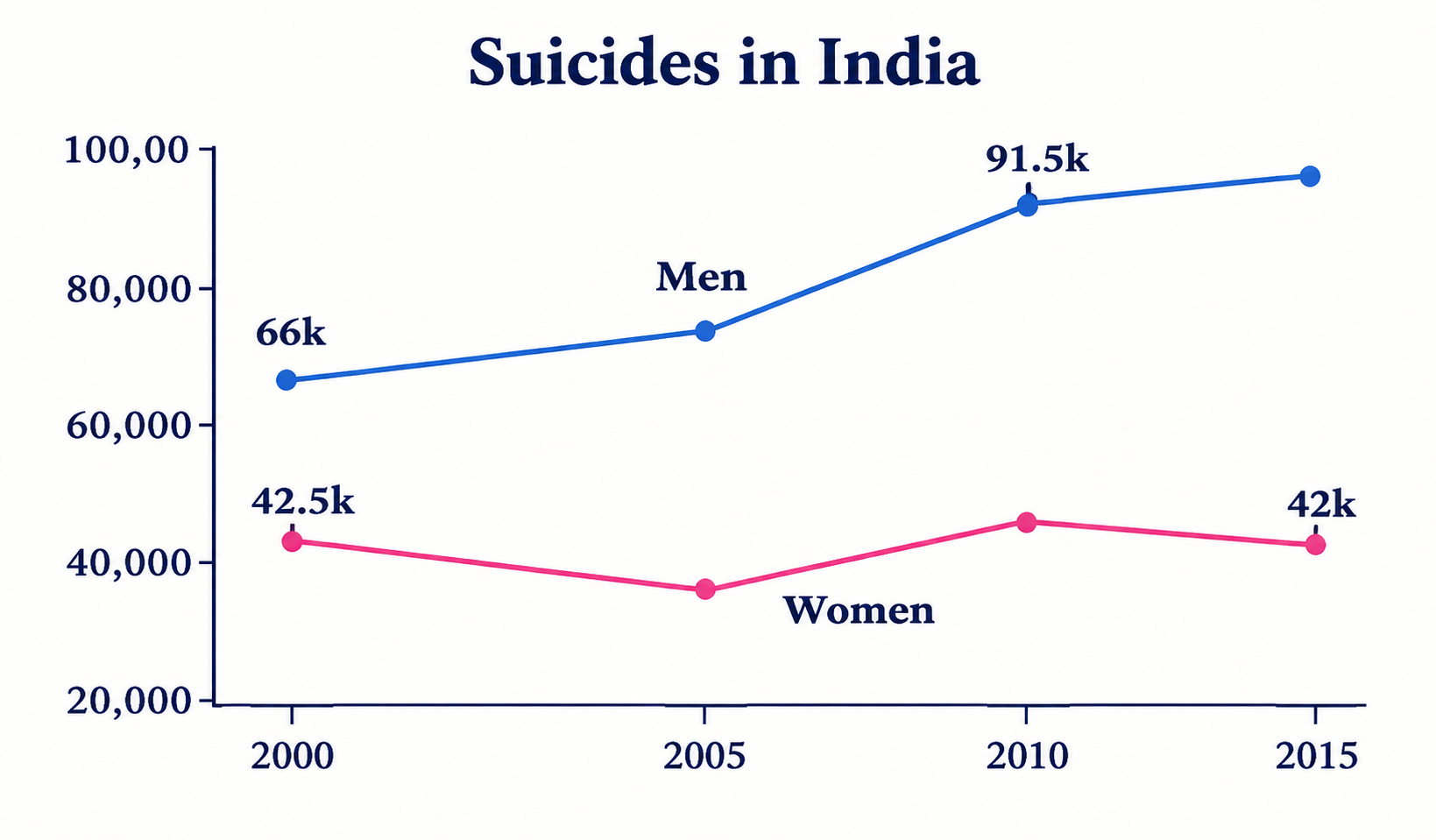
Additionally, the text contextualizes societal harm by presenting public health statistics from the Central Bureau of Health Intelligence and WHO, noting that suicide deaths in India increased significantly between 2000 and 2015, with young adults and individuals aged 18 to 45 accounting for over 66% of total cases.
Abhayanand Mishra v State of Bihar
In the landmark case of Abhayanand Mishra v. State of Bihar, the Supreme Court of India examined the boundary between non-punishable preparation and an actionable criminal attempt under Section 420/511 of the IPC.
The appellant submitted forged degree and teaching certificates to Patna University to obtain permission and an admit card to sit for the MA English examination, but was exposed before taking the test.
Justices Raghubar Dayal and K. Subba Rao held that while preparing the false application constituted mere preparation, dispatching it to the university was an overt act of deception that officially crossed into a criminal attempt.
The Court affirmed that an attempt under Section 511 IPC does not need to be the immediate or penultimate step prior to completion, but simply an intentional act performed during the execution of the offense.
Because the appellant successfully deceived the university into issuing an admit card and failed to complete the fraud solely due to an external discovery beyond his control, the Supreme Court dismissed the appeal and upheld his conviction for attempting to cheat.
State of Maharashtra v Mohd Yakub
In State of Maharashtra v. Mohd Yakub, the Supreme Court of India addressed the distinction between preparation and criminal attempt within the context of economic offenses under the Customs Act, 1962 and the Foreign Exchange Regulation Act, 1947.
The trial court initially convicted the accused of attempting to smuggle silver out of India, but the Sessions Court and High Court acquitted him, reasoning that transporting silver to a creek amounted to mere preparation rather than a direct act toward export.
Reversing the acquittal, Justices Sarkaria and O. Chinnappa Reddy held that but for the intervention of law enforcement officers who intercepted the vehicles at the creek, the unlawful export would have been completed.
The Court emphasized that because smuggling harms public revenues, foreign exchange, and economic stability, “attempt” must be interpreted broadly enough to encompass deliberate movements of contraband to a place of embarkation that are reasonably proximate to execution.
Consequently, the Supreme Court set aside the acquittal, contrasting such direct execution interrupted by authorities with the doctrine of locus poenitentiae, where an actor voluntarily retains the opportunity to repent and abandon the crime prior to enforcement intervention.
Malkiat Singh v State of Punjab
In Malkiat Singh v. State of Punjab, the Supreme Court of India addressed the boundary between preparation and criminal attempt regarding regulatory export offenses.
The appellant, a truck driver carrying paddy without a licence in violation of the Punjab (Export) Control Order, 1959, was intercepted 14 miles inside the Punjab-Delhi border and initially convicted for an attempt to illegally export the goods.
Reversing the conviction, the Supreme Court established that an act constitutes mere preparation if the overt steps taken would remain completely harmless should the actor voluntarily change their mind and stop.
Because the truck was still 14 miles away from the border, the offense was far removed from completion, leaving the driver ample time and opportunity to desist.
The Court clarified that proximity is evaluated in relation to intention rather than strictly time and space, requiring the act—viewed within its surrounding circumstances—to reveal the criminal intent with reasonable certainty.
Emphasizing that this test depends on specific facts rather than serving as a general rule to excuse last-minute interceptions, the Supreme Court allowed the appeal and set aside the conviction.
Madan Lal v State of J&K
In Madan Lal v. State of J&K, the Supreme Court of India evaluated the distinction between mere preparation, outraging modesty, and an attempt to commit rape under Section 376 read with Section 511 of the IPC, 1860.
The appellant, a middle school headmaster, was charged with attempting to rape his student.
Although the Sessions Court acquitted him based on discrepancies in witness statements, the High Court reversed the acquittal and restored his conviction.
Delivering the judgment, Justice G.B. Pattanaik held that the difference between preparation and attempt lies chiefly in a greater degree of determination to execute the offense.
The Court clarified that where an accused strips a victim, forces her to the ground, undresses himself, and engages in direct sexual contact but fails to achieve penetration, the act cannot be reduced to simple assault under Section 354 IPC; rather, such explicit conduct clearly establishes an attempt to commit rape under Section 376/511 IPC.
Finding the conviction fully justified by the facts, the Supreme Court dismissed the appeal.
Regina v Shivpuri
In the landmark House of Lords ruling Regina v Shivpuri, the court established that factual impossibility does not excuse an individual from criminal attempt liability under section 1(1) of the Criminal Attempts Act, 1981.
The appellant, Shivpuri, was convicted for attempting to handle and harbour illegal heroin, though the substance in his possession turned out to be harmless vegetable powder akin to snuff.
In dismissing his appeal, the House of Lords overruled its previous decision in Anderton v Ryan, rejecting the doctrine that “objectively innocent acts” could not constitute an attempt.
The court held that because the appellant possessed the requisite guilty intent—believing the substance to be a prohibited drug—and took steps beyond mere preparation by delivering the package, he was fully liable for a criminal attempt despite the factual impossibility of completing the substantive offense.
Reg v Smith (Roger)
In Reg v Smith (Roger), the House of Lords considered whether a person could be convicted of attempting to handle stolen goods when those goods had already been recovered by law enforcement.
Police officers intercepted a van carrying stolen goods and subsequently monitored the vehicle as it proceeded to a service area, where the respondent arranged for the future disposal of the property.
Although the respondent was initially convicted under Section 22(1) of the Theft Act, 1968, the Crown acknowledged that because the goods were in police custody, they legally ceased to be “stolen goods” under Section 22(3) of the Act.
In dismissing the Crown’s appeal against acquittal, the House of Lords held that an offense of handling or attempting to handle stolen goods requires that the goods actually remain stolen at the time of the act.
The Court established that an objectively lawful act cannot be rendered criminal under attempt law merely because the accused mistakenly believed the goods were still stolen.
Lucus v The Queen
In Lucas v The Queen, the High Court of Australia (per Barwick CJ, Owen, and Walsh, JJ.) considered an application for leave to appeal following the appellant’s conviction in the Supreme Court of the Northern Territory for the attempted murder and attempted rape of a seven-year-old child.
The appellant had been sentenced to concurrent terms of imprisonment with hard labour for seven and five years, respectively.
On appeal, the defense argued an absence of intent and pleaded insanity, asserting that excessive consumption of methylated spirits induced a state of delirium tremens and impaired his comprehension of events.
In dismissing the appeals and refusing to reduce the sentences, the High Court held that voluntary severe intoxication alone does not satisfy the legal threshold for insanity without evidence of an actual mental disease or disorder that rendered the accused incapable of understanding the nature or quality of his actions.
Because no medical evidence was presented to establish such a mental disease, the Court confirmed that the defense failed and ruled that the concurrent sentences imposed were entirely appropriate given the severity of the offenses.
Munah Binte Ali v Public Prosecutor
In Munah Binte Ali v. Public Prosecutor, the Court of Appeal of Malaysia addressed whether a person can be convicted under Section 312 read with Section 511 of the Penal Code for attempting to cause a miscarriage when the target individual is not actually pregnant.
The accused inserted an instrument into a woman’s vagina intending to induce an abortion, unaware that the woman was not pregnant, making completion of the act factually impossible.
Writing for the majority, Justices Whyatt and Good dismissed the appeal and held that Section 511 extends liability to acts performed toward committing an offense even when full commission is thwarted by an unknown, independent factual circumstance.
Drawing a direct parallel to the classic statutory illustration of a pickpocket reaching into an empty pocket, the majority affirmed that proof of actual pregnancy is unnecessary for an attempt charge if the accused held the requisite intent and acted on the belief that the condition existed.
Although Chief Justice Thomson dissented—arguing that Section 312 strictly requires the presence of products of conception—the majority upheld the conviction, establishing that factual impossibility does not negate criminal attempt liability.
6.5 Attempt to Murder and Attempt to Commit Culpable Homicide
Sections 307 and 308 of the Indian Penal Code, 1860 govern attempt to murder and attempt to commit culpable homicide, establishing severe statutory penalties distinct from the general attempt framework under Section 511.
Under Section 307, any overt act done with the intention or knowledge that would make a resulting death murder is punishable by up to ten years’ imprisonment, escalating to life imprisonment (or the death penalty for life convicts) if physical hurt is caused.
The statutory illustrations explicitly mark the boundary between preparation and execution: purchasing a weapon or mixing poison in private constitutes non-punishable preparation, whereas pulling the trigger or placing poisoned food within reach of the target constitutes an actionable attempt.
Similarly, Section 308 penalizes acts that would result in culpable homicide not amounting to murder—such as an attack launched under grave and sudden provocation—punishable by up to three years’ imprisonment, or seven years if hurt is inflicted.
Classified as cognizable, non-bailable, and non-compoundable offenses, both provisions focus on the offender’s state of mind and direct execution steps, ensuring that dangerous preliminary actions aimed at human life are strictly penalized regardless of whether the ultimate harm occurs.
Re Maragatham
In Re Maragatham, the Madras High Court (per Justices Anantanarayanan and Ramaswami) evaluated the impact of an intervening accidental event on criminal causation and liability under Section 307 of the Indian Penal Code.
Destitute and starving, a husband and wife tied themselves together carrying their one-and-a-half-month-old infant and jumped into a well to end their lives.
Although a passerby rescued both parents, the infant slipped during the rescue effort and drowned.
The trial court convicted the parents of murder under Section 302 read with Section 34 IPC, but the High Court modified the conviction to attempt to murder under Section 307 IPC.
The Court reasoned that while both mens rea and actus reus were established past the point of preparation, the child’s accidental fall during the rescue constituted an independent intervening event that snapped the chain of direct causation.
Consequently, because the parents’ initial act was not the direct causa causans of the child’s drowning death, they could not be convicted of completed murder, but remained fully liable for attempted murder.
State of AP v M Narasimha Rao
In State of AP v M Narasimha Rao, the Supreme Court of India (per Harjit Singh Bedi, J.) addressed the doctrine of transferred intent and mistaken identity in a murder prosecution.
Following a prior family dispute, the accused arrived at midnight armed with a knife intending to kill PW3, but instead inflicted fatal knife blows on PW3’s father, who was sleeping on the verandah in his son’s place.
The High Court had acquitted the accused, but the Supreme Court set aside the acquittal, ruling that ignoring clear, credible eyewitness accounts from family members corroborated by medical evidence showing face and neck cut injuries would result in a travesty of justice.
Clarifying that minor, explained delays in police filings do not undermine unimpeachable eyewitness testimony, the Supreme Court held that attacking the wrong individual under a mistaken identity retains full criminal culpability for murder under Section 302 of the IPC, sentencing the respondent to life imprisonment.
6.6 ATTEMPT TO COMMIT SUICIDE
Section 309 of the Indian Penal Code, 1860 governs the attempt to commit suicide, defining it as an offense when an individual attempts to end their own life and performs an overt act toward the execution of that attempt.
Under this provision, an overt step taken in furtherance of self-destruction crosses the threshold into criminal liability, punishable by simple imprisonment for a term extending up to one year, a fine, or both.
6.6.1 Introduction
Section 6.6.1 outlines the underlying rationale and legal Framework governing suicide under the Indian Penal Code, 1860.
Suicide itself is not legally classified as a crime because a successful act leaves no living offender to prosecute; consequently, criminal liability attaches only when an individual fails in the attempt.
This statutory penalization is grounded in the principle that human life is valuable to the individual, the family, and the State, imposing an obligation on the government to prevent individuals from taking their own lives just as it prevents them from harming others.
While English common law historically punished successful suicides posthumously through estate forfeiture, England later abrogated all rules criminalizing suicide and its attempt under the Suicide Act of 1961, highlighting the evolving legal treatment of self-harm across jurisdictions.
6.6.2 An Attempt to Commit Suicide—Meaning
Section 6.6.2 examines the legal meaning and requisite elements of an attempt to commit suicide under Section 309 of the Indian Penal Code, 1860.
An attempt under this section requires an overt act directed toward ending one’s own life, such as drowning, shooting oneself, or taking poison; for example, if an individual jumps into a well intending to commit suicide and is rescued, the physical act satisfies the statutory criteria for an attempt.
Because the legal essence of suicide is intentional self-destruction, acts resulting from accidental poison overdoses, severe intoxication, or evasion of pursuers fall outside the scope of Section 309 due to the absence of deliberate suicidal intent.
Furthermore, legal commentary emphasizes a humane perspective, observing that individuals driven to self-harm by acute emotional distress, family discord, or personal tragedy warrant sympathy, consolidation, and care rather than punitive criminal sanctions.
6.6.3 Euthanasia (Mercy Killing)
Section 6.6.3 explores the legal and conceptual framework of euthanasia, derived from the Greek words eu (“good”) and thanatos (“death”), which refers to the painless termination of life to relieve incurable suffering.
The text categorizes euthanasia into three distinct forms: voluntary (at the explicit request of the patient), non-voluntary (where the patient lacks the mental capacity to make an informed decision), and involuntary (where life is terminated without the individual’s request).
While popularly viewed as any end-of-life intervention by physicians, the strict definition requires a voluntary, explicit, and repeatedly expressed consent from the patient.
Jurisdictions such as Netherlands and Belgium have legalized euthanasia under defined legal standards, such as those established by the Dutch Government Commission on Euthanasia in 1985, which defines it as the deliberate and active termination of a patient’s life by a doctor upon the patient’s explicit request.
Ramchandra Shanbaug v Union of India
In the landmark case Aruna Ramchandra Shanbaug v. Union of India, the Supreme Court evaluated the constitutional and legal validity of euthanasia within Indian criminal jurisprudence.
The petition, brought under Article 32 by journalist Pinki Virani as “next friend,” detailed the harrowing condition of Aruna Shanbaug, a KEM Hospital nurse who suffered severe hypoxic brain damage after a brutal sexual assault and strangulation in 1973.
Reduced to a Persistent Vegetative State (PVS) for 36 years without conscious awareness, speech, or sensory faculties, the petitioner prayed for an order directing the hospital to cease mandatory feeding and allow her to die peacefully.
Delivering the judgment, Justice Katju reflected on the profound existential dilemma before the judiciary, ultimately dismissing the prayer for active life termination.
The Supreme Court ruled that active euthanasia (mercy killing) remains illegal under Indian penal law, amounting to murder under Section 302 or culpable homicide under Section 304 of the IPC, while physician-assisted suicide constitutes abetment to suicide under Section 306 IPC.
Common Cause (A registered Society) v UOI
In Common Cause (A registered Society) v. Union of India, a five-judge Constitution Bench of the Supreme Court of India delivered a landmark judgment on March 9, 2018, legalizing passive euthanasia and recognizing the validity of Advance Medical Directives (“Living Wills”).
Reinterpreting Article 21 of the Constitution, the Court held that the fundamental right to live with dignity encompasses the right to die with dignity, relieving terminally ill patients and those in a Persistent Vegetative State (PVS) from unnecessary, artificially prolonged suffering.
To operationalize this right while guarding against potential abuse by relatives or medical practitioners, the Court instituted stringent procedural safeguards.
Under these guidelines, an adult of sound mind may voluntarily draft a Living Will signed before two witnesses and countersigned by a Judicial Magistrate of First Class (JMFC).
When enforced, the directive requires dual approval from both a hospital-level Primary Medical Board and a Collector-constituted Secondary Medical Board, alongside judicial inspection by the JMFC, ensuring a balanced synthesis of individual autonomy and state protection.
Comments
The commentary examines the philosophical, historical, and theological commentary surrounding the Supreme Court’s ruling on passive euthanasia.
Proponents of the judgment highlight historical traditions of dignified death, drawing upon Marcus Aurelius’s poetic reflections on self-determination in dying, Bhishma Pitamah’s exercise of Icchha Mrityu in the Mahabharata, and Socrates’ choice to maintain full conscious awareness until his final moments.
These classical perspectives assert that controlling one’s exit with dignity and awareness is far preferable to lingering at the mercy of terminal illness or medical machinery.
Conversely, religious organizations like the Kerala Catholic Bishops’ Council (KCBC) strongly oppose the verdict.
Led by President Soosai Pakiam, the council contends that God is the sole custodian of human life, arguing that terminating a person’s life—regardless of suffering, old age, or intent of mercy—remains morally unacceptable and incompatible with the sanctity of life.
6.6.3.1 Physician Assisted Suicide and Euthanasia Distinguished
Section 6.6.3.1 explores the international legal and ethical debate surrounding physician-assisted suicide and euthanasia (mercy killing) for terminally ill patients and individuals in a Persistent Vegetative State (PVS).
It focuses on whether an individual suffering from extreme pain, misery, and mental agony should have the right to terminate their life prematurely, and whether those assisting should face criminal prosecution for causing death.
Advocates argue that prolonging life in a PVS offers no meaningful benefit, while legal systems struggle to balance individual self-determination against state regulation.
This complex tension sets the foundation for landmark judicial rulings, such as the 1993 House of Lords decision legalizing the withdrawal of artificial life support for patients in a persistent vegetative state.
NHA Trust v Bland
In the landmark case Airedale NHS Trust v Bland, the UK House of Lords addressed whether withdrawing artificial life support from a patient in a Persistent Vegetative State (PVS) constitutes murder.
Anthony Bland, a victim of the 1989 Hillsborough Stadium disaster, suffered irreversible brain damage and was kept alive only through medical intervention.
With his parents’ agreement, the NHS Trust sought legal permission to discontinue feeding and life support.
Overruling the Official Solicitor’s appeal, the House of Lords held that the principle of the sanctity of life is not absolute when prolonged medical intervention provides no benefit to a patient in a PVS.
The Court established a critical legal boundary: while actively administering a lethal agent to end a patient’s life remains unlawful regardless of compassionate intent, withdrawing artificial life-sustaining treatment is lawful as it merely allows the underlying condition to take its course and respects the individual’s autonomy against unauthorized bodily intrusion.
R (Burke) v GMC
In the case R (Burke) v GMC, Justice Munby examined the scope of patient rights under the European Convention on Human Rights (ECHR), ruling that withdrawing Artificial Nutrition and Hydration (ANH) against a patient’s wishes violates Article 8.
The court affirmed that personal autonomy extends to choosing how one manages their final days and death.
Furthermore, dignity interests under Article 8 and Article 3 protect individuals from both unwanted medical interference and the withdrawal of care that would lead to avoidably distressing circumstances, establishing that a competent patient’s choice to receive life-sustaining treatment must be legally respected.
R v Cambridge Health Authority
In R v Cambridge Health Authority, the English judiciary addressed the ethical and administrative limits of state-funded healthcare when resource constraints conflict with an individual’s right to life.
Doctors refused to allocate GBP 75,000 for a second bone marrow transplant and chemotherapy for a 10-year-old girl suffering from acute myeloid leukemia, arguing that the low probability of success did not justify expending scarce public funds that could benefit other patients.
Although Justice John Laws in the lower court emphasized that the fundamental right to life should not be compromised by budget limitations, the Court of Appeal upheld the health authority’s discretion.
The appellate ruling established a key legal precedent confirming that courts cannot substitute their judgment for medical and resource allocation decisions made by health authorities managing limited public healthcare resources.
Comments
The commentary critique argues that the Court of Appeal’s ruling allowing state health authorities to withhold medical treatment based on financial constraints requires judicial review.
It highlights the growing danger that legal exceptions grounded in the “limited resources of the State” will be increasingly abused as medical costs escalate, potentially leading healthcare systems to deny necessary care to terminally ill or costly patients under the pretext of fiscal limitation.