
Criminal Breach of Trust
The legal framework of Criminal Breach of Trust under Section 405 of the Indian Penal Code, 1860, punishable under Section 406 IPC with up to three years’ imprisonment, a fine, or both.
Section 405 IPC establishes that the offense requires an initial lawful entrustment of property or control, wherein legal title remains with the transferor while the transferee holds mere custody bound by express contract, implied agreement, or legal direction.
The offense is completed when the transferee dishonestly misappropriates, converts, uses, or disposes of the property in violation of such trust or legal mandate.
Statutory Explanations 1 and 2 explicitly extend this principle to employer payroll deductions for Provident Fund and ESI accounts, deeming non-remittance of deducted employee contributions to be a dishonest conversion under the law.
Furthermore, Sections 407 through 409 IPC outline enhanced penalties of up to seven or ten years’ imprisonment for aggravated breaches committed by custodians, servants, bankers, merchants, agents, or public servants—a principle affirmed by the Supreme Court in 1956 regarding the unauthorized pledging of third-party securities under Section 409 IPC.
Jaswantrai Manilal Akhaney v. State of Bombay
In Jaswantrai Manilal Akhaney v. State of Bombay, the Supreme Court affirmed the conviction under Section 409 IPC of a bank managing director who re-pledged a customer’s overdraft security assets to a third party to secure a loan for his bank without the owner’s authorization or consent.
The Court held that re-pledging pledged property in direct contravention of a custodial contract establishes dishonest intent by intentionally causing wrongful loss to the rightful owners, as it deprives them of their property rights during the period of re-pledge.
Emphasizing a foundational principle of property offenses, the judgment clarifies that whether the resulting wrongful loss or deprivation of property is temporary or permanent is legally immaterial.
Complementing these fiduciary standards, established Supreme Court precedent from 1974 further reinforces that misappropriating property through falsified accounting entries similarly attracts criminal liability under Section 409 IPC.
Superintendent and Remembrancer of Legal Affairs, WB v. SK Roy
In Superintendent and Remembrancer of Legal Affairs, WB v. SK Roy, the Court affirmed the Section 409 IPC conviction of an insurance superintendent who improperly collected cash premiums from policyholders without authorization and misappropriated the funds after entering false entries in official registers.
The Court established that Section 409 IPC covers dishonest misappropriation regardless of whether the initial receipt of property was proper or unauthorized, provided the public servant gained control over the property by virtue of their official position.
Furthermore, establishing criminal breach of trust under Section 409 IPC requires proving dishonest conversion rather than a simple failure or omission to return property, as affirmed in Supreme Court precedent from 1977.
Sardar Singh v. State of Haryana
In Sardar Singh v. State of Haryana, the Court set aside the conviction under Section 409 IPC of a patwari who was entrusted with an official receipt book but failed to return it to his superior authorities.
The Court held that a mere failure, omission, or inability to produce or return entrusted government property does not automatically constitute criminal breach of trust, as the document might have been simply lost or misplaced.
To sustain a conviction under Section 409 IPC, the prosecution bears the affirmative burden of proving that the public servant dishonestly misappropriated, converted, or disposed of the property for personal benefit.
While gross nonfeasance or unjustified neglect by a public officer may constitute an abuse of public trust or misconduct under administrative standards, the absence of proven dishonest intention precludes criminal liability for breach of trust.
Attorney General’s Reference (No. 3 of 2003)
In Attorney General’s Reference (No. 3 of 2003), the court clarified the core ingredients of common law misconduct in public office, establishing that wilful failure or gross neglect of duty amounting to an abuse of public trust requires proving that the officer was aware of the duty or subjectively reckless toward its existence, rather than demonstrating bad faith or malicious intent.
Applying this principle to a case where police officers placed a head-injured detainee in a semi face-down position resulting in fatal asphyxiation after being assured by a doctor that he was fit for detention, the trial judge directed an acquittal due to insufficient evidence of subjective recklessness to sustain either manslaughter or misconduct charges.
Paralleling this restriction on extending public trust concepts into penal liability, the Indian Supreme Court held in 1999 (reversing its 1996 view) that a Minister’s administrative “power to allot” petrol outlets is a regulatory power rather than “property,” thereby ruling out criminal liability for Criminal Breach of Trust under Section 405 IPC for the improper exercise of discretionary allotment powers.
Common Cause, A Registered Society v. Union of India
In Common Cause, A Registered Society v. Union of India (1999), a three-judge Bench of the Supreme Court reversed its 1996 ruling that had held Minister Captain Satish Sharma personally liable for criminal breach of trust and levied Rs 50 lakh in exemplary damages for arbitrary petrol pump allocations.
The Supreme Court ruled that criminal liability must be strictly construed according to statutory definitions, holding that the broad “doctrine of trust” cannot be substituted for statutory ingredients under penal law.
The Court clarified that a Minister’s constitutional “power to allot” discretionary licenses is an executive function rather than “property” under Section 405 IPC, and that a Minister is not a legal “trustee” under trust law, thereby precluding charges under Sections 405 and 409 IPC regardless of whether the allotments were arbitrary or illegal.
Although criticized in legal commentary for weakening public accountability by overriding civil tort principles of misfeasance in public office established in decisions like Lucknow Development Authority and global comparative precedents (Roncarelli, Tynes, Samulla), the 1999 decision firmly established that administrative misfeasance or abuse of statutory discretion cannot be prosecuted as criminal breach of trust without the dishonest misappropriation of actual property.
Shiva Sagar Tiwari v. Union of India
In Shiva Sagar Tiwari v. Union of India, a Supreme Court advocate brought a public interest petition highlighting that Union Minister for Urban Development, Mrs. Shiela Kaul, had arbitrarily allotted government shops and stalls to her grandsons, domestic servants, friends, and staff relatives without establishing norms or competitive procedures.
In 1996, the Supreme Court held that the Minister was personally and politically accountable for such unconstitutional misuse of power, imposing Rs 60 lakhs in exemplary damages, canceling the allotments, and ordering a criminal investigation under IPC Sections 120B, 420, 468, and 471 alongside Sections 13(1)(d) and 13(2) of the Prevention of Corruption Act, 1988.
However, in 2002, the Supreme Court allowed a review petition that quashed the fine, citing compassionate grounds in light of the former Minister’s advanced age, ill health, and personal hardship.
N. Raghavender v. State of Andhra Pradesh
In N. Raghavender v. State of Andhra Pradesh, CBI, the Supreme Court, per Surya Kant, J., set aside the criminal conviction of a bank branch manager sentenced to five years’ rigorous imprisonment under IPC Sections 409, 420, and 477A alongside Section 13(2) read with Section 13(1)(d) of the Prevention of Corruption Act, 1988 for alleged unauthorized account overdrafts, premature FDR encashments, and cheque clearances benefiting his relative’s academy account.
Reversing the High Court judgment, the Apex Court established that where the prosecution fails to prove an actual pecuniary loss to the bank or its customers, or demonstrate a prior meeting of minds establishing criminal conspiracy, procedural irregularities and abuse of managerial power do not meet the statutory threshold of criminal breach of trust, cheating, or account falsification beyond a reasonable doubt.
However, emphasizing the strict legal distinction between the criminal evidentiary standard of proof beyond reasonable doubt and the administrative standard of preponderance of evidence, the Court clarified that granting the benefit of doubt does not entitle the officer to reinstatement or service benefits, leaving his departmental dismissal for gross administrative misconduct fully intact.
Receiving of Stolen Property
The statutory regime for Receiving Stolen Property under Sections 410 through 414 of the Indian Penal Code, 1860, establishing a wide definition under Section 410 IPC that classifies property transferred via theft, extortion, robbery, criminal misappropriation, or criminal breach of trust as “stolen property,” regardless of whether the predicate offense occurred within or outside India.
The statutory definition contains a crucial limiting proviso: if stolen property subsequently comes into the possession of a person legally entitled to its possession, its illegal status terminates, and it ceases to be stolen property under the law.
Penal provisions enforce a graded hierarchy based on the receiver’s culpability and the underlying offense: Section 411 IPC punishes dishonest receipt with up to three years’ imprisonment, Section 412 IPC elevates punishment up to life imprisonment for receiving property stolen during a dacoity, Section 413 IPC penalizes habitual dealers in stolen property with up to ten years’ imprisonment, and Section 414 IPC penalizes those assisting in the concealment or disposal of stolen assets with up to three years’ imprisonment.
As affirmed by the Supreme Court in 1954, establishing criminal liability across this framework strictly necessitates proving both actual or constructive possession and conscious knowledge of the property’s tainted origins.
Trimbak v. State of MP
In Trimbak v. State of MP, the Supreme Court quashed the conviction under Section 411 IPC of an accused who led police to recover stolen ornaments from an open field accessible to the general public, holding that recovery from an open, accessible site does not constitute conclusive proof of possession.
The Court clarified that the mere fact of pointing out a location is consistent with the hypothesis that a third party hid the property and the accused merely acquired knowledge of its whereabouts.
To secure a conviction for dishonestly receiving stolen property under Section 411 IPC, the prosecution bears the affirmative burden of proving three essential statutory ingredients: that the stolen property was in the actual possession of the accused, that prior possession rested with another person before transferring to the accused, and that the accused possessed conscious knowledge that the property was stolen.
Ajendra Nath v. State of MP
In Ajendra Nath v. State of MP, the Supreme Court, per Raghubar Dayal, J., upheld a conviction under Section 414 IPC against an accused involved in hiding stolen railway cargo consisting of woolen shawls and mufflers.
The Court established that securing a conviction under Section 414 IPC does not require the prosecution to first trace or convict the principal offender who committed the primary theft.
Instead, liability is established once the prosecution proves that the goods qualify as stolen property and that the accused actively rendered assistance in their concealment or disposal.
Where circumstantial evidence demonstrates that the accused was seen unloading bales into a house late at night, knew the precise locations of items divided and hidden throughout the premises, and attempted to sell portions of the stolen property prior to police recovery, such conduct satisfies the statutory ingredients of assisting in the concealment of stolen property under Section 414 IPC.
Cheating
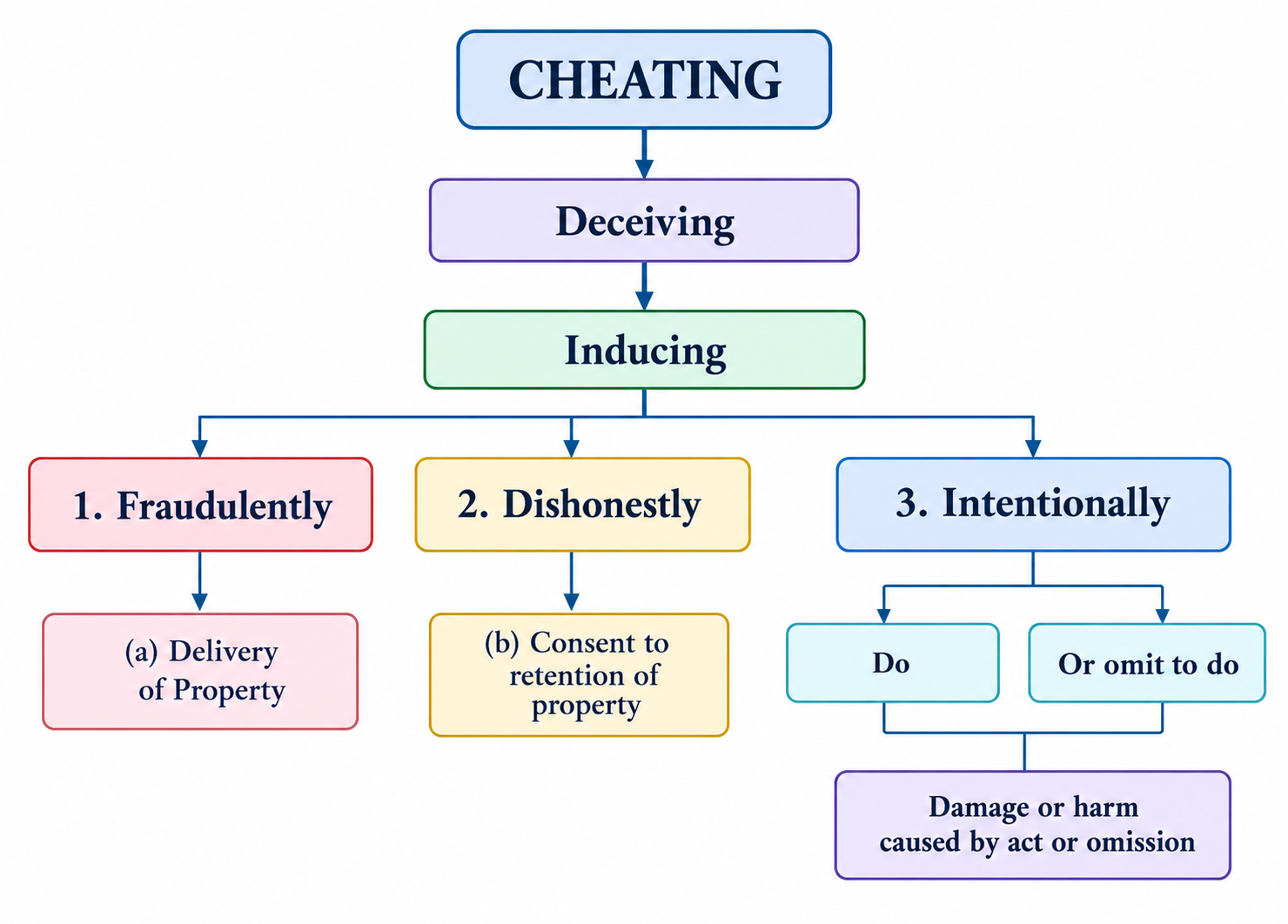
The comprehensive statutory framework governing Cheating under Sections 415 through 420 of the Indian Penal Code, 1860, defining Section 415 IPC through three distinct modalities involving deception, fraudulent or dishonest inducement, and the intentional causation of act or omission likely to cause harm in body, mind, reputation, or property.
The statutory scheme establishes that dishonest concealment of facts constitutes active deception, while Section 416 IPC penalizes cheating by personation—whether assuming the identity of a real, deceased, or imaginary person.
The legal framework enforces a clear hierarchy of penalties: Section 417 IPC punishes simple cheating with up to one year of imprisonment, Section 418 IPC penalizes breach of a fiduciary duty to protect against wrongful loss with up to three years’ imprisonment, Section 419 IPC targets impersonation, and Section 420 IPC serves as the primary aggravated offense—imposing up to seven years’ imprisonment and fine where deceit dishonestly induces the delivery of property or the creation, alteration, or destruction of a valuable security.
As affirmed by Supreme Court precedent from 1965, providing falsified names or qualifications to public service commissions to secure employment constitutes actionable deception under Section 419 IPC.
Kanumukkala Krishna Murthy v. State of AP
In Kanumukkala Krishna Murthy v. State of AP, the Supreme Court, per Raghubar Dayal, J., affirmed the conviction under Section 419 IPC of a doctor who impersonated another individual and falsely claimed an MBBS degree to secure a permanent appointment in the state medical service.
Rejecting the defense that ten years of satisfactory surgical service disproved any reputational harm or injury to the public service commission, the Court established that professional competence does not sanitize an initial fraud.
The Court held that deception under Section 415 IPC persisted throughout the hiring pipeline, deceiving the government into issuing an appointment order and disbursing salaries.
Because government salary constitutes “property” dishonestly obtained through misrepresentation of identity and qualifications, the act satisfies all statutory ingredients of cheating by personation under Section 419 IPC.
Bakhshish Singh Dhaliwal v. State of Punjab
In Bakhshish Singh Dhaliwal v. State of Punjab, the Supreme Court upheld the conviction under Section 420 IPC of an appellant who submitted fictitious financial claims and supply bills to the exile government for unperformed army contract work.
The Court held that submitting bogus claims contrary to true facts justifies a direct inference that the claimant possessed conscious knowledge of their falsity, thereby establishing the necessary element of dishonest inducement under Section 420 IPC.
Reinforcing this statutory scope, established Supreme Court precedent from 1999 further confirms that making fraudulent representations regarding divine healing powers to cure physical conditions like dumbness similarly constitutes cheating punishable under Section 420 IPC.
Sri Bhagawan Samardhan Sreepada Vallabha Venkata Vishwandadha Maharaj v. State of AP
In Sri Bhagawan Samardhan Sreepada Vallabha Venkata Vishwandadha Maharaj v. State of AP, the Supreme Court, per Thomas, J., affirmed the conviction under Section 420 IPC of an accused who extracted Rs. 1 lakh by claiming personal divine healing powers capable of curing a fifteen-year-old girl of congenital speech impairment.
The Court drew a clear legal distinction between offering prayers for the sick—which contains no element of fraud—and actively representing or inducing another to believe that one personally possesses supernatural or divine powers.
The Court held that where money or property is handed over pursuant to such representations and the promised result fails, the act constitutes fraudulent inducement under Section 415 IPC, entitling the court to presume the commission of cheating under Section 420 IPC and placing the burden on the accused to rebut the presumption.
Fraudulent Deeds and Disposition of Property
The legal framework under Sections 421 through 424 of the Indian Penal Code, 1860, targeting fraudulent dispositions of property aimed at frustrating creditors’ claims and causing wrongful loss.
Section 421 IPC penalizes the dishonest removal, concealment, or transfer of property without adequate consideration to defeat lawful distribution among creditors.
Section 422 IPC addresses preventing debts owed to oneself or others from being realized for creditor satisfaction.
Section 423 IPC criminalizes executing instruments with false statements regarding consideration or true beneficiaries.
Section 424 IPC functions as a broader penal provision against dishonest concealment, removal, or release of claims.
As affirmed by the Supreme Court in 1961, removing property that has been attached under a valid court order—even by its rightful owner—satisfies the ingredients of Section 424 IPC.
Teeka v. State of UP
In Teeka v. State of UP, the Supreme Court affirmed the convictions under Sections 424 and 447 read with Section 149 IPC of judgment debtors who forcibly entered a decree holder’s premises to retrieve cattle that had been seized under a civil court’s warrant of attachment.
The Court established that a valid court attachment by actual seizure instantly transfers legal possession from the owner to the court, rendering any third-party custodian or decree holder a mere bailee of the court officer.
Consequently, because legal possession vests exclusively in the court, an owner who forcibly retrieves attached property causes wrongful loss to the court and wrongful gain to himself under Section 23 IPC, thereby satisfying the requirement of acting “dishonestly” under Section 24 IPC for the purposes of Section 424 IPC.
The Court emphasized that an owner cannot resort to self-help or force to recover seized assets, as his sole legal remedy is to seek the discharge of the attachment through proper legal process in court.
Mischief
The statutory definition and penalty for Mischief under Sections 425 and 426 of the Indian Penal Code, 1860, defining the offense as any act committed with the intent or knowledge to cause wrongful loss or damage to the public or any person by destroying property, or altering its condition or situation in a manner that diminishes its value, utility, or affects it injuriously.
Explanation 1 clarifies that the offender need not specifically target the legal owner of the property, provided the act causes or is likely to cause wrongful loss to any person, while Explanation 2 confirms that mischief can be committed against property owned jointly or solely by the offender.
Section 426 IPC prescribes punishment of up to three months’ imprisonment, fine, or both for simple mischief.
Furthermore, as affirmed by judicial precedent, the offense strictly requires that the damaged property belong to a legal entity or the public; consequently, the destruction of unowned property (res nullius) does not attract criminal liability for mischief.
Nabin Chandra Gogoi v. State
In Nabin Chandra Gogoi v. State, the Court quashed the conviction under Section 429 IPC of an accused who shot and killed a wild rhinoceros, establishing key principles regarding statutory interpretation and the essential elements of mischief.
Applying the rule of ejusdem generis, the Court held that the phrase “or any other animal” following the specific enumeration of domestic animals in Section 429 IPC must be restricted solely to domestic or domesticated animals, thereby excluding wild animals like a rhinoceros.
Furthermore, because the overarching definition of mischief under Section 425 IPC strictly necessitates the destruction of or injury to “property,” the court held—relying on Romesh Chunder Sanyal v. Hiru Mondal—that killing an animal in which no person or entity possesses property rights (res nullius) does not constitute property destruction, and thus cannot attract criminal liability under Section 425 or Section 429 IPC.
Criminal Trespass
The Indian Penal Code comprehensively addresses the offense of criminal trespass and its aggravated variants under Sections 441 through 462.
This statutory regime establishes the foundational parameters for prosecuting unauthorized entries onto property, setting the stage for specific definitions of criminal trespass, house trespass, lurking house-trespass, and house-breaking alongside their respective punishments.