PUNISHMENT: MEANING, AIMS AND OBJECTS
Punishment is defined as a court-imposed legal sanction against an individual’s person or property for violating societal rules, designed to safeguard the public through deterrence, prevention, and rehabilitation.
Drawing upon ancient principles like Manu’s concept of danda as well as modern legal standards like Section 84 of the Indian Penal Code, criminal law recognizes that sentencing must not be uniform; rather, it varies based on an offender’s age, intent, mental capacity, and specific case circumstances.
While criminal jurisprudence grants judges discretion to adhere to the principle of proportionality, sentences must remain firm and reflective of the crime’s gravity, brutality, and public abhorrence, ensuring that misplaced sympathy toward perpetrators does not compromise the legal system.
Ultimately, by balancing deterrence with reform and adapting to evolving societal challenges, criminal law functions as the cornerstone of social order, preventing lawlessness and upholding public justice.
Section 7.2 Theories of punishment
The passage outlines section 7.2 on the theories of punishment, explaining that penalties are applied primarily to protect society by reducing illegal behavior.
It highlights three major approaches to addressing offenders: a punitive strategy that imposes strict sanctions on dangerous individuals, a therapeutic model that treats psychological causes, and a preventive model aimed at eliminating systemic conditions that foster crime.
While legal frameworks utilize deterrence, prevention, retribution, and reformation to safeguard the public, deterrence is considered the primary function of punishment, with all other objectives serving secondary roles.
7.2.1 Deterrent Theory
According to the Deterrent Theory of jurisprudence, the primary objective of punishment is to prevent recidivism by making an example of the offender to deter others with criminal tendencies, a concept jurist Salmond considered crucial for controlling crime.
Grounded in the hedonistic assumption that human behavior is guided by calculations of pleasure and pain, the theory aims to make committing crimes a “bad bargain” through the social utility of punitive measures.
Historically, this framework justified severe and disproportionate penalties—such as stoning or mutilation for minor theft and forgery in medieval England and Mogul-era India—and it remains central to penal codes in countries like Pakistan, Iran, Iraq, and Saudi Arabia today.
However, critics argue that the theory is often ineffective in curbing crime, as overly harsh or cruel punishments can evoke public sympathy for the offender, harden criminal mindsets, and fail to deter individuals who no longer fear imprisonment.
7.2.2 Preventive Theory
Under the Preventive Theory of punishment, the primary objective is to disable or incapacitate offenders to prevent them from repeating criminal acts in the future.
As noted by jurist Paton, this theory focuses directly on the individual prisoner through mechanisms such as imprisonment, forfeiture of office, exile, or the death penalty, all of which serve to neutralize the offender’s physical or legal ability to commit further offenses.
However, legal scholars criticize this approach because institutionalizing first-time or juvenile offenders alongside seasoned, hardened criminals can inadvertently corrupt vulnerable individuals, leading to deeper criminal tendencies rather than successful social reintegration.
7.2.3 Retributive Theory
The Retributive Theory of punishment originates from primitive societal practices where criminal justice was rooted in direct personal vengeance, governed by the lex talionis principle of “an eye for an eye”.
As Justice Holmes observed, early legal procedures were grounded in vengeance; however, in modern times, private revenge has been replaced by state-sanctioned retribution.
Advocates argue that State-imposed punishment acts as the official counterpart to personal retaliation, satisfying society’s and victims’ instinct for justice while preventing citizens from taking the law into their own hands through mob lynching or withholding court testimony.
Conversely, critics argue that inflicting pain upon an offender does not repair original harms and that legal punishment, being an evil in itself, cannot be justified solely through revenge unless it generates positive, constructive outcomes for society.
7.2.4 Reformative Theory
The Reformative Theory posits that the true purpose of criminal justice is moral reformation and societal reintegration, emphasizing that an offender retains their basic humanity regardless of their crime.
To achieve this, the theory advocates for prison-based vocational training, improved living conditions, and specialized judicial evaluation of an offender’s background, motives, and character.
However, legal scholars emphasize that a functional justice system cannot rely on reform alone; it must synthesize reformative principles with deterrence and proportionality.
While juvenile delinquents and first-time offenders benefit from lenient, treatment-focused approaches, courts must avoid imposing overly soft sentences on serious, economic, or white-collar crimes, ensuring that correctional efforts do not lead to nominal punishments that jeopardize public safety and social justice.
7.3 CAUSES OF CRIME
Modern jurisprudence has undergone a significant shift toward a humanitarian approach, viewing the offender as an integral part of society deserving of human dignity and sympathetic consideration rather than mere condemnation.
Guided by global human rights standards, contemporary legal systems emphasize looking at the specific individual rather than focusing strictly on the offense, tailoring sanctions to suit distinct categories such as juvenile delinquents, mentally abnormal persons, and first-time offenders versus recidivists.
Depending on the gravity and nature of the crime, the quantum of punishment ranges widely from a mild admonition to capital punishment.
Underlying these evolving penal practices is an ongoing interdisciplinary inquiry across law, sociology, and psychology to uncover why individuals deviate from established legal codes, driving scholars and jurists to propound diverse theories on the root causes of crime causation.
7.3.1 Pre-scientific Theories: Diabolical Criminal Conduct
The pre-scientific theory of diabolical criminal conduct represents the earliest explanation for crime, attributing unlawful behavior to individuals succumbing to the allurements of evil spirits.
Flourishing across primitive, oriental, and medieval societies, this framework viewed offenders as spiritually possessed, leading to punishments aimed at either exorcising the entity or enforcing “social death” through banishment or execution to protect the community and appease divine forces.
A classic historical manifestation of this mindset includes the elimination of women accused of witchcraft during the Massachusetts witch trials under the belief that they were controlled by the devil.
While modern legal systems rely on scientific and psychological models, supernatural explanations of criminal conduct and traditional practices like using charms to fend off evil spirits continue to persist among tribal and isolated populations across parts of India, China, and Myanmar.
7.3.2 The Classical Theory
The Classical Theory of criminology emerged in England during the latter half of the nineteenth century and gained widespread traction across Europe, grounding its explanation of criminal behavior in hedonistic psychology.
Under this philosophy, individuals operate as rational actors who balance the pleasure expected from breaking a law against the pain of potential punishment.
Consequently, proponents argued that legal penalties must be severe enough that the pain of punishment decisively exceeds the pleasure gained from the crime.
Although the theory originally enforced a strict principle of absolute equality in sentencing—ignoring personal factors like age, sanity, social standing, or circumstance—this rigid framework was later modified to exempt children and lunatics from standard criminal penalties due to their lack of full mental capacity.
7.3.3 Moral Insanity and Moral Imbecility
The theory of Moral Insanity and Moral Imbecility gained significant traction in the nineteenth century as scholars began attributing certain criminal acts to psychological compulsions rather than purely rational choice.
Building on Benjamin Rush’s 1812 definition of “moral derangement”—where overwhelming passion forces an individual into involuntary wrongdoing—James Cowles Prichard coined the term “moral insanity” in 1835.
Medical jurisprudence expert Isaac Ray further expanded this framework in 1833, proposing that individuals could be driven by irresistible, blind instincts toward destructive acts, thereby establishing a critical distinction between legally culpable murder and acts resulting from homicidal mania.
Together, these perspectives shifted criminal legal theory toward recognizing that emotional and mental disorders can overpower free will, influencing how courts evaluate criminal responsibility.
7.3.4 Anthropological Theories
Anthropological theories of crime, spearheaded by Cesare Lombroso in 1911, proposed that deviant behavior stems from anatomical and physiological differences, framing the “criminal man” as a distinct biological type.
Lombroso theorized that criminals were evolutionary throwbacks—savages retaining sub-human ancestral traits—who could be identified through physical “stigmata of degeneration” such as facial asymmetry, low foreheads, receding jaws, and cranial deformities.
Although this theory of degeneration marked a historical shift by replacing supernatural explanations like “satanic interference” with an empirical cause-and-effect framework connecting crime, mental deficiency, and pauperism, it has since been completely discredited.
Modern jurisprudence and social sciences recognize that crime is a social phenomenon rather than an organic biological entity, concluding that anthropometric measurements and physical examinations hold no validity in predicting or identifying criminal behavior.
7.3.5 Psychological Theories
Psychological theories represent a major paradigm shift in criminology, turning attention toward the internal mental processes, motives, and driving forces behind an individual’s criminal conduct.
Centered on the interplay between instincts and desires, this approach views instincts as fundamental biological and psychological needs that supply energy to the organism, while desires direct that energy toward achieving specific goals.
Because individuals continually strive to fulfill these core needs and reach their targets, instincts and desires act as internal psychological beacons guiding human decisions.
Consequently, criminality is understood as a manifestation of how these internal driving forces and goal-seeking behaviors navigate through or clash with societal laws and expectations.
7.3.6 Sociological Theories
Sociological theories view criminal behavior as an outgrowth of a person’s social environment, building on historical perspectives dating back to Plato that view crime as a indicator of societal disease.
Central to this framework is Edwin H. Sutherland’s “differential association” theory, which explains that criminality is learned when an individual’s daily social circle is predominantly composed of criminals or crime-motivated individuals.
Expanding on the cultural influence, Donald R. Taft highlighted how competitive, materialistic societies foster high crime rates by creating structural hypocrisies, systemic inequality against underprivileged and minority groups, and a cultural standard that measures personal worth through material wealth and conspicuous consumption rather than integrity.
Together, these sociological perspectives demonstrate that crime is a learned and environmentally driven response to systemic social pressures, unequal treatment, and distorted cultural values.
7.3.7 Multiple Cause Approach: Multiple Factor Theory
The Multiple Cause Approach (or Multiple Factor Theory) rejects single-origin explanations of crime, positing instead that criminal behavior is the result of a complex, varied network of interconnected factors.
Because these factors interact differently in every scenario, scholars contend that a single universal theory of criminality is impossible; rather, the approach is best applied to individual cases, acknowledging that different crimes stem from unique combinations of circumstances.
Prominent criminologist Enrico Ferri categorized these manifold causes into individual/anthropological factors (such as age, sex, education, and psychic constitution), physical/natural factors (such as climate, season, and geographical environment), and social factors (such as population density, economic conditions, public administration, and legal frameworks).
Ultimately, this theory demonstrates that criminal behavior is a highly individualized phenomenon requiring a holistic examination of personal characteristics, environmental contexts, and societal structures.
7.4 PUNISHMENTS UNDER THE INDIAN PENAL CODE, 1860
Chapter III (Sections 53 to 75) of the Indian Penal Code, 1860, establishes a structured and graded system of legal penalties designed to address diverse categories of criminal offenses.
Under Section 53, the law outlines five distinct types of punishments: the death sentence, life imprisonment, rigorous or simple imprisonment, forfeiture of property, and monetary fines.
Apart from specific high-gravity offenses such as murder or sexual crimes where minimum sentences are mandated, the Code grants courts broad discretion to determine sentences up to the legal maximum.
This flexibility allows judges to evaluate individual case merits by weighing key factors such as the crime’s gravity, degree of premeditation, and the offender’s age, character, prior criminal record, and potential for reform.
7.4.1 New Forms of Punishment Suggested
Section 7.4.1 highlights proposals to expand the statutory penalties under Section 53 of the IPC, 1860, by introducing alternative forms of punishment intended to exert a deeper psychological, social, and moral impact on offenders.
These proposed measures include direct compensation to victims, externment, public censure, mandatory community service, and disqualification from holding public office.
Designed to deter specific classes of offenders and modernize the penal system, these sanctions aim to address the limitations of standard imprisonment and fines.
However, with the exception of victim compensation, these alternative measures have not been formally implemented into the code, and existing statutory frameworks for victim compensation remain inadequate to achieve their full restorative goals.
7.5 COMPENSATION TO VICTIMS OF CRIME
Section 7.5 addresses a critical structural flaw in criminal jurisprudence, pointing out that while criminal law reflects societal ambitions by punishing and reforming offenders, it historically overlooks the victims of crime.
The text criticizes an offender-centric system where misplaced sympathy results in the state providing housing, food, clothing, and basic amenities to prisoners using tax revenues.
Consequently, victims receive no direct support or restitution, and instead indirectly fund the maintenance of the very individuals who harmed them.
This paradox emphasizes an ongoing weakness in traditional legal frameworks, underscoring the necessity of expanding victim compensation and shifting toward a more balanced, restorative approach to justice.
7.5.1 Compensation under the Criminal Procedure Code, 1973
Following the Law Commission of India’s 41st Report in 1969, Section 357 of the Criminal Procedure Code, 1973, was enacted to establish structured statutory mechanisms for compensating crime victims following trial and conviction.
Under Section 357(1), courts can direct portions of a court-imposed fine toward prosecution expenses, victim losses actionable in civil court, claims under the Fatal Accidents Act 1855, or innocent property purchasers.
Because sub-section (1) restricts compensation to cases where a fine is imposed and caps the payout at the fine’s value, the legislature included Section 357(3).
Sub-section (3) grants judicial authority to order independent compensation for physical or economic harm caused by an offense, even in cases where a fine does not form part of the sentence, ensuring broader restorative relief for victims.
7.5.2 Victim Compensation Scheme
The introduction of Section 357A through the Code of Criminal Procedure (Amendment) Act, 2008 (Act 5 of 2009) established a statutory requirement for State Governments, in coordination with the Central Government, to create dedicated funds for victim compensation and rehabilitation.
Under this provision, District and State Legal Services Authorities are empowered to evaluate court recommendations, fix compensation amounts, and provide immediate medical and financial assistance to victims or their dependents.
Despite these legal mechanisms, trial courts historically showed reluctance to grant compensation liberally, prompting the Supreme Court to intervene in landmark cases like Hari Kishan and Sarup Singh to enforce victim-centric relief.
This approach was reaffirmed in Suresh v. State of Haryana (2014), where the Apex Court overturned a High Court dismissal, ruling that courts should award Section 357A compensation even without a formal petition and directing the State to pay ₹10,000,000 (10 lakhs) in interim compensation to a victim’s family.
Furthermore, in Tekan (2016), the Supreme Court called for eliminating vast regional disparities in compensation amounts—such as those awarded to rape victims—urging alignment with established frameworks like the National Commission for Women guidelines to ensure uniform, equitable justice across all jurisdictions.
Tekan alias Tekan v. State of MP
In Tekan alias Tekan v. State of MP, the Supreme Court addressed a case involving the conviction of an accused under Section 376 IPC for raping an 18-year-old blind woman under the false pretext of marriage.
The prosecution successfully established guilt through the victim’s ability to identify the perpetrator by voice and touch, alongside the accused’s admissions before a village Panchayat, leading to a confirmed sentence of seven years’ rigorous imprisonment.
Crucially, the Apex Court took suo motu cognizance of the victim’s welfare, noting her lack of familial support and extreme financial vulnerability.
Instead of granting a lump-sum compensation amount that she could not safely manage, the Court crafted a protective, long-term solution by directing the State to pay her ₹8,000 per month for life—representing the interest on a ₹10,000,000 (10 lakhs) fixed deposit—thereby establishing a holistic model for victim rehabilitation alongside a comprehensive national survey of state compensation schemes.

7.5.3 Death Sentence under Indian Penal Code, 1860
Under the Indian Penal Code, 1860, the death sentence is categorized as the most extreme statutory penalty, designed by its framers to be applied sparingly for severe offenses against the State and grave crimes against life, such as waging war (Section 121) and murder (Section 302).
While global human rights frameworks criticize mandatory death sentences for failing to account for individual defendant circumstances, Indian jurisprudence has grappled with public demands for retribution in extreme cases, as reflected in landmark rulings like Dhananjay Chatterjee and Mahesh v. State of MP.
The debate over capital punishment reveals two distinct perspectives: critics emphasize its retributive nature, lack of proven comparative deterrence, irreversibility, and the subjective, “judge-centric” risk of miscarriage of justice.
Conversely, supporters argue that extensive procedural safeguards—such as split sentencing hearings under Section 235(2) CrPC, mandatory High Court confirmation, Apex Court review, and executive clemency—render the possibility of executing an innocent person statistically negligible.
To resolve this tension between retributive demands and human rights concerns, legal scholars propose a middle ground: temporarily suspending the death penalty on a five-year experimental trial—modeled after England’s 1965 approach—to gather empirical data on crime rates before Parliament makes a final determination on retention or abolition.
7.5.3.1 Application of the “Rarest of Rare” Test May Lead to Error of Judgment
In examining Section 7.5.3.1, the legal analysis reveals that while the Supreme Court in Bachan Singh and Machhi Singh established the “rarest of rare” doctrine requiring a balanced evaluation of aggravating and mitigating factors, its practical application frequently yields inconsistent outcomes.
In practice, courts often focus primarily on the nature and brutality of the crime while neglecting crucial mitigating elements such as the offender’s background, lack of prior record, or capacity for rehabilitation.
This subjective inconsistency is demonstrated across contrasting judicial precedents: whereas death sentences were confirmed in rape and murder cases like Dhananjoy Chatterjee and Laxman Naik, sentence commutation was granted under comparable circumstances in State of UP v. Kumudi.
Similarly, in multiple-murder cases, outcomes varied from life imprisonment in Om Prakash v. State of Haryana (seven deaths) and State of UP v. Bhoora (four deaths) to execution in Shiv Ram v. State of UP (five deaths), demonstrating that the “rarest of rare” test can become judge-centric and create risks of unequal treatment or error of judgment in capital cases.
7.5.4 Visualising the possibility of error of Judgment
Under Section 7.5.4.1, the text details how more than 32 years after the Supreme Court instituted the “rarest of rare” doctrine in Bachan Singh (1980), a division bench comprising Justices K.S. Radhakrishnan and Madan B. Lokur formally recognized that the doctrine lacked uniformity and called for a fresh review.
While commuting a death sentence to life imprisonment in a Haryana multiple-murder case, the bench observed that capital sentencing in India had degenerated into a “judge-centric” exercise rather than a principled one, primarily because courts failed to give equal weight to the criminal alongside the crime.
Justice Lokur noted that the balancing of aggravating and mitigating circumstances had not been effectively implemented in practice, resulting in subjective and inconsistent application across different benches.
Consequently, alongside urging a comprehensive re-evaluation of death penalty standards, the Court restricted state governments from exercising blanket executive remissions for life convicts on national occasions, emphasizing the need for structured, objective principles in the administration of criminal justice.
7.6 MOVEMENTS TOWARDS WORLDWIDE ABOLITION OF DEATH SENTENCE
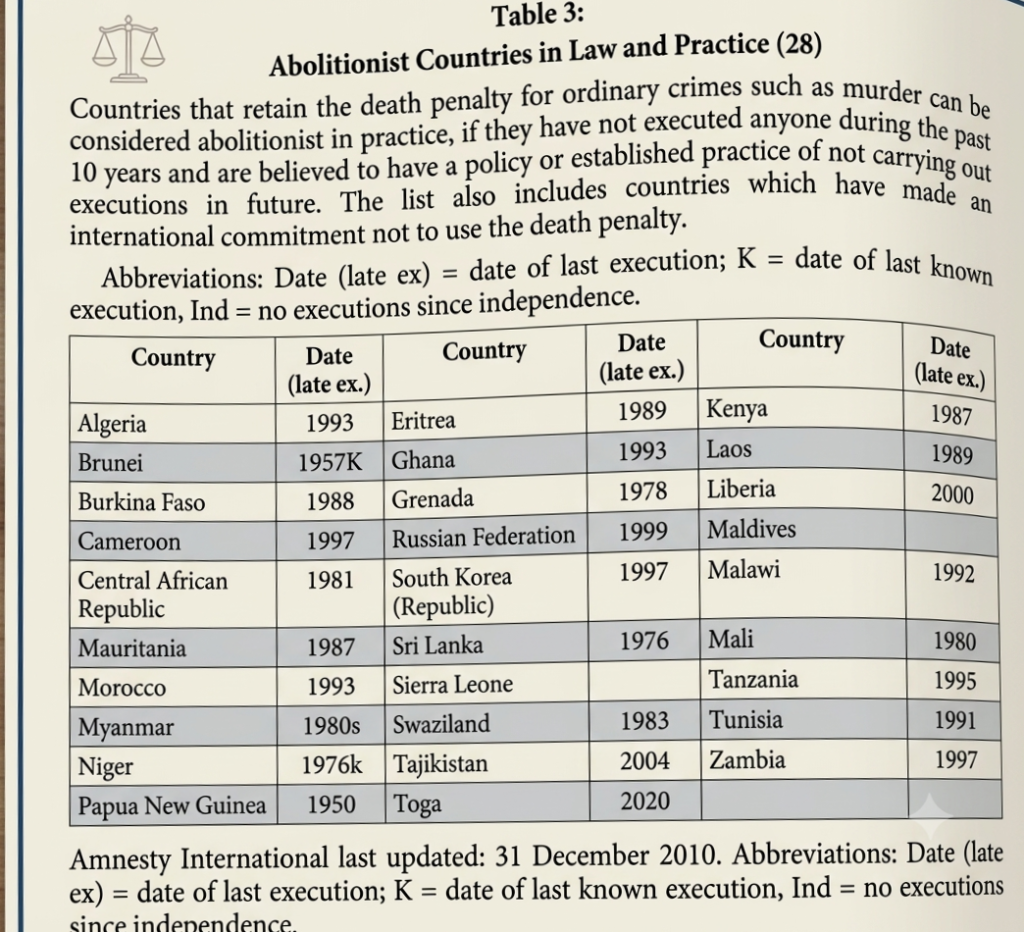
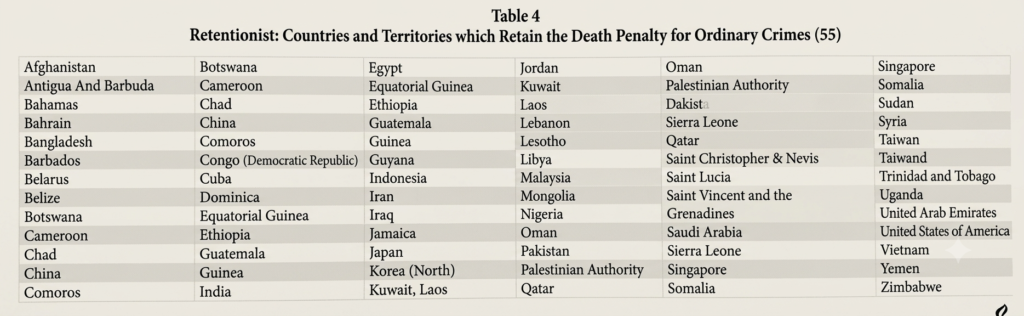
Under Section 7.6, titled Movements Towards Worldwide Abolition of Death Sentence, the provided text highlights a clear international divide on capital punishment, contrasting a growing Western consensus that considers the death penalty an outdated and barbaric practice with nations that continue to retain it.
In response, global bodies like the United Nations and the UN Commission on Human Rights actively advocate for global abolition by urging member states to institute a moratorium on executions, restrict capital liability to fewer offenses, and establish absolute prohibitions against executing juveniles under 18 years of age or individuals with mental disorders.