
INTRODUCTION
Under Indian criminal jurisprudence, a person is ordinarily presumed to understand the nature and consequences of their actions and is held legally accountable for them.
However, the law recognizes vital exceptions where an individual may be excused from criminal liability, such as the absence of a guilty mind (mens rea) or other recognized defenses codified in Chapter IV (Sections 76–106) of the Indian Penal Code, 1860.
To avoid repetitive phrasing across every crime, the framers consolidated these “General Exceptions” into a single chapter that applies not only to IPC offences but also to offences under special and local laws.
Furthermore, Section 6 of the IPC mandates that every offence definition, penal provision, and statutory illustration must automatically be interpreted subject to these General Exceptions, ensuring that general defenses continuously temper penal liability across the legal framework.
Illustration
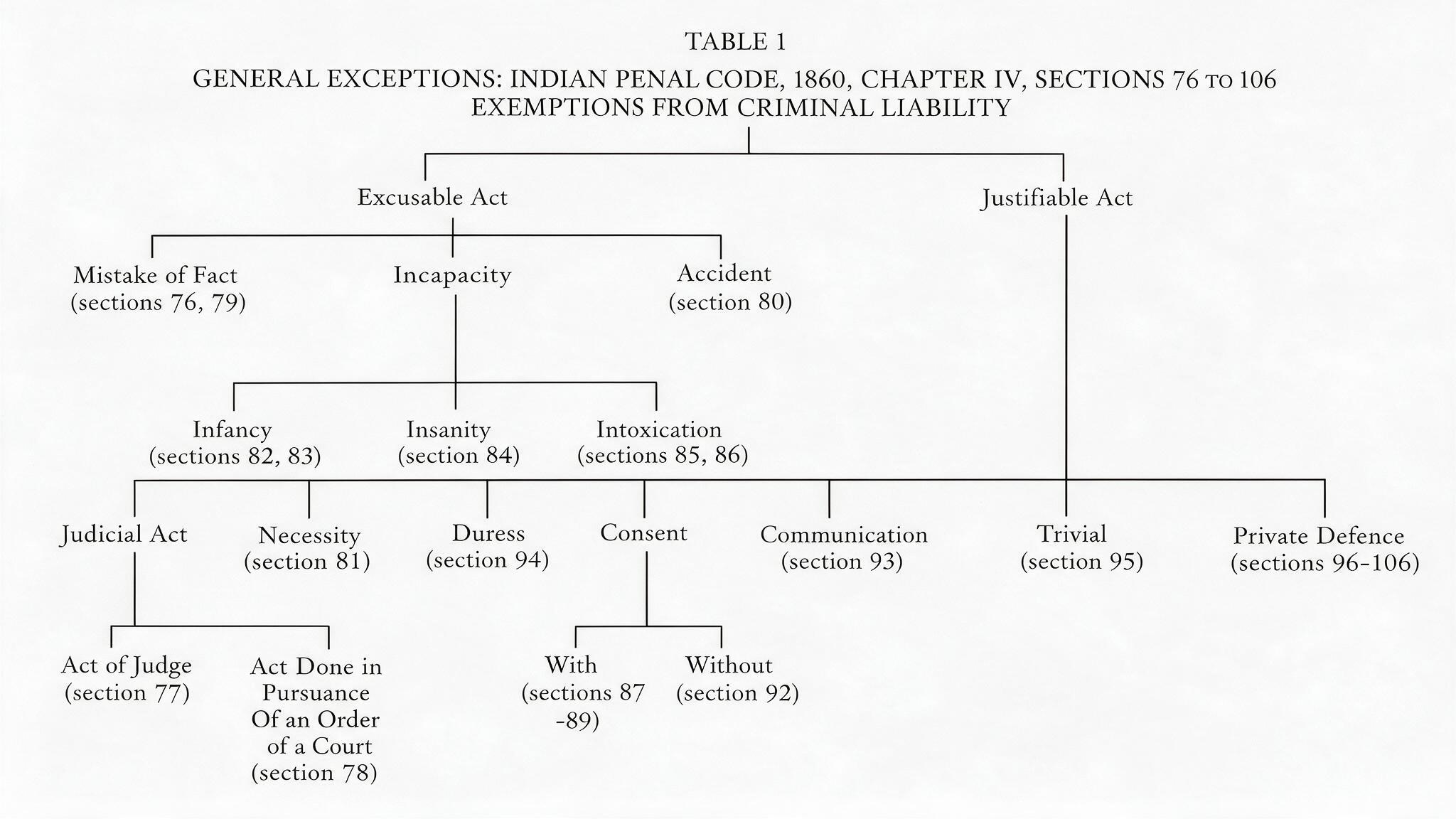
Under Indian penal law, general exceptions are divided into excusable and justifiable categories to ensure that individuals acting without criminal intent or under legal authority are protected from prosecution.
Excusable exceptions relieve individuals of liability when mens rea is absent due to infancy, insanity, accident, or honest mistake of fact, as demonstrated by the rule exempting children under seven years of age from criminal liability regardless of the statutory definition of an offence.
Conversely, justifiable exceptions validate acts that are legally permissible or socially necessary, such as judicial actions, good-faith communications, acts performed under threat, private defense, or a police officer arresting a suspect under a statutory duty without being liable for wrongful confinement.
3.2 BURDEN OF PROOF
The burden of proof signifies the legal obligation to establish a claim in court, operating under two distinct senses: the fixed obligation to prove a case and the shifting duty to produce evidence during trial.
Derived from the classical Roman maxim ei qui affirmat non ei qui negat incumbit probatio, the law mandates that the party asserting an affirmative fact carries the initial obligation to prove it.
Legal standards differ significantly by forum: civil cases are decided on a mere preponderance of probability, whereas criminal cases demand proof beyond reasonable doubt, requiring the prosecution to establish both the prohibited act and the guilty mind (mens rea) throughout the entire trial without ever shifting that primary burden to the defense.
If the prosecution fails to eliminate reasonable doubt, as highlighted in Bibuishan v State of Maharashtra, the benefit must strictly favor the accused.
Conversely, when an accused pleads a statutory defense or general exception under Chapter IV of the IPC, the burden shifts to the accused to prove that defense, though only to the lighter civil standard of a preponderance of probabilities.
3.3 MISTAKE OF FACT
Under Section 76 of the Indian Penal Code, 1860, titled “Act done by a person bound, or by mistake of fact believing himself bound, by law,” an action is excused from being a criminal offence if performed by someone who is legally bound to do it, or who in good faith believes themselves to be legally bound due to a mistake of fact.
This section enshrines a fundamental legal defense by distinguishing between a mistake of fact and a mistake of law.
While an honest, reasonable misunderstanding of factual circumstances held in good faith relieves an individual of criminal liability, ignorance or a mistaken understanding of the law itself offers no defense.
Illustration
Under the statutory illustrations of Section 76 of the Indian Penal Code, 1860, individuals performing acts under a legal duty or a good-faith mistake of fact are fully protected from criminal liability.
As shown in the first illustration, a soldier firing on a mob pursuant to a superior officer’s lawful command commits no offence because the soldier acts under a direct legal obligation.
Similarly, the second illustration demonstrates that if a court officer tasked with arresting Y carries out a proper investigation but mistakenly arrests Z in good faith believing Z to be Y, the officer commits no crime due to an honest mistake of fact while executing a court mandate.
79. Act done by a person justified, or by mistake of fact believing himself, justified, by law.
Section 79 of the Indian Penal Code, 1860, titled “Act done by a person justified, or by mistake of fact believing himself, justified, by law,” provides that an action is not a criminal offence if performed by a person who is legally justified in doing it, or who in good faith believes themselves to be justified by law due to a mistake of fact.
This statutory provision acts as a key defense under criminal law, protecting individuals who exercise a legal right or duty under a genuine, reasonable misunderstanding of the factual circumstances.
Importantly, the section strictly excludes mistakes of law, establishing that while an honest mistake regarding facts made with due care excuses an individual, ignorance or misunderstanding of legal statutes provides no immunity from criminal liability.
Illustration
Sections 76 and 79 of the Indian Penal Code embody the fundamental legal doctrines that a mistake of fact excuses criminal liability (ignorantia facti excusat), whereas a mistake of law provides no immunity (ignorantia juris neminem excusat).
Section 76 applies to individuals who believe in good faith that they are legally bound to act—such as a police officer who diligently investigates and accidentally arrests person Z thinking he is suspect Y under a court warrant.
Conversely, Section 79 protects those who believe they are legally justified in taking action—such as a citizen who detains someone reasonably suspected of murder, even if that person was actually acting in self-defense.
Legally, a genuine mistake of fact negates the mental element (mens rea) necessary to establish a crime, rendering the act innocent.
However, ignorance or mistake of law is strictly rejected as a defense because allowing citizens to plead unawareness of legal rules would make criminal law unenforceable and undermine public policy.
State of West Bengal v. Shew Mangal Singh
In State of West Bengal v. Shew Mangal Singh, the Supreme Court of India addressed whether police officers carrying out superior orders during a riot could be held criminally liable for murder under Section 302 of the IPC.
The respondents had opened fire on a violent mob on the direct orders of the Deputy Commissioner after one of their fellow officers was injured.
Clarifying the application of Section 76 of the IPC, the Supreme Court held that when a superior officer’s command is objectively lawful and justified by the circumstances, subordinate officers who act in obedience to that command are completely protected from criminal liability.
The court noted that evaluating whether subordinate officers subjectively believed the order to be legal is only necessary if the command itself was unlawful; where the command is valid, execution of that duty cannot constitute a crime.
Consequently, the Supreme Court upheld the High Court’s acquittal and dismissed the State’s appeal.
Chirangi v State
In Chirangi v. State, the court addressed whether an individual who kills his own child while suffering a temporary delusion that he is attacking a tiger is criminally responsible under Section 302 of the IPC.
Chirangi Lohar struck his son Ghudsai with an axe while gathering leaves, later explaining in distress that he mistakenly believed a tiger had attacked him.
Medical testimony confirmed that Chirangi’s physical ailments and fall had induced a state of mind where he held a bona fide belief that his target was a wild animal.
Reversing the trial court’s conviction, the High Court relied on established precedents like Waryam Singh v. Emperor to rule that criminal liability requires mens rea—an intention to commit a wrongful act against a human being.
Because Chirangi acted under an honest mistake of fact without malice toward his son, he believed himself legally justified in destroying a dangerous beast.
Consequently, his conviction was quashed, establishing that a genuine, good-faith mistake of fact negating criminal intent entitles an accused to protection under Section 79 of the IPC.
Per Widgery, LJ:
According to the legal principles articulated by Widgery, LJ, a person who honestly and reasonably believes that they or their child face imminent danger of injury retains the right to use reasonable force in defense, even if that belief stems from a genuine mistake of fact.
The law excuses actions taken in self-defense or defense of others—including fatal force when necessary to protect life—provided the individual operated under a reasonable, good-faith assessment of immediate danger.
However, this justification requires a true emergency.
If a child is in police custody without any immediate threat of physical harm, there is no urgency requiring force, and a parent who attempts to forcibly release the child acts at their own peril; if the arrest is lawful, the parent’s use of force cannot be legally justified.
R v Rose
In the case of R v Rose, the court addressed the legal boundaries of defense of others when an individual acts under a reasonable mistake of fact.
The defendant shot and killed his father during a violent domestic quarrel after his mother screamed for help while being forced up the stairs under threats of being stabbed.
Although no weapon was ultimately found on the father, the court acquitted the defendant.
As Justice Lopes highlighted, the law excuses lethal force if the accused acts without vindictiveness and holds an honest, well-founded belief that another person’s life is in immediate danger, making the intervention strictly necessary for their survival.
This establishes that a genuine, reasonable belief in an imminent threat to life provides a complete defense against homicide charges, regardless of subsequent factual discoveries.
State of Maharashtra v Mayer Hans George
In State of Maharashtra v. Mayer Hans George, the Supreme Court of India reaffirmed the fundamental legal maxim that ignorance of the law is no excuse (ignorantia juris non excusat).
Justice Ayyangar and Justice Mudholkar, speaking for the majority, held that an official notification issued by the Reserve Bank of India acquires the full force of law the moment it is published in the Official Gazette.
Once published, constructive notice is legally presumed, meaning all individuals are deemed to have knowledge of the law regardless of whether it was brought to their actual personal attention.
Addressing the Privy Council’s precedent in Lim Chin Aik—where an individual was excused because no mechanism existed in Singapore to publish or discover the regulation—the Court noted that such exceptions do not apply when proper official publication has occurred.
Consequently, the Court rejected the respondent’s defense that the RBI notification was ineffective due to lack of actual personal notice, ruling that official Gazette publication on November 25, 1962, satisfied all legal requirements for enforcement.
3.4 JUDICIAL ACT
Sections 77 and 78 of the Indian Penal Code provide essential legal immunity to judges and the officers executing their orders to ensure the fearless administration of justice.
Under Section 77, a judge is protected from criminal prosecution for acts performed in their judicial capacity if done in good faith, even if they mistakenly exceed their legal jurisdiction.
This protection is strictly functional and does not extend to personal wrongs or illegal acts outside official duties, such as assault.
Complementing this, Section 78 shields administrative and police officers who carry out court orders, ensuring they are not held liable even if the underlying warrant or order is later determined to be defective or issued without jurisdiction.
As highlighted by Markby J in Chunder Narain Singh v Birjo Bullub Gooyee, this immunity is vital because judicial duties require making difficult decisions regarding punishment and rights; without legal protection against the personal consequences of honest mistakes, judicial officers could not maintain the independence of mind essential to their role.
3.5 ACCIDENT
Section 80 of the Indian Penal Code, 1860, titled “Accident in doing a lawful act,” exempts a person from criminal liability when harm results strictly from accident or misfortune.
For an individual to successfully claim protection under this provision, the act causing the injury must be performed without any criminal intention or knowledge, while engaged in a lawful act, carried out in a lawful manner, by lawful means, and with proper care and caution.
By eliminating criminal fault in cases where reasonable care was taken and criminal intent (mens rea) was entirely absent, Section 80 ensures that purely unintentional and blameless mishaps are not treated as criminal offences under the law.
Illustration
The provided text outlines the statutory defense of accident under Section 80 of the Indian Penal Code, 1860, illustrated by the scenario of a worker using a hatchet whose iron head unexpectedly detaches and strikes a bystander.
If the worker exercised due care and precaution, the resulting death is deemed excusable, as criminal liability requires criminal intent or knowledge (mens rea) rather than merely an unfortunate, unintended outcome from lawful conduct.
This principle is further reflected in a 2017 Supreme Court ruling involving a fatal collision between a truck and a jeep.
The Court set aside a murder conviction after mechanical inspections and brake marks established that the driver attempted to prevent the crash, proving the incident was an unavoidable accident rather than an intentional crime.
State of Punjab v Pargat Singh
In State of Punjab v. Pargat Singh, Justices Ashok Bhushan and Deepak Gupta of the Supreme Court of India dismissed the State’s appeal against a High Court judgment that had acquitted individuals previously convicted under Sections 302/34, 307/34, and 120-B of the IPC.
The Supreme Court upheld the High Court’s rejection of the alleged murder conspiracy, noting that a genuine advance knowledge of such a plan would logically have prompted reports to the police or village authorities.
Furthermore, physical evidence—including mechanical reports and brake/tire marks at the scene—demonstrated that the collision was an unavoidable accident where the driver attempted to brake, rather than an intentional attack.
Acknowledging that previous enmity between the parties rendered the claim of false implication highly plausible, the Court reaffirmed the established legal doctrine that an appellate court should not interfere with an order of acquittal when a plausible view supporting innocence exists.
3.6 NECESSITY
Section 81 of the Indian Penal Code incorporates the “doctrine of necessity,” exempting actions that cause harm if performed without criminal intent, in good faith, and specifically to prevent greater, imminent harm to persons or property.
Grounded in legal maxims such as quod necessitas non habet legem (“necessity knows no law”), the law recognizes that under extraordinary circumstances, technical compliance with the letter of the law must yield to preserving greater value.
Statutory illustrations demonstrate this principle: a ship captain swerving away from a boat carrying thirty people toward one carrying two acts lawfully if done in good faith to avert the larger tragedy, just as a person pulling down houses during a conflagration is protected if acting to prevent the spread of fire.
To claim protection under Section 81, three cumulative criteria must be satisfied: the act was taken to avoid other harm, the harm avoided was severe enough to justify the risk, and the action was executed in good faith without any criminal intent.
However, this defense has clear boundaries, as established by the 1884 House of Lords ruling, which affirmed that the deliberate killing of an unoffending person can never be justified on grounds of necessity.
Queen v Dudley and Stephens
In the historic case Queen v Dudley and Stephens (1884), four crew members were stranded at sea without food or water.
On the 18th day, Dudley and Stephens killed the youngest and weakest crew member, an unoffending 17-year-old boy, and fed on his remains for four days until rescued.
Writing for the bench, Lord Coleridge, CJ, rejected the defense of necessity, holding that while self-preservation is a natural instinct, there is no absolute legal right to take an innocent person’s life to save one’s own.
The Court emphasized that human life cannot be measured by strength or intellect, and allowing temptation or severe hunger to excuse homicide would create a dangerous loophole for grave crimes.
Consequently, the Court ruled the act to be willful murder, though the executive later commuted the prisoners’ sentences to six months’ imprisonment in recognition of their extreme suffering.
United States v Holmes
In United States v Holmes, following the sinking of the William Brown after striking an iceberg, crew member Holmes and other crew threw fourteen male and two female passengers out of an overflowing, leaking lifeboat to prevent it from sinking, while sparing all crew members.
Charged with manslaughter, Holmes argued that his actions were justified under the law of necessity and natural survival.
The prosecution and the court, led by Justice Baldwin, emphasized that when extreme necessity demands the sacrifice of human life to save others, selection must be fair and impartial—typically through drawing lots—rather than arbitrarily sparing the crew at the expense of passengers.
Because no fair procedure was followed and passengers were targeted selectively, the jury convicted Holmes of manslaughter, resulting in a six-month sentence and a $20 fine, though his prison sentence was ultimately remitted.
R v Quayle (Attorney General's Reference No 2 of 2004)
In R v Quayle (Attorney General’s Reference No 2 of 2004), several appellants convicted under the Misuse of Drugs Act, 1971 and the Customs and Excise Management Act, 1979 argued that their cultivation, importation, and possession of cannabis were legally excusable under the defense of necessity because the substance was required to relieve severe pain and suffering associated with debilitating medical conditions.
Delivering the judgment for the Court of Criminal Appeal, Lord Justice Mance dismissed the appeals, holding that the common law defense of necessity cannot be invoked to bypass or legitimize conduct directly contrary to clear statutory policies.
The court reasoned that permitting an ad-hoc defense of medical necessity would subvert Parliament’s strict statutory framework governing controlled substances, leading to unregulated distribution and usage devoid of medical safeguards and judicial control.
London Borough of Southwark v Williams
In London Borough of Southwark v Williams, two homeless families facing severe housing shortages occupied an empty council-owned property and asserted the defense of necessity against a possession order.
Rejecting the defense and dismissing the appeal, Lord Denning MR and Edmund Davies LJ established that while common law necessity can excuse property interference during sudden, life-threatening emergencies—such as throwing cargo overboard during a storm (Mouse’s Case) or escaping a burning jail—it cannot be extended to chronic social misfortunes like homelessness or starvation.
The court reasoned that permitting poverty or lack of shelter to legally justify trespass or larceny would undermine private property rights and create widespread lawlessness, opening a legal floodgate that could not be controlled.
R v Loughnan
In R v Loughnan, an Australian inmate convicted of escaping prison argued that he fled under the defense of necessity after receiving credible threats that he would be killed that night.
Dismissing the appeal, the Supreme Court of Victoria acknowledged the validity of the necessity defense in law but established strict criteria for its application.
To successfully plead necessity, the accused must face an imminent peril involving irreparable harm, act proportionately, intend to avoid greater harm, and—most crucially—have no reasonable alternative legal options available.
The court highlighted that unlike self-defense, which targets the source of threat directly, escaping custody affects the public interest, requiring an objective standard: whether a reasonable person in the accused’s position would have seen escape as the sole remaining recourse.
3.7 DURESS
Under Section 94 of the statutory code governing duress, an individual is exempted from criminal liability for actions performed under compulsion, reflecting the legal maxim actus me invito non est mens actus—that an involuntary act done under coercion is not legally one’s own.
To successfully claim duress, the accused must prove they acted under a reasonable apprehension of instant death, had no reasonable alternative, and did not voluntarily expose themselves to the threat (such as willingly joining a gang of dacoits).
However, the law draws strict boundaries: compulsion cannot excuse hunger-driven theft, nor can it ever justify murder or treason against the State, as the legal framework maintains that saving one’s own life does not permit taking an innocent life or threatening public order.
(S v Goliath)
In examining duress as a defense to murder, legal systems diverge between realistic assessments of human behavior and strict public policy mandates.
As articulated by Rumpff, J. in S v Goliath, holding an individual criminally liable for killing under extreme compulsion demands an exceptional level of heroism that goes beyond the standard of the ordinary person.
Conversely, English jurisprudence, after briefly permitting duress as a defense for secondary accomplices in Northern Ireland v Lynch, strictly revoked this stance in R v Howe out of concern that terror organizations could exploit the defense to compel individuals into violent crimes.
To resolve this tension, legal commentators propose reforming statutory provisions like Section 94 and Section 300 so that duress operates as a partial defense—reducing a murder charge to culpable homicide not amounting to murder—thereby acknowledging reduced moral culpability without granting complete immunity for taking a human life.
Abbott v R
In Abbott v R, a commune member in Trinidad participated in the brutal murder of a young woman under explicit death threats from the head of the commune and subsequently appealed his murder conviction, arguing that the defense of duress should apply.
Rejecting the appeal, Lord Salmon, J. ruled that duress is not available to an actual killer, emphasizing that civilized societies cannot excuse the intentional taking of innocent life under coercion.
Drawing an analogy to war crime trials where the “superior orders” defense was universally rejected, the court reasoned that permitting duress for murder would create grave public risks, effectively serving as a charter for terrorists, gang leaders, and kidnappers to compel others into committing atrocious crimes with legal impunity.
R v Hudson and Taylor
In R v Hudson and Taylor, two individuals convicted of perjury successfully appealed their convictions by pleading duress after testifying falsely under fear of a threat-maker present in the courtroom who threatened to “cut them up”.
The Court of Appeal set aside the convictions, rejecting the trial court’s rigid view that duress required physical violence occurring simultaneously inside the courtroom.
The court held that because the threat was effective and the accused had no practical alternative to avoid the imminent threat of harm, the coercion sufficiently justified their false testimony.
However, this defense remains strictly circumscribed, as noted by the House of Lords in 2005, which reaffirmed that duress cannot excuse crimes like aggravated burglary when an individual voluntarily associates with criminal actors.
R v Hasan
In R v Hasan, the House of Lords clarified the stringent boundary conditions governing the defense of duress in criminal law.
The case centered on a defendant charged with aggravated burglary who claimed he was coerced by threats of violence against his family.
While trial courts utilize a four-question test evaluating genuine belief, reasonable firmness, available legal alternatives, and voluntary risk assumption, the House of Lords firmly established that duress is legally excluded if the defendant voluntarily associated with criminal actors and foresaw—or reasonably ought to have foreseen—the risk of being subjected to violent threats or compelled to commit crimes.
As Baroness Hale emphasized, exposing oneself to the risk of unlawful violence without a valid justification strips an accused of the ability to rely on duress as an excuse for criminal acts.
3.8 INFANCY
Under Sections 82 and 83 of the Indian Penal Code, 1860, the defense of infancy shields young children from criminal liability on the fundamental premise that they lack the cognitive ability to distinguish right from wrong or form criminal intent (mens rea).
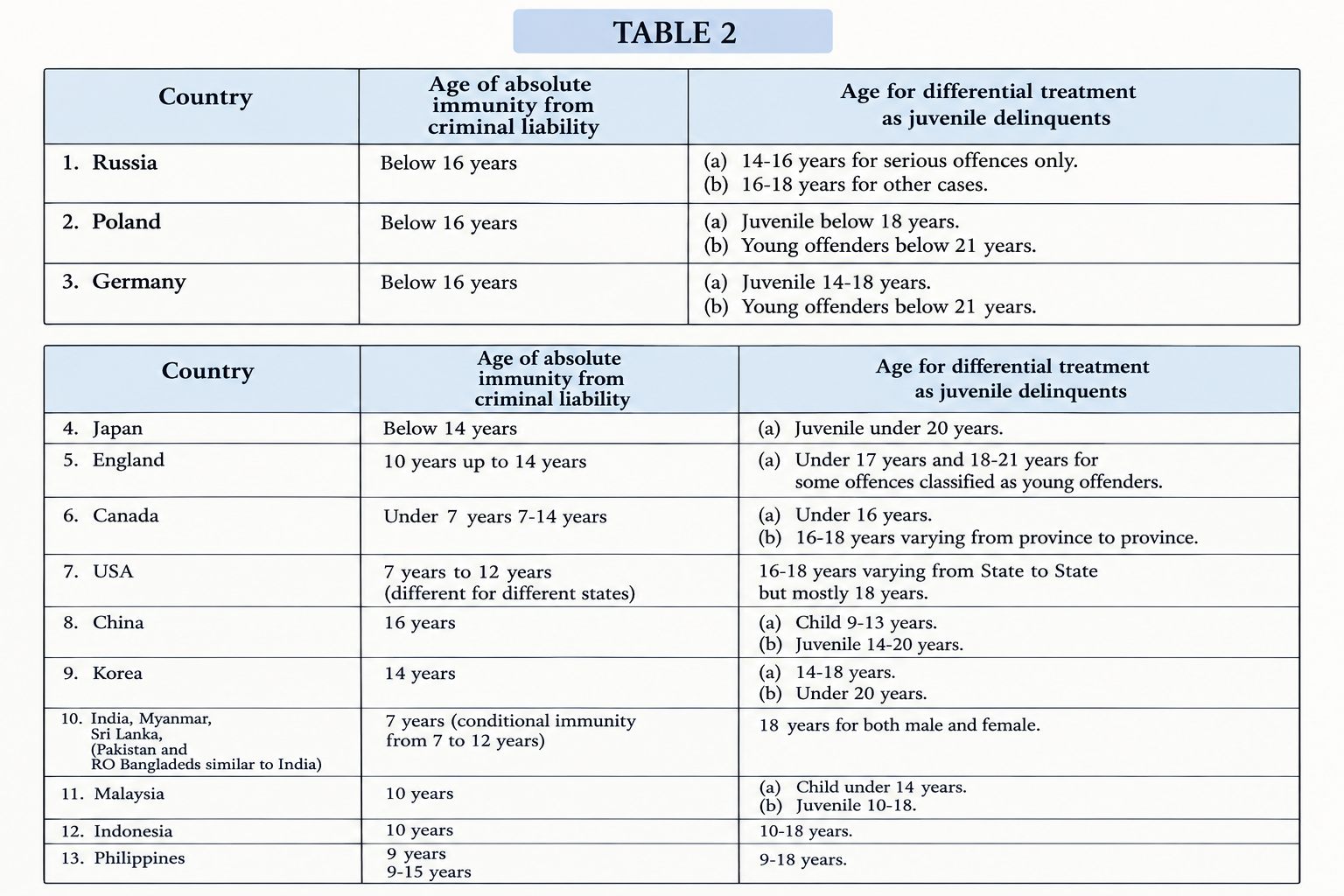
Section 82 provides absolute immunity (doli incapax) to children under seven years of age, irrebuttably presuming them incapable of committing a crime.
For children aged seven to twelve, Section 83 offers qualified immunity, where exemption depends on whether the child possessed sufficient maturity to understand the nature and consequences of their conduct—a determination inferred from their actions, such as selling stolen property to hide theft.
Globally, the age threshold for criminal discretion varies significantly, ranging from absolute immunity under seven in countries like Canada and Thailand, to ten in England and Malaysia, and up to fourteen or fifteen in nations such as Germany, Japan, and Sweden.
3.8.1 Crimes against Children
Crimes against children encompass various forms of physical and emotional abuse, neglect, and exploitation, such as sex trafficking and child pornography.
Under the framework established by the Juvenile Justice Act, 2000, any individual under the age of 18 is recognized as a child, providing a clear threshold for legal protections across applicable statutes.
To penalize acts committed against minors, the Indian Penal Code, 1860, outlines specific statutory offences ranging from foeticide, infanticide, and abandonment to violent offenses like murder, rape, kidnapping, sexual harassment, and the buying or selling of minor girls for prostitution.
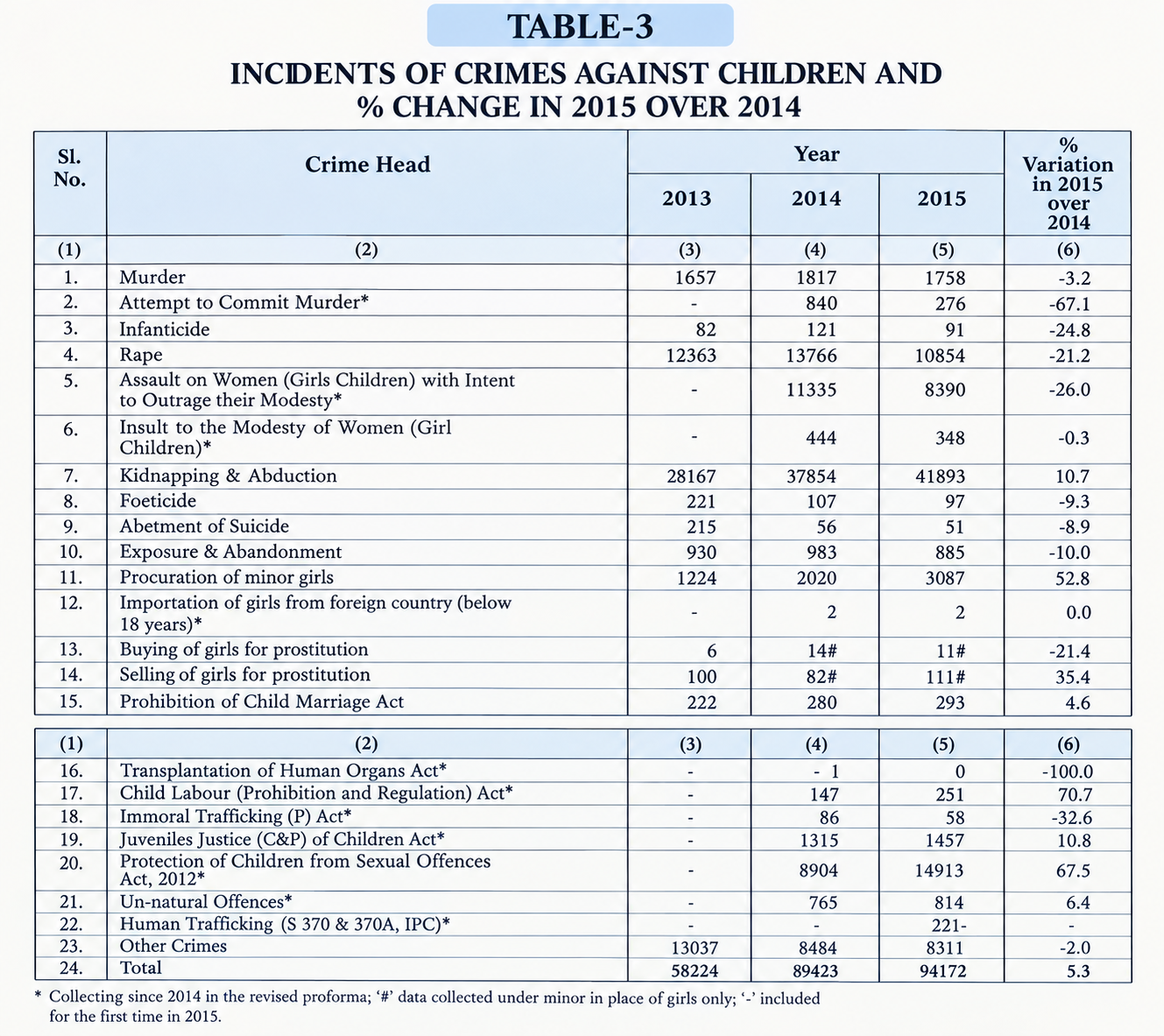
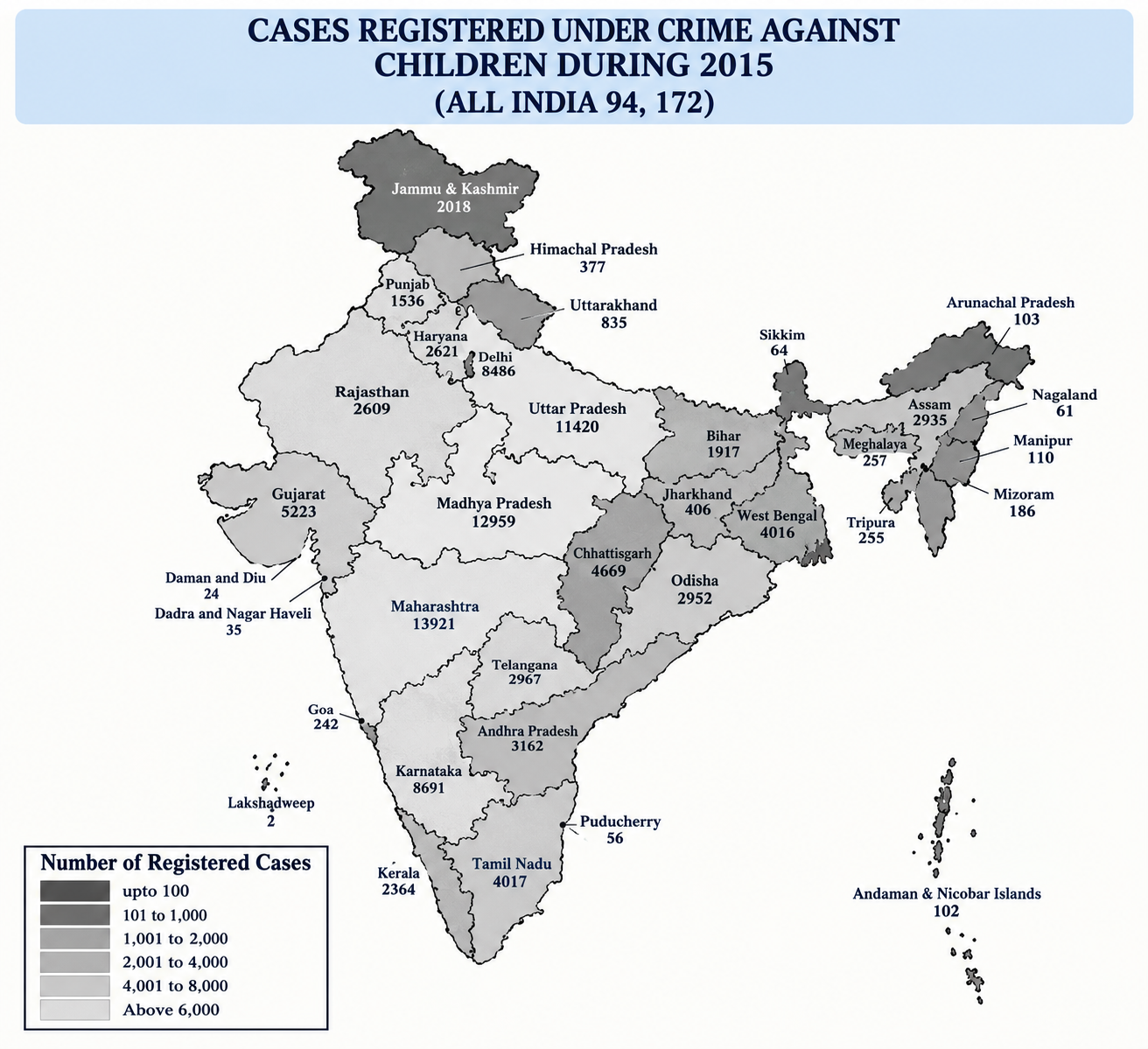
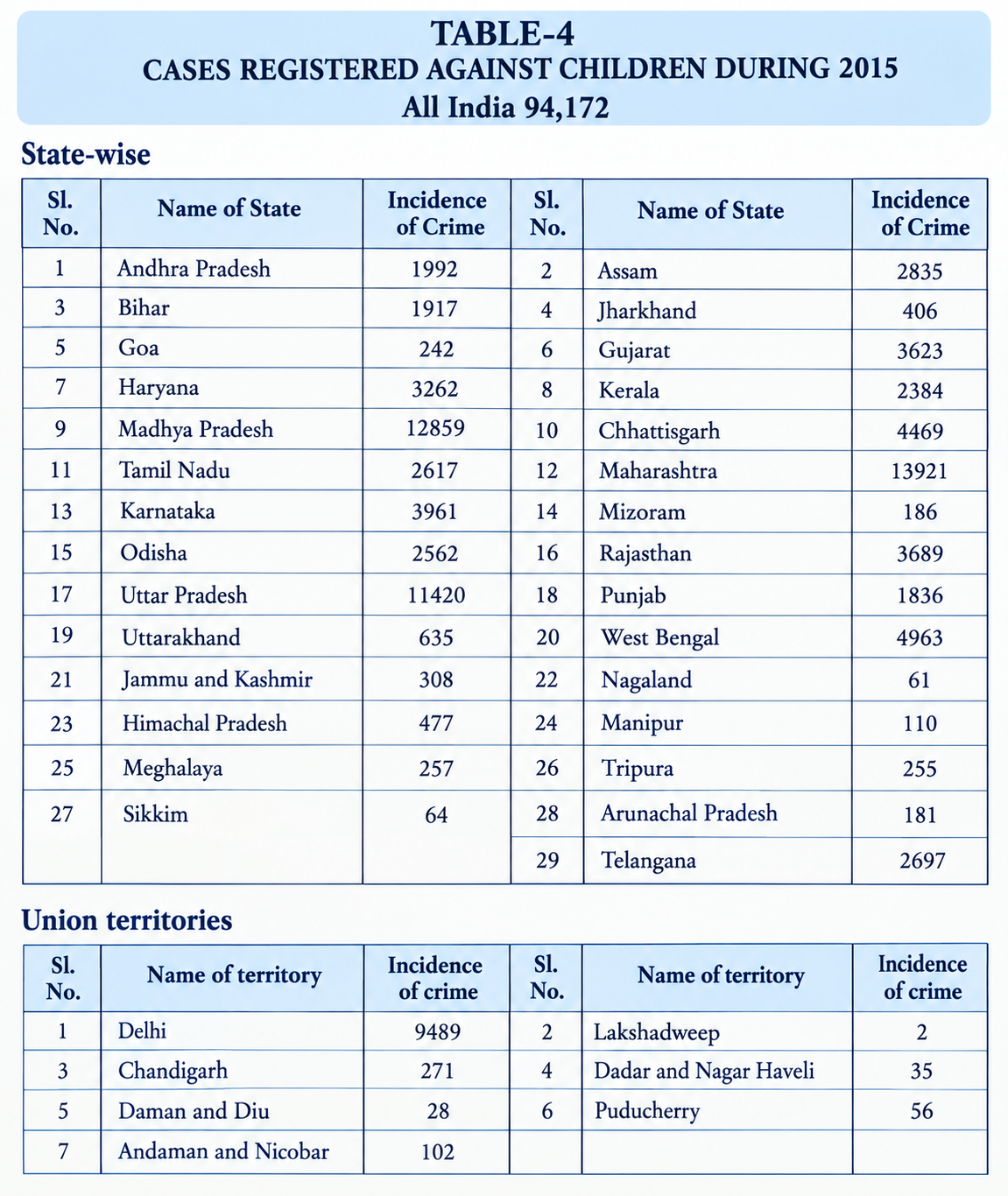
Incidence of Crime against Children: 94,172
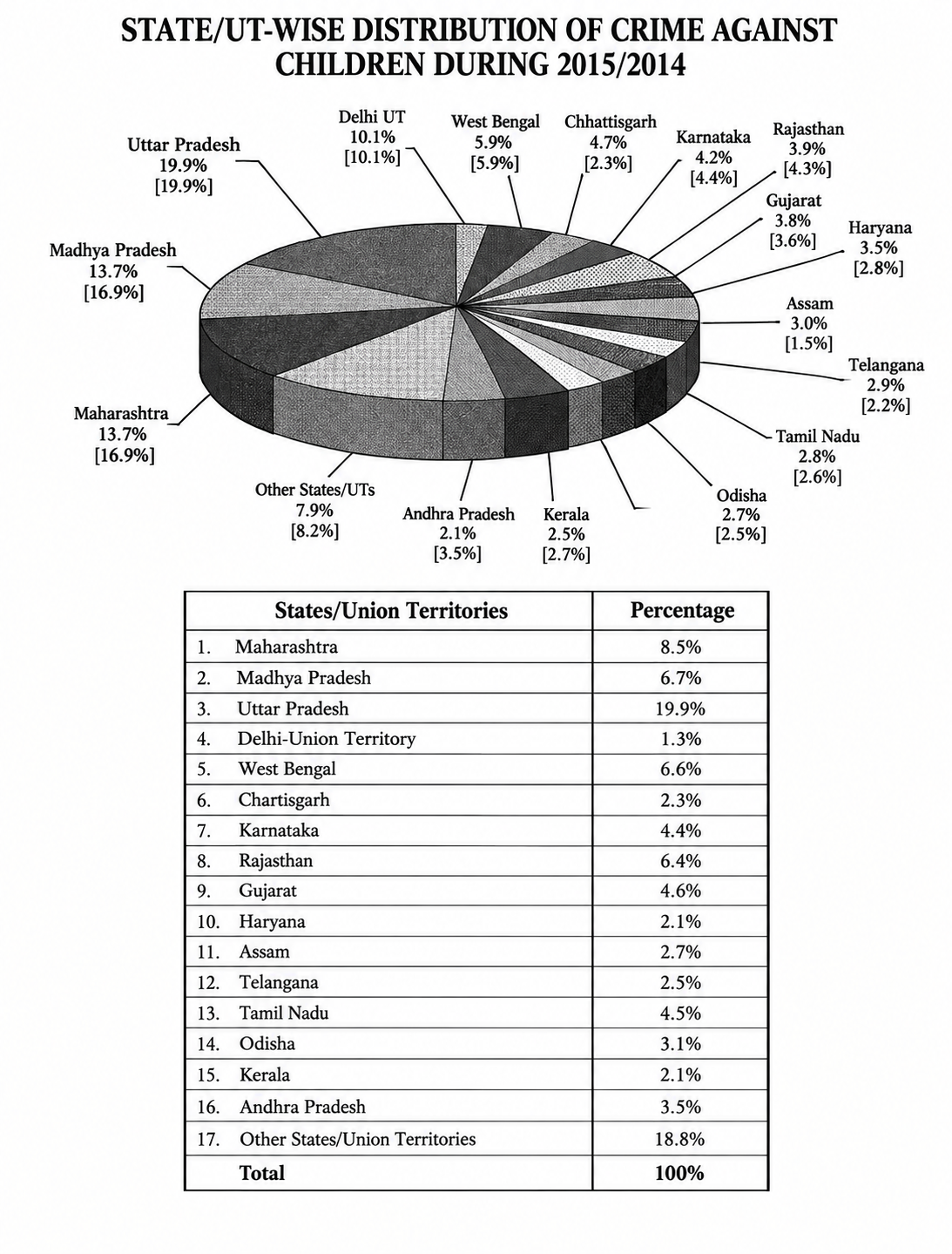
Statistical data on the incidence of crime against children demonstrates a continuous upward trajectory, rising from 88,108 cases in 2014 to 92,715 cases in 2015—a year-over-year increase of 5.3%.
Geographically, the highest concentrations of these reported cases in 2015 occurred in Maharashtra (14.8%), followed closely by Madhya Pradesh (13.7%), Uttar Pradesh (12.1%), and Delhi (10.1%).
This escalating trend continued into 2016, where total registered offenses against children reached 1,04,705 cases, reflecting an increasing incidence of reported offenses against minors nationwide.
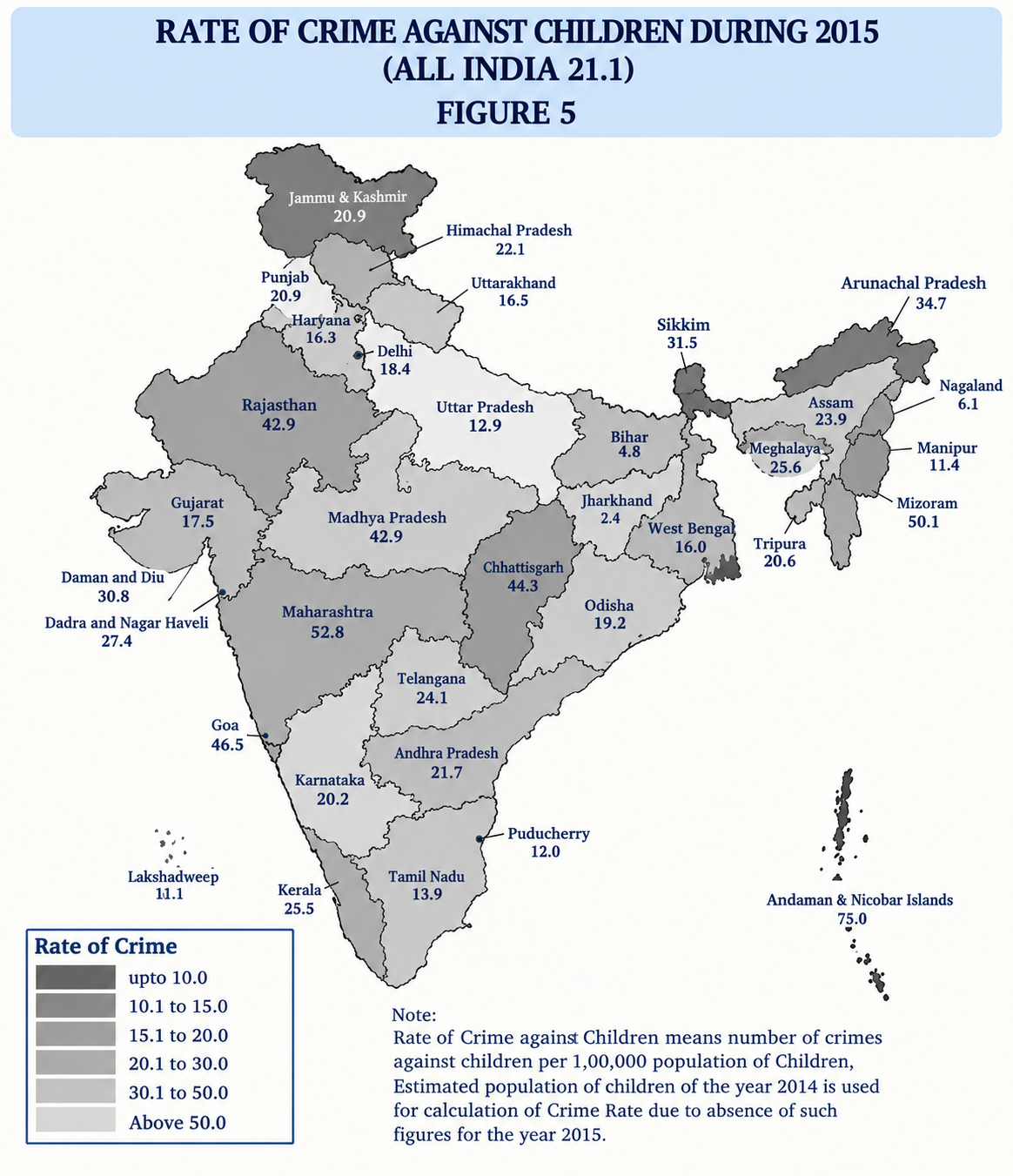
Crime Rate: 21.1
In measuring crimes against children, the crime rate is defined as the total number of reported cases per 1,00,000 children under 18 years of age, providing a population-adjusted metric to evaluate risk across regions.
During 2015, the overall national crime rate against children in India stood at 21.1.
However, significant regional disparities emerged, with Delhi recording the highest crime rate in the nation at 169.4—more than eight times the national baseline—followed by Andaman & Nicobar Islands (75.0), Chandigarh (67.8), Mizoram (50.1), and Goa (46.5), all of which far exceeded the national average.
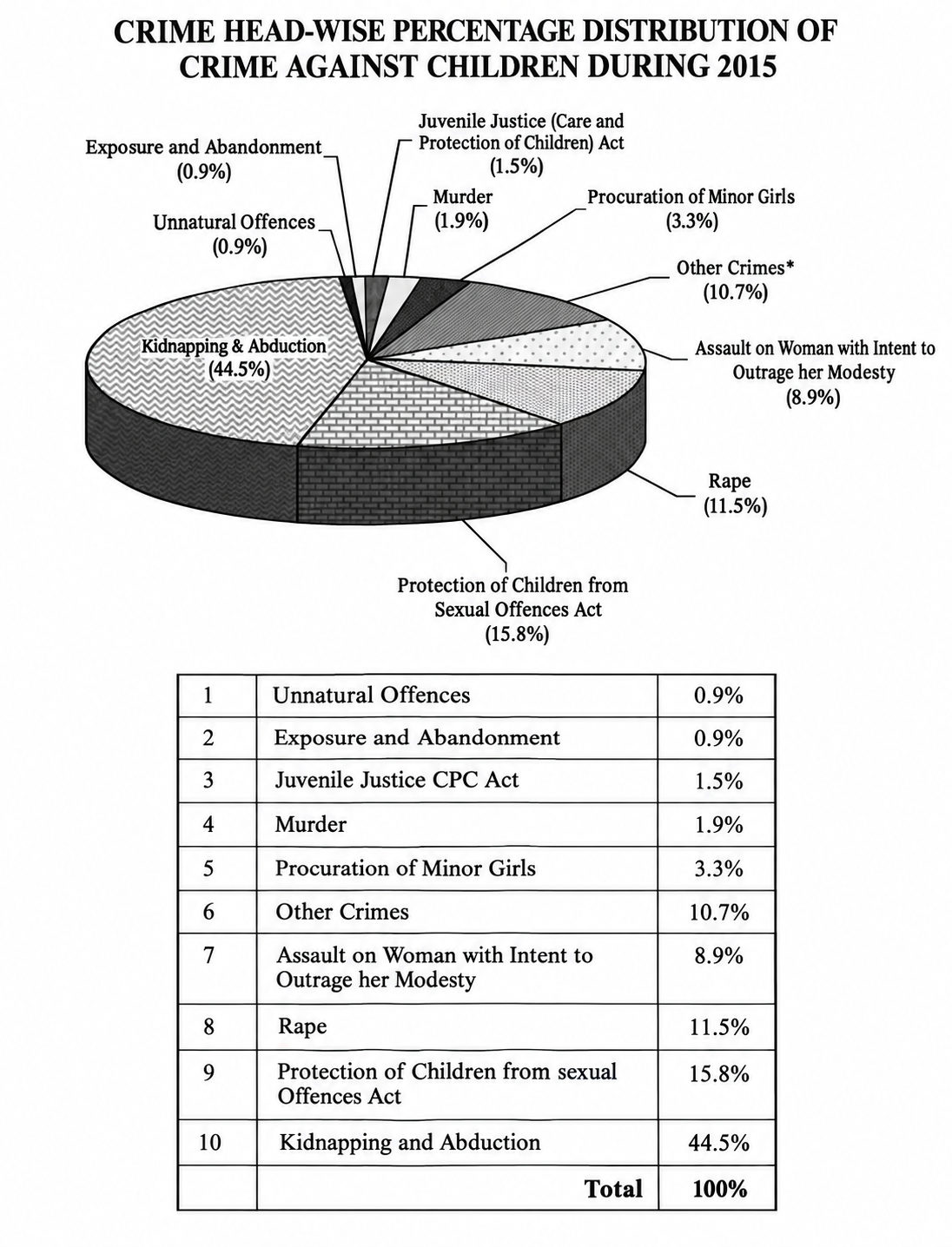
Crime Head-wise Analysis
Under the category of “Murder (excluding Infanticide),” India recorded a total of 1,758 cases involving 1,937 victims during 2015, representing a 3.2% decrease from the 1,817 cases reported in 2014.
At the state level, Uttar Pradesh accounted for the single highest share with 474 cases, comprising 27.0% of the entire national total.
In contrast, regions such as Sikkim, Lakshadweep, and Puducherry reported no cases of intentional child homicide during 2015.
While the overall national crime rate for child murder stood low at 0.4 per 1,00,000 child population, Union Territories and states with smaller populations—specifically Dadra & Nagar Haveli (1.6) and Arunachal Pradesh (1.3)—recorded disproportionately higher crime rates compared to the national baseline.
Infanticide (Section 315 IPC): Incidence: 91 Rate: Negligible
Under Section 315 of the Indian Penal Code, cases categorized as infanticide saw a significant reduction across India, declining by 24.8% from 121 cases in 2014 down to 91 cases in 2015.
Geographically, the highest incidence was reported in Madhya Pradesh with 25 cases, followed by Rajasthan with 18 cases, and Uttar Pradesh with 9 cases.
Despite these specific regional concentrations, the overall national crime rate for infanticide remained statistically negligible, standing at just 0.1 cases per 1,00,000 children in Haryana, Himachal Pradesh, Madhya Pradesh, Rajasthan, and Delhi.
Rape (Section 376 IPC): Incidence: 10,854 Rate: 2.4
Under Section 376 of the Indian Penal Code (IPC), registered cases of child rape in India decreased by 21.1% from 13,766 cases in 2014 to 10,854 cases in 2015, resulting in an overall national crime rate of 2.4 per 1,00,000 children.
Geographically, the highest number of child rape cases under the IPC was recorded in Maharashtra with 2,231 cases, followed by Madhya Pradesh with 1,568 cases and Odisha with 1,052 cases.
Alongside general IPC provisions, offenses against minors are also addressed through Special and Local Laws (SLL), which encompass vital child-centric legislation including the Prohibition of Child Marriage Act (2006), Child Labour Act (1986), Immoral Traffic (Prevention) Act (1956), Juvenile Justice Act (2000), and the Protection of Children from Sexual Offences (POCSO) Act (2012).
Sexual Harassment (Section 354A, IPC): Incidence: 3,350 Rate: 0.8
Under Section 354A of the Indian Penal Code (IPC), India registered a total of 3,350 child sexual harassment cases during 2015, establishing an overall national crime rate of 0.8 per 100,000 children.
In terms of raw volume, Maharashtra (1,043 cases), Uttar Pradesh (729 cases), and Madhya Pradesh (471 cases) reported the highest total numbers of incidents across the country.
However, when evaluating population-adjusted risk, Mizoram recorded the highest crime rate in the nation at 5.7, closely followed by Delhi at 4.8—both substantially surpassing the national average.
Kidnapping & Abduction of Children: Incidence: 41,893 Rate: 9.4
In 2015, child kidnapping and abduction in India experienced a 10.7% increase over 2014, with total registered cases rising from 37,854 to 41,893 and yielding a national crime rate of 9.4 per 100,000 children.
While Maharashtra (6,960 cases) and Delhi (6,881 cases) recorded the highest overall totals, the Union Territory of Delhi faced a extraordinarily high crime rate of 122.9, followed by Chandigarh at 41.0.
General kidnapping under Section 363 IPC accounted for 23,462 cases involving 24,304 victims, with Delhi reporting the single largest victim count at 7,257.
Specific sub-categories reveal distinct regional drivers: kidnapping of girl children to compel marriage totaled 12,516 cases nationally (rate of 2.8), with Uttar Pradesh reporting the highest share at 4,462 victims.
Furthermore, Uttar Pradesh dominated cases involving grave offenses, accounting for 129 out of 192 national victims of kidnapping in order to murder under Section 364 IPC, as well as 29 out of 147 victims of kidnapping for ransom under Section 364A IPC.
3.8.2 Juvenile Justice (Care and Protection of Children) Act, 2000
The Juvenile Justice Act, 2000 replaced the earlier 1986 legislation to align Indian law with the UN Convention on the Rights of the Child and international frameworks like the Beijing Rules.
The Act consists of 70 sections structured across five chapters.
Key provisions include replacing terms like “delinquent juvenile” with “juvenile in conflict with law,” setting a uniform age limit of 18 for all minors, and prohibiting life imprisonment and the death penalty for juveniles.
Additionally, the law outlines structured rehabilitation methods—such as adoption, foster care, and social auditing—alongside institutional safeguards including age-segregated observation homes, appellate restrictions to prevent prolonged litigation, and Special Juvenile Police Units to handle child-related matters.
3.8.3 Trial of Juvenile at Sixteen under Penal Code of India
Under Section 3.8.3, titled “Trial of Juvenile at Sixteen under Penal Code of India,” the text details the legal shift following public outcry over lenient sentencing for juveniles accused of grave crimes like murder and rape.
Driven by the December 2012 “Nirbhaya gang rape” in Delhi—where a principal perpetrator was a minor—the Indian Parliament replaced the 2000 statutory framework with the Juvenile Justice (Care and Protection of Children) Act, 2015.
This legislative reform established three distinct categories of offences: “petty,” “serious,” and “heinous”.
For heinous crimes committed by minors aged 16 to 18, the Juvenile Justice Board, collaborating with social psychologists and domain experts, conducts a preliminary assessment to determine whether the juvenile should be tried in a juvenile forum or transferred to an adult court, establishing a structured mechanism to address severe juvenile delinquency while maintaining specialized judicial review.